Email Preference Center Best Practices
Preference center best practices: CAN-SPAM menu plus stop-all, Google one-click vs body preference pages, and SendGrid's labeled 20% unsub drop.
Email marketing guide: automations earn 22x campaigns per send. Map lifecycle, hygiene, and newsletter jobs—never one blended ROI.

TL;DR: Email marketing is permissioned sending to a list you can still reach: campaigns on a calendar, automations on behavior, and a hygiene floor so mailbox providers keep you. In Omnisend’s 2025 campaign dataset, automations earned $3.41 per email versus $0.155 for campaigns (22x). Do not average that with sunset dollars or newsletter CPMs.
Most “email marketing guides” still open with send-on-Tuesday folklore. That is how you optimize a subject line while the cart flow is off and Postmaster is already over 0.10%. The job is not prettier campaigns. The job is picking a scorecard that matches the send.
This email marketing guide is the definition, the labeled numbers, and the cluster map for feat.'s Email Marketing pillar. Use it to decide which job you are in. Then open the spoke that owns that job. Do not treat HubSpot’s 20–30 supporting-post umbrella as a reason to mash every table into one fake ROI (HubSpot; how to build a topic cluster).
Email marketing is sending commercial or relationship messages to people who gave you an address, then measuring whether those messages earned a click, an order, a complaint, or a clean suppress.
It is not “we have a Mailchimp account.” An ESP is plumbing. The system is consent, a trigger or a calendar, a mailbox-provider floor, and a scorecard that does not lie about the job. Campaigns are one-time sends to a selected audience. Automations (flows) fire on behavior, a date, or a segment. Transactional mail tells the buyer what already happened. Sponsored newsletter inventory sells the list itself. Mixing those four into one dashboard is how founders underperform a fictional KPI.
A useful email marketing guide therefore does two things at once. It answers the searcher who asked what the channel is. And it routes the operator who already knows the channel to the spoke that owns welcome dollars, cart recovery, sunset hygiene, or a media kit. If you came from Google looking for one number, pick the cluster below and ignore every other table until that job is fixed.
Email marketing matters because it is one of the few channels where you can still name the person, the trigger, and the dollar without renting the attention twice. That only holds if the list is real and the scorecard is honest.
This email marketing guide works as three clusters under one pillar: lifecycle automations that recover and retain store revenue, hygiene and deliverability that keep the pipe open, and newsletter monetization when the list is the product. Each cluster lists the spoke to open first and the headline figure that makes that spoke unique. Read the spoke for sources and caveats. Come back here for siblings.
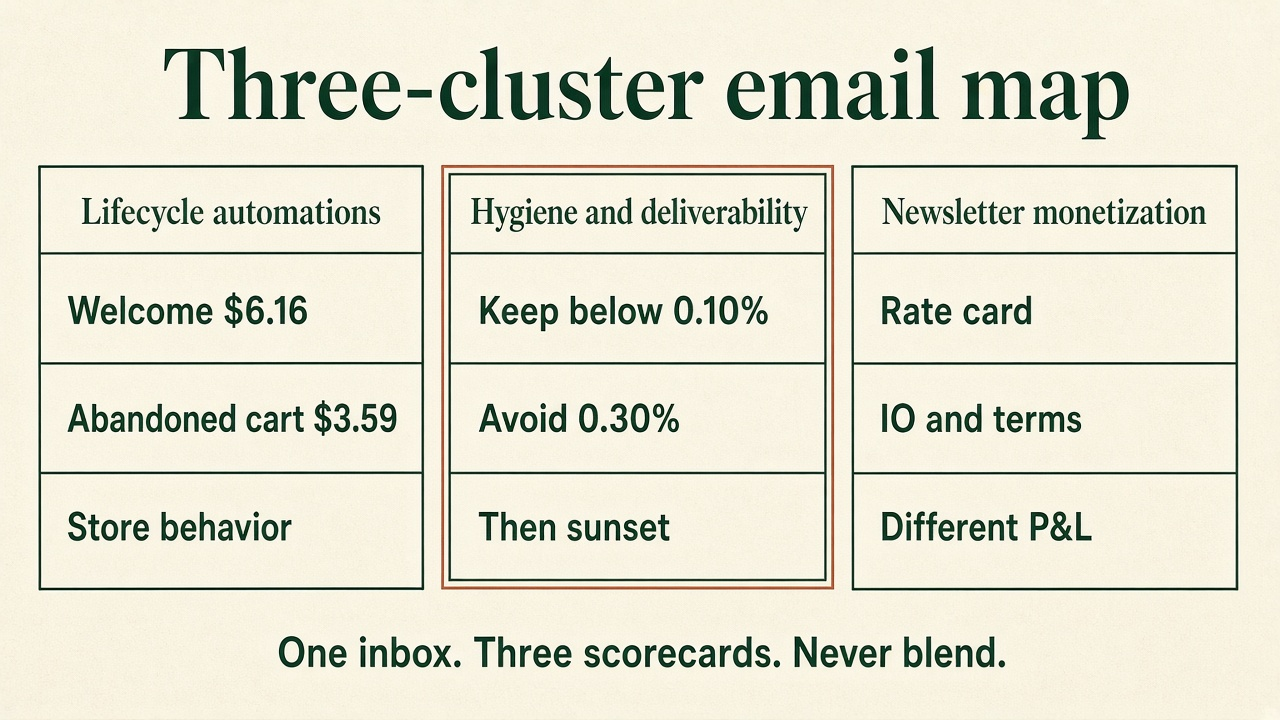
Source: Editorial framework for feat. Email Marketing pillar spokes. Cluster rule from /blog/how-to-build-a-topic-cluster and HubSpot topic-cluster guidance. https://blog.hubspot.com/marketing/topic-clusters-seo
| Job | What you send | Scorecard to trust | Headline figure (labeled) |
|---|---|---|---|
| Campaign broadcasts | Calendar promos, newsletters you did not sell | Revenue and conversion per campaign send | Omnisend campaign $0.155 / 0.08% conversion |
| Lifecycle automations | Welcome, cart, shipping, post-purchase | Revenue per automated send | Omnisend auto $3.41 (22x campaigns) |
| Concentration check | Same automations, different Omnisend sample | Share of sends vs share of revenue | 2% of sends, 30% of email revenue |
| Hygiene | Winback, then sunset and suppress | Spam rate, then leftover dollars | Google 0.10% / 0.30%; reactivation $0.51 |
| Newsletter sponsorship | Sold placements in someone else’s inbox | Rate card, network fee, IO, makegood | DMA £40.96 per £1 (UK survey); Paved 30% / 50% fees |
Operators on r/Klaviyo say the split in one sentence: if it should send automatically, it is a flow; if it is a promo or a newsletter, it is a campaign (r/Klaviyo 101). That is the grammar. The dollars sit in the next table.
Open these when the job is revenue from store behavior. Omnisend’s 2026 report says abandoned cart and welcome drove 76% of automation-generated orders. r/Emailmarketing says the same in operator English: “Welcome series goes up day one, no debate” (thread). Birthday AOV of $744.37 is real and is not an order-share argument (Omnisend).
| Spoke | Job | Headline figure to remember |
|---|---|---|
| Welcome email benchmarks | Opt-in onboarding | Omnisend welcome $6.16/email; unsub 0.87% |
| Browse abandonment email benchmarks | Earlier than cart | Omnisend Page viewed $0.76 vs cart $3.59 |
| Abandoned cart email benchmarks | Added-to-cart recovery | Omnisend cart $3.59; used by 22.5% of automation brands |
| Abandoned checkout email benchmarks | Checkout Started, not cart | Top Growth checkout median RPR $2.57 vs cart $1.82 |
| Post-purchase email benchmarks | Shipping, confirm, nurture | Omnisend shipping $3.08; cross-sell $0.95 |
| Replenishment email benchmarks | Same-SKU reorder clock | Labeled small-panel median RPR ~$0.17–$0.29 |
| Birthday email benchmarks | Occasion AOV + coverage | Omnisend birthday AOV $744.37; unsub 0.22% |
| SMS marketing vs email benchmarks | Channel mix | Omnisend campaign CTR SMS 12.39% vs email 0.74% |
Industry and campaign ladders that sit beside these flows: email marketing benchmarks by industry. Product back-in-stock posted $9.14 per email in Omnisend’s automation table, with only 0.6% of brands using it. That is an opportunity row, not a reason to skip welcome.
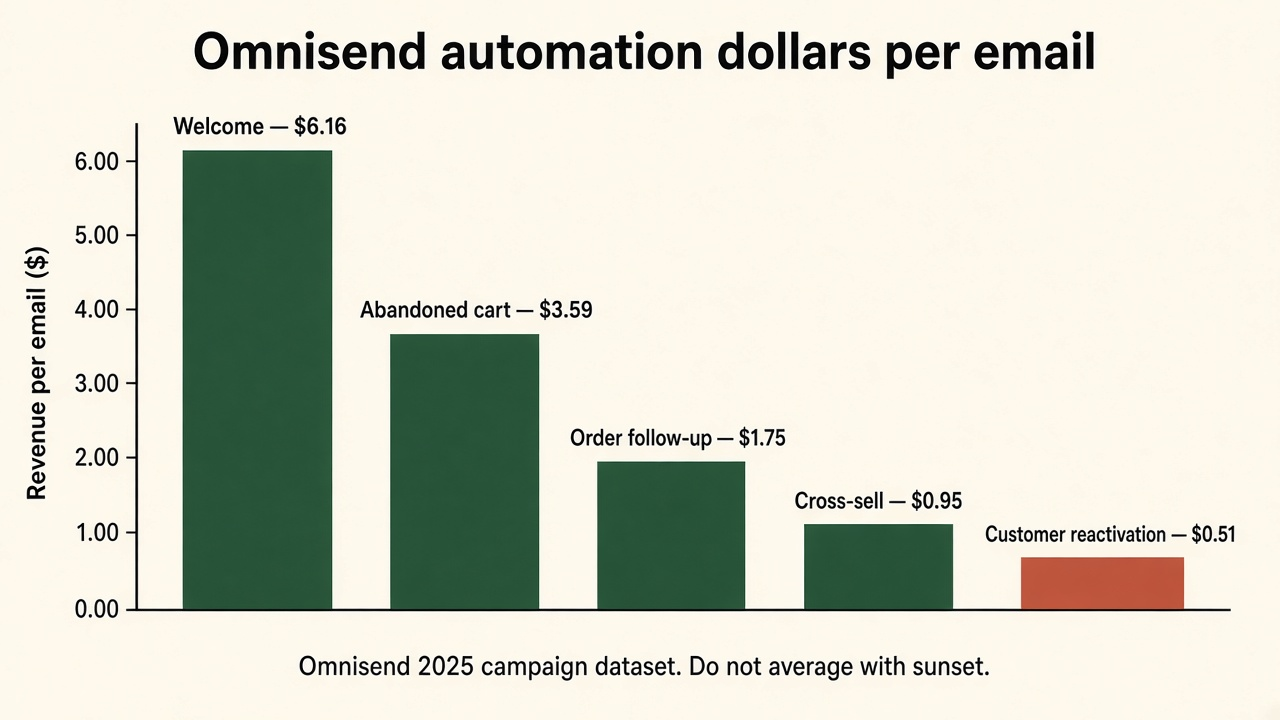
Source: Omnisend, Email marketing benchmarks (2025 dataset; page dated May 12, 2026). https://www.omnisend.com/blog/email-marketing-benchmarks/
Open these when the job is inbox placement, plan limits, or cold-list cleanup. A sunset flow that earns $0.01 median RPR can still be a win if it stops you paying to email ghosts (sunset email flow explained).
| Spoke | Job | Headline figure to remember |
|---|---|---|
| Transactional vs marketing email | Primary-purpose fork + rails | FTC Message A/B; Omnisend shipping $3.08 vs campaign $0.155 |
| Email frequency benchmarks | Campaign cadence vs unsub/CTR | MailerLite irregular unsub 0.87% vs twice-weekly 0.33% |
| Klaviyo vs Omnisend | ESP billing units + fee ladder | Omnisend excludes unsubscribed; Standard $16 vs Klaviyo Email $20 at 500 (vendor table) |
| Mailchimp vs Klaviyo | Contact billing fork + send multipliers | Mailchimp bills unsubs until archive; Essentials 10x / Standard 12x / Premium 15x vs Klaviyo 10x |
| Email preference center best practices | Opt-down UX + legal stop-all | CAN-SPAM menu+stop-all; Google one-click ≠ preferences page |
| Double opt-in vs single opt-in | Consent capture + proof | GetResponse SOI 1.28% vs DOI 0.33% signup; DOI open 35.72% |
| Email list growth benchmarks | Capture CVR + net growth | Omnisend popup census 2.1%; LP 6.47% → embedded 1.28% |
| Winback email benchmarks | Last revenue try on cold contacts | Omnisend reactivation $0.51 / 0.54% CVR |
| Sunset email flow explained | Last chance, then suppress | Klaviyo Sunset (Email) 180-day segment; Top Growth sunset RPR $0.01 |
| Email deliverability benchmarks | Spam floors + inbox samples | Google 0.10% / 0.30%; Validity 2025 global IPR 87.2% |
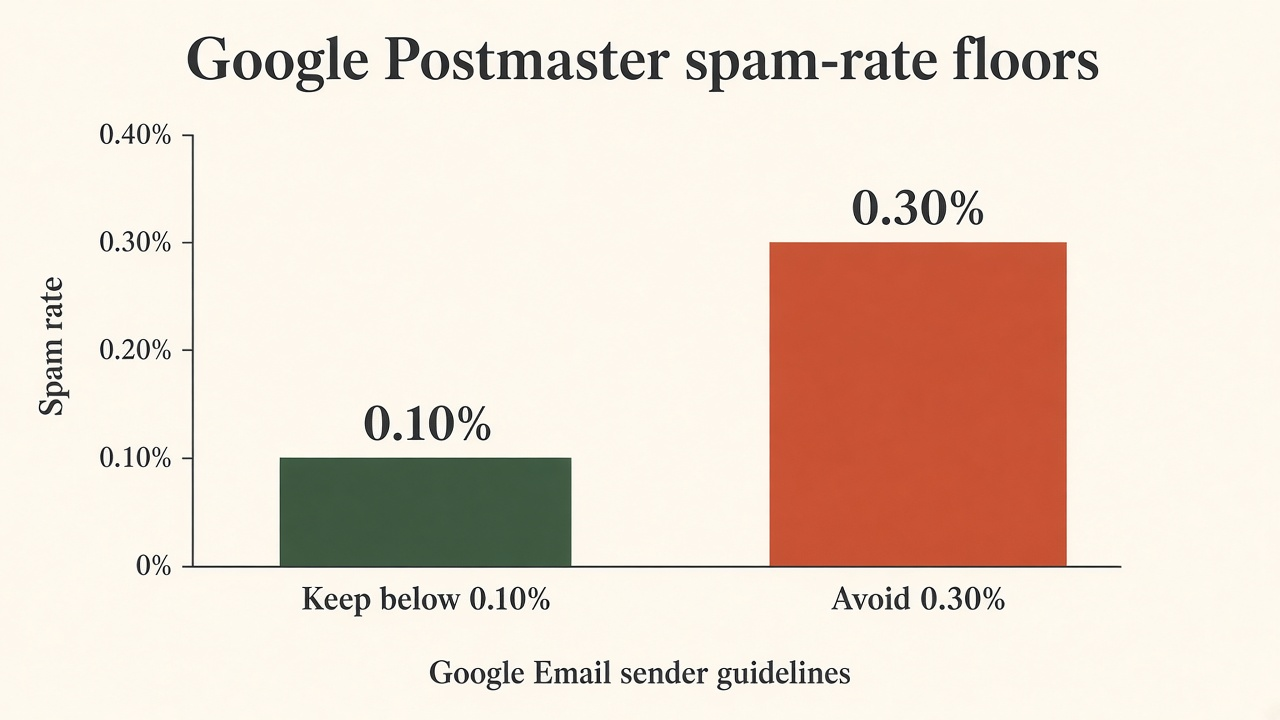
Source: Google Workspace Admin Help, Email sender guidelines. https://support.google.com/a/answer/81126
Open these when the inbox is the product you sell to sponsors. Same SMTP path. Different P&L. Do not price a cart flow with beehiiv size bands.
| Spoke | Job | Headline figure to remember |
|---|---|---|
| How to get newsletter sponsors | Acquisition paths | Network / outbound / inbound after readiness gate |
| Newsletter sponsorship rates by subscriber count | Pricing rails | beehiiv size bands (planning, not a census) |
| How to build a newsletter media kit | Discovery asset | Seven-section kit + visible rate table |
| Paved vs beehiiv ad network | Network fee incidence | Paved 30% Marketplace / 50% Ad Network |
| Dedicated email sponsorship pricing | Solo-send premiums | About 1.5x–5x primary slot across named sources |
| Newsletter ad CTR and CPC planning benchmarks | Performance pricing | Paved rebooked CPM / CPC ladders |
| Newsletter insertion order explained | Deal confirmation | Five-line IO, not a twelve-page binder |
| Newsletter sponsorship kill fees explained | Cancel pricing | Published ladders, not a fake industry average |
| How to invoice newsletter sponsors | Cash timing | Prepay or deposit; Net 15/30 from a dated clock |
| Newsletter makegood and underdelivery policies | Delivery vs performance | Paved CTR ≤1% and bot ≥50% triggers |
| How to write newsletter sponsorship terms of service | Evergreen terms | MSA + IO stack; React Weekly section map |
Adjacent creator-economy comparisons (different pillar, useful neighbors): beehiiv vs Kit, Substack vs beehiiv vs Kit, newsletter hybrid monetization.
Do not invent a single email marketing conversion rate that averages welcome, cart, sunset, and sponsored newsletter CTR. Do not treat ESP “delivered” as inbox placement. Do not quote agency mashups that invent Omnisend or Klaviyo cells the primary tables do not publish. Do not merge Omnisend’s $3.41 (20-billion campaign sample) with $2.87 (150,000-brand report) into one “automation dollar.” Each spoke already labels those gaps.
Building an email marketing program means naming one job, wiring consent and authentication, launching the two automations that carry order volume, then defending the spam floor before you scale campaigns or sell the list.
Q: What is email marketing? A: Email marketing is permissioned sending to a list you can still reach, then measuring clicks, orders, complaints, and suppresses against the job you named. Campaigns follow a calendar. Automations follow behavior. Newsletter sponsorship sells the list. They are not one KPI.
Q: How does email marketing work? A: You collect an address, authenticate the sending domain, pick a trigger or a send date, and keep spam complaints under mailbox floors. In Omnisend’s 2025 campaign dataset, automations earned $3.41 per email versus $0.155 for campaigns. Hygiene (winback, then sunset) protects that pipe.
Q: Which email automation should I build first? A: Build welcome and abandoned cart, and audit whether your “cart” trigger is actually checkout. Omnisend’s 2026 report says those two flows drove 76% of automation-generated orders. Birthday and replenishment come after the volume engines.
Q: What is a good email marketing ROI? A: There is no honest single percentage that covers every flow and every newsletter. Omnisend automations beat campaigns 22x on dollars per email in one sample and 16x in another. The DMA’s 2026 UK marketer survey reports £40.96 per £1. Use the labeled row. Do not invent a blended channel ROI.
Q: Why not one average email open rate for everything? A: Apple Mail Privacy Protection can preload the tracking pixel, so opens are directional. Welcome, cart, sunset, and sponsored placements are different jobs. Omnisend’s overall campaign open was 30.22%. Email marketing benchmarks by industry keeps sample labels. This hub keeps job labels.
An email marketing guide that earns citations is a map of labeled scorecards, not a list of subject-line tricks. Automations out-earn campaigns when the trigger is real. Hygiene keeps the mailbox. Newsletter inventory is a different P&L. Start at the spoke that matches the job, then climb back here for the sibling.
If creators should sell the products your email program protects and promotes, browse the feat. marketplace for co-branded storefront inventory.
Preference center best practices: CAN-SPAM menu plus stop-all, Google one-click vs body preference pages, and SendGrid's labeled 20% unsub drop.
Mailchimp vs Klaviyo: contact billing fork, send multipliers (10x/12x/15x), starting prices, and when ecommerce depth beats a general ESP.
Email list growth benchmarks: Omnisend 1.24B popup displays at 2.1%, form-type ladder, and levers that beat the average without inventing MoM %s.