Email Preference Center Best Practices
Preference center best practices: CAN-SPAM menu plus stop-all, Google one-click vs body preference pages, and SendGrid's labeled 20% unsub drop.
How to get newsletter sponsors: three paths (ad network, outbound, inbound), a readiness gate before you pitch, Paved fees, and beehiiv pricing bands.

TL;DR: How to get newsletter sponsors means picking a path (ad network, outbound, or inbound), but only after a readiness gate: media kit, rate card, and booking rules. Model network take-home with Paved’s 30% Marketplace and 50% Ad Network cuts. Price with beehiiv size bands, not vibes.
Most “I cannot get sponsors” posts are really “I have not decided how I sell inventory.” Waiting for 25,000 subscribers while your advertise page stays empty is not patience. It is unpaid inventory with a growth excuse. Sponsors buy a dated slot from a described audience, not a future list fantasy.
The full cluster map lives in the email marketing guide.
How to get newsletter sponsors is the acquisition spoke in the sponsorship cluster. Pricing lives on newsletter sponsorship rates by subscriber count. The sales asset is how to build a newsletter media kit. Network fee math is Paved vs beehiiv ad network. After a yes, use the insertion order, sponsorship terms, invoice, kill fee, and makegood guides.
Getting newsletter sponsors means filling paid placements by matching advertisers to a described audience through a network, outbound sales, inbound interest, or a mix, then confirming the deal in writing before send. The work is commercial: a path, a price, and a booking rule, not a hope that brands discover your footer link.
It is not “post a media kit and hope.” It is also not the same job as writing the kit, setting the rate, or drafting TOS. Those are inputs. Acquisition is the motion that turns a dated slot into a paid booking.
On r/Newsletters, publishers under a few thousand subscribers repeatedly ask who finds whom. The honest reply pattern is: networks find you some demand, outbound finds brands already buying the channel, and inbound shows up later when the list and the advertise page are real (thread).
A sponsor acquisition system matters because dated inventory dies when the send leaves. Without a path, a kit, and a price, every cancel and every soft “send rates?” email becomes improvisation. Systems beat inspiration when the slot is Thursday and the creative file is still missing.
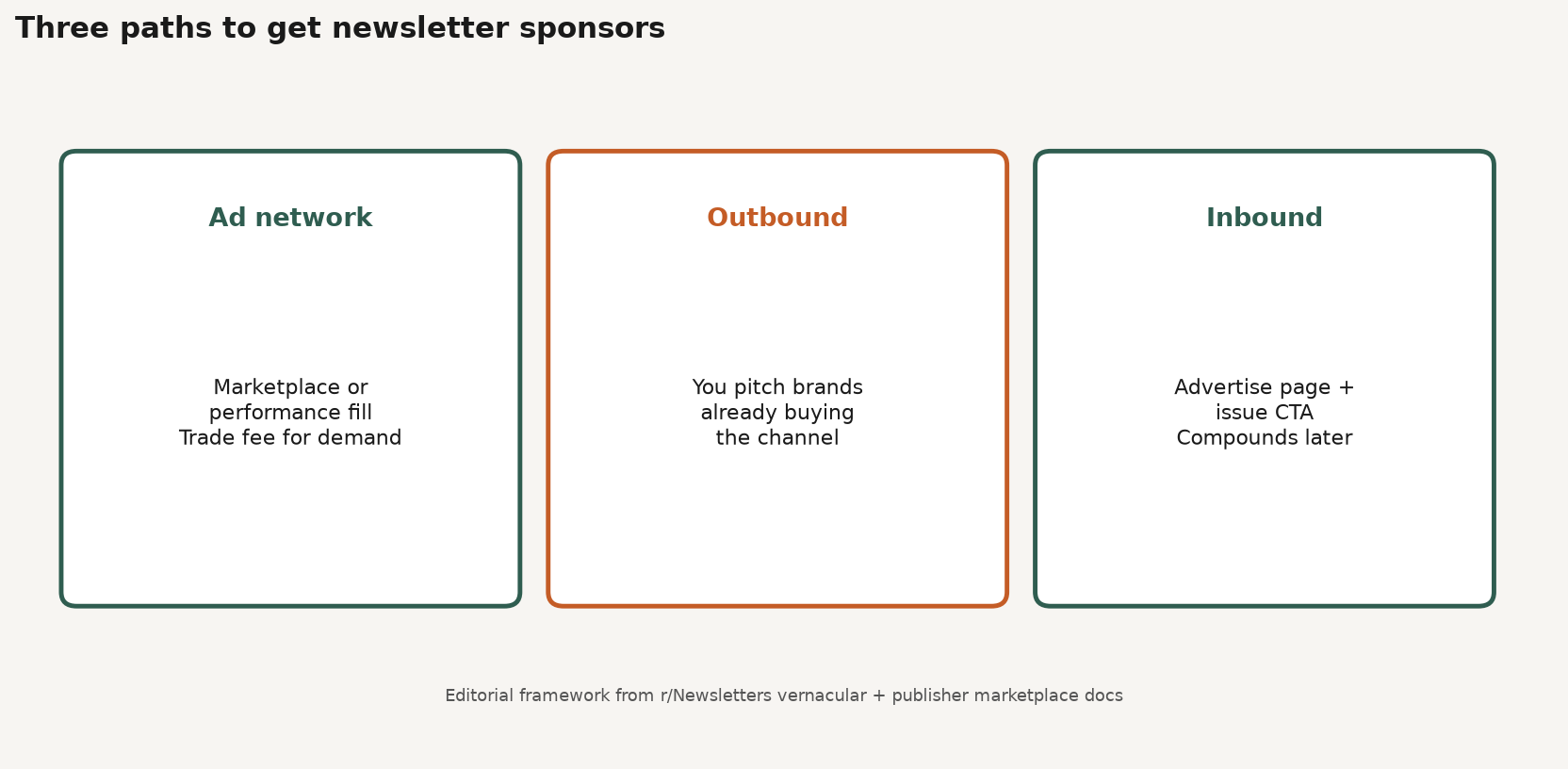
Source: Editorial three-path framework synthesized from r/Newsletters operator vernacular and publisher marketplace docs (Paved, beehiiv). https://www.reddit.com/r/Newsletters/comments/1sk5jj1/curious_how_newsletter_creators_find_sponsors/
How to get newsletter sponsors works as a readiness gate, then a path choice. Build proof and pricing first. Then fill inventory with network offers, outbound to brands already buying newsletters, inbound from an advertise page, or a mix that matches your list size and sales capacity.
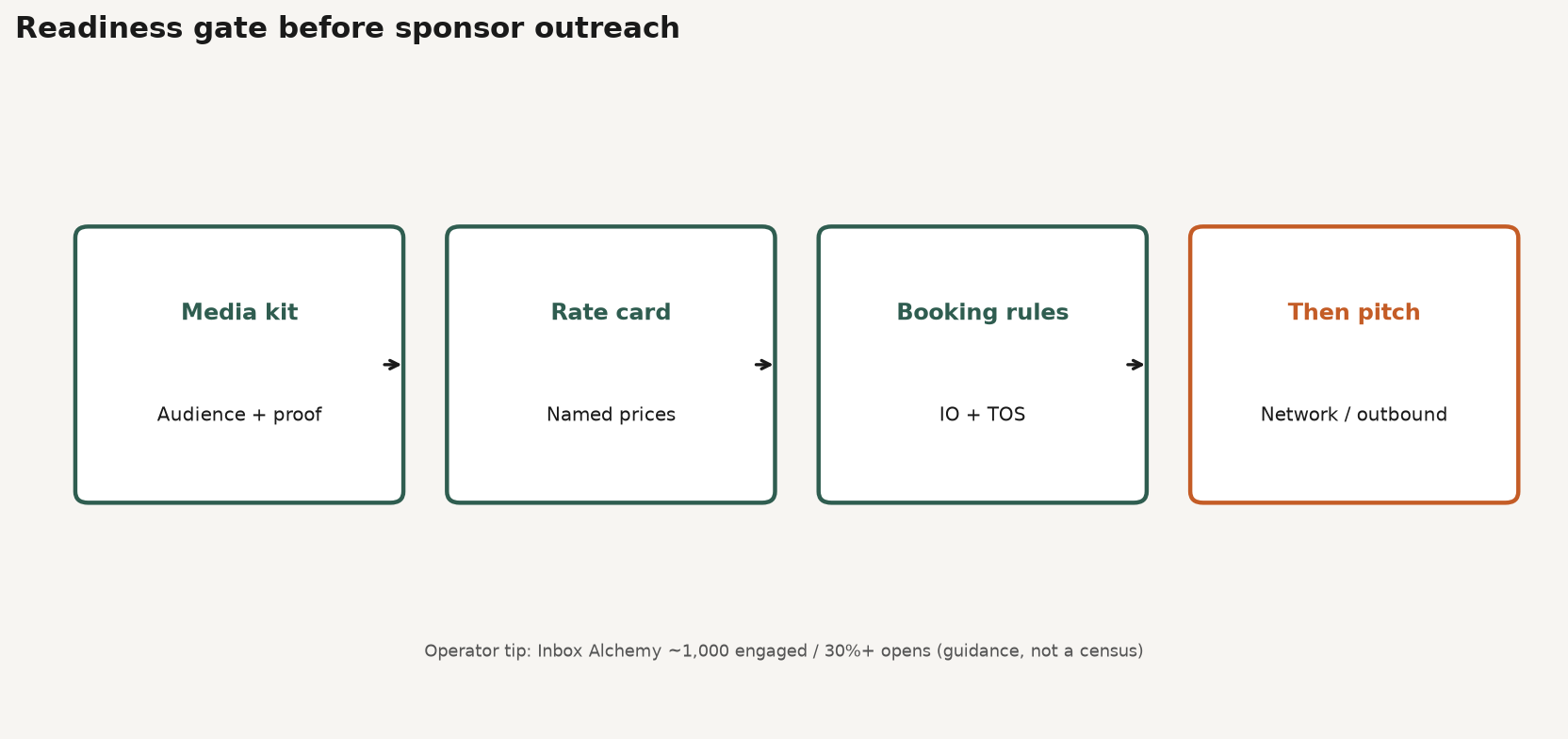
Source: Editorial readiness gate linking feat. media kit, rates, IO, and TOS spokes. Operator thresholds from Inbox Alchemy (Apr 20, 2026) labeled as guidance, not a census. https://inboxalchemy.co/blog/how-to-get-newsletter-sponsors
| Gate item | Job | Where it lives |
|---|---|---|
| Audience one-liner | Name who reads you in one sentence a buyer can verify | Media kit intro |
| Proof metrics | Subscribers, send cadence, opens (MPP-honest), clicks | Media kit |
| Rate card | Named placements with prices or CPM method | Rates |
| Booking rules | How payment, cancel, and creative deadlines work | TOS + IO |
| Advertise surface | A public page or footer link so inbound can happen | Your site / issue footer |
Inbox Alchemy’s four-line pitch (ICP match, proof, specific offer, two-option CTA) only works after the gate exists (Inbox Alchemy). Destini Copp notes many networks quietly want roughly 1,000 to 5,000 engaged subscribers before the overhead is worth it (Destini Copp). That is operator guidance for network floors, not a law for direct sales.
Use a network when you want fill without building a full outbound desk.
| Rail | Access / model | Publisher economics (official) | Best for |
|---|---|---|---|
| Paved Marketplace | List profile; advertisers book | 30% of booking | Direct-style deals with marketplace demand |
| Paved Ad Network | Snippet / performance fill | 50% of performance earnings | Remnant inventory on autopilot |
| beehiiv Ad Network | Scale+ and actively sending on beehiiv; offer feed | Paid on CPC/CPM offers; non-exclusive | beehiiv senders filling open dates |
Sources: Paved pricing; beehiiv Ad Network; beehiiv FAQ.
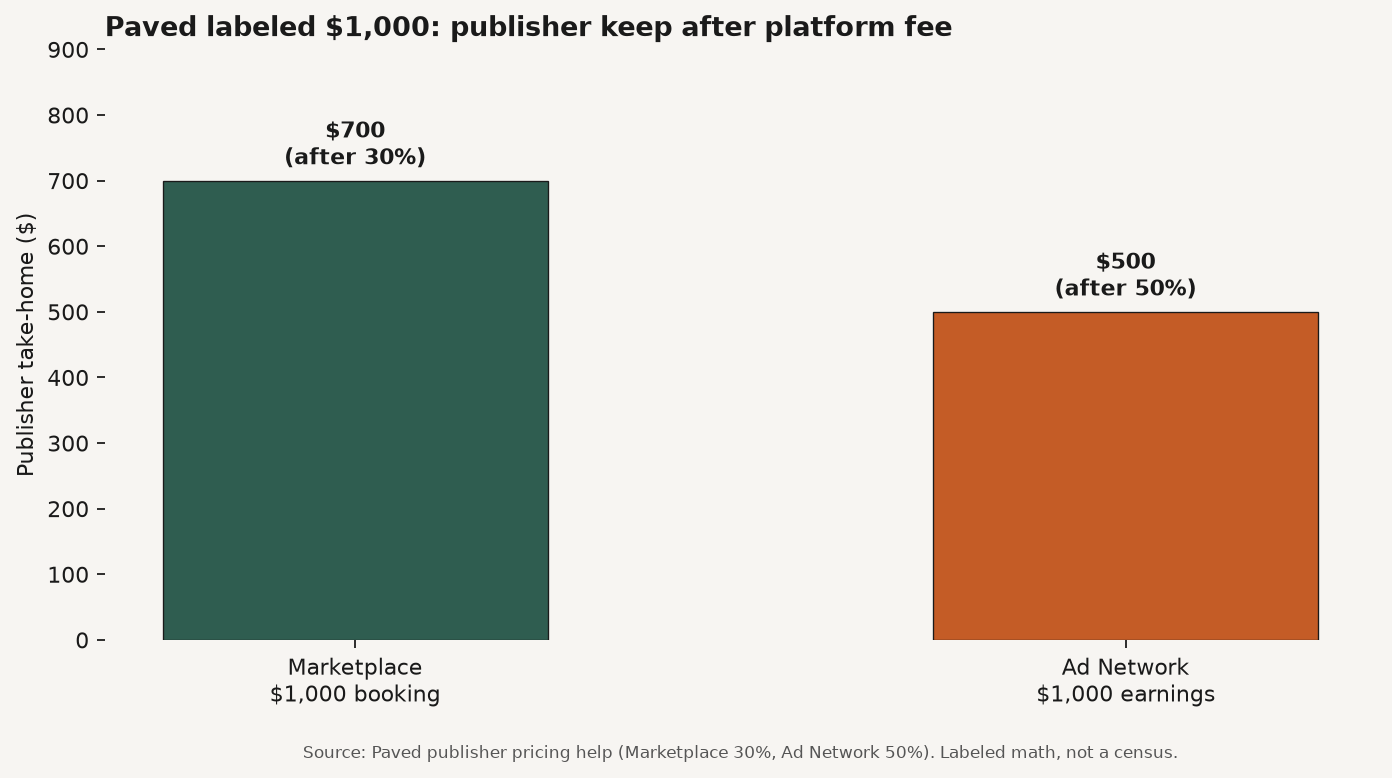
Source: Editorial math from Paved publisher pricing (Marketplace 30%, Ad Network 50%). https://www.paved.com/help/articles/8124389-paved-s-pricing-for-publishers
On a labeled $1,000 Marketplace booking you keep $700. On $1,000 of Ad Network earnings you keep $500. Full fee-incidence comparison, including beehiiv’s advertiser-funded offer model and $15k brand-campaign floor, lives on Paved vs beehiiv. An older beehiiv blog post also mentioned 1,000 active subscribers as a qualification; prefer the live Scale-plan FAQ when they disagree (beehiiv blog; FAQ).
Outbound wins when your niche is clear and you can name buyers who already sponsor adjacent newsletters or podcasts. Build a list of 20-30 targets before the first email (common playbook length across Inbox Alchemy, MailAdx, and SponsorGap guides). Prefer brands already spending in the channel over Fortune 500 cold starts.
Four-line pitch structure (adapted from Inbox Alchemy):
Keep the first touch short. Attach or link the media kit after interest, not as a five-megabyte cold attachment. Price inside beehiiv’s bands so you are not inventing mid-thread (beehiiv).
Inbound is the low-effort path Reddit operators describe: an advertise page, a footer link, and occasional mentions that slots are open (r/Newsletters). It rarely replaces outbound early. It compounds once the list and proof exist. Put rate ranges or “request the card” on that page so serious buyers self-select.
| Stage | Primary path | Secondary | Avoid |
|---|---|---|---|
| Very small / irregular sends | House ads + product/affiliate tests | Warm outbound to creators who know you | Pretending you are a media brand to agencies |
| Engaged niche ~1K+ (operator guidance) | Outbound to channel-ready brands | Network remnant fill | Quoting without a kit |
| Mid-list with cadence | Mix: outbound + Marketplace + inbound page | Network for gaps | Selling every slot through a 50% cut when you can direct-sell |
| Sold-out direct | Raise rates; waitlist buyers | Network only for true remnant | Discounting to fill boredom |
There is no public dataset that proves these stage mixes as industry averages. They are an editorial planning table from the path definitions above.
Confirm with a short IO, point at evergreen sponsorship terms, invoice before leverage dies at send, and know your kill fee and makegood fork. Label ads clearly for disclosure.
Booking your first sponsors means closing the readiness gate, picking one primary path, running a small target list, and confirming the first yes in writing. Skip the gate and you will pitch vapor: a date without a price, or a price without a cancel rule.
Q: How many subscribers do I need to get newsletter sponsors? A: There is no official public threshold. Inbox Alchemy’s operator guidance suggests pitching around 1,000 engaged subscribers with 30%+ opens. Destini Copp notes many networks prefer roughly 1,000 to 5,000 engaged subscribers. Direct sales to niche buyers can start smaller if fit is obvious.
Q: Should I use an ad network or sell newsletter sponsorships directly? A: Use networks for demand and remnant fill; use direct outbound when you can name buyers and want to keep more of the dollar. On Paved, Marketplace keeps 70% of a labeled booking after 30%, while Ad Network keeps 50% after the performance cut. Model both before you default.
Q: What should a newsletter sponsorship pitch include? A: Keep it short: ICP overlap, proof metrics, a specific placement with price and date, and a two-option CTA. Link the media kit after interest. Vague “interested in partnering?” emails train buyers to ignore you.
Q: How much should I charge for a newsletter sponsorship? A: Start from beehiiv’s size bands (about $50-$250 flat under 5,000 subscribers for many lists) and the flat-vs-CPM choice on the rates guide. Niche B2B can justify higher CPMs than broad consumer. Do not invent a niche median from an unsourced table.
Q: Can I get sponsors with a small newsletter list? A: Yes, if the audience is specific and you can prove engagement. Small lists usually win with outbound to channel-ready niche buyers or creator-adjacent sponsors, plus network remnant when eligible, not with agency RFPs built for huge opens.
How to get newsletter sponsors is a readiness gate plus a path choice: network, outbound, inbound, or a deliberate mix. Price with published bands, model Paved’s 30% and 50% cuts before you outsource the sale, and confirm every yes in writing. Browse the feat. marketplace if creators should sell an owned product beside sponsorship cash.
Preference center best practices: CAN-SPAM menu plus stop-all, Google one-click vs body preference pages, and SendGrid's labeled 20% unsub drop.
Mailchimp vs Klaviyo: contact billing fork, send multipliers (10x/12x/15x), starting prices, and when ecommerce depth beats a general ESP.
Email list growth benchmarks: Omnisend 1.24B popup displays at 2.1%, form-type ladder, and levers that beat the average without inventing MoM %s.