Email Preference Center Best Practices
Preference center best practices: CAN-SPAM menu plus stop-all, Google one-click vs body preference pages, and SendGrid's labeled 20% unsub drop.
Sunset email flow explained: Klaviyo's 180-day Sunset (Email) segment, Top Growth $0.01 median RPR, and suppress vs delete.

TL;DR: A sunset email flow is a last-chance hygiene sequence for confirmed ghosts, then suppress. Klaviyo’s Sunset (Email) segment uses Created ≥180 days, ≥5 emails in ~72 weeks, and zero forever engagement. A labeled Top Growth panel (n=9) puts median sunset RPR at $0.01. Judge it on clean suppression, not cart dollars.
Founders ask for a “good sunset open rate” the way they ask for a good cart rate. That is the wrong scoreboard. Sunset exists to confirm someone is gone so you can stop mailing them, stop paying for them as an active profile, and stop training mailbox providers that your domain is noise.
The full cluster map lives in the email marketing guide.
Sunset email flow explained means defining the unengaged segment, sending a short last-chance series, tagging non-responders, and suppressing them without deleting history you still need. Revenue scorecards for cold lists live in winback email benchmarks. Broader ESP ladders live in email marketing benchmarks by industry. Complaint floors that make hygiene urgent live next to Google’s bulk sender rules in the sibling deliverability queue.
A sunset email flow is an automation that targets long-unengaged subscribers with a short last-chance series, then marks non-responders for suppression so they stop receiving marketing email and stop counting as active profiles. It is a hygiene machine with a goodbye letter attached, not a discount ladder for people who already ignored you.
It is not a weaker winback. Winback still believes a lapsed buyer or cold subscriber is worth a revenue try. Sunset assumes silence has already spoken and asks one last time before you cut the send path. Klaviyo’s Help Center says you should sunset lists and segments you plan to suppress, because once suppressed they cannot receive marketing emails, and the flow’s job is to catch anyone who still engages before that cut (Klaviyo).
If you are still hunting recovery dollars on a cold cohort, stay on winback email benchmarks. If you are protecting inbox placement and plan limits, this page is the operating manual.
A sunset email flow matters because unmonitored inboxes drag open rates, invite spam complaints, and inflate the active-profile count you pay for, while a short last-chance series still salvages the few who wake up before you suppress. Skip it and you subsidize ghosts with both cash and sender reputation.
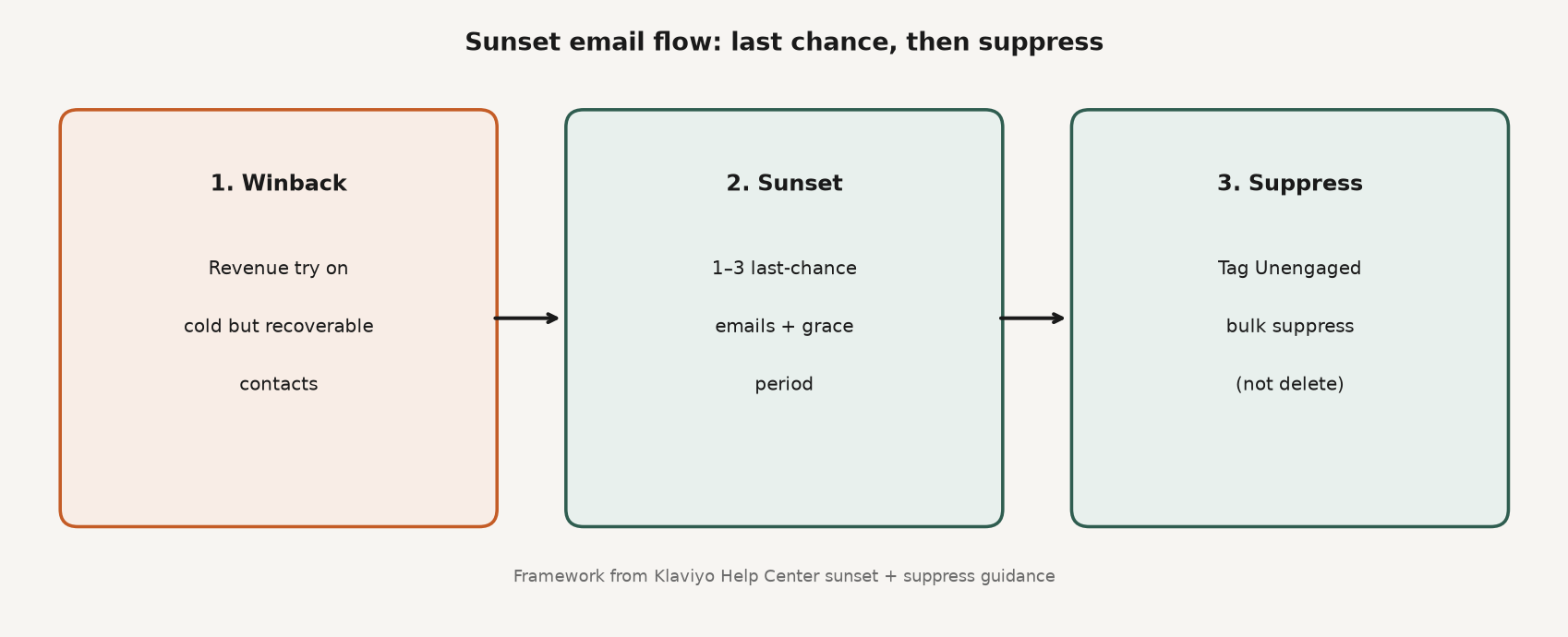
Source: Editorial framework synthesizing Klaviyo Help Center sunset and suppress guidance with the winback-versus-sunset operator split. https://help.klaviyo.com/hc/en-us/articles/360017518492 · https://help.klaviyo.com/hc/en-us/articles/24312135764251
A sunset email flow works when a profile enters a strict unengaged segment, receives one to three last-chance messages, exits on real engagement, and gets tagged for bulk suppression if silence holds through a short grace period. The dollars will look tiny. The hygiene is the product.
Klaviyo’s recommended segment (also the Segment Library “Sunset (Email)” preset) is AND-logic all the way down (Klaviyo):
| Condition | Rule |
|---|---|
| Marketing eligibility | Person can receive email marketing |
| Profile age | Created is at least 180 days ago |
| Proof you actually mailed them | Received Email at least 5 times in the last 72 weeks |
| Zero engagement forever | Opened Email 0, Clicked Email 0, Active on Site 0, Viewed Product 0, Checkout Started 0, Placed Order 0 (all time) |
That definition is stricter than “no open in 90 days.” It requires a long tenure, repeated sends, and zero lifetime marketing and site engagement. Mis-wire AND versus OR and the segment either stays empty or vacuums recent buyers. Klaviyo’s troubleshooting guide calls that out for sunset flows specifically (Klaviyo).
On the Suppressed profiles page, Klaviyo’s suppression recommendations use the same never-engaged pattern but require Created at least 365 days ago, plus ≥5 emails over roughly the last 72 weeks, never opened or clicked, and never visited or purchased (Klaviyo). Treat 180 days as the flow-trigger library default and 365 days as the safer bulk-suppress recommendation band. Do not invent a third “industry average inactivity window.”
Klaviyo’s from-scratch recipe: add flow filters so anyone who opens or clicks since starting the flow exits, send one to three emails (not more), wait a grace period after the last email (3 days if you send daily, 7-10 if less often), then update a boolean profile property such as Unengaged = True (Klaviyo). Unsubscribes suppress automatically. Silent non-responders need the tag, then a Suppress current members action on a segment of Unengaged = True.
Klaviyo is explicit: it is not currently possible to suppress profiles as a native Flow Action. Bulk suppress from Lists & segments (or an API/webhook recipe) is the path (Klaviyo; Community).
| Action | Profile remains? | Marketing email? | Counts toward plan limits? | Recoverable? |
|---|---|---|---|---|
| Suppress | Yes | No | No | Can unsuppress (with rules) |
| Delete | No | N/A | N/A | No |
Prefer suppress for list hygiene. Delete when a person requests erasure or you are certain you never need the record (Klaviyo). Note the manual re-suppress cooldown: after a manual suppress then unsuppress, you generally cannot manually suppress again within 90 days (Klaviyo).
| Metric | Labeled figure | How to read it |
|---|---|---|
| Sunset / re-engagement median CTR | 0.41% (n=9) | Cold cohort; under 1% by design |
| Top-quartile CTR | 0.96% | Still not a cart flow |
| Median conversion | 0.01% | Hygiene job, not checkout recovery |
| Median RPR | $0.01 | Contrast checkout $2.57 (n=13) |
| Top-quartile RPR | $0.11 | Upside tail, not a week-one target |
Source: Top Growth Marketing DTC email flow benchmarks, July 2025 to June 2026 (Top Growth). Small panel, agency-managed Klaviyo brands, equal-weight percentiles. Use it as a humility floor, not a census.
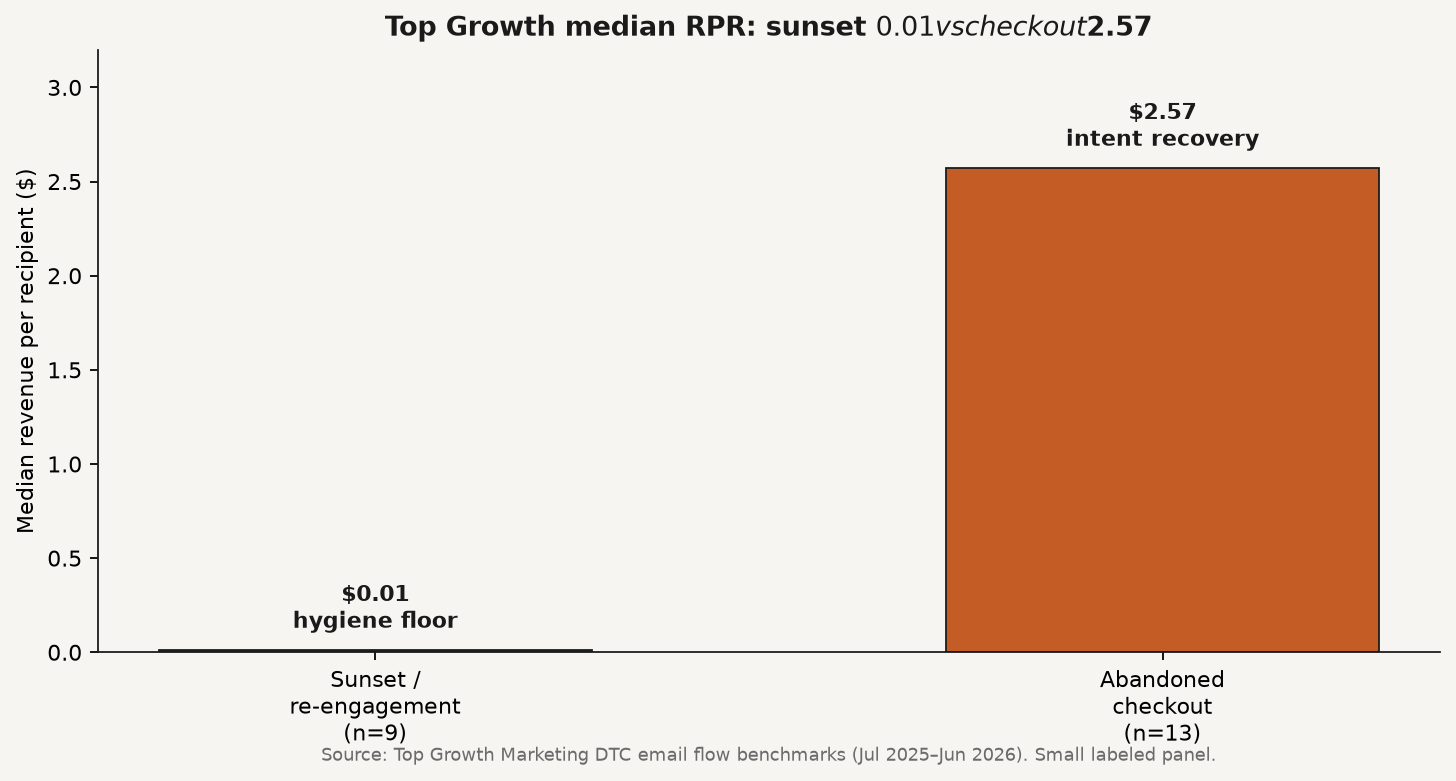
Source: Top Growth Marketing, Email Flow Benchmarks for DTC Ecommerce (July 2025 to June 2026; sunset n=9, checkout n=13). https://topgrowthmarketing.com/dtc-ecommerce-benchmarks/email-flow-benchmarks/
Klaviyo’s exit filters often key on opens and clicks. Apple Mail Privacy Protection can inflate opens (email marketing benchmarks by industry; how iOS privacy changes affected performance marketing). Prefer clicks, site activity, and purchases when you tighten filters. Do not celebrate a “recovered” open that is only a privacy proxy fetch.
There is no public dataset for a verified Klaviyo or Omnisend all-account sunset $/email or open-rate census matching agency “15-25% open / 3-8% re-engagement” tables. feat. does not invent a national sunset conversion rate. Use Klaviyo’s published segment rules plus labeled small panels, then measure your own suppress volume.
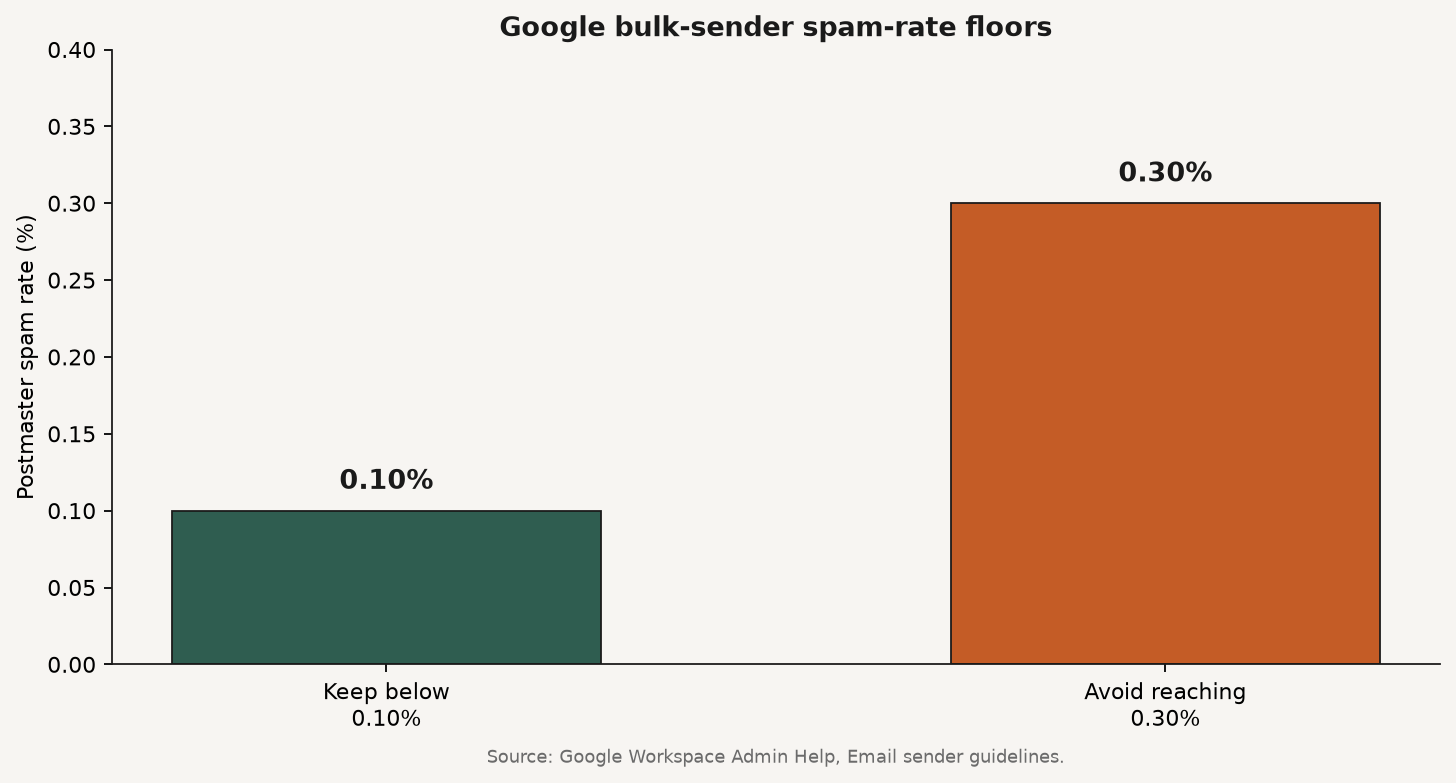
Source: Google Workspace Admin Help, Email sender guidelines. https://support.google.com/a/answer/81126
Building a sunset email flow means copying Klaviyo’s Sunset (Email) logic (or your ESP’s equivalent), limiting the series to three messages, tagging silence, and bulk-suppressing without deleting. Run winback first when the cohort still deserves a revenue try. Score success on suppress volume and complaint-rate headroom, not on cart RPR.
These answers restate the Sunset (Email) segment rules, the suppress-versus-delete choice, the Top Growth hygiene floor, and why open-rate vanity fails so a founder can quote labeled sources without inventing a national sunset benchmark. Keep them next to the tables above when you brief a teammate or paste a short answer into Slack.
Q: What is a sunset email flow? A: It is an automation that sends a short last-chance series to long-unengaged subscribers, then suppresses (or deletes) people who still do not engage. Klaviyo positions it as list hygiene and billing control, not as a top revenue flow.
Q: How is a sunset flow different from a winback flow? A: Winback still chases recovery from lapsed buyers or cold subscribers. Sunset confirms ghosts before you cut marketing sends. Run winback first when the cohort deserves a try, then sunset non-responders (winback email benchmarks).
Q: What segment should trigger a Klaviyo sunset flow? A: Start from the Sunset (Email) library definition: can receive email, Created ≥180 days, Received Email ≥5 in 72 weeks, and zero lifetime opens, clicks, site activity, product views, checkouts, and orders. Suppression recommendations on the Suppressed profiles page use a 365-day created gate with the same never-engaged pattern.
Q: What is a good sunset email conversion or RPR? A: A labeled Top Growth DTC panel (n=9) shows median conversion 0.01% and median RPR $0.01 (top quartile $0.11). Those numbers look like failure next to checkout $2.57. They are the humility floor for a hygiene job. There is no public Omnisend or Klaviyo all-account sunset $/email census in the sources used here.
Q: Should I suppress or delete unengaged profiles? A: Prefer suppress for hygiene: the profile stays for analysis, cannot get marketing email, and does not count toward plan limits. Delete only for erasure requests or records you are sure you never need. Klaviyo does not offer suppress as a native Flow Action, so use bulk suppress or a documented API webhook.
A sunset email flow is how you stop mailing people who already voted with silence. Klaviyo’s 180-day Sunset (Email) segment, the 365-day suppress recommendation twin, and Top Growth’s $0.01 median RPR all point the same way: measure clean cuts, not cart envy.
If the engaged list you protect should sell through creators, browse the feat. marketplace for co-branded storefront inventory.
Preference center best practices: CAN-SPAM menu plus stop-all, Google one-click vs body preference pages, and SendGrid's labeled 20% unsub drop.
Mailchimp vs Klaviyo: contact billing fork, send multipliers (10x/12x/15x), starting prices, and when ecommerce depth beats a general ESP.
Email list growth benchmarks: Omnisend 1.24B popup displays at 2.1%, form-type ladder, and levers that beat the average without inventing MoM %s.