Email Preference Center Best Practices
Preference center best practices: CAN-SPAM menu plus stop-all, Google one-click vs body preference pages, and SendGrid's labeled 20% unsub drop.
How to invoice newsletter sponsors: prepay vs Net 15/30, deposits, invoice clock start, and why send-to-cash can lag six to eight weeks.

TL;DR: How to invoice newsletter sponsors starts before the send. Prefer prepay or a deposit for new advertisers, then name Net 15 or Net 30 from a dated clock (invoice date or send date). Plan cash on a longer lag than the label. There is no official public median days-to-pay for newsletter ads. Not legal or tax advice.
A newsletter send cannot be unlisted. When the issue leaves, the advertiser has the whole deliverable and you have lost every bit of leverage that withholding an asset would give you in other media. “I’ll invoice after” is how you finance their campaign with your inventory.
The full cluster map lives in the email marketing guide.
How to invoice newsletter sponsors is the accounts-receivable spoke after the deal is sold. Pair it with newsletter insertion order explained, newsletter sponsorship kill fee, how to build a newsletter media kit, newsletter sponsorship rates by subscriber count, and newsletter ad CTR and CPC planning benchmarks.
Invoicing newsletter sponsors is the process of stating the fee, the payment clock, and the collections rules for a sponsorship placement so money moves on a dated obligation instead of a memory of Slack approval. It turns a sold slot into accounts receivable with a start date, a due date, and a written late-fee rule before you hit send.
Net terms are the B2B clock. The US Chamber defines them as how long a customer has to pay after receiving an invoice. Net 30 means thirty days. Net 15 is tighter. Net 60 and Net 90 stretch further and are more common with large organizations that use payment terms as working capital (US Chamber). InfluencersKit’s newsletter-specific point is sharper: write when the obligation arises (on send), when payment is due (Net 30 from the invoice date as a common standard), what happens if it is late, whether undisputed amounts stay payable during a dispute, and what suspension looks like on multi-issue packages (InfluencersKit).
The invoice is not a separate universe from the insertion order. Mismatched terms between the two is where disputes start.
It matters because newsletter inventory is irreversible and time-bound. You turned other buyers away to hold the slot. If payment is optional theater after delivery, you priced opportunity cost at zero and gave away the only leverage a send still had. Write the invoice clock while the brand still needs the date.
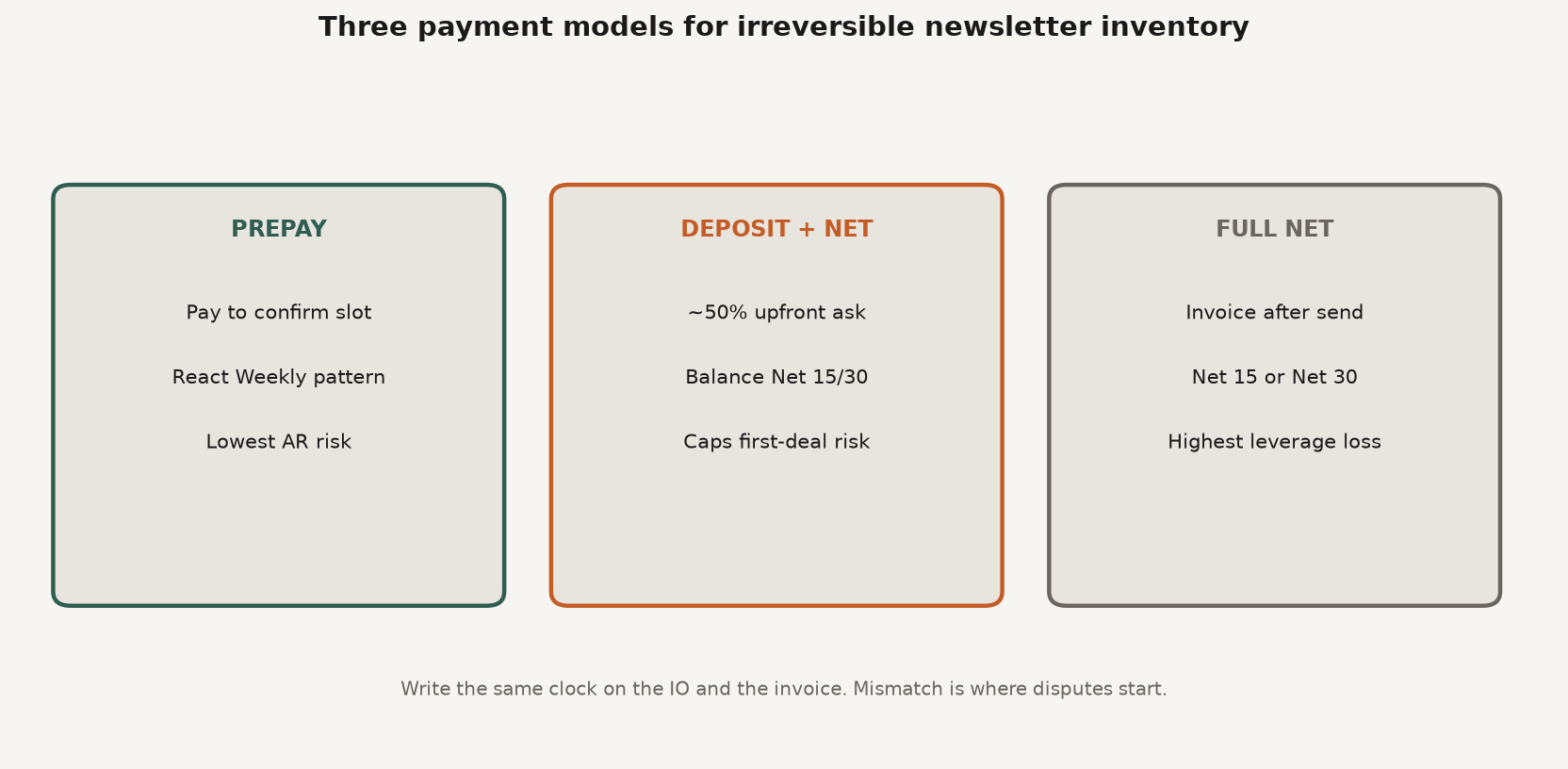
Source: Editorial framework. Prepay pattern from React Weekly Sponsorship Terms; deposit and Net 30 guidance from InfluencersKit; Net 15/30 planning from CrossLetter; Net 15 after invoice from Retail Brew IO terms. https://react-weekly.dev/sponsor/terms · https://www.influencerskit.com/blog/newsletter-sponsorship-contract-getting-paid · https://crossletterplatform.beehiiv.com/p/the-collaborator-by-crossletter-13 · https://www.retailbrew.com/io-terms-conditions
They work as a payment model choice, then a dated invoice, then collections habits. Choose prepay, deposit plus net, or full net. Name the clock. Invoice on send day when you are not prepaid. Assume the customer uses the full term.
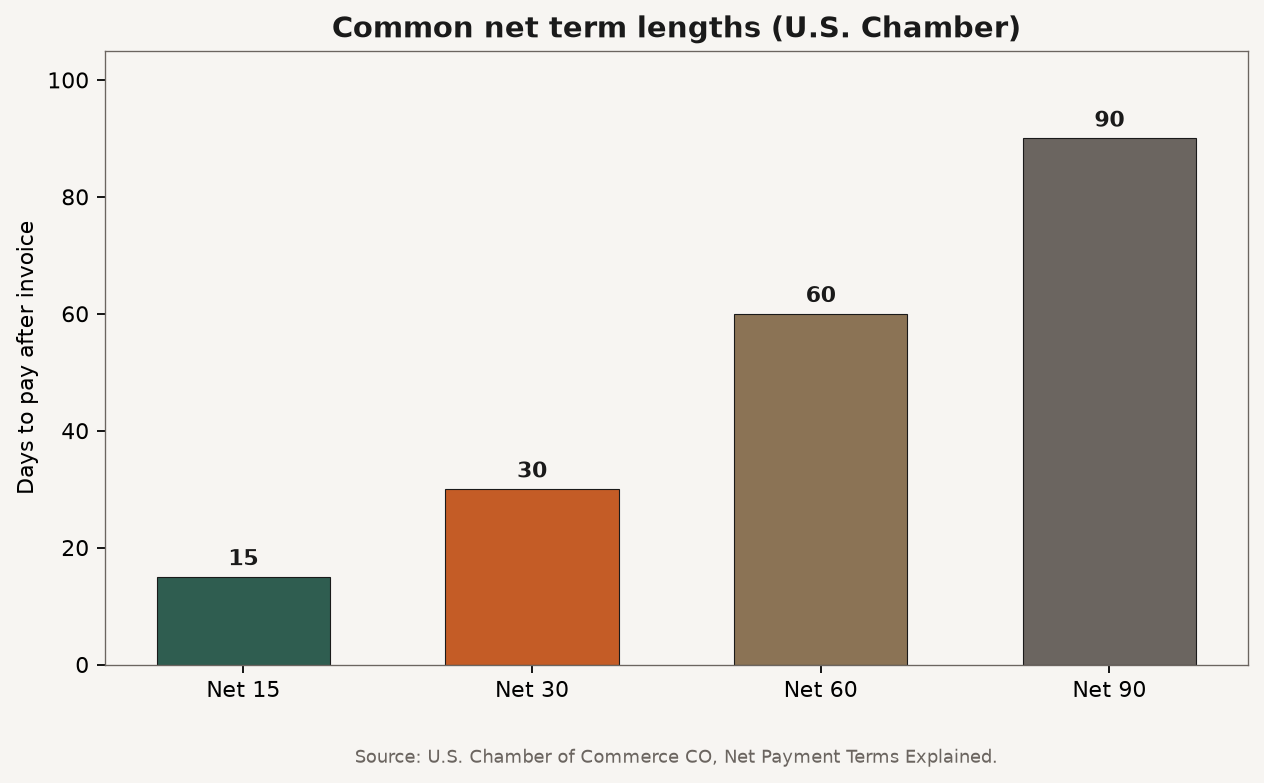
Source: U.S. Chamber of Commerce CO, Net Payment Terms Explained. Common variants Net 15, 30, 60, and 90. https://www.uschamber.com/co/run/finance/what-are-net-terms
| Payment model | When cash moves | Best for | Risk if unpaid |
|---|---|---|---|
| Prepay / pay to confirm | Before slot is held | Indie weeklies; first-time sponsors | Low after confirmation (React Weekly pattern: paid in full to confirm) (React Weekly) |
| Deposit + net balance | 50% (common ask) on booking; balance on Net 15/30 | New advertisers; mid-size deals | Caps exposure; filters non-payers (InfluencersKit) |
| Full net after invoice | Net 15 or Net 30 after invoice/send clock | Repeat sponsors; some agencies/enterprise | Highest; you already delivered |
| Enterprise long net | Net 60 / 90 | Large orgs with procurement norms | Working-capital heavy (US Chamber) |
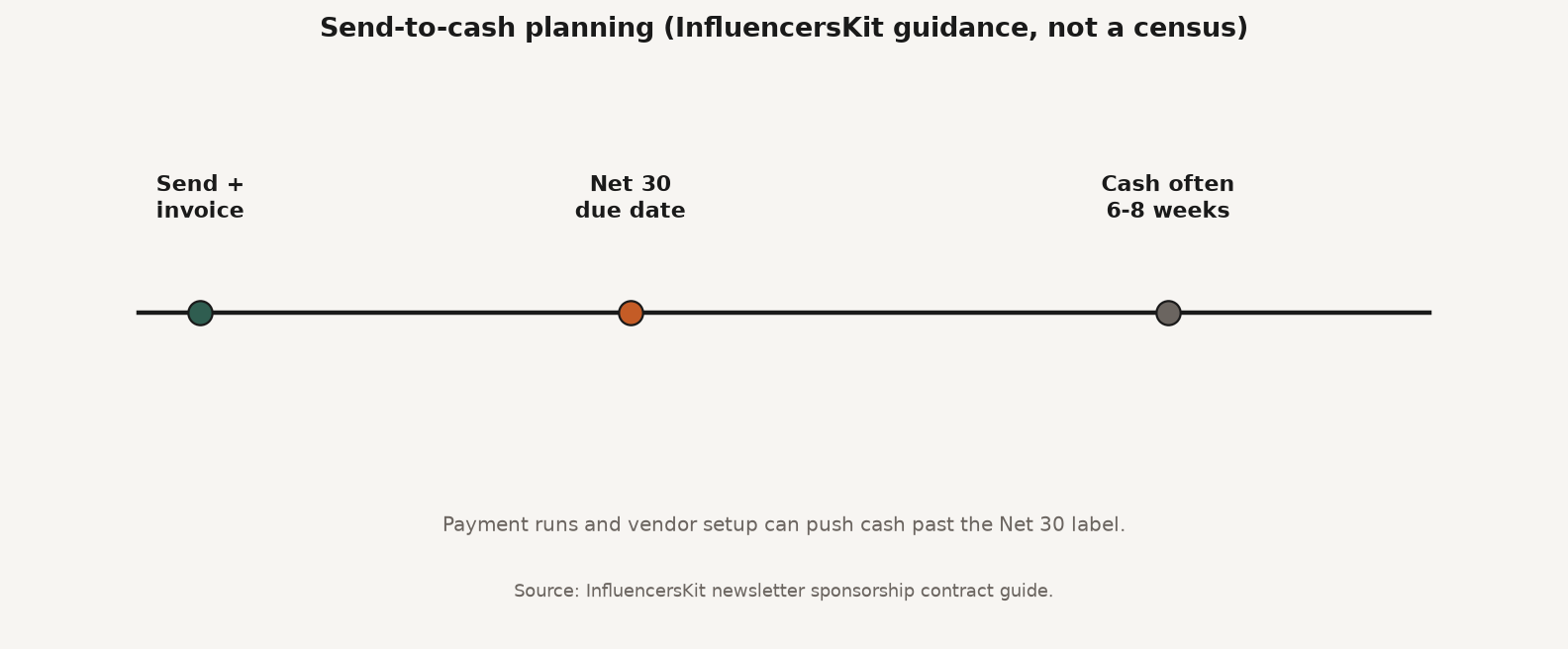
Source: InfluencersKit cash-flow guidance (Net 30 example plus payment-run lag; six to eight week planning band). https://www.influencerskit.com/blog/newsletter-sponsorship-contract-getting-paid Not an official public median DSO.
InfluencersKit’s March-to-mid-April style example is the warning: solo operators who book sponsorship revenue in the month of the send will overstate cash (InfluencersKit). Deposits convert part of every deal into cash on signature. Multi-issue packages should keep suspension rights so unpaid issue one can pause issues two through four (InfluencersKit).
InfluencersKit notes many agencies pay after their client pays them. Net 30 with an agency can become Net 30 after that settlement. Ask whether payment is contingent on their client, and write your obligation so it is not conditional on a third party (InfluencersKit). That is commercial practice language, not a statute.
The Chamber’s classic example is 5% 10 net 30: 5% off if paid in 10 days, otherwise full amount in 30 (US Chamber). Only use discounts if your margin can stand them. For late fees, agree in the contract, print on the invoice, then remind, call AP, and escalate. Collections agencies may keep roughly a quarter to half of what they recover (US Chamber). Past that, small claims or write-off usually ends the relationship.
Do not publish a fake “newsletter industry average Net 30 clears in 28 days.” There is no public dataset for that median. Do not promise earnings from sponsorship AR. Link cancel economics to the kill fee spoke instead of restating every ladder here.
Invoice from a written IO, not from memory. Choose the payment model before you hold the date. Send the invoice the day the obligation triggers. Follow up like a professional who delivered a dated product, then suspend future inventory if the balance stays unpaid past terms.
Q: What does Net 30 mean on a newsletter sponsorship invoice? A: Per the U.S. Chamber, net terms set how many days the buyer has to pay after the invoice. Net 30 means thirty days (US Chamber). InfluencersKit recommends stating Net 30 from the invoice date so the clock has a start (InfluencersKit).
Q: Should I require a deposit before a newsletter sponsorship send? A: For advertisers you have not been paid by before, InfluencersKit treats a 50% deposit as a normal ask because the send is irreversible (InfluencersKit). CrossLetter also recommends a deposit even when small (CrossLetter). Some publishers require payment in full to confirm (React Weekly).
Q: Is Net 15 or Net 30 better for newsletter sponsors? A: The Chamber positions Net 15 for smaller invoices and newer relationships, and Net 30 as the common B2B default (US Chamber). Retail Brew’s published IO uses net 15 days after invoice date (Retail Brew). Choose the shortest clock you can enforce with your buyer mix.
Q: How long does it really take to get paid after a newsletter sponsorship? A: InfluencersKit plans about six to eight weeks from selling/sending a placement to cash in hand when payment runs and vendor setup intervene, even when the label says Net 30 (InfluencersKit). There is no official public median for all newsletters.
Q: Can I add a late fee after a sponsor invoice is overdue? A: The Chamber’s guidance is that late fees need to be agreed in writing and appear on every invoice; a fee introduced only on a past-due notice is hard to enforce (US Chamber). InfluencersKit makes the same point for newsletter contracts (InfluencersKit). Put the fee in the IO first. Not legal advice.
How to invoice newsletter sponsors is a leverage problem first and a PDF second. Prepay or deposit before irreversible inventory ships. Name Net 15 or Net 30 from a real date on both the IO and the invoice. Plan cash longer than the label when payment runs sit between due date and bank deposit.
There is still no official public median days-to-pay for newsletter ads. If you also want product distribution beyond sponsorship AR, start at feat..
Preference center best practices: CAN-SPAM menu plus stop-all, Google one-click vs body preference pages, and SendGrid's labeled 20% unsub drop.
Mailchimp vs Klaviyo: contact billing fork, send multipliers (10x/12x/15x), starting prices, and when ecommerce depth beats a general ESP.
Email list growth benchmarks: Omnisend 1.24B popup displays at 2.1%, form-type ladder, and levers that beat the average without inventing MoM %s.