Email Preference Center Best Practices
Preference center best practices: CAN-SPAM menu plus stop-all, Google one-click vs body preference pages, and SendGrid's labeled 20% unsub drop.
Browse abandonment email benchmarks: Omnisend Page viewed vs cart dollars, Klaviyo RPR $1.07 vs $3.65, and why browse needs different filters than cart.

TL;DR: Browse abandonment email benchmarks measure earlier intent than cart. Omnisend’s Page viewed automation shows 8.53% CTR and $0.76/email versus Abandoned cart 4.13% CTR and $3.59/email. Klaviyo puts browse RPR at $1.07 versus cart $3.65. Suppress cart and checkout profiles from browse, or you over-message high-intent buyers.
Founders copy their cart sequence into a browse flow and then wonder why conversion looks soft. Curiosity is not checkout intent. Discount it like a half-filled cart and you train shoppers to wait for a coupon on every product page view.
The full cluster map lives in the email marketing guide.
Browse abandonment email benchmarks are labeled open, click, conversion, and revenue figures for automations fired after someone views a product (or page) without adding to cart. This page owns the browse scorecard. Cart recovery lives in abandoned cart email benchmarks. Signup intent lives in welcome email benchmarks. Broader campaign-versus-flow ladders live in email marketing benchmarks by industry.
Browse abandonment email benchmarks are labeled performance ranges for automated messages sent after a shopper views a product or page without adding to cart, usually reported as open rate, click rate, conversion or placed-order rate, and revenue per email or per recipient from a named ESP sample.
They are not a weaker cart email. They are an earlier job on the same path. Omnisend names the automation “Page viewed.” Klaviyo names the flow “browse abandonment.” Operators on r/Klaviyo and r/ShopifyeCommerce still argue about filters so cart wins when both could fire. The public datasets below give you numbers worth putting in a planning memo. The job is to keep the intent label attached.
On r/ecommercemarketing, founders ask whether browse is “worth it” next to creepiness and lower conversion. That is the right tension. Browse is optional for thin catalogs. It is expensive to skip when product pages are your main acquisition surface and cart already has a healthy sibling flow.
Browse abandonment email benchmarks matter because most unpaid product-page traffic never reaches a cart. Misread the metric and you either kill a high-CTR flow for looking soft on conversion, or you blast cart-ready buyers with browse reminders they should never receive.
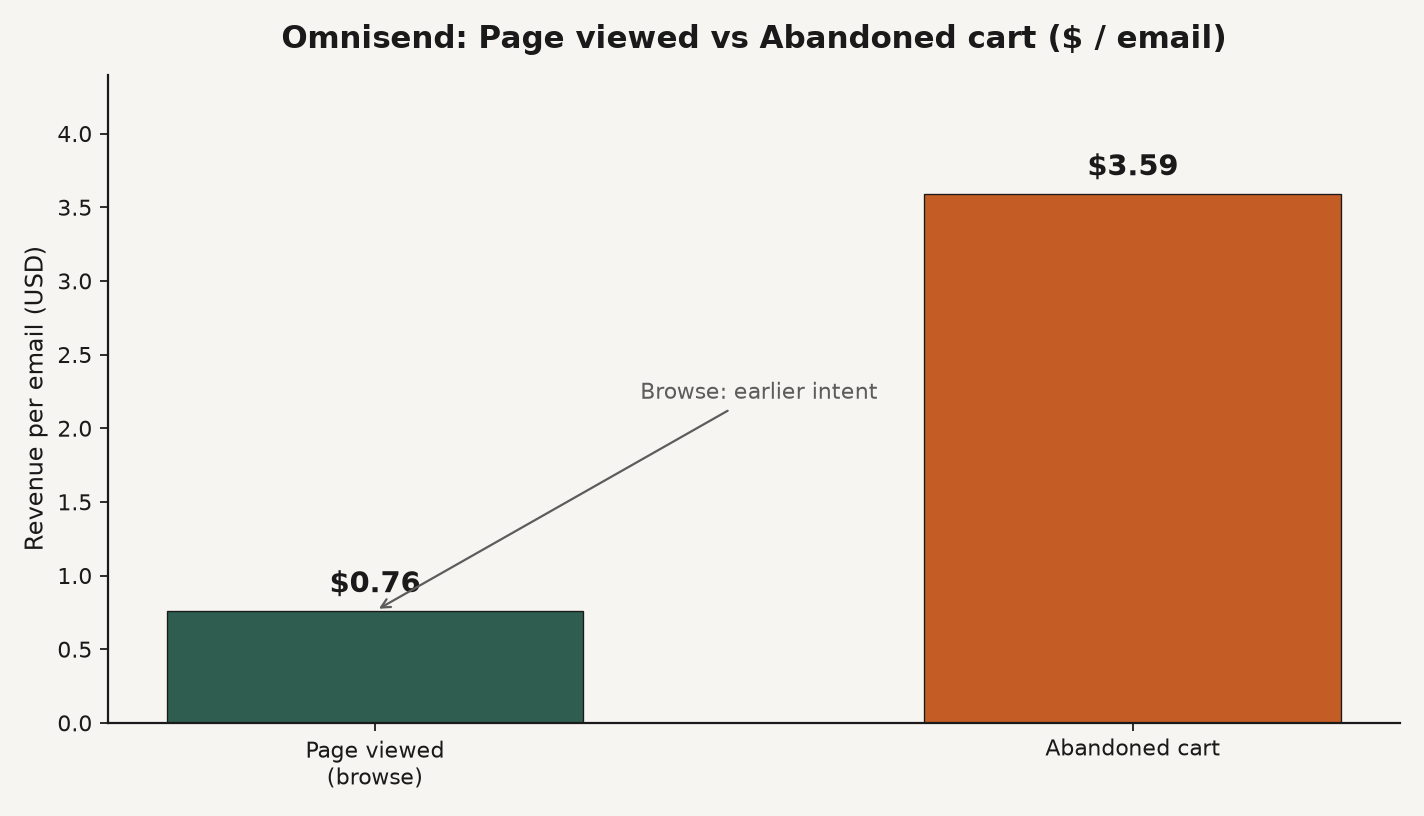
Source: Omnisend Email Marketing Benchmarks (2025 ecommerce automation data; article May/Sep 2026). https://www.omnisend.com/blog/email-marketing-benchmarks/
Browse abandonment email benchmarks work as an intent ladder: same-table Omnisend Page viewed versus Abandoned cart, plus a Klaviyo RPR ladder that puts browse dollars below cart and above campaigns. Match your ESP label first. Then manage browse on CTR and RPR, not cart conversion envy. Suppress anyone who adds to cart or starts checkout.
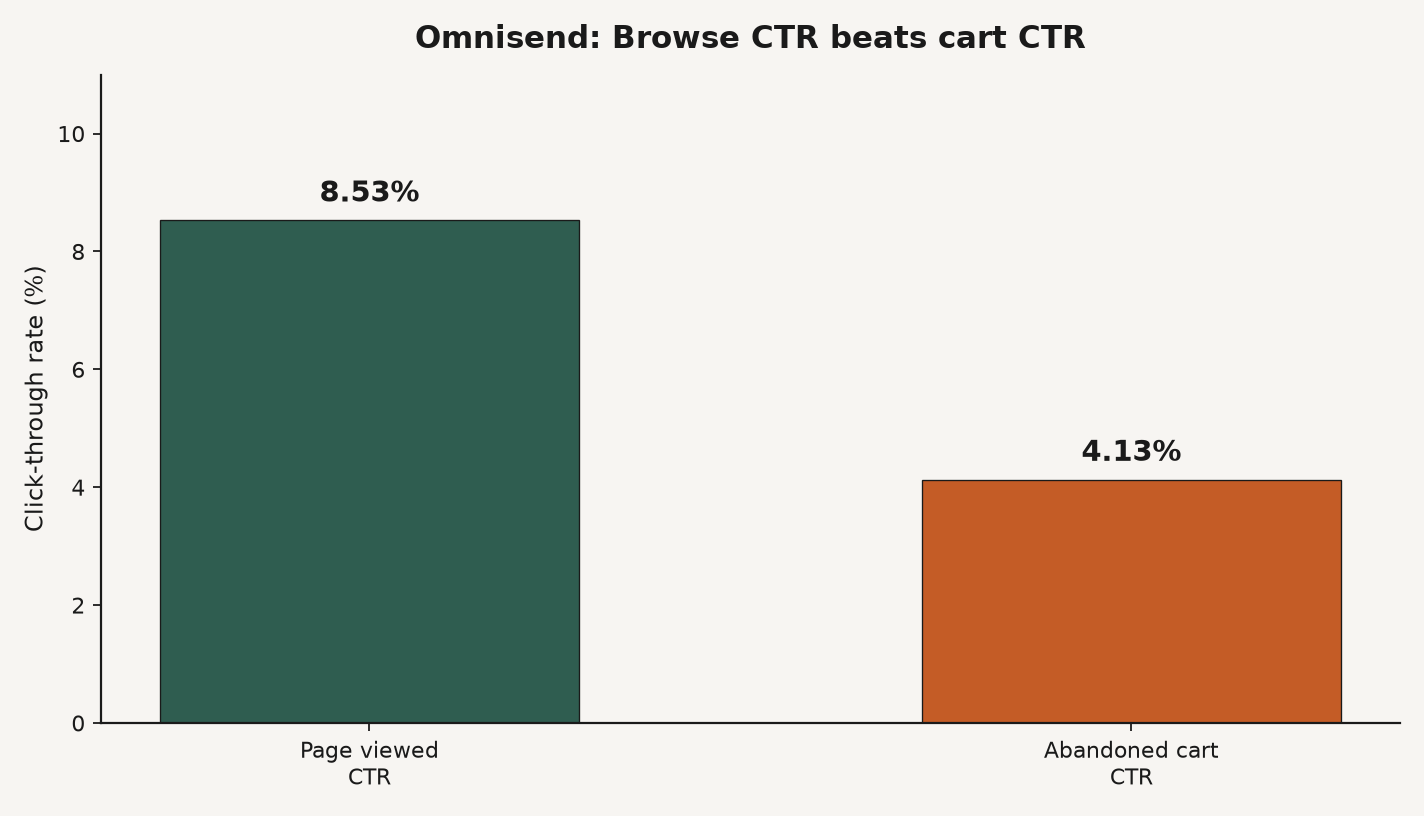
Source: Omnisend Email Marketing Benchmarks (2025). https://www.omnisend.com/blog/email-marketing-benchmarks/
| Automation | Open rate | CTR | CTOR | Conversion | $ per email | Unsubscribe |
|---|---|---|---|---|---|---|
| Page viewed (browse-style) | 44.47% | 8.53% | 18.59% | 0.59% | $0.76 | 0.51% |
| Abandoned cart | 37.12% | 4.13% | 11.12% | 1.72% | $3.59 | 0.45% |
| Welcome (sibling) | 35.53% | 3.94% | 11.19% | 2.11% | $6.16 | 0.87% |
| Campaign emails (baseline) | (see industry page) | 0.08% | $0.155 |
Source: Omnisend email marketing benchmarks (2025 ecommerce data).
Read the table left to right. Page viewed opens and clicks harder than cart. Cart and welcome convert and earn more. That is the intent ladder, not a quality judgment on your subject lines. If your browse CTR collapses below cart CTR in the same ESP, your trigger timing or product-feed personalization is the suspect, not “browse is dead.”
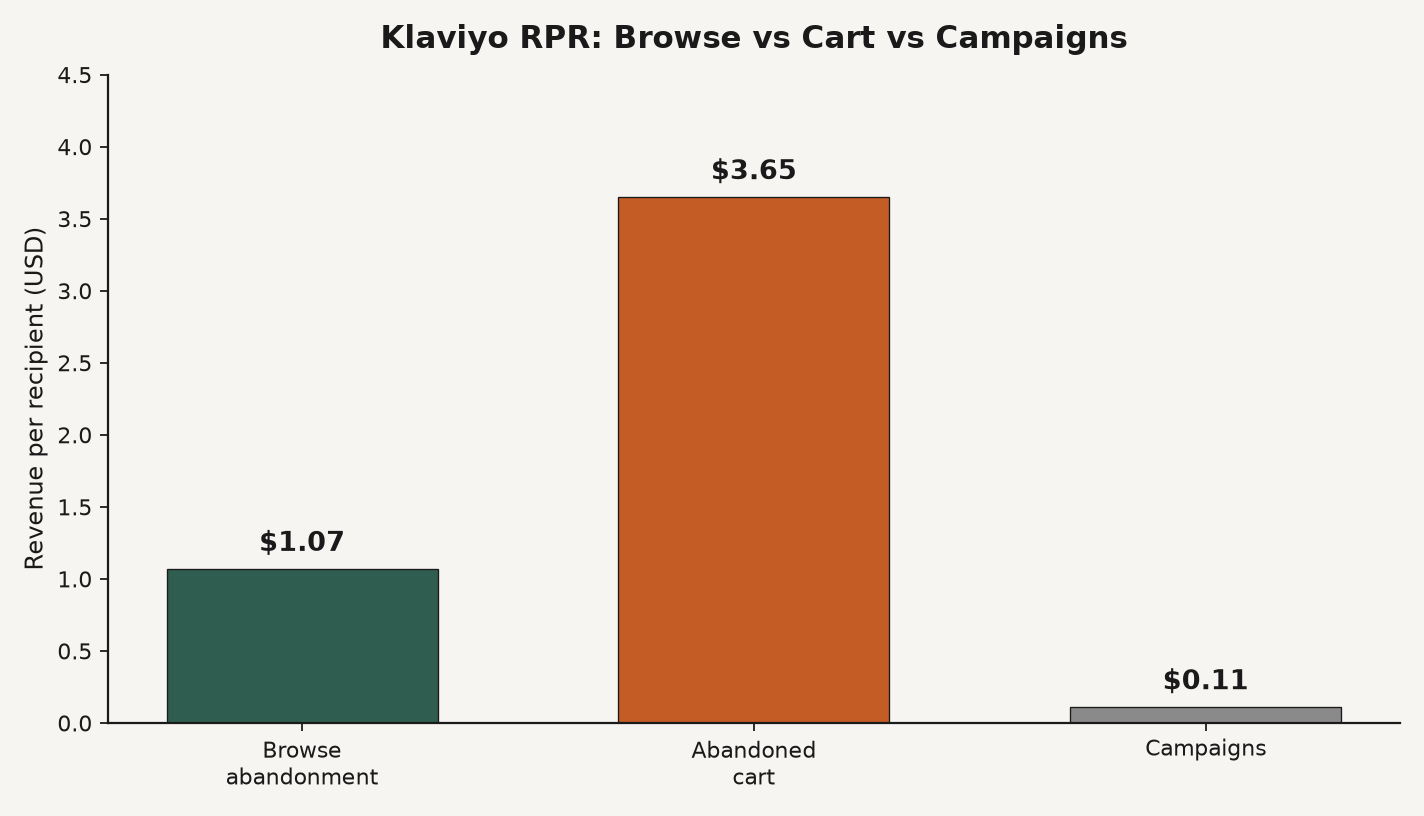
Source: Klaviyo, What is revenue per recipient? (Dec 12, 2024). https://www.klaviyo.com/blog/revenue-per-recipient
| Flow / send type | Average RPR | Top 10% RPR |
|---|---|---|
| Browse abandonment | $1.07 | $7.21 |
| Abandoned cart | $3.65 | $28.89 |
| Welcome | $2.65 | (see RPR article) |
| All flows (avg) | $1.94 | |
| Campaigns | $0.11 |
Source: Klaviyo RPR. Cart placed-order detail also sits on abandoned cart benchmarks (avg 3.33% / top 7.69%).
Do not convert Omnisend’s $ per email into Klaviyo’s RPR without a methodology note. One is revenue divided by emails sent in that automation type. The other is revenue per recipient in the flow. Both say browse pays less than cart and more than a random blast. Neither licenses inventing a feat. proprietary “browse ROI.”
Klaviyo’s June 2022 browse guide reported browse conversion near 0.96% versus campaign 0.10% (about 9.6x), and noted browse often earns higher opens than cart (Klaviyo). A Klaviyo small-business page cites browse abandonment near 0.82% average placed-order rate (more than 10x average campaign) (Klaviyo). Omnisend’s 2025 Page viewed conversion is 0.59%. Refuse any chart that averages 0.96%, 0.82%, and 0.59% into one fake “industry browse conversion.” Keep the year and the ESP on the number.
Threads on r/Klaviyo and r/ShopifyeCommerce repeat the same operating rule: keep browse and cart as separate flows, and exit browse when someone adds to cart or starts checkout. That is not a public census of recovery lift. It is the vernacular that stops you from stacking three reminders on one session. Pair it with your ESP’s “has not started checkout” and “is not in cart flow” conditions before you celebrate a browse open rate.
There is no public dataset that publishes one official browse open-rate band for every ESP and every page-viewed definition. Secondary posts that invent 35%-45% open targets or mash Omnisend’s 0.59% with Klaviyo’s 2022 0.96% into one median stay out of the charts. feat. does not publish a proprietary browse conversion census here.
Using browse abandonment email benchmarks means treating browse as an earlier intent job than cart, funding it on labeled CTR and RPR, and wiring filters so cart always supersedes browse. Copy your cart discount ladder into browse only if you want to teach shoppers to wait for a coupon on every view.
These answers restate the Omnisend Page viewed versus Abandoned cart ladder, the Klaviyo browse RPR gap, and the filter rule so a founder can quote a labeled number without inventing one fake national browse open rate target across every ESP.
Q: What are good browse abandonment email benchmarks in 2026? A: Use labeled samples. Omnisend’s Page viewed automation shows 44.47% open, 8.53% CTR, 0.59% conversion, and $0.76 per email. Klaviyo puts browse abandonment RPR at $1.07 average (top 10% $7.21). Compare those to cart siblings ($3.59 Omnisend / $3.65 Klaviyo RPR), not to a mashup open band.
Q: How do browse abandonment emails compare to abandoned cart emails? A: Browse is earlier intent. In Omnisend’s table, Page viewed wins on CTR (8.53% vs 4.13%) while Abandoned cart wins on conversion (1.72% vs 0.59%) and dollars ($3.59 vs $0.76). Klaviyo’s RPR table shows the same dollar gap: browse $1.07 versus cart $3.65.
Q: What is a good browse abandonment email open rate? A: Omnisend’s Page viewed cell sits near 44.47% open. Klaviyo’s older browse guide noted browse often earns higher opens than cart, but opens are directional under Apple Mail Privacy Protection. Prefer CTR and RPR when open samples conflict across ESPs.
Q: Should browse and cart flows share the same discount? A: Usually no. Copying cart urgency and deep discounts into browse trains shoppers to wait for a coupon on every product view. Keep browse on reminder, social proof, and product education unless your own cohort data proves a light offer pays without cannibalizing cart.
Q: When should I suppress browse abandonment emails? A: Suppress when the profile adds to cart, starts checkout, places an order, or is already inside a cart or checkout recovery flow. Operator threads on r/Klaviyo treat those exits as required so high-intent buyers are not over-messaged.
Browse abandonment email benchmarks are an intent problem before they are a creative problem. Keep Omnisend’s Page viewed $0.76 and 8.53% CTR separate from cart $3.59 and 1.72% conversion, and keep Klaviyo browse RPR $1.07 below cart $3.65.
Separate the flows, suppress overlaps, and stop discounting curiosity like checkout. List the product on feat. if affiliates should sell the same catalog your browse flow is trying to recover.
Preference center best practices: CAN-SPAM menu plus stop-all, Google one-click vs body preference pages, and SendGrid's labeled 20% unsub drop.
Mailchimp vs Klaviyo: contact billing fork, send multipliers (10x/12x/15x), starting prices, and when ecommerce depth beats a general ESP.
Email list growth benchmarks: Omnisend 1.24B popup displays at 2.1%, form-type ladder, and levers that beat the average without inventing MoM %s.