Email Preference Center Best Practices
Preference center best practices: CAN-SPAM menu plus stop-all, Google one-click vs body preference pages, and SendGrid's labeled 20% unsub drop.
Birthday email benchmarks: Omnisend AOV $744.37 (4x+ avg), 0.22% unsubscribe, and why coverage beats open-rate vanity.

TL;DR: Birthday email benchmarks are an average-order-value and coverage scorecard. Omnisend’s 2026 report puts birthday AOV at $744.37, more than 4x the average. Birthday also posts the lowest automation unsubscribe rate at 0.22%. Without a birthdate on file, none of that matters. Refuse fake $3.22 RPR mashups.
Founders ask for a “good birthday open rate” and skip the only question that matters: what share of the list has a usable birthdate? A 45% open on a 3% coverage segment is a party hat, not a growth program. Score the wrong metric and you will either never build the flow or celebrate vanity while cart and welcome still do the real work.
The full cluster map lives in the email marketing guide.
Birthday email benchmarks are planning numbers for automations sent on or around a subscriber’s birthday. Welcome intent lives in welcome email benchmarks. Broader campaign-versus-flow ladders live in email marketing benchmarks by industry. Retention siblings live in post-purchase email benchmarks and winback email benchmarks.
Birthday email benchmarks are labeled performance ranges for automated messages sent on or around a subscriber’s birthday, usually reported as open rate, click-to-conversion, unsubscribe rate, and average order value from a named ESP sample that also admits when a $/email cell is missing.
They are not a weaker welcome email. Welcome fires when someone opts in. Birthday fires once a year when a stored date matches. Omnisend defines birthday emails as occasion messages that combine a greeting with an incentive and a clear redeem path (Omnisend). The scorecard that makes the flow worth the data work is order value and coverage, not whether opens beat a campaign average after Mail Privacy Protection.
If you lack birthdates, this page is a collection project first. If you already have dates and a thin offer, it is a creative and margin project second.
Birthday email benchmarks matter because a once-a-year, named message can move unusually large baskets when the offer is real, while collecting the date badly can shrink the list that funds every other flow. Treat them as a coverage-and-AOV scorecard first, then as an open-rate vanity check.
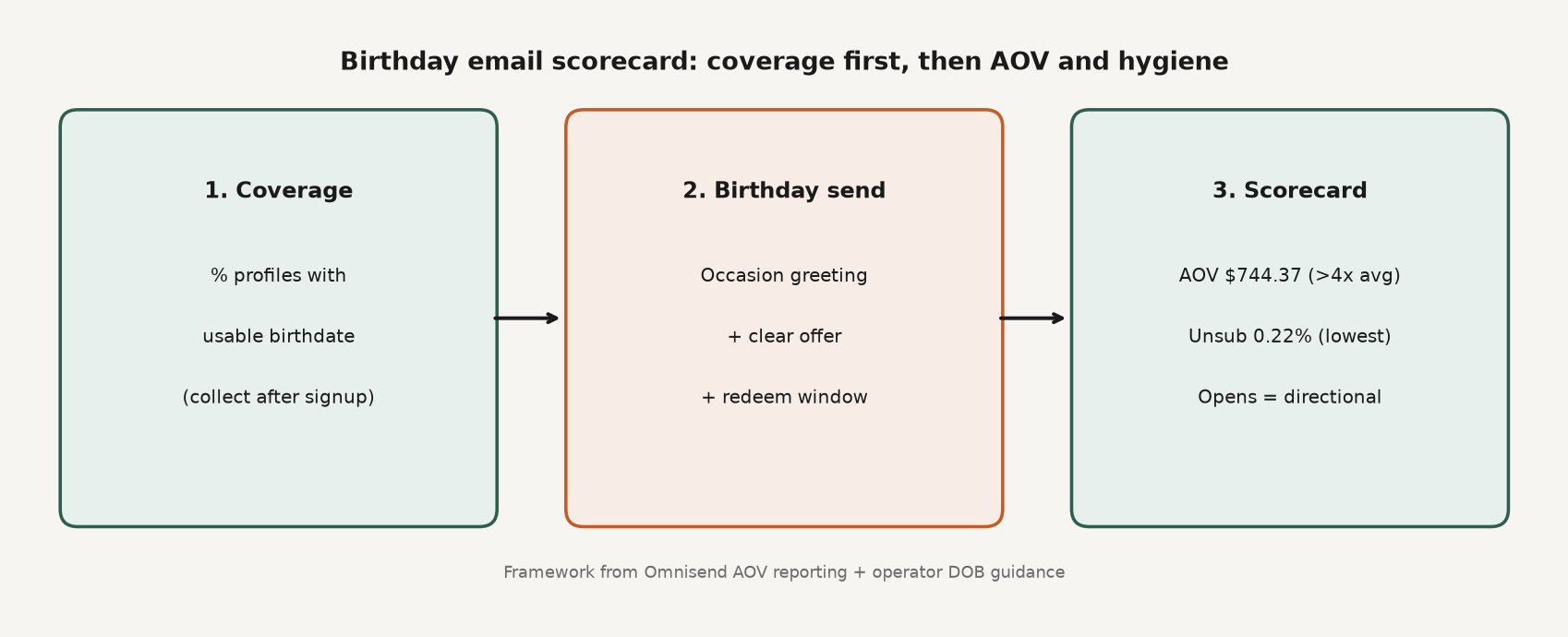
Source: Editorial framework synthesizing Omnisend birthday AOV reporting with operator DOB-collection guidance. https://www.omnisend.com/resources/reports/2026-ecommerce-marketing-report/ · https://www.reddit.com/r/Klaviyo/comments/1kdsqum/happy_birthday_flow_any_tips_for_capturing_date/
Birthday email benchmarks work when you separate three layers: engagement (opens and click-to-conversion), hygiene (unsubscribes), and commercial outcome (AOV), then multiply everything by birthdate coverage. Missing any layer turns the flow into folklore. The sections below walk each layer with Omnisend’s labeled figures and the gaps that stay unlabeled.
| Metric | What it answers | Published Omnisend figure | Notes |
|---|---|---|---|
| Birthday AOV | How large are converting birthday orders? | $744.37, more than 4x average | 2026 report / 2025 data |
| Unsubscribe rate | Does the occasion feel spammy? | 0.22% (lowest automation row) | Benchmarks automation table |
| Open rate | Did the subject get attention? | 43.3% (statistics page); tips ~45% | Opens are MPP-aware |
| Click-to-conversion | Of clickers, who bought? | 14.3% | Statistics page |
| Conversion (tips article) | Older editorial conversion | 0.72% vs campaign 0.07% | July 2024 tips |
| $/email on main automation table | Revenue per birthday send | no public dataset in that table | Do not invent a cell |
Automations overall still matter as context: Omnisend’s 2026 report puts automations at 2% of sends and 30% of email-driven revenue, at $2.87 per automated send versus $0.18 for campaigns (Omnisend). Birthday rides that automation advantage only for profiles with dates.
The unique commercial read is basket size. Omnisend could have led with birthday open rate in the 2026 report. It led with $744.37 AOV and the 4x comparison instead (Omnisend). Plan offers that protect margin at gift baskets: percent off with floors, free shipping add-ons, or product gifts that do not train permanent discounting. Cheap $3 “gifts” get roasted in public, which Omnisend’s own tips page documents with a Redbox-style failure story (Omnisend).
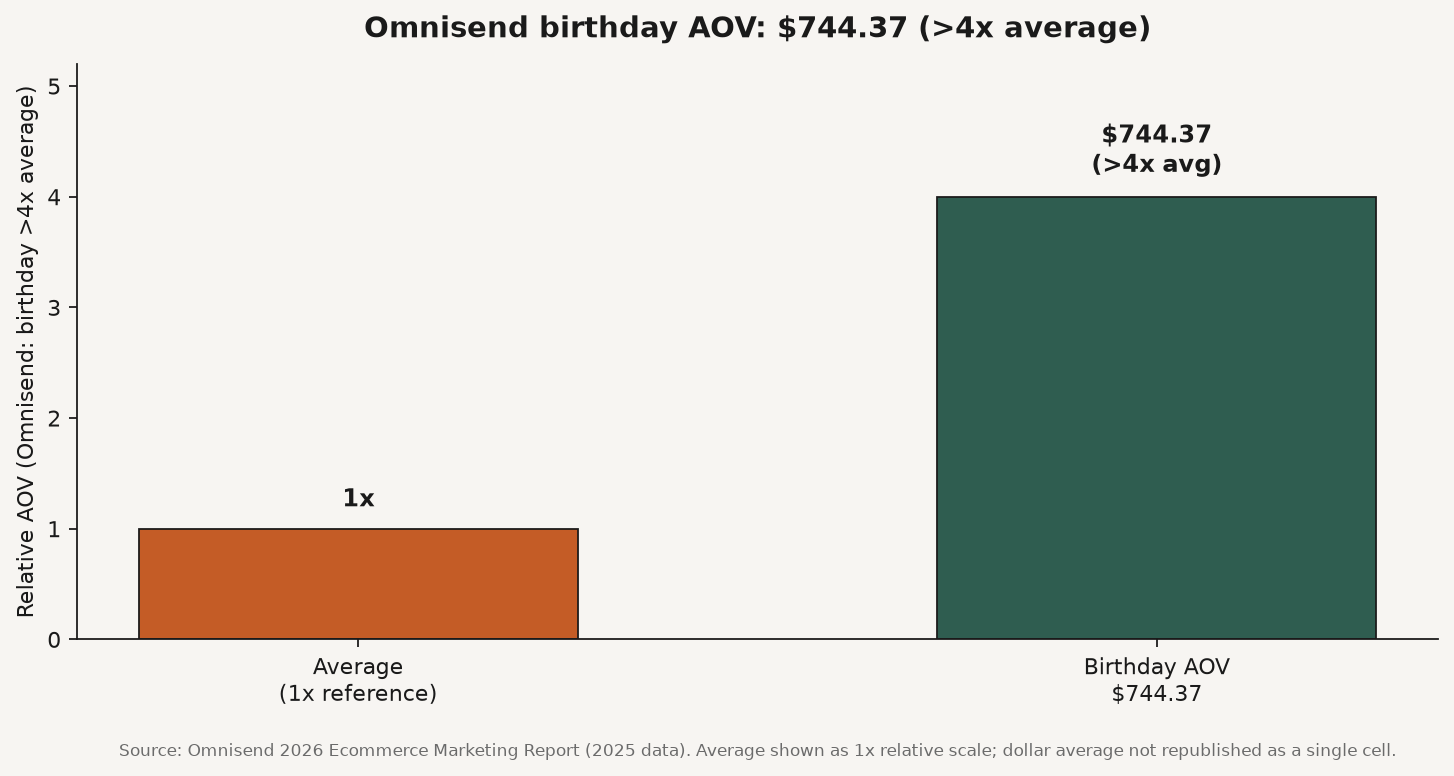
Source: Omnisend 2026 Ecommerce Marketing Report (2025 data). https://www.omnisend.com/resources/reports/2026-ecommerce-marketing-report/
Birthday’s 0.22% unsubscribe rate is the hygiene win. Cross-sell (0.89%) and Welcome (0.87%) sit much higher. Abandoned cart is 0.45%. Customer reactivation is 0.68% (Omnisend). That pattern fits a named, once-a-year message. It does not license daily “birthday week” spam.
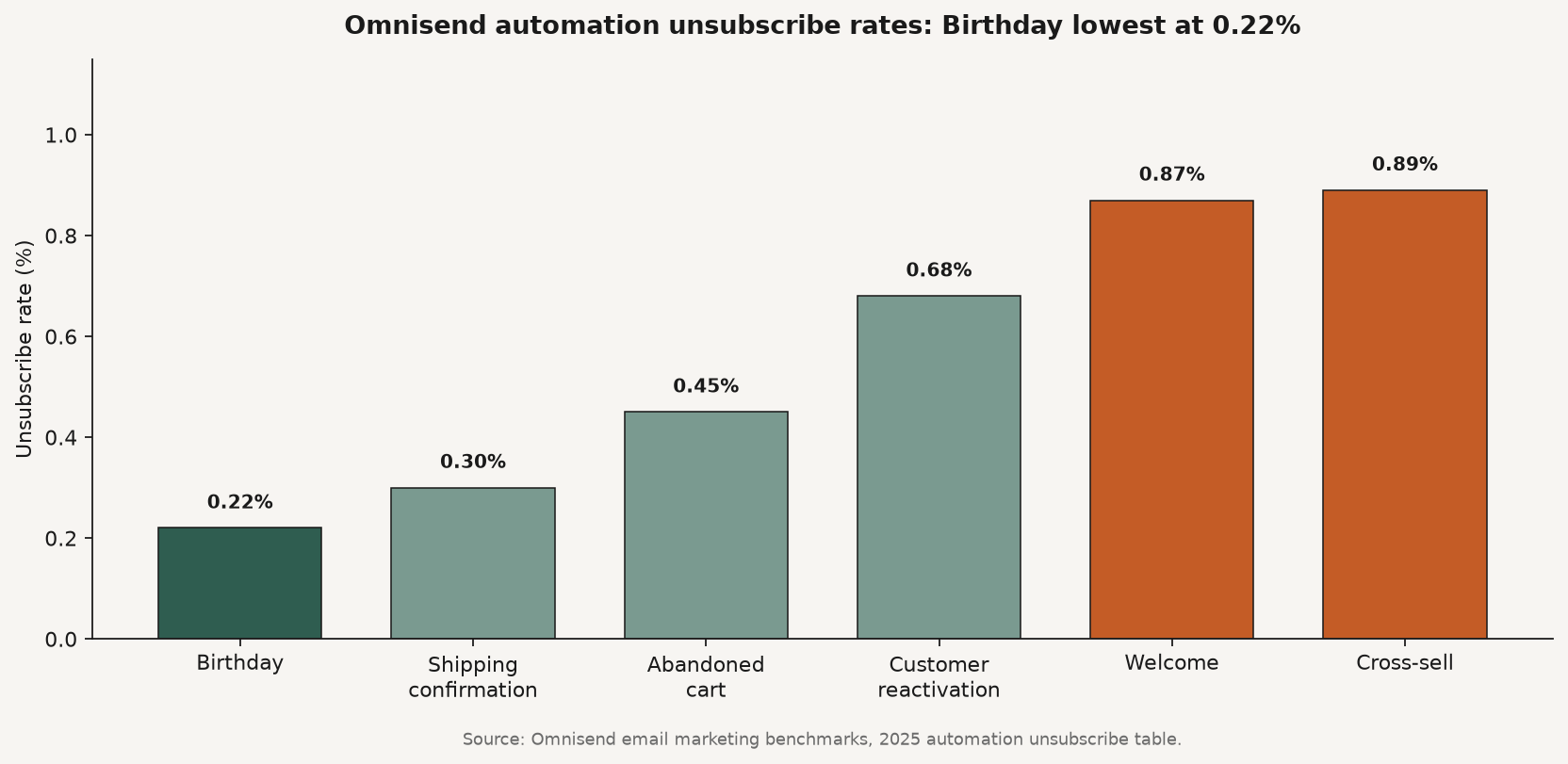
Source: Omnisend email marketing benchmarks, 2025 automation unsubscribe table. https://www.omnisend.com/blog/email-marketing-benchmarks/
Omnisend’s detailed automation table publishes dollars for Welcome ($6.16), Abandoned cart ($3.59), Order follow-up ($1.75), Cross-sell ($0.95), and Customer reactivation ($0.51), among others. Birthday appears in the unsubscribe list and in the 2026 AOV callout, not as a $/email row on that table. Say what is known. Do not invent a birthday RPR by averaging cart and welcome. Agency posts that invent $3.22 RPR as a Klaviyo 2025 census without a primary table are refused.
Prefer click-to-conversion, AOV, redemption rate, and unsubscribes. Apple Mail Privacy Protection can inflate opens (email marketing benchmarks by industry; how iOS privacy changes affected performance marketing).
There is no public dataset for a birthday $/email cell on Omnisend’s main automation performance table, and no public dataset for a verified Klaviyo all-account birthday RPR/placed-order census matching the fake $3.22 tables circulating in 2026 listicles. feat. does not invent birthday coverage percentages or proprietary AOV here.
Using birthday email benchmarks means treating birthdate coverage as KPI number one, offer quality as KPI number two, and open rate as a directional check. Build the flow after welcome and cart are live. Score AOV and unsubscribes against Omnisend’s labeled figures.
These answers restate Omnisend’s birthday AOV headline, the lowest unsubscribe row, the missing $/email cell, and the coverage bottleneck so a founder can quote labeled figures without inventing a national birthday RPR. Use them as short, liftable answers next to the longer sections above.
Q: What are good birthday email benchmarks in 2026? A: Use Omnisend’s labeled commercial figures: birthday AOV $744.37 (more than 4x average in the 2026 report) and 0.22% unsubscribe. Engagement figures near 43.3% open and 14.3% click-to-conversion are secondary. There is no Omnisend $/email birthday cell on the main automation table.
Q: What is a good birthday email open rate? A: Omnisend publishes birthday opens near 43.3% on its statistics page and about 45% in a July 2024 tips article. After Apple Mail Privacy Protection, prefer click-to-conversion, AOV, and redemption. Do not average birthday opens with welcome or cart into one fake target.
Q: Why is birthday email AOV so high? A: Omnisend reports birthday AOV at $744.37, more than 4x average, which fits gift and self-gift baskets on a personal date. Your AOV will follow your catalog and offer. The benchmark is a planning ceiling signal, not a guarantee.
Q: Should I add date of birth to my main signup form? A: Usually no. r/Klaviyo operators report that DOB fields add friction and hurt opt-in rates. Collect birthdays after subscribe through preferences, a second popup step, post-purchase, or a dedicated incentive campaign.
Q: Is there a standard birthday email revenue per recipient? A: Not in the primary Omnisend automation $/email table, and not as a verified Klaviyo all-account census in the sources used here. Refuse listicles that invent $3.22 RPR as “Klaviyo 2025” without a primary report. Track your own RPR once coverage exists.
Birthday email benchmarks reward the brands that treat the date field as inventory. Omnisend’s $744.37 AOV and 0.22% unsubscribe rate are the labeled commercial story. Opens are optional theater. Coverage is the real denominator. Build the flow after welcome and cart, then grow the date file before you chase open-rate vanity.
If affiliates should sell the products those birthday buyers gift themselves, browse the feat. marketplace for co-branded storefront inventory.
Preference center best practices: CAN-SPAM menu plus stop-all, Google one-click vs body preference pages, and SendGrid's labeled 20% unsub drop.
Mailchimp vs Klaviyo: contact billing fork, send multipliers (10x/12x/15x), starting prices, and when ecommerce depth beats a general ESP.
Email list growth benchmarks: Omnisend 1.24B popup displays at 2.1%, form-type ladder, and levers that beat the average without inventing MoM %s.