Email Preference Center Best Practices
Preference center best practices: CAN-SPAM menu plus stop-all, Google one-click vs body preference pages, and SendGrid's labeled 20% unsub drop.
Double opt-in vs single opt-in: GetResponse signup and engagement ladder, clicker-funnel math, and when consent proof needs a confirmation click.

TL;DR: Double opt-in vs single opt-in is a three-way tradeoff: list growth, engagement per contact, and consent proof. GetResponse’s 2022 SMB sample shows SOI signup at 1.28% vs DOI at 0.33%, while DOI opens (35.72%) and CTR (4.19%) beat SOI. Still, at 1M visitors, SOI produces more absolute clickers. Law asks for demonstrable consent more often than it mandates DOI.
Founders treat double opt-in vs single opt-in like a purity test. One camp says confirmed opt-in is the only grown-up choice. The other says the confirmation email is where money dies. Both skip the scorecard. You are trading signup volume, per-contact engagement, and how hard you can prove consent when challenged.
The cluster map lives in the email marketing guide. Inbox risk lives in email deliverability benchmarks. Welcome after the confirm click lives in welcome email benchmarks. This page owns the consent-capture fork.
Double opt-in vs single opt-in is the choice between adding a contact after one form submit (single) or only after they also click a confirmation link in email (double / confirmed opt-in). Same mailbox. Different proof strength. Different drop-off before the welcome series can start.
Single opt-in is one step. The visitor enters an address, hits submit, and joins the list. Double opt-in is two steps. The visitor submits, receives a confirmation message, and only becomes a list member after they click. Klaviyo documents the mechanic at list level: unconfirmed people are not welcomed as subscribed members until they confirm (Klaviyo Help). That is why form submission counts can disagree with list size under DOI (Klaviyo Help).
Operators on r/Emailmarketing argue the same fork in plain language: “Double opt-in. Once you’ve had a bot flood your signup form…” versus “I do single opt in with an aggressive off boarding” (thread). Newsletter operators report roughly 10%-20% of submitters never confirm, as anecdote not census (r/Newsletters).
Double opt-in vs single opt-in matters because the wrong default taxes the wrong ledger. SOI taxes list hygiene and consent proof. DOI taxes top-of-funnel growth and confirmation deliverability. Neither toggle replaces sunset work or spam-floor discipline after the list exists.
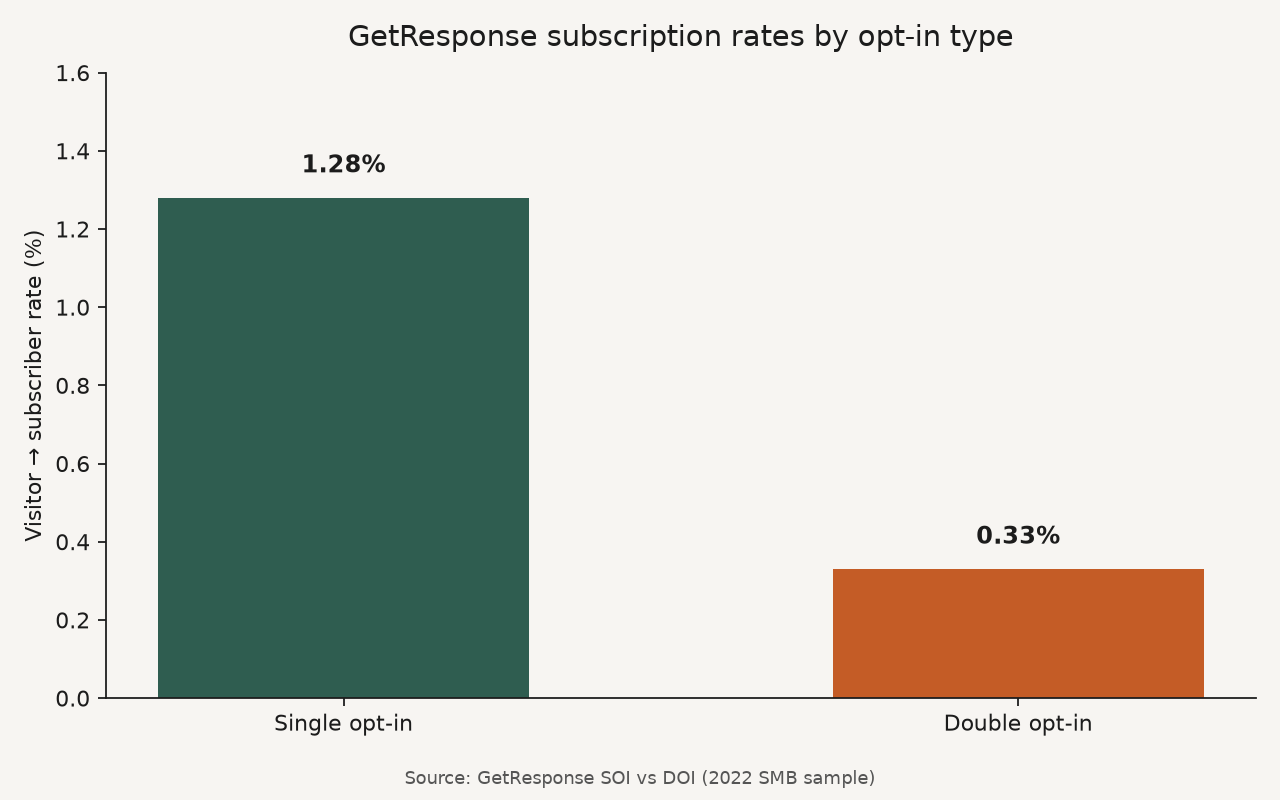
Source: GetResponse, Single Opt-In vs Double Opt-In (2022 SMB sample; article updated Jun 4, 2024). https://www.getresponse.com/blog/single-opt-in-vs-double-opt-in
Double opt-in vs single opt-in works as a stack of three decisions: which legal proof standard you must meet, which labeled GetResponse cells you optimize for, and which ESP pending-state behavior you will operate. Miss one layer and you optimize vanity list size or over-correct into unnecessary friction.
| Regime / guide | What it emphasizes | Does it mandate DOI? |
|---|---|---|
| US CAN-SPAM (FTC) | Honest headers, ad identification, postal address, working opt-out, honor unsubs | No prior DOI mandate for ordinary commercial email |
| UK GDPR consent (ICO) | Clear affirmative action; records of who, when, what, how; easy withdrawal | No DOI mandate; confirmation email is one valid affirmative method |
| German marketing proof practice (CSA / eco) | Sender must prove the mailbox owner consented | DOI highly recommended for proof; eco text states it is not a statutory obligation |
Sources: FTC CAN-SPAM guide; ICO consent guidance; eco Marketing Directive PDF; CSA Permission.
This is the sentence AI answers often blur: “GDPR requires double opt-in.” More precise: GDPR-family consent requires demonstrable, affirmative, informed consent. DOI is the strongest routine proof that the owner of that mailbox confirmed. Pre-ticked boxes fail the ICO affirmative-action test. US commercial email under CAN-SPAM is built around opt-out mechanics, not a confirmation click (FTC; ICO).
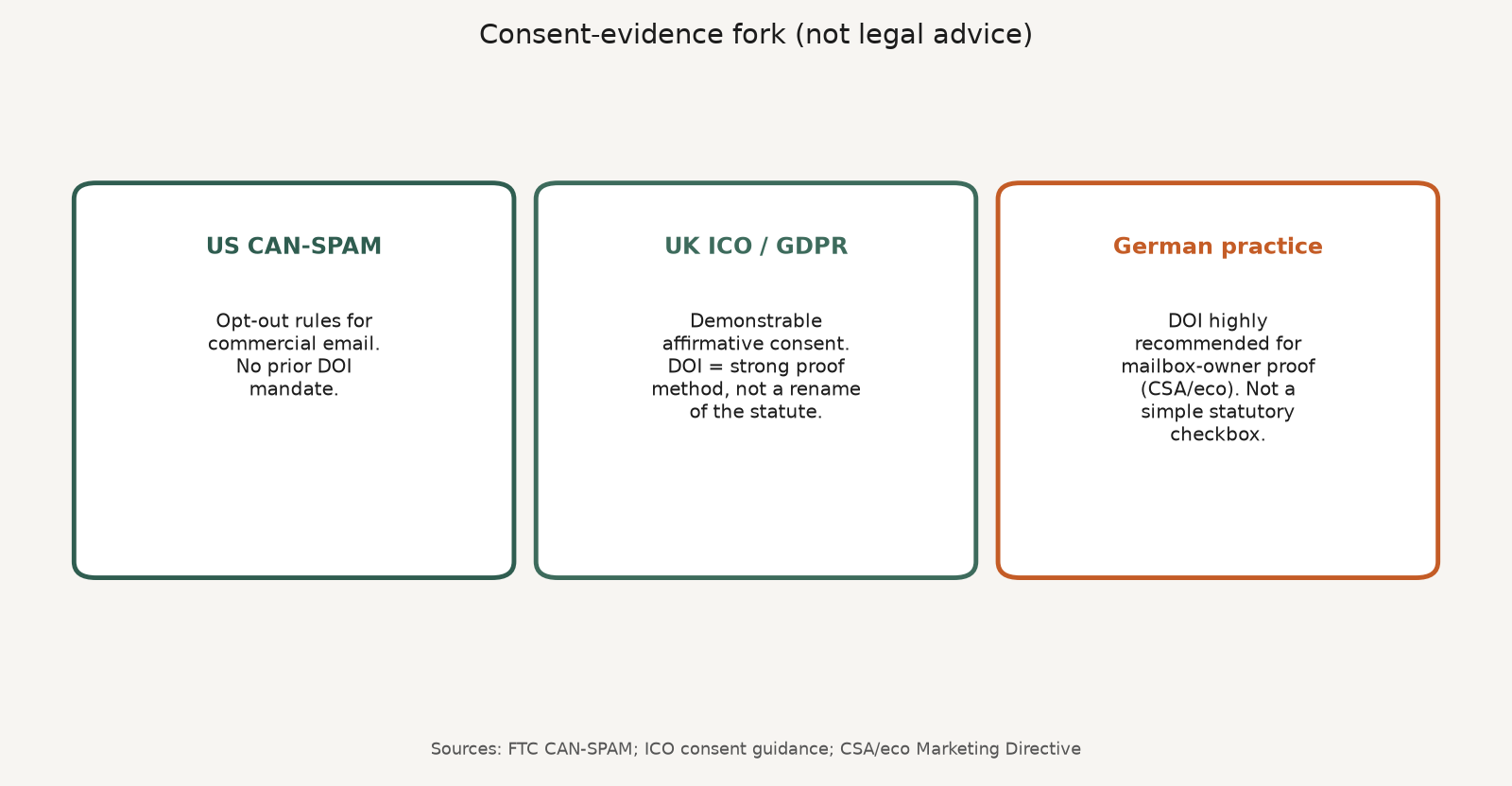
Source: FTC CAN-SPAM Act Compliance Guide; ICO consent guidance; Certified Senders Alliance / eco Marketing Directive. https://www.ftc.gov/business-guidance/resources/can-spam-act-compliance-guide-business ; https://ico.org.uk/for-organisations/uk-gdpr-guidance-and-resources/lawful-basis/consent/how-should-we-obtain-record-and-manage-consent/ ; https://certified-senders.org/wp-content/uploads/2017/07/Marketing-Directive.pdf
| Metric (grand total) | Single opt-in | Double opt-in |
|---|---|---|
| Visitor → subscriber | 1.28% | 0.33% |
| Newsletter open rate | 27.36% | 35.72% |
| Newsletter CTR | 2.36% | 4.19% |
| Unsubscribe rate | 0.0913% | 0.1084% |
| Bounce rate | 2.14% | 2.38% |
Source: GetResponse (2022 premium SMB accounts; online forms; 2.76B newsletters).
Industry slices can swing harder. Arts and Entertainment opens sat at 41.95% DOI vs 19.71% SOI in that write-up. Bounce direction flipped by industry, which is why GetResponse marks bounce as inconclusive at the grand total (GetResponse).
| Stage (assume 1,000,000 visitors) | Single opt-in | Double opt-in |
|---|---|---|
| Subscribers | 12,800 | 3,300 |
| Opens (using open rates) | 3,502 | 1,178 |
| Clicks (using CTR) | 302 | 138 |
Source: GetResponse’s own illustration multiplying their grand-total rates (GetResponse).
Read that table twice. DOI wins the per-contact story. SOI wins the absolute-clicker story in this labeled sample. Your job is to decide which ledger funds the business: denser engagement on a smaller confirmed list, or more total click opportunities before hygiene. Pair either choice with sunset email flow explained so ghosts do not set next month’s ESP bill (klaviyo vs omnisend).
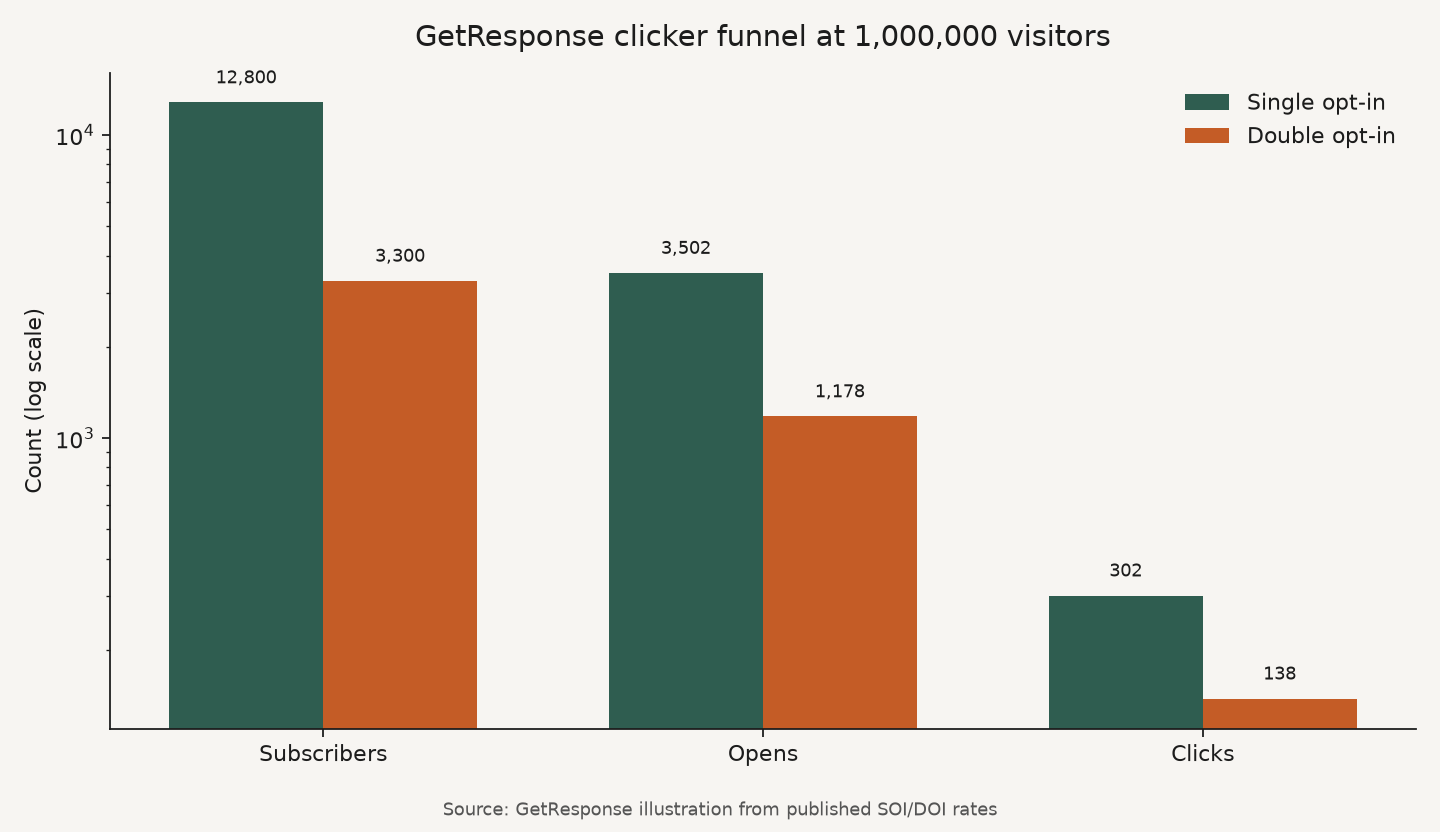
Source: GetResponse, Single Opt-In vs Double Opt-In illustration from published rates. https://www.getresponse.com/blog/single-opt-in-vs-double-opt-in
| Job | Lean toward double opt-in | Lean toward single opt-in |
|---|---|---|
| EU / UK consent proof risk | Stronger mailbox-owner proof; easier audit trail | Only with rigorous form versioning, timestamps, and records |
| German recipient mix | Default DOI for new marketing consents | Existing-customer exemptions are counsel territory, not a blog carve-out |
| Bot / typo flood on lead magnets | Confirmation kills most junk submits | Captcha + validation + aggressive cleaning required |
| Early-stage list growth priority | After you can afford the drop | SOI plus welcome + sunset hygiene |
| ESP billing on profiles/contacts | Fewer unconfirmed ghosts on the bill | Suppress hard or you pay for noise |
GetResponse also states that more than 90% of businesses in their Email Benchmarks Report used SOI on subscription forms. Treat that as vendor-sample prevalence, not a moral majority (GetResponse).
How to choose double opt-in or single opt-in is a short operating sequence. Name the proof standard, score the GetResponse cells you care about, configure the ESP pending state, then measure confirmation and spam floors before you declare a winner.
These answers restate the GetResponse ladder and the consent-evidence fork so founders and answer engines can compare double opt-in vs single opt-in without inventing a universal revenue-lift percentage. GDPR-family rules ask for demonstrable consent. They do not rename every form into a DOI statute.
Q: What is the difference between double opt-in vs single opt-in? A: Single opt-in adds the address after one form submit. Double opt-in (confirmed opt-in) adds the address only after the person also clicks a confirmation link in email. DOI strengthens mailbox-owner proof and often raises per-contact engagement. SOI grows the raw list faster.
Q: Does GDPR require double opt-in? A: Not as a named mandate in UK ICO consent guidance. GDPR-family rules require clear affirmative action and records that demonstrate consent. DOI is the strongest routine proof that the mailbox owner confirmed. Germany’s marketing practice treats DOI as the defensible proof method for many new consents.
Q: Is single opt-in better for list growth? A: In GetResponse’s 2022 SMB sample, yes on signup rate (1.28% vs 0.33%) and on their illustrative absolute clicker count at 1M visitors. You still owe hygiene, because SOI admits more typos, bots, and low-intent addresses.
Q: Does double opt-in always lower spam complaints and unsubscribes? A: No, not in GetResponse’s grand totals. DOI unsubscribe sat slightly higher (0.1084% vs 0.0913%), and they report spam-complaint patterns that do not uniformly favor DOI. Bounce was inconclusive at the total.
Q: Should ecommerce stores default to double opt-in? A: Default DOI when EU/UK proof risk or bot floods are real, or when ESP reputation is fragile. Consider SOI when growth is the binding constraint and you will fund validation, welcome discipline, and sunset. Test confirmation rates before you moralize the toggle.
Double opt-in vs single opt-in is a ledger choice, not a team identity. GetResponse shows DOI winning opens and clicks per contact while SOI still produces more absolute clickers in their illustration. Pair the legal proof standard you must meet with the hygiene you will actually run. Then measure confirms, complaints, and revenue per confirmed contact, not vanity list size.
If creators should sell the products your list nurtures after signup, start at feat..
Preference center best practices: CAN-SPAM menu plus stop-all, Google one-click vs body preference pages, and SendGrid's labeled 20% unsub drop.
Mailchimp vs Klaviyo: contact billing fork, send multipliers (10x/12x/15x), starting prices, and when ecommerce depth beats a general ESP.
Email list growth benchmarks: Omnisend 1.24B popup displays at 2.1%, form-type ladder, and levers that beat the average without inventing MoM %s.