Email Preference Center Best Practices
Preference center best practices: CAN-SPAM menu plus stop-all, Google one-click vs body preference pages, and SendGrid's labeled 20% unsub drop.
Newsletter ad CTR and CPC planning benchmarks: Paved's rebooked CPM ($6.53/$23.01) and CPC ($4.96/$18.36), plus why CPC beats opens after MPP.

TL;DR: Newsletter ad CTR and CPC planning benchmarks start with published efficiency rails, not vanity opens. On Paved’s March 2026 guide, rebooked newsletters average about $6.53 CPM (general) vs $23.01 (premium niche), and about $4.96 vs $18.36 CPC. Prefer estimated CPC over open-rate stories after Apple MPP. There is no official public median CTR for every newsletter.
A media kit that leads with “55% opens” is selling a metric Apple already broke for many iOS inboxes. Sponsors who only compare cost per thousand subscribers will overpay broad lists and underpay sharp niches. Publishers who only defend CPM will lose the rebooking conversation.
The full cluster map lives in the email marketing guide.
Newsletter ad CTR and CPC planning benchmarks are how both sides stress-test a flat fee before the send. Pair this planning spoke with newsletter sponsorship rates by subscriber count, dedicated email sponsorship pricing, how to build a newsletter media kit, Paved vs beehiiv ad network, and newsletter insertion order explained.
Newsletter ad CTR and CPC planning benchmarks are published efficiency rails that help advertisers and publishers evaluate a sponsorship fee using cost per thousand subscribers (CPM), cost per click (CPC), and click-through rate (CTR), instead of relying on open rates alone.
CPM answers “what does access to this list cost per thousand names?” CPC answers “what did each click actually cost?” CTR answers “what share of the delivered audience clicked?” Paved’s Ultimate Newsletter Sponsorship Guide frames sponsored email, dedicated email, and native CPC network ads as three formats with different jobs, then publishes rebooked CPM and CPC averages for planning (Paved).
This page is not a substitute for your own click history. It is the public floor for a negotiation that should end in your rate card and a written insertion order.
They matter because newsletter inventory is sold in dollars but bought in outcomes. A cheap broad CPM can be an expensive CPC. A pricey niche CPM can be efficient if clicks are dense. After MPP, open-rate theater hides that math.
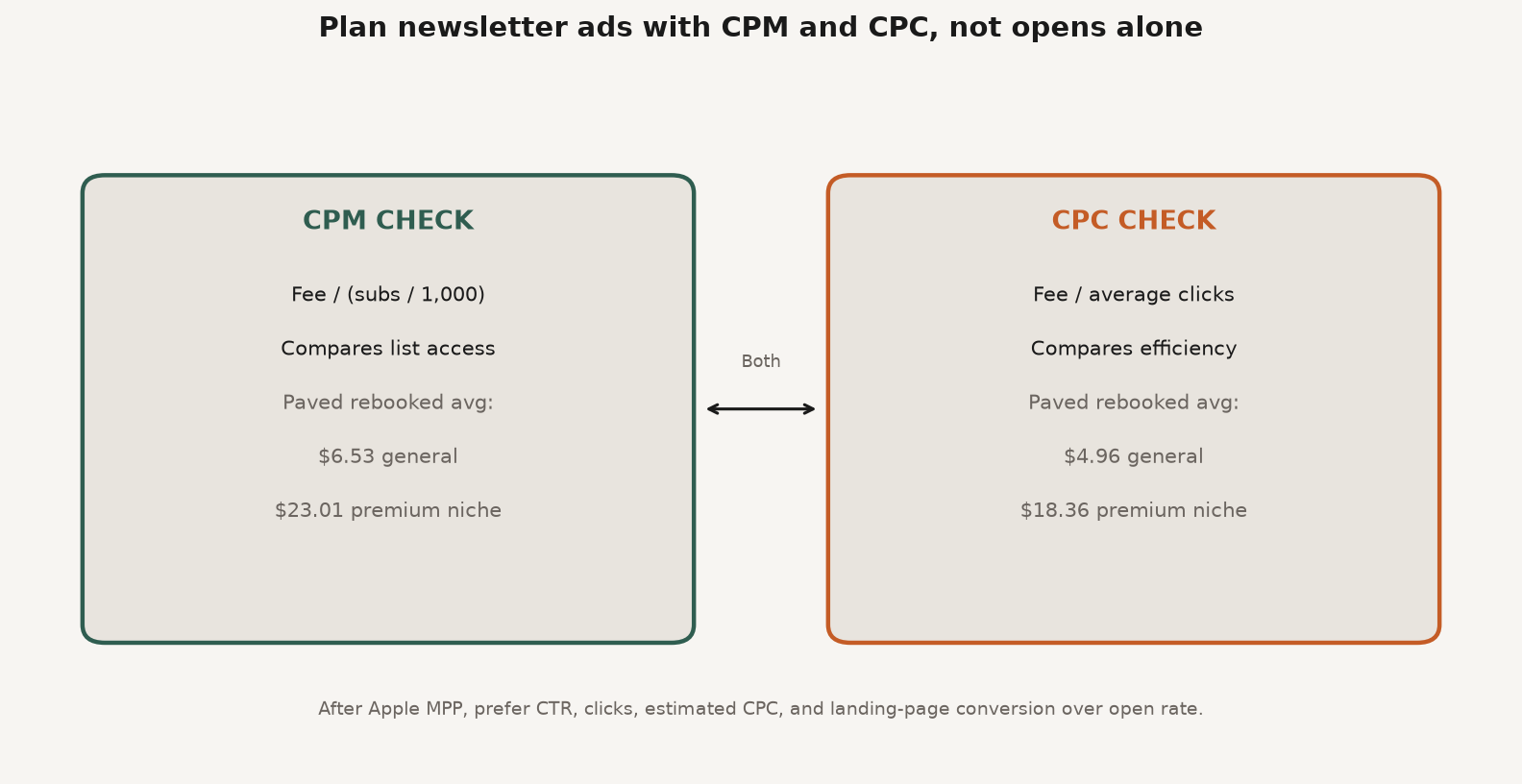
Source: Editorial framework. Method and metric priority from Paved Ultimate Newsletter Sponsorship Guide (Mar 9, 2026). https://www.paved.com/blog/the-ultimate-newsletter-sponsorship-guide/
They work as a two-step check. First, place the ask against published CPM bands for list access. Second, convert the fee into estimated CPC with real or promised average clicks, then decide if the niche premium is worth it. CTR is the bridge metric when you have both clicks and a clean delivery base.
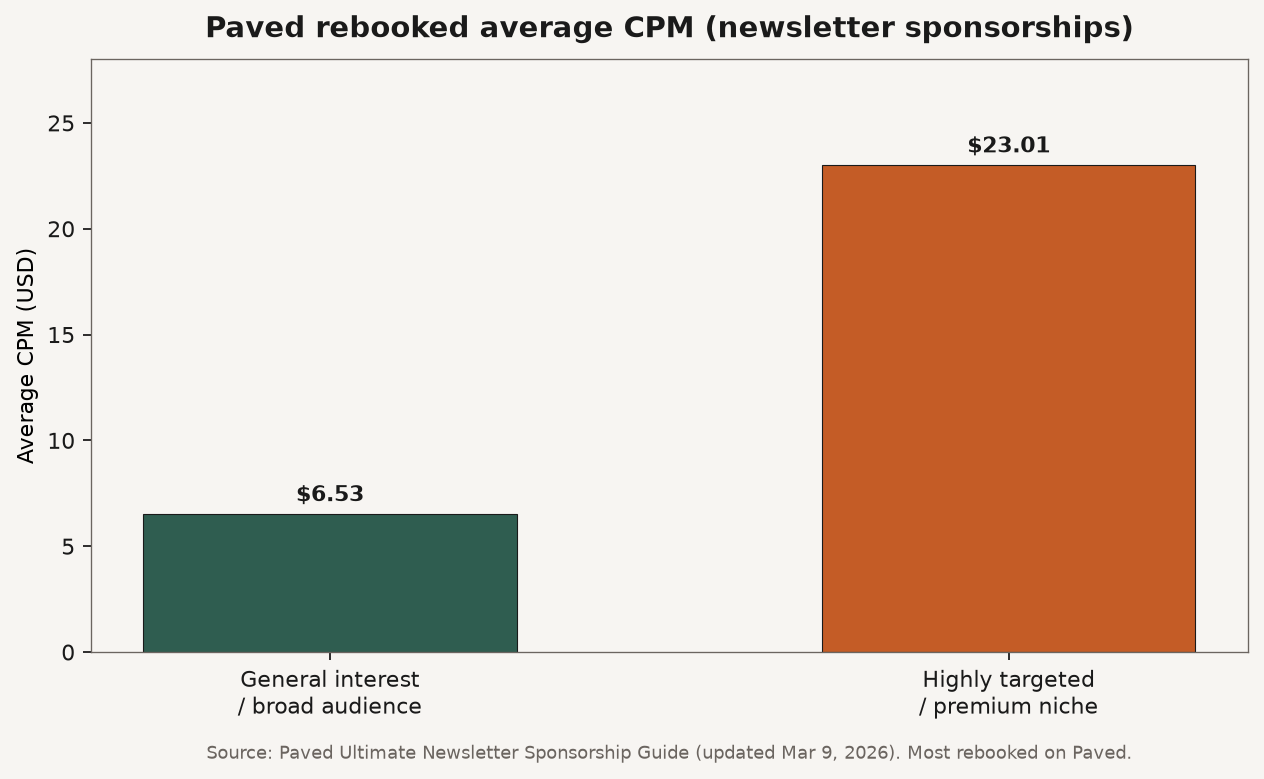
Source: Paved, The Ultimate Newsletter Sponsorship Guide, updated March 9, 2026. Average CPM for the most rebooked newsletters on Paved. https://www.paved.com/blog/the-ultimate-newsletter-sponsorship-guide/
| Newsletter type (Paved) | Average CPM | Average CPC | Planning use |
|---|---|---|---|
| General interest / broad audience | $6.53 | $4.96 | Floor check for wide lists |
| Highly targeted / premium niche | $23.01 | $18.36 | Ceiling check for scarce audiences |
| Method note | Cost per 1,000 subscribers (Paved framing) | Sponsorship cost ÷ average clicks | Rebooked titles on Paved, not every pub |
Source: Paved Ultimate Guide, March 9, 2026 update.
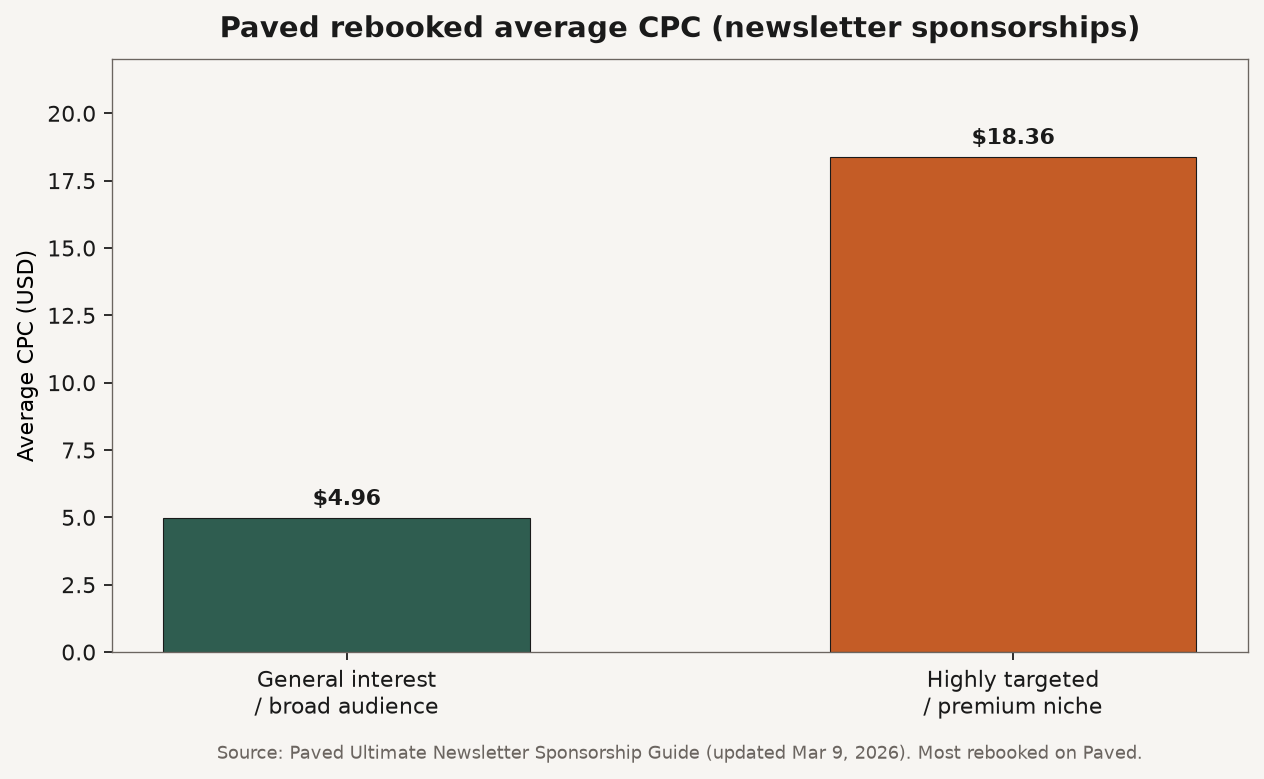
Source: Paved, The Ultimate Newsletter Sponsorship Guide, updated March 9, 2026. Average CPC for the most rebooked newsletters on Paved. https://www.paved.com/blog/the-ultimate-newsletter-sponsorship-guide/
Paved is blunt that a 10,000-subscriber list at 5% CTR can beat a 100,000-subscriber list at 0.5% CTR on clicks, often at a lower effective CPC (Paved). That is a worked comparison, not a promise for your niche.
Suppose a primary sponsorship costs $1,500 on a 50,000-subscriber general list. Subscriber CPM = $1,500 ÷ 50 = $30, which sits above Paved’s $6.53 general rebooked average and even above the $23.01 niche average (Paved). If the publisher’s recent average is 400 sponsorship clicks, estimated CPC = $1,500 ÷ 400 = $3.75, which sits under the $4.96 general rebooked CPC average. The CPM looks expensive. The CPC may still clear. If average clicks are only 50, CPC jumps to $30, and the niche CPC rail ($18.36) no longer saves you.
That math is why dedicated sends need their own click history. A dedicated fee can look sane on CPM and terrible on CPC if the creative or landing page fails.
Paved separates sponsored placements inside a regular issue, dedicated emails owned by the brand’s message, and native CPC network ads that buy clicks across many pubs (Paved). Direct deals should show historical sponsorship clicks in the media kit. Network CPC buys should be judged on realized CPC and brand safety, which is the other half of Paved vs beehiiv.
Do not paste secondary “CTR by category” tables that cite Paved without a matching primary Paved category CTR table in hand. This run cut those. Do not treat Litmus $36 or Paved’s channel ROI pitch ($36-$42) as your sponsorship break-even. Do not mix beehiiv’s opens-based CPM bands with Paved’s subscriber CPM averages without relabeling units (beehiiv; Paved).
Use the rails to accept, renegotiate, or walk. Publishers should show click history that makes CPC honest. Advertisers should refuse open-rate-only decks. Put the agreed fee, placement, and reporting basis in the insertion order before you hold the date.
Q: What are typical newsletter sponsorship CPC benchmarks? A: Paved’s March 2026 guide lists average CPC of about $4.96 for general interest / broad audience and $18.36 for highly targeted / premium niche among the most rebooked newsletters on Paved (Paved). Your niche can sit outside those averages.
Q: What are typical newsletter CPM benchmarks for ads? A: On the same Paved rebooked sample, average CPM is about $6.53 (general) and $23.01 (premium niche) (Paved). Confirm whether a publisher quotes subscriber CPM or opens-based CPM before you compare.
Q: Why is newsletter ad CTR hard to benchmark publicly? A: CTR needs a shared definition of the click and the denominator, plus enough placements to average. There is no public dataset for one official median newsletter-ad CTR across all publishers. Prefer a publisher’s own recent sponsorship click history over unsourced category tables.
Q: Should advertisers use CPM or CPC to evaluate newsletter ads? A: Use both. CPM compares list access. CPC compares efficiency. Paved recommends evaluating on CPC because clicks signal response better than subscriber count alone, especially when open rates are MPP-inflated (Paved).
Q: Does a $36 email ROI mean my newsletter sponsorship will return $36 per dollar? A: No. Litmus’s widely cited roughly $36 per $1 figure is about email marketing ROI for programs marketers run on lists they own (Litmus). Sponsorship CPC depends on offer fit, creative, and landing page. Model your own CPA from estimated CPC × conversion rate.
Newsletter ad CTR and CPC planning benchmarks exist so you stop arguing about inflated opens. Paved’s rebooked rails put general vs niche CPM near $6.53 vs $23.01 and CPC near $4.96 vs $18.36. Run that math on real clicks, then lock the fee in an insertion order.
There is still no official public median CTR for every newsletter. If you also want product distribution beyond inbox sponsorships, start at feat..
Preference center best practices: CAN-SPAM menu plus stop-all, Google one-click vs body preference pages, and SendGrid's labeled 20% unsub drop.
Mailchimp vs Klaviyo: contact billing fork, send multipliers (10x/12x/15x), starting prices, and when ecommerce depth beats a general ESP.
Email list growth benchmarks: Omnisend 1.24B popup displays at 2.1%, form-type ladder, and levers that beat the average without inventing MoM %s.