Email Preference Center Best Practices
Preference center best practices: CAN-SPAM menu plus stop-all, Google one-click vs body preference pages, and SendGrid's labeled 20% unsub drop.
Newsletter sponsorship rates by subscriber count: beehiiv size bands, flat vs CPM vs CPA, and why opens beat list size after Apple MPP.

TL;DR: Newsletter sponsorship rates by subscriber count are planning bands, not a price tag. beehiiv’s size bands put many small lists near $50-$250 flat, mid-lists near $500-$3,000, and 50K+ lists near $3,000-$20,000+. Pick flat, CPM, or CPA first. After Apple Mail Privacy Protection, do not treat opens as a hard meter.
Creators ask for one number: “What do I charge at 10,000 subscribers?” Buyers ask for the same number from the other side of the invoice. Both questions skip the model. Flat, CPM, and CPA are different products. List size only sets a starting band.
The full cluster map lives in the email marketing guide.
Newsletter sponsorship rates by subscriber count means size-based planning ranges for a primary email placement, plus the math that turns a CPM into a dollar quote. Pair this with email marketing benchmarks by industry, abandoned cart email benchmarks, digital product vs sponsorship revenue, how creators monetize a small audience under 10K, and influencer marketing rates by follower count.
Newsletter sponsorship rates by subscriber count means the dollar quote (or CPM-derived quote) a publisher asks for a sponsored placement, grouped by audience size bands. Subscriber count is an input to the quote. It is not the product the sponsor buys. The product is attention from a described audience on a specific placement.
That definition already kills two bad habits. First, copying a lifestyle list’s rate onto a CFO list. Second, treating a CPM built on raw subscribers as identical to a CPM built on unique opens. beehiiv’s public formula for the common publisher quote is sponsorship cost divided by subscribers, times 1,000 (beehiiv). Other operators price off opens. Name which denominator you used.
For engagement context (opens, clicks, flows), use email marketing benchmarks by industry. For whether sponsorship is even the right monetization job versus owned products, see digital product vs sponsorship revenue.
Size bands matter because they stop you from quoting $50 on a sold-out mid-list or $5,000 on a cold 800-person list. They lie when you ignore niche, placement, and measurement. A sponsor buying pipeline will not pay impression math the same way a brand buying awareness will.
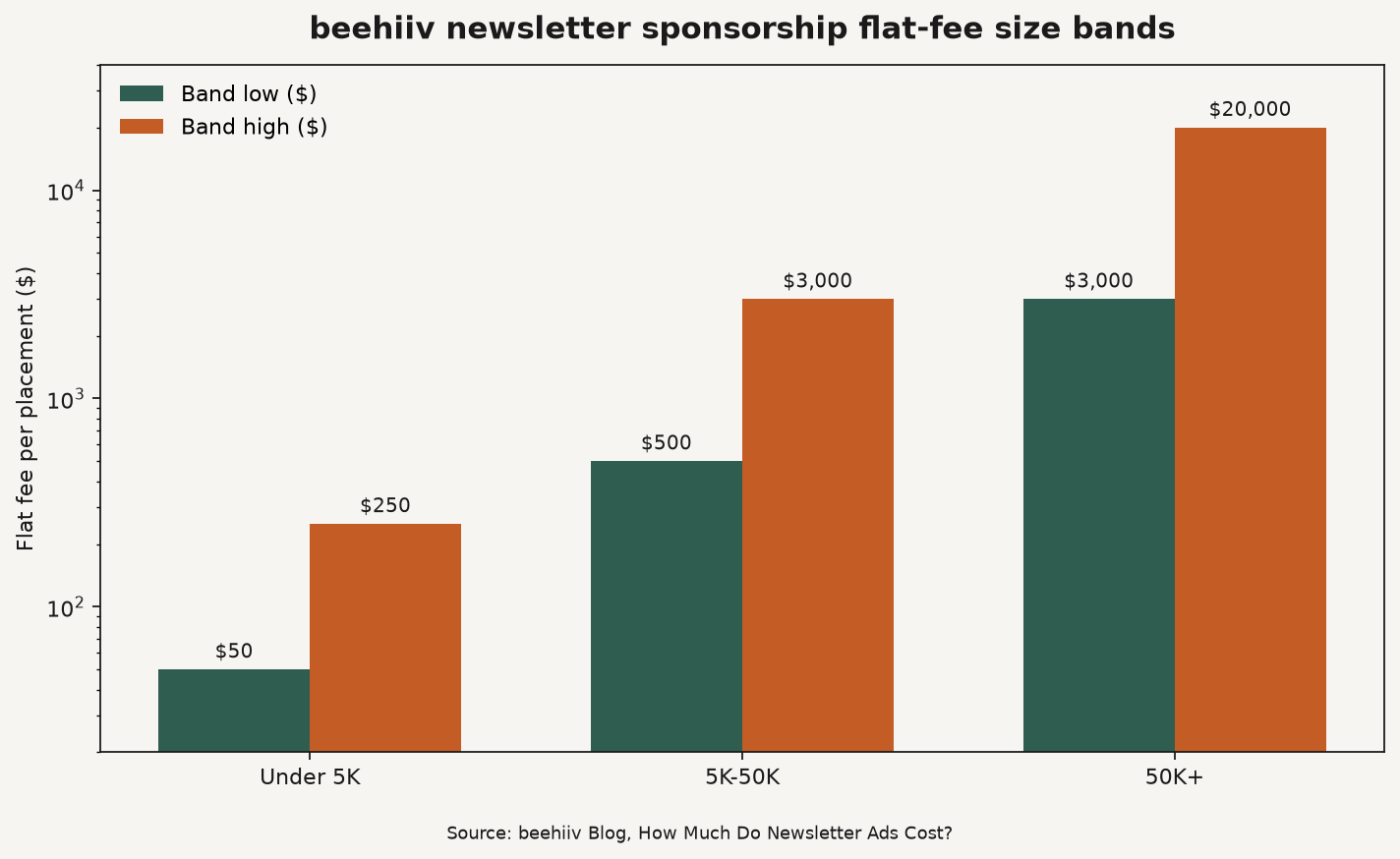
Source: beehiiv Blog, How Much Do Newsletter Ads Cost? https://www.beehiiv.com/blog/newsletter-sponsorship-cost
Newsletter sponsorship pricing works as a three-step stack: choose the commercial model, pick a size-band floor from a named source, then run labeled math sponsors can audit. Skip the model step and you will argue about subscriber count forever without settling the deal.
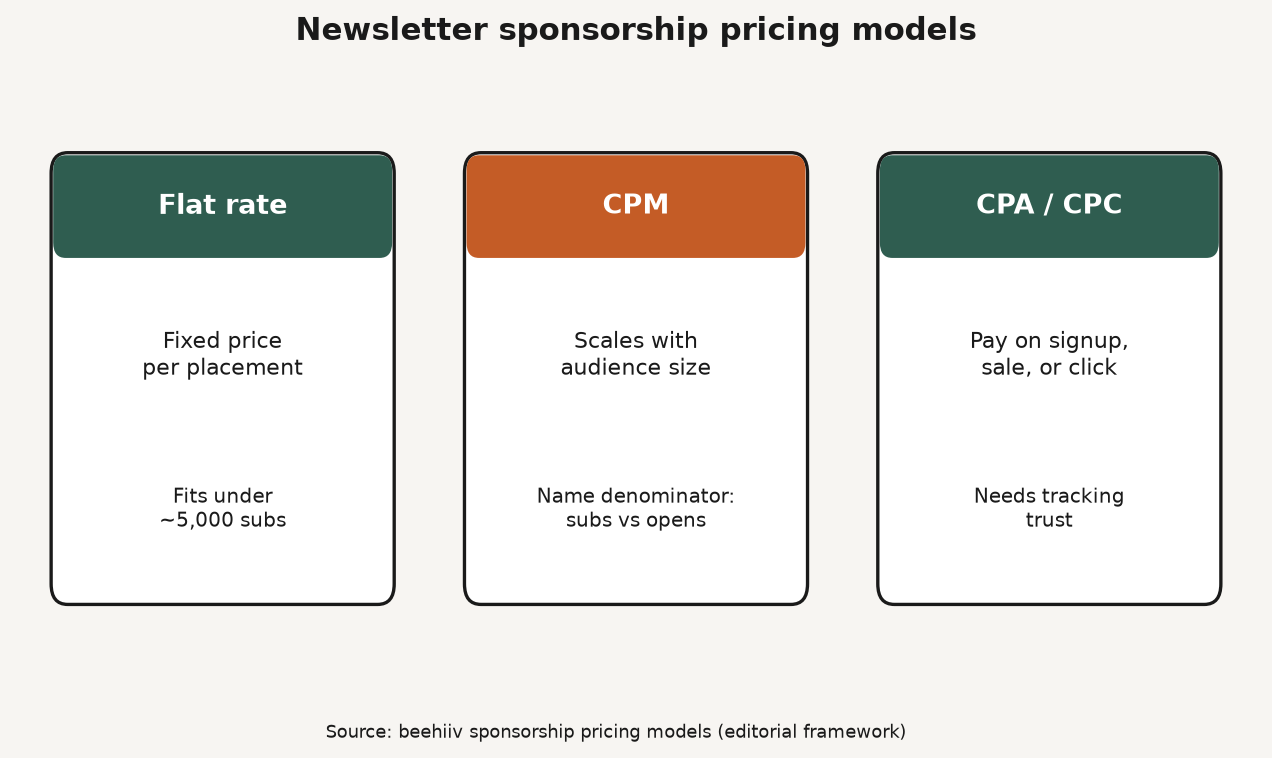
Source: beehiiv Blog sponsorship pricing models. https://www.beehiiv.com/blog/newsletter-sponsorship-cost Editorial framework.
| Model | What the sponsor pays for | When it fits | Watch-out |
|---|---|---|---|
| Flat rate | One fixed price per placement | Lists under ~5,000 subs; simple first deals | Must still show audience proof or you look arbitrary |
| CPM | Price scales with audience (beehiiv example uses subscribers) | Larger lists with steady demand | Name the denominator: subscribers vs opens |
| CPA / CPC | Pay on signup, sale, or click | Performance buyers; early lists proving value | Tracking trust; publisher takes outcome risk |
beehiiv’s worked CPM example: 10,000 subscribers × $25 CPM = $250. Their packages post uses $50 CPM × 10,000 = $500 as the scaling illustration (beehiiv; packages). CPA bands on the cost post commonly run about $10-$100 per acquisition depending on offer value. That is a wide planning range, not a promise.
| Subscriber band | Typical flat quote (beehiiv) | Typical CPM language (beehiiv) | Labeled example |
|---|---|---|---|
| Under 5,000 | $50-$250 per placement | Often $15-$35 CPM | 3,000 × $25 CPM = $75 |
| 5,000-50,000 | $500-$3,000 (often ~$1,000-$1,500) | Often $20-$50 CPM | 20,000 × $35 CPM = $700 |
| 50,000+ | $3,000-$20,000+ | Scales with niche and proof | 50K-100K often discussed near $3,000-$7,000 |
Source: beehiiv cost breakdown. Treat these as platform-published planning bands from beehiiv’s analysis of newsletter pricing patterns, not as feat. marketplace data and not as an IR take-rate filing.
Hold CPM constant and you can see what subscriber count does to the quote.
| Subscribers | Price at $25 CPM |
|---|---|
| 1,000 | $25 |
| 3,000 | $75 |
| 5,000 | $125 |
| 10,000 | $250 |
| 20,000 | $500 |
Formula: price = subscribers × CPM / 1,000. Raise CPM for scarce B2B audiences. Lower it when you are buying a case study. Do not confuse this table with opens-CPM math.
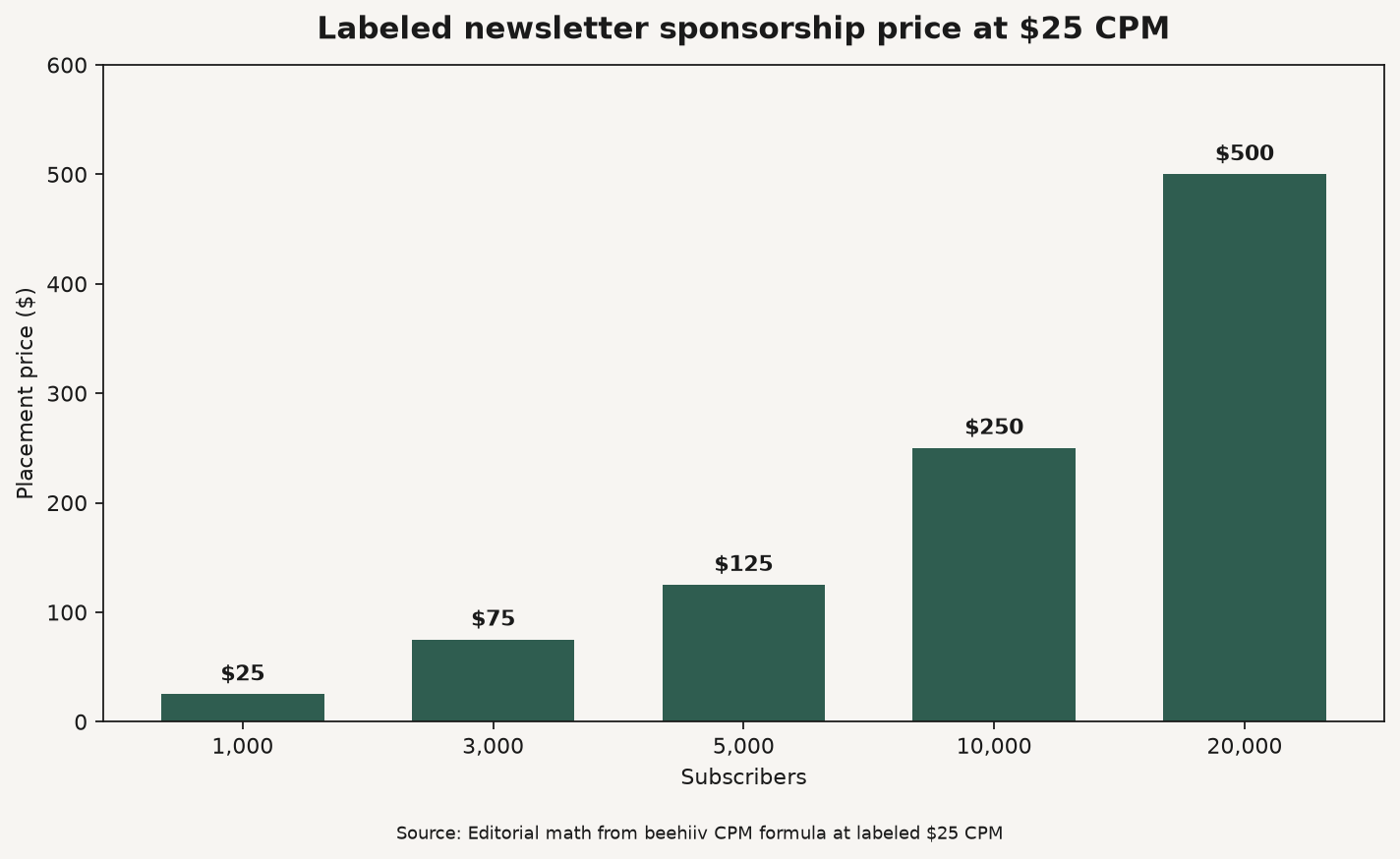
Source: Editorial math from beehiiv CPM formula (sponsorship cost / subscribers) × 1,000 at a labeled $25 CPM. https://www.beehiiv.com/blog/newsletter-sponsorship-cost
Sponsors still ask for open rate. Give them a 90-day average, then put click-through and, when you have it, conversion next to it. Apple’s Mail Privacy Protection can mark mail as opened without a human read (Apple). That is why email benchmarks by industry treat opens as directional. If you price on opens, disclose the privacy caveat in the media kit.
beehiiv also claims Ad Network sponsors who run 12-week campaigns see 40% better performance than one-offs, and that consistent publishing correlates with 25% higher sponsor retention on their platform data. Those are beehiiv product claims. Use them as hypotheses, not as your own study.
Secondary blogs publish niche CPM ladders (finance vs lifestyle vs SaaS) from private rate-card scrapes. Until those samples publish a method as clear as an ESP benchmark report, they are not charted here as “the” market. There is no public dataset in this article for one official global median newsletter CPM by niche. Quote beehiiv bands. Run your own labeled math. Negotiate from proof.
Influencer pricing by follower tier is a different scorecard. Keep it separate via influencer rates by follower count.
Common mistakes in newsletter sponsorship pricing are model confusion, vanity denominators, and overstuffed issues. Fix the quote sheet before you blame the niche. Most rate-card failures are process errors, not audience quality problems that a higher CPM can magically repair.
These answers cover the rate-card questions operators ask first: size bands, CPM math, flat versus CPM under 5,000 subscribers, opens after Apple Mail Privacy Protection, and whether any public census publishes one official niche CPM. Use them as planning language, not as earned income promises.
Q: What are typical newsletter sponsorship rates by subscriber count? A: beehiiv’s planning bands put many lists under 5,000 subscribers near $50-$250 flat per placement, 5,000-50,000 near $500-$3,000, and 50,000+ near $3,000-$20,000+. Niche and engagement can move you outside those bands. Treat them as starting rails, not guarantees.
Q: How do you calculate newsletter sponsorship CPM? A: beehiiv’s common example is (sponsorship cost / subscribers) × 1,000. At 10,000 subscribers and a $25 CPM, the placement is $250. If you price on unique opens instead, say so explicitly. Opens and subscribers are different denominators.
Q: Should small newsletters use flat rate or CPM? A: beehiiv’s packages guidance is to stick with flat rates under about 5,000 subscribers, then lean CPM when the list is larger and demand is consistent. Flat is easier to sell. CPM scales cleaner once you are not explaining every dollar.
Q: Do open rates still matter for sponsorship pricing after Apple MPP? A: They matter as a directional signal, not as a hard census of human reads. Apple’s Mail Privacy Protection can download remote content without engagement. Pair opens with clicks and conversions, the same way you should read email benchmarks.
Q: Is there one official average newsletter CPM by niche? A: Not in the sources used for this article as a public census. beehiiv publishes broad CPM language ($10-$75 typical; B2B often $50-$100+; consumer nearer $15-$35). Niche aggregator ladders are secondary samples. Do not chart them as universal truth.
Newsletter sponsorship rates by subscriber count are a size-band planning tool plus a model choice. Use beehiiv’s $50-$250 / $500-$3,000 / $3,000-$20,000+ rails to avoid fantasy quotes, run labeled CPM math, and keep Apple MPP honest on the opens line. If you built a product worth selling beyond a single ad slot, list it on feat..
Preference center best practices: CAN-SPAM menu plus stop-all, Google one-click vs body preference pages, and SendGrid's labeled 20% unsub drop.
Mailchimp vs Klaviyo: contact billing fork, send multipliers (10x/12x/15x), starting prices, and when ecommerce depth beats a general ESP.
Email list growth benchmarks: Omnisend 1.24B popup displays at 2.1%, form-type ladder, and levers that beat the average without inventing MoM %s.