Email Preference Center Best Practices
Preference center best practices: CAN-SPAM menu plus stop-all, Google one-click vs body preference pages, and SendGrid's labeled 20% unsub drop.
How to write newsletter sponsorship terms: MSA plus IO stack, React Weekly section map, payment and cancel clauses, plus kill fee and makegood links.

TL;DR: How to write newsletter sponsorship terms of service means publishing evergreen Sponsorship Terms once, then attaching a short insertion order per deal. React Weekly’s public terms (updated June 24, 2026) show the section map. Put payment, cancel, no-guarantee, disclosure, and liability in writing. Not legal advice.
Most newsletter “contracts” live in Slack until a cancel request, a soft CTR complaint, or an unpaid invoice forces a rewrite under stress. That is not a sponsorship program. That is improvisation with inventory you cannot unsend. Evergreen terms exist so the next dispute starts from a document, not from memory.
The full cluster map lives in the email marketing guide.
How to write newsletter sponsorship terms of service is the hub for the ops cluster: insertion order, kill fees, invoicing, makegoods, rates, and sponsored disclosure. Merchant affiliate TOS is a different document for a different pair of parties (affiliate program TOS).
Newsletter sponsorship terms of service are the evergreen rules a publisher publishes for paid placements: who may book, what packages mean, how creative is approved, how payment and cancellation work, what is not guaranteed, how ads are labeled, and how liability is capped. They sit above each deal-specific insertion order.
They are not the same as a merchant affiliate program TOS. Affiliate TOS bind a seller to many promoters on ongoing tracked commissions. Sponsorship terms bind a publisher to an advertiser for dated inventory. Mixing those templates is how you inherit cookie language you do not use and miss kill fees you do.
React Weekly states that submitting a request, approving creative, or remitting payment means the sponsor agrees to those terms (React Weekly). GRC says individual Sponsorship Agreements plus site Terms govern engagements (GRC). Either pattern works if counsel reviews it. The job is the same: stop renegotiating first principles on every Thursday send.
Written sponsorship terms matter because newsletter inventory is dated, irreversible, and sold to people who already have agency paperwork habits. Without evergreen rules, every cancel, late asset file, and soft-click complaint becomes a new negotiation after your leverage left with the send.
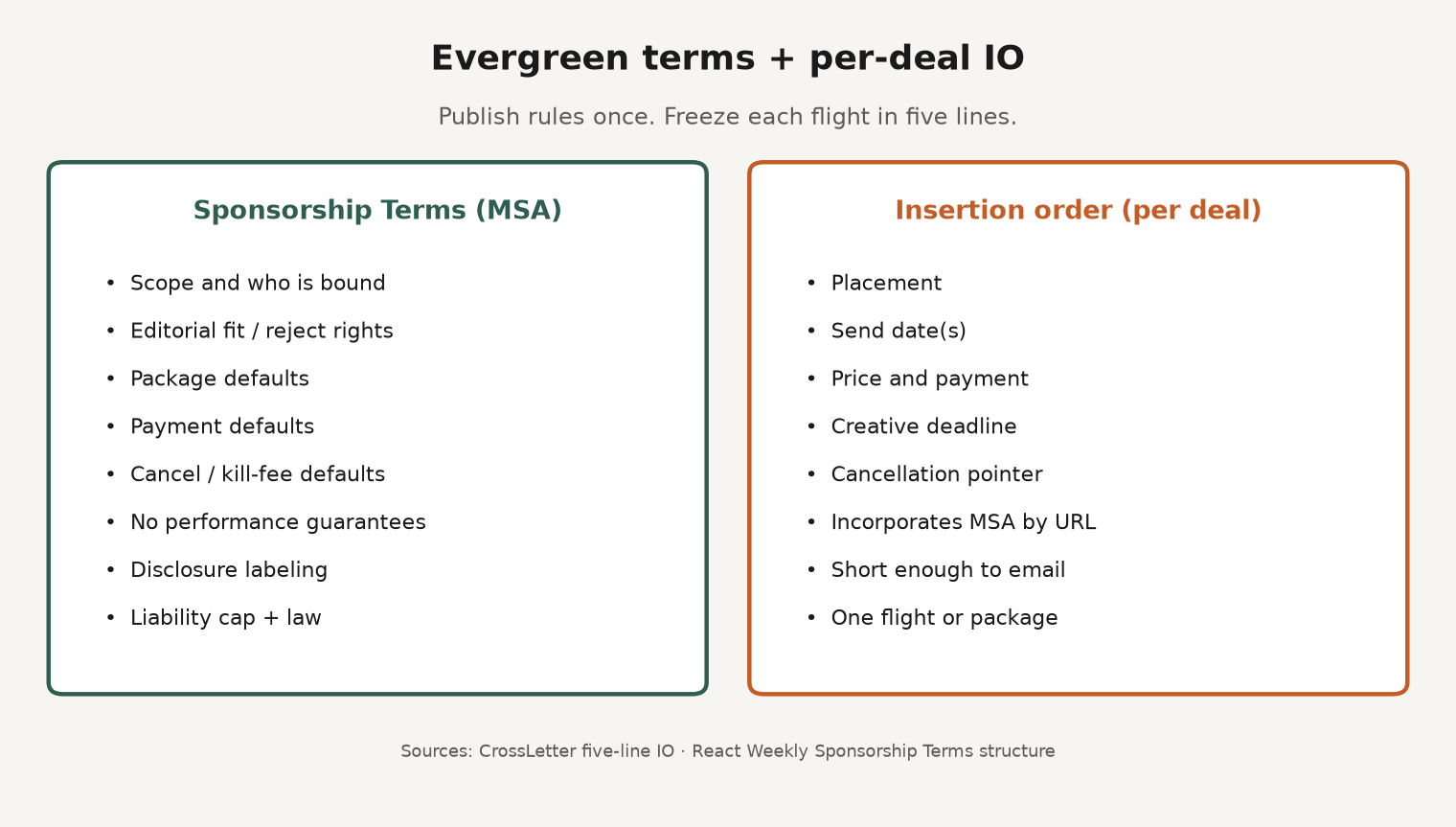
Source: Editorial two-document stack from CrossLetter five-line IO guidance (https://crossletterplatform.beehiiv.com/p/the-collaborator-by-crossletter-13) and React Weekly Sponsorship Terms structure (https://react-weekly.dev/sponsor/terms). Accessed 2026-09-27.
Newsletter sponsorship terms of service work as an evergreen MSA that each short IO incorporates by reference. The MSA settles rules that should not change every week. The IO freezes the five deal fields: placement, dates, price and payment, creative deadline, and cancellation (CrossLetter).
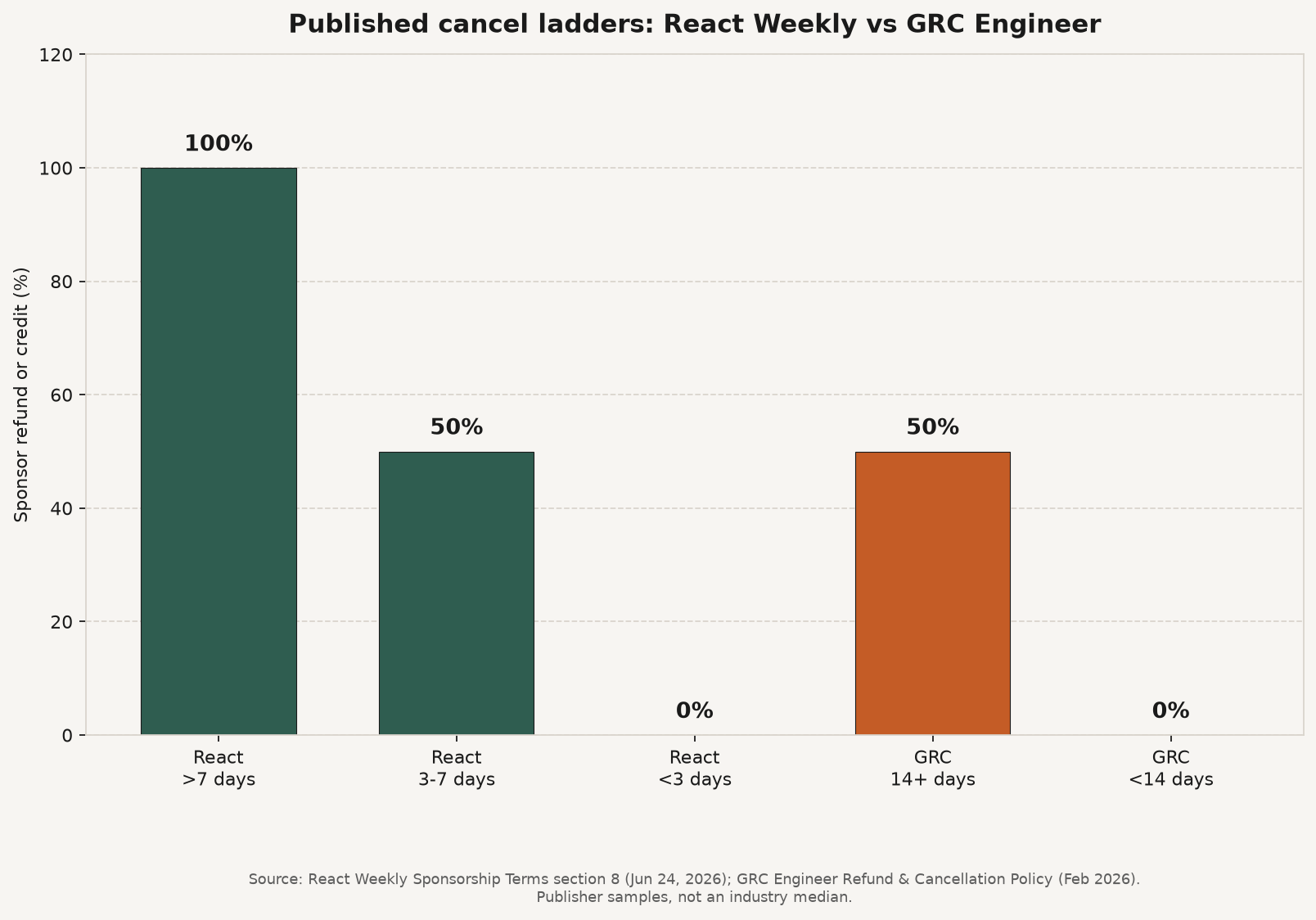
Source: React Weekly Sponsorship Terms section 8 (June 24, 2026), https://react-weekly.dev/sponsor/terms; GRC Engineer Refund & Cancellation Policy (February 2026), https://grcengineer.com/c/terms.
| Document | Cadence | Job | Minimum contents |
|---|---|---|---|
| Sponsorship Terms (MSA-style) | Publish once; version-date updates | Evergreen rules for all paid placements | Scope, fit, packages, creative, approval, payment defaults, cancel defaults, no-guarantee, disclosure, liability, law |
| Insertion order | One per flight or package | Freeze this deal | Placement, date(s), price/payment, deliverables/deadline, cancellation pointer (IO guide) |
Wellput’s CEO described a related pattern on r/adops: signing an IO can open a reservation system without obligating you to run every offered campaign (thread). Direct publishers can mirror that idea: evergreen terms plus optional flights, not a new twelve-page binder every Tuesday.
React Weekly’s public Sponsorship Terms (last updated June 24, 2026) are a clean section map you can study, not copy blindly (React Weekly):
| Section | What it settles |
|---|---|
| 1. Scope | Terms cover paid placements and related surfaces named in the package |
| 2. Booking and availability | Request is not reserved; confirm + payment; typical review 24 to 48 hours; book 2 to 3 weeks ahead when possible |
| 3. Accepted sponsors / fit | Audience relevance; reject misleading, unsafe, or off-niche creative |
| 4. Packages and deliverables | Main Sponsor vs Sponsored Link expectations (e.g. up to 150 words on Main) |
| 5. Creative specs | Asset sizes (e.g. 1200x600), formats, IP warranties |
| 6. Review and publication | Approval timing; late feedback may jeopardize the date; publisher keeps layout control |
| 7. Pricing and payment | Confirmed after invoice paid in full unless other written terms |
| 8. Cancellation | More than 7 days full refund/credit; 3 to 7 days 50%; under 3 days none; missed assets may count as sponsor-driven cancel |
| 9. Performance | No guarantees on opens, clicks, conversions, or revenue |
| 10. Warranties / liability | Sponsor warrants materials; publisher aggregate liability capped at fees paid for the placement |
That map is why a public TOS beats a Notion FAQ. Sponsors can self-serve the defaults before sales even replies.
| Publisher / guide | Default cash rule | Notes |
|---|---|---|
| React Weekly | Pay in full to confirm booking | Slot not reserved until paid (React Weekly) |
| GRC Engineer | Payment due within 30 days of invoice | Paired with 14-day cancel ladder (GRC) |
| InfluencersKit guidance | 50% deposit normal for new advertisers; Net 30 from invoice date | Plan 6 to 8 weeks send-to-cash (InfluencersKit) |
| CrossLetter planning | Deposit + Net 15 / 30 from send | Five-line IO stack (CrossLetter) |
Pick one default and write exceptions in the IO. Do not invent a “standard industry deposit percentage” census. There is no public dataset for that.
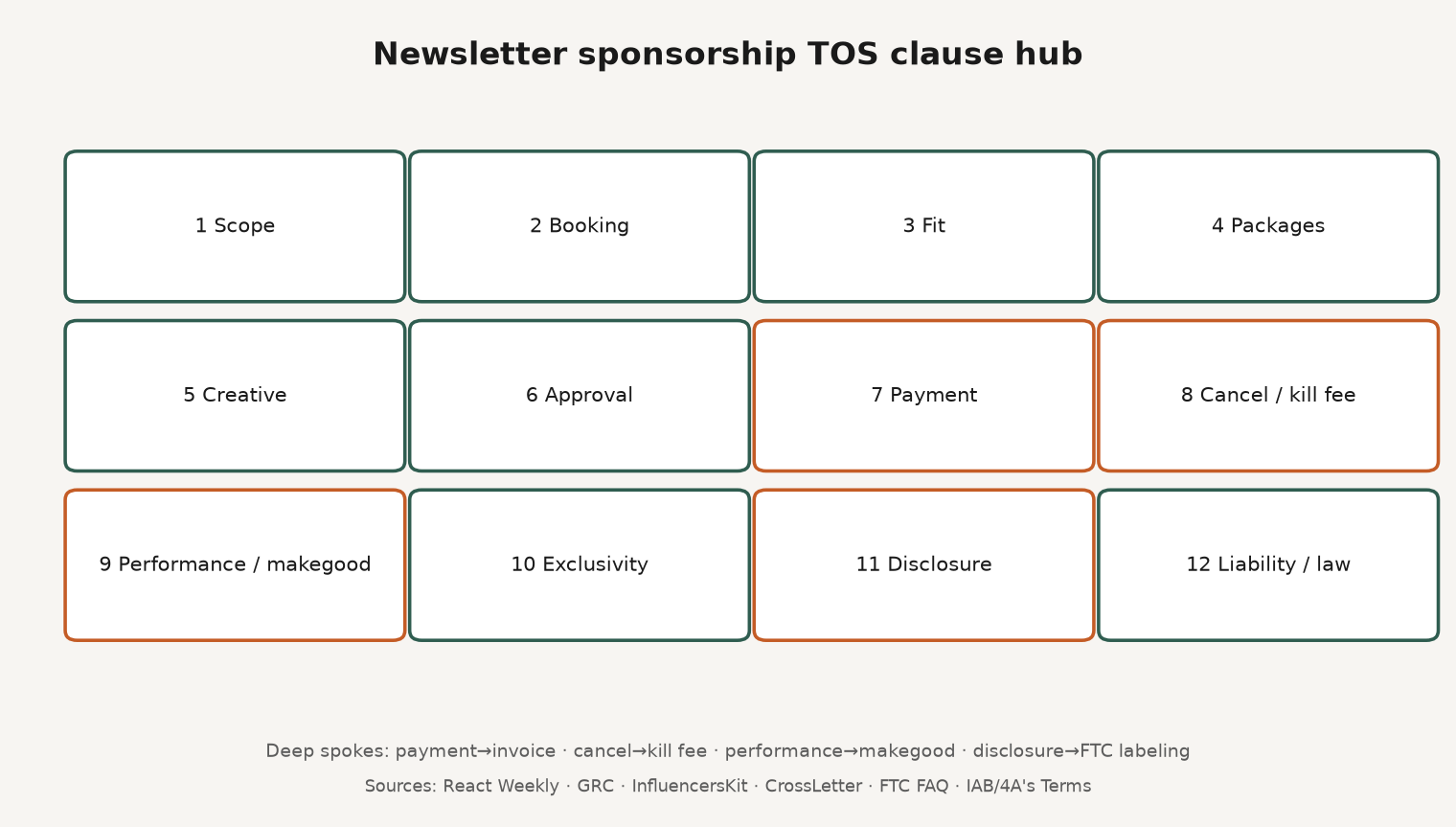
Source: Editorial clause hub mapped from React Weekly Sponsorship Terms, GRC Engineer Terms, InfluencersKit contract guidance, CrossLetter IO stack, FTC Endorsement Guides FAQ, and IAB/4A’s Standard Terms. URLs in External Links. Not legal advice.
Draft evergreen terms before the next inbound, while you still have time to choose defaults you will enforce. Keep each insertion order short and boring. Have counsel review anything you treat as binding. Not legal advice. The steps below are an editorial checklist, not a statute.
Q: What is the difference between sponsorship terms of service and an insertion order? A: Sponsorship terms are evergreen rules for all paid placements. An insertion order freezes one flight: placement, dates, price and payment, creative deadline, and cancellation. CrossLetter’s five-line IO is the practical minimum for indie deals (CrossLetter).
Q: Do I need a lawyer to write newsletter sponsorship terms? A: This guide is education, not legal advice. Use published publisher samples and the clause hub as a checklist, then have counsel review anything you treat as binding, especially liability caps, governing law, and refund language.
Q: Should I require payment in full or a deposit before a newsletter sponsorship send? A: React Weekly confirms bookings after payment in full (React Weekly). InfluencersKit treats a 50% deposit as a normal ask for advertisers you have not been paid by before (InfluencersKit). Pick the stricter default you will enforce.
Q: Can newsletter sponsorship terms guarantee clicks or conversions? A: You should not. React Weekly section 9 states it does not guarantee impressions, opens, clicks, conversions, leads, hires, or revenue (React Weekly). InfluencersKit makes the same point: guaranteeing clicks underwrites the advertiser’s landing page (InfluencersKit).
Q: How do kill fees and makegoods fit into sponsorship terms of service? A: Kill fees price cancel before send. Makegoods price remedy after send. Put default ladders and delivery-versus-performance rules in the evergreen terms, then point each IO at those sections. Deep dives: kill fees and makegoods.
Sponsorship terms are how you stop rewriting the same fight in every inbox. Publish evergreen rules with a dated section map, attach a short IO per flight, and send sponsors to the clause that already answers cancel, payment, performance, and disclosure. Study React Weekly and GRC as primary samples, then make the defaults yours.
If you want distribution beyond a single dated sponsorship slot, list a product affiliates can sell through co-branded storefronts on feat..
Preference center best practices: CAN-SPAM menu plus stop-all, Google one-click vs body preference pages, and SendGrid's labeled 20% unsub drop.
Mailchimp vs Klaviyo: contact billing fork, send multipliers (10x/12x/15x), starting prices, and when ecommerce depth beats a general ESP.
Email list growth benchmarks: Omnisend 1.24B popup displays at 2.1%, form-type ladder, and levers that beat the average without inventing MoM %s.