How to Turn Your Audience Into a Distribution Channel
Turn your audience into a distribution channel with a five-rung ladder—attention, trust, offer, sales surface, and economics—not follower vanity.
Newsletter hybrid monetization model explained: ads plus paid subscriptions, three free/paid structures, and beehiiv's 0.62% median conversion.

TL;DR: Newsletter hybrid monetization means stacking advertiser-funded ads with reader-funded paid subscriptions. The wallets do not cannibalize. Pick one of three free/paid architectures, then plan conversion against beehiiv’s 0.62% platform median (about six paying readers per 1,000), not against influencer myths.
Most operators treat a newsletter hybrid monetization model as a vibes mix: “we will add a paywall someday and keep a few sponsor slots.” That is how you measure yourself against the wrong ceiling and quit at the median. Hybrid is a structure choice first, a pricing choice second.
Newsletter hybrid monetization model explained means naming which free/paid architecture you run, then stacking ads and subscriptions as two wallets. This page is not creator newsletter vs brand newsletter, which owns Romaine sponsorship-share bands (Creator 10-25%, Hybrid 30-50%, Media Brand 90%+). Pair it with digital product vs sponsorship revenue, one-time vs subscription digital product pricing, newsletter sponsorship rates by subscriber count, and beehiiv vs Kit.
Newsletter hybrid monetization is running paid advertising (or sponsorships) and a paid subscription tier on the same list, with free and paid surfaces designed so neither wallet depends on the other collapsing. The stack is structural: you decide what free readers see, what paying readers buy, and how ads sit on the free surface.
Hybrid is not “a little of everything.” Affiliate links, digital products, and coaching can sit next to ads and subs. Those are additional SKUs. The structural hybrid that ranking guides and operators argue about is the ads-plus-subscriptions stack: free readers who see ads (or a free digest), plus paying readers who buy access, extras, or an ad-free path.
On Reddit’s r/Newsletters, operators at about 5,000 subscribers already list sponsor slots, a paid tier, and a product as parallel paths, and they note that ads feel easier while paid-sub conversion can stay low (thread). That vernacular matches the data: median conversion is under 1%, so hybrid without a named architecture becomes a quiet disappointment.
Hybrid monetization matters because each wallet has a different ceiling, a different sales cycle, and a different failure mode. Stacking them without a structure produces the worst of both: thin ad inventory and a paywall that converts at the platform median while you expected creator-economy folklore.
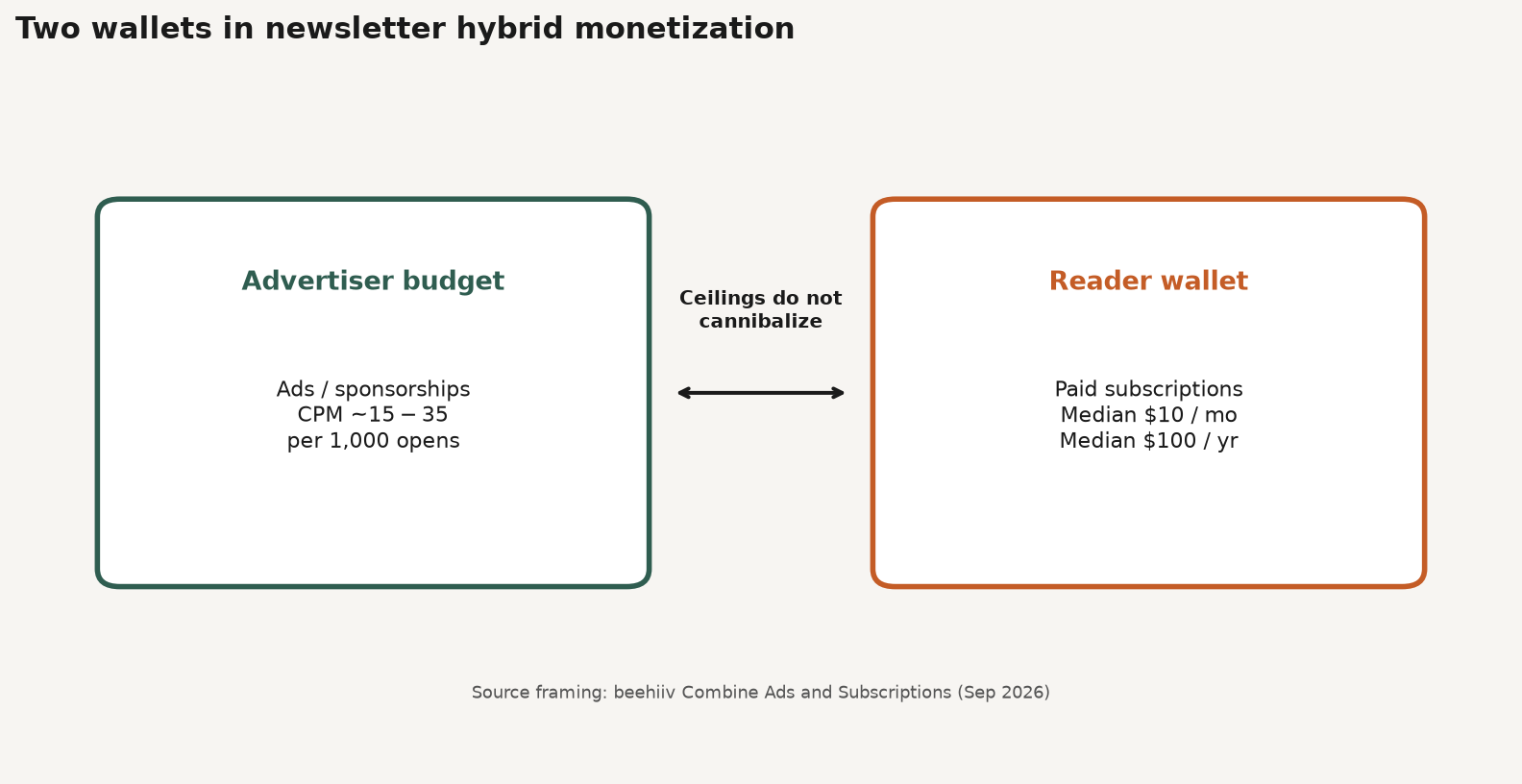
Source: Editorial two-wallet framing from beehiiv, Combine Ads and Subscriptions (Sep 20, 2026). https://www.beehiiv.com/blog/combine-ads-subscriptions-newsletter
Hybrid monetization works by picking one free/paid product architecture, pricing the paid tier near published medians unless your niche proves otherwise, then running ads on the free surface without pretending paid conversion will bail out a thin media kit. The wallets stay separate; the architecture decides what free readers get and what paid readers buy.
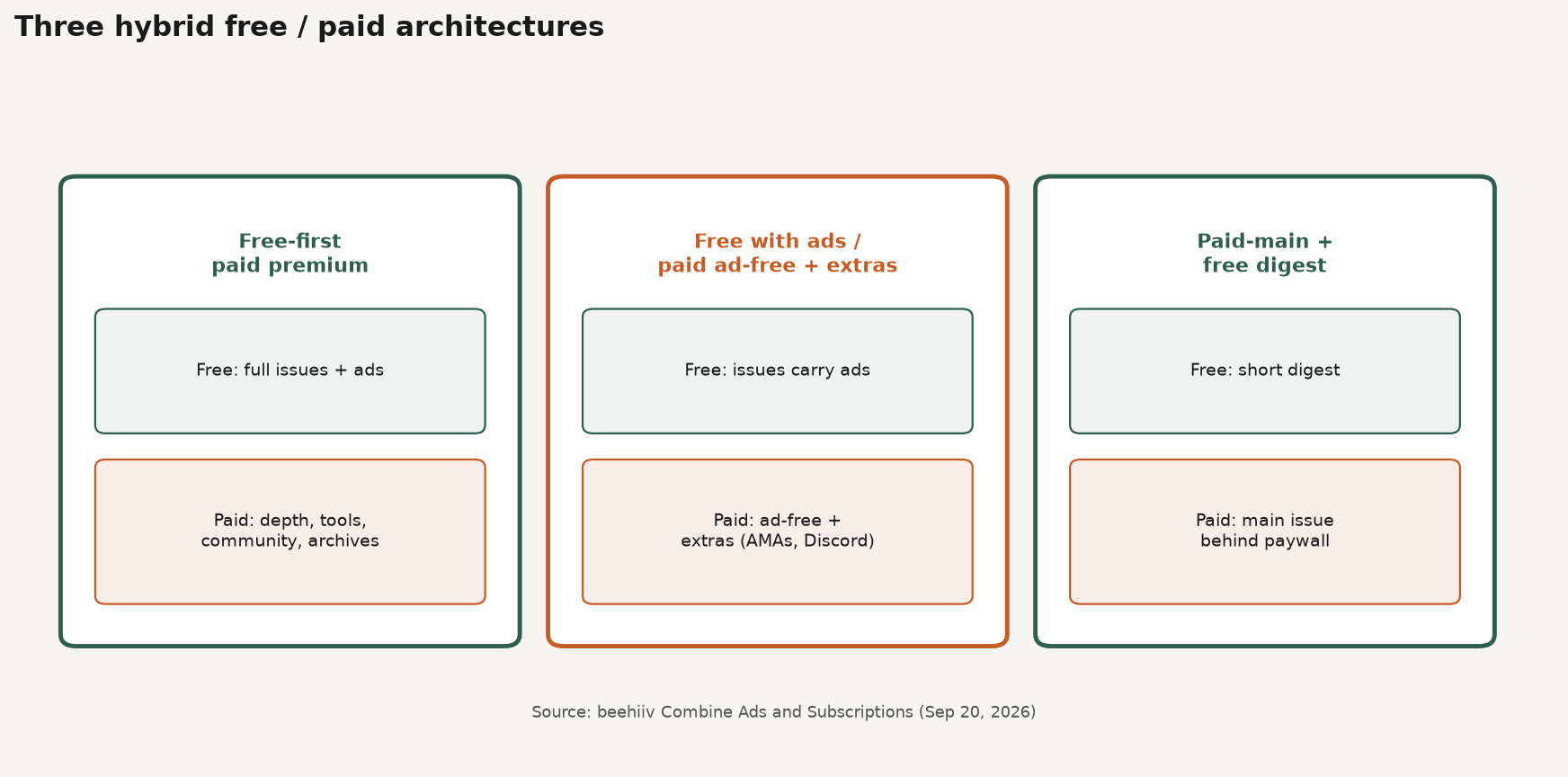
Source: Editorial framework from beehiiv three hybrid structures, Combine Ads and Subscriptions (Sep 20, 2026). https://www.beehiiv.com/blog/combine-ads-subscriptions-newsletter
beehiiv’s combine-ads guide names three structural models operators actually ship (beehiiv):
| Model | Free surface | Paid surface | Best when |
|---|---|---|---|
| Free-first, paid premium | Full (or near-full) free issues; ads on free | Deeper research, community, archives, tools | You need reach and open volume for ads while a minority pays for depth |
| Free with ads / paid ad-free + extras | Free issues carry ads | Ad-free plus extras (templates, AMAs, Discord) | Readers will pay to remove friction and unlock side benefits |
| Paid-main + free digest | Short free digest or teaser | Main issue lives behind paywall | The paid product is the business; free is acquisition and SEO |
Pick one. Do not run all three half-finished. Free-first keeps ad inventory healthy. Paid-main starves opens on the free list unless the digest still earns sponsor-worthy attention. Ad-free paid tiers are popular in community threads because they give a clean upgrade reason without hiding the entire archive on day one.
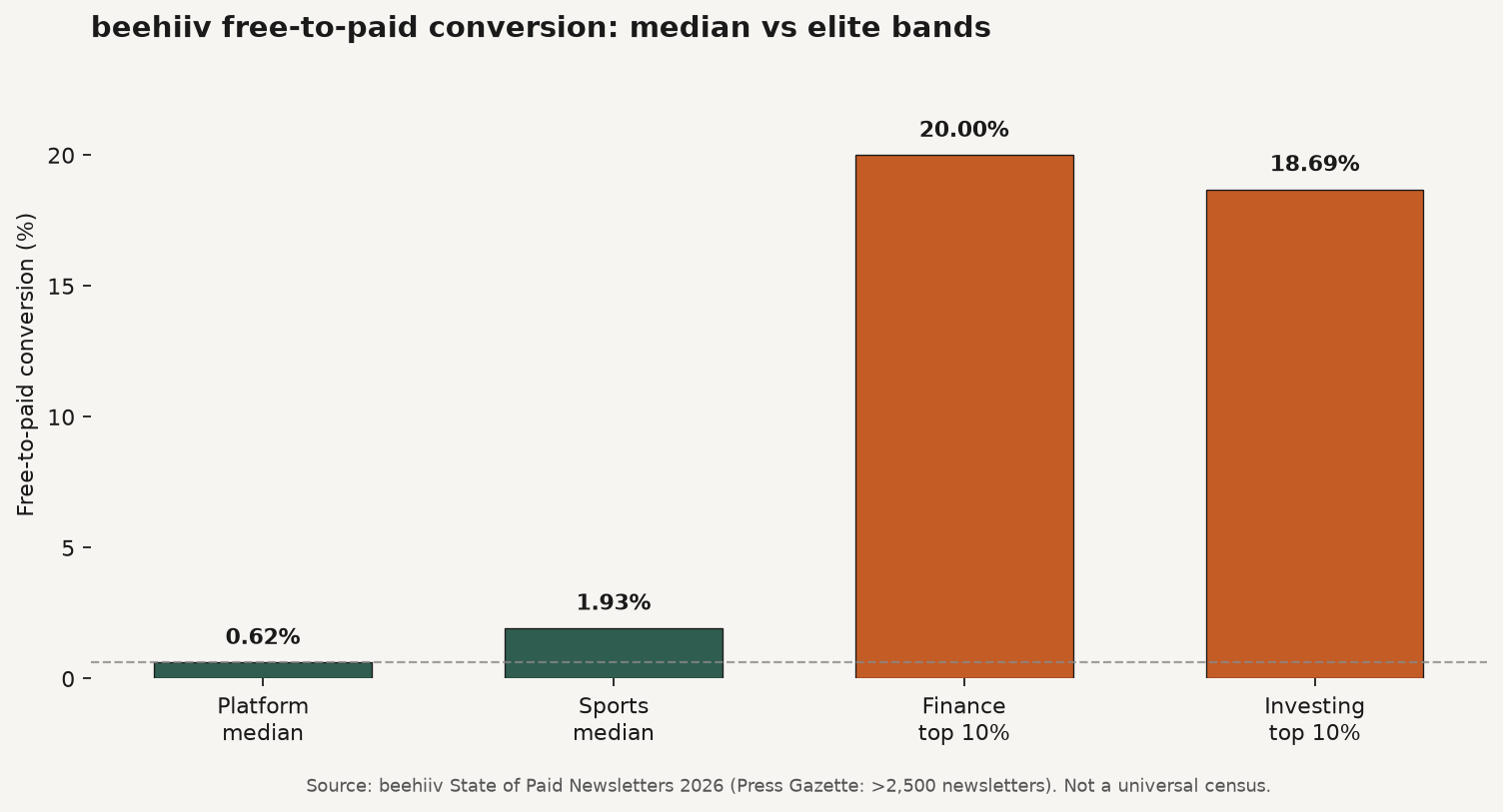
Source: beehiiv, The State of Paid Newsletters 2026. https://www.beehiiv.com/blog/the-state-of-paid-newsletters-2026 Press Gazette notes analysis of more than 2,500 newsletters. https://pressgazette.co.uk/newsletters/newsletters-2026-prices-retention-churn/
| Signal | Figure | How to use it |
|---|---|---|
| Platform median free-to-paid | 0.62% | Default planning rate until your niche proves higher |
| Finance median / investing median | 0.78% / 0.84% | Vertical context, still under 1% |
| Sports median | 1.93% | Outlier vertical; do not copy into B2B SaaS |
| Finance top 10% / investing top 10% | 20.00% / 18.69% | Proof that elite niches exist; not your week-one forecast |
| Top 25% across most industries (beehiiv) | Roughly 2-5% | Longer-horizon aim after product-market fit |
| Median price | $10/mo · $100/yr | Default offer shape before you invent tiers |
| Typical launch timing | ~45 days after start | Do not wait a year “until the list is ready” without a reason |
Sources: State of Paid 2026; Press Gazette.
Labeled planning math from the same report: at 0.62% and $10/month, 1,000 subscribers is about $62/month before churn. That number is a planning floor, not a promise. Retention also varies: beehiiv estimates subscriber lifetime from about 6 months (Money) to nearly 20 months (Food & Drink). Treat those as estimated category ranges, not your audited LTV.
Platform context only: paid subscriptions on beehiiv generated $19M in 2025, up 138% year over year (beehiiv). That is platform GMV growth, not a publisher median income figure.
On the free surface, price and sell inventory with the same ops stack you would use without a paywall: rates by list size, a media kit, an insertion order, and clear sponsorship terms. Consumer CPM bands of about $15 to $35 per 1,000 opens are a planning rail from beehiiv’s combine-ads guide, not a guarantee for every niche (beehiiv).
beehiiv also publishes an illustrative dual-monetization table at growing list sizes (assumptions include about $25 CPM, 8 sends/month, $10/month paid price, opens stepping down from about 45% toward 35%, and conversion near 0.62% rising toward 2-3%). Use that table as labeled planning illustration only. It is not a census of what every hybrid newsletter earns (beehiiv).
If your paid tier is ad-free, say so in the media kit so buyers know inventory is free-list opens, not total subscribers. If paid readers still see soft promos for your own products, that is not the same as selling third-party sponsor slots into the paid issue. Confusing those two is how you train paid readers to churn.
Hybrid ads-plus-subs is not a universal revenue-mix percentage. There is no public dataset that states what share of all newsletters run X% ads, Y% subscriptions, and Z% affiliates. Refuse any chart that invents that mix. For SKU ownership surveys (products vs sponsorships across creator samples), use digital product vs sponsorship. For price architecture on owned digital goods, use one-time vs subscription pricing.
Launching a hybrid stack means naming the architecture, shipping a paid offer near published medians, protecting free-list ad inventory, and measuring conversion against 0.62% before you declare failure. Skip any of those and you will either starve sponsor opens or quit a paywall that was never priced or timed like the beehiiv medians.
Q: Does adding a paid subscription cannibalize newsletter ad revenue? A: Not by wallet. Ads are funded by advertisers; subscriptions are funded by readers. beehiiv’s combine-ads framing treats those ceilings as independent. Poor architecture (hiding the free issue entirely) can shrink open volume, which is an inventory design problem, not automatic cannibalization.
Q: What free-to-paid conversion rate should I plan for? A: Plan against beehiiv’s 0.62% platform median until your niche proves higher. Sports medians sit near 1.93%, while finance and investing top-10% publishers reach about 20% and 18.69%. Those elite bands are not week-one forecasts.
Q: What are the three hybrid newsletter models? A: Free-first with paid premium extras; free with ads and a paid ad-free-plus-extras tier; or paid-main with a free digest for acquisition. beehiiv’s combine-ads guide is the structural source. Pick one and write the free vs paid promise in plain language.
Q: When should I launch a paid newsletter tier? A: beehiiv reports typical creators launch about 45 days after starting the newsletter, with median prices near $10/month and $100/year. Launch early enough to learn, not so early that you have no proof the free issue is habit-forming.
Q: Is hybrid the same as Romaine’s Hybrid creator/media-brand band? A: No. Romaine’s Hybrid band (about 30-50% sponsorship share of income) is an operating-identity planning range on creator vs brand newsletter. This page is free/paid product architecture plus the ads-and-subscriptions wallet stack.
Hybrid monetization is a named free/paid architecture plus two wallets, not a vague promise to “add subscriptions later.” Plan against a 0.62% median and $10/$100 defaults, keep the free surface sponsorable, and leave Romaine identity bands on their own page. Browse the feat. marketplace when partners should sell beside your list.
Turn your audience into a distribution channel with a five-rung ladder—attention, trust, offer, sales surface, and economics—not follower vanity.
Affiliate marketing for small creators works on trust density: one problem, one offer class, one surface, EPC math (median ~$0.14), FTC disclosure—not a follower floor.
How to create a storefront as a creator: name the job (route, sell-own, sell-others), pick Linktree, Stan, Beacons, or a co-branded page, then ship one hero offer.