How to Choose an Affiliate Program to Promote
Choose an affiliate program with five gates—fit, dollars, attribution, settlement, rights. Amazon Table 1 often pays 1%–4% with a 24-hour cart cookie.
Promote affiliate products on a five-rung surface ladder—owned intent pages, email, video, community, storefront—matched to cookies and FTC disclosure.

TL;DR: How to promote affiliate products is a Promotion Surface Ladder: buyer-intent owned pages, email, video demos, help-first communities, then a co-branded storefront when a naked link is the wrong job. Match each surface to the cookie window and put the FTC disclosure on the same place as the pitch. Tip lists that ignore Amazon’s 24-hour cart rule waste weeks of “great content.”
Most creators who ask how to promote affiliate products already have a link—and a tip list that says “post more.” That is how you end up in the Reddit trap where education converts and hard sells get smoked, while Amazon cart rules quietly erase credit you thought you earned (r/Affiliatemarketing).
Promotion is a surface job, not a channel scavenger hunt. You already chose the program—see how to choose an affiliate program to promote. Now you pick where the recommendation lives, how long attribution lasts, and whether the reader needs a page or a parameter. Shopify’s published bands remind you the economics differ by shape—physical often 5%–15%, digital 20%–50%, subscriptions 15%–30% recurring (Shopify). Amazon’s Table 1 is a different animal—often 1%–4% everyday retail with a short cart window (Amazon Table 1).
Key takeaways:
Promoting affiliate products is the work of placing a tracked recommendation on a surface your audience already trusts, so a qualifying purchase, lead, or subscription can be attributed and paid under the program contract.
It is not dumping links into every caption. It is not “growth hacking” a community that bans affiliates. It is also not the same job as recruiting for a merchant—see how to recruit affiliates for your product if you sit on the brand side.
On feat., promotion still means an honest recommendation. The difference is the surface: a co-branded storefront instead of a naked tracking parameter—compare affiliate marketing vs storefront and what is a creator storefront.
Wrong surfaces burn trust faster than they earn commissions. Right surfaces still fail if the cookie dies before the cart or the disclosure is buried in a footer nobody reads.
Why the ladder beats tip lists:
There is no public dataset for a universal “best channel CVR” across affiliate niches. Track your own sub-IDs per surface for two weeks before you expand.
The Promotion Surface Ladder is a fail-closed order. Start on the durable owned page. Escalate only when the job needs a different surface—not when you are bored of writing.
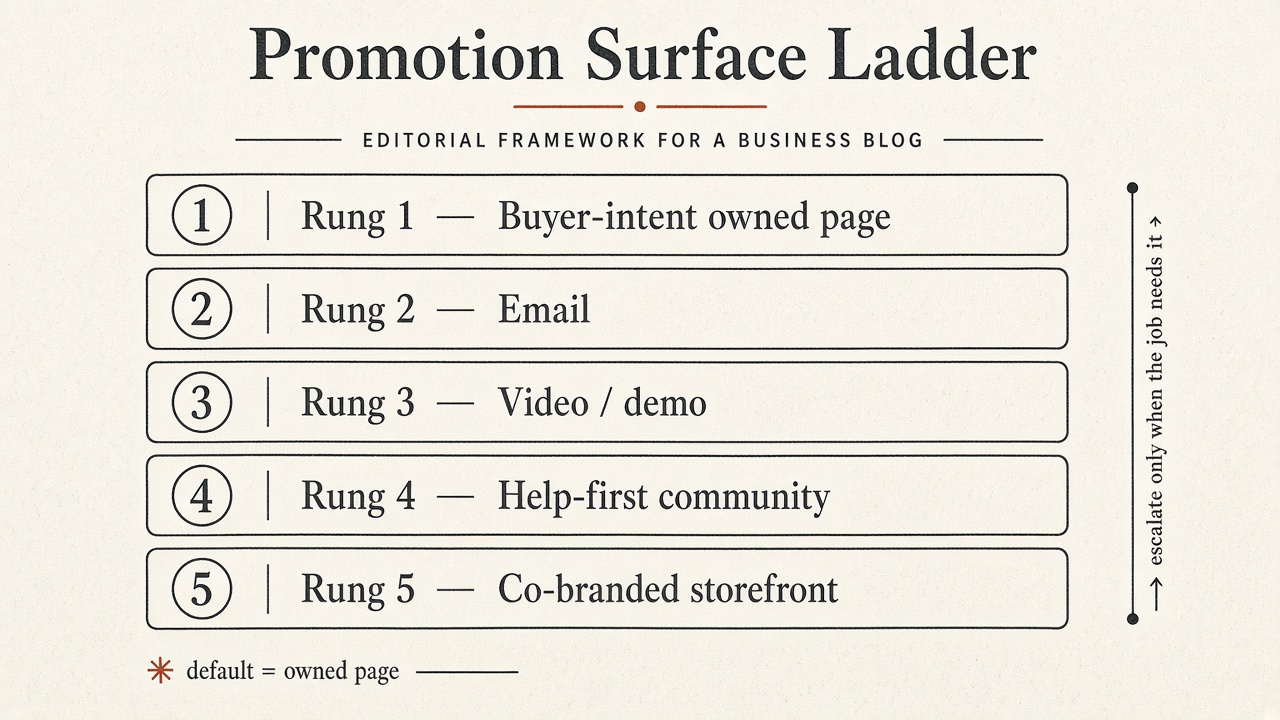
Source: Editorial framework synthesizing Amazon Associates cookie help, Shopify commission bands, Rewardful activation benchmarks, Sprout creator-storefront rates, and FTC endorsement guidance. Taxonomy diagram, no invented channel CVRs.
Write the comparison, review, or tutorial the reader is already searching. Put the recommendation where the decision happens—not in a footer dump. If the article would still help with every link removed, you are on the right rung. This is the default for SEO and for anyone starting with no audience.
Send the same recommendation to people who asked to hear from you. Match the offer to the list’s job; do not paste Amazon ASIN spam into every issue. Longer brand cookies fit considered purchases better than Amazon’s 24-hour cart rule.
Show the product solving the problem. Say the disclosure out loud; put the link in the description. Video compounds like search when the tutorial stays evergreen—the Reddit “education converts” pattern (r/Affiliatemarketing).
Answer for weeks before you link. Drop-and-run gets banned. When someone asks for a setup, share what you use with disclosure. Slow surface; high trust.
Use when the reader needs a shoppable page for a specific merchant product—not a catalog parameter. Retailer programs publish real rates: Lowe’s up to 20% with a 30-day window; Sephora 15% (Sprout Social). On feat., approved sellers get a co-branded page for merchant-listed products—see Amazon Associates vs feat.
| Surface | Best when | Cookie / credit pressure | Disclosure placement |
|---|---|---|---|
| Owned intent page | Buyer is comparing or learning how | Prefer 30d+ brand cookies; Amazon only if cart is near | Above first affiliate link on the page |
| List already trusts you | Longer windows win for considered buys | Near the recommendation in the issue | |
| Video / demo | Product needs to be seen | Description + verbal mention; mind short cart rules | Spoken + written near the CTA |
| Help-first community | Trust is earned in-thread | Often last-click; no spam | In the same comment or post as the link |
| Co-branded storefront | One merchant product needs a page | Storefront checkout attribution | On the storefront and in the share post |
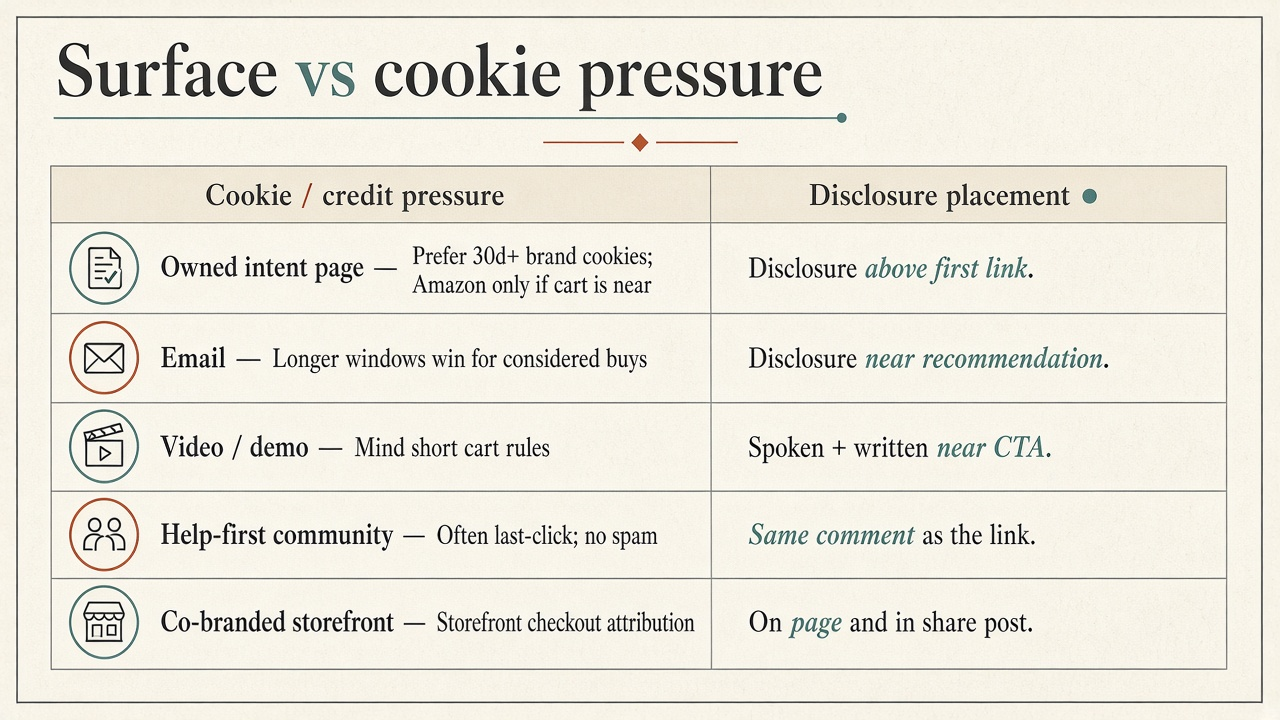
Source: Amazon Associates cookie help. https://affiliate-program.amazon.com/help/node/topic/G9SMD8TQHFJ7728F · Sprout Social creator storefronts. https://sproutsocial.com/insights/creator-storefronts/ · FTC Endorsement Guides. https://www.ftc.gov/business-guidance/resources/ftcs-endorsement-guides-what-people-are-asking
Do not spend storefront-level effort on pennies-per-click retail without knowing the band.
| Offer shape | Published economics signal | Source |
|---|---|---|
| Amazon US Table 1 (many retail lines) | Often 1%–4% | Amazon Table 1 |
| Shopify-style physical | 5%–15% per sale | Shopify, 2026 |
| Shopify-style digital | 20%–50% per sale | Shopify, 2026 |
| Shopify-style subscriptions | 15%–30% recurring | Shopify, 2026 |
| Rewardful SaaS average | 24.16% | Rewardful, n=2,847 |
| Lowe’s / Sephora storefront examples | Up to 20% / 15% | Sprout Social, 2025 |
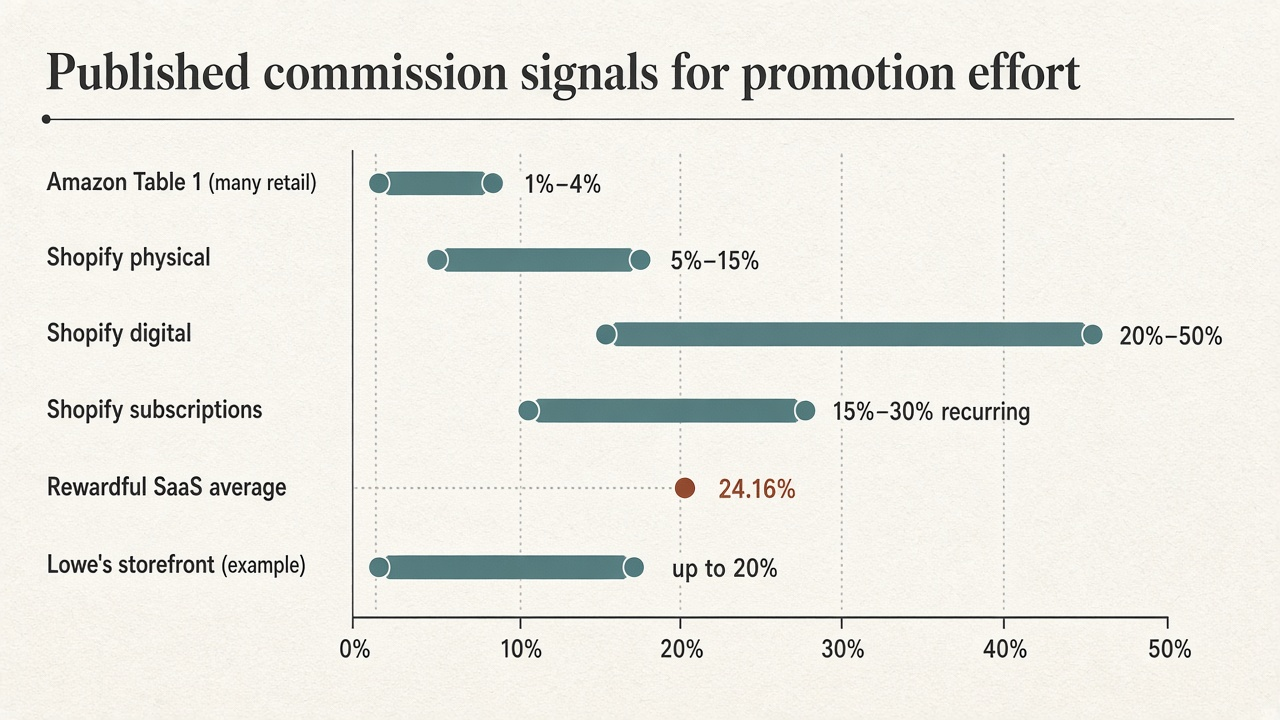
Source: Amazon Associates US Table 1. https://affiliate-program.amazon.com/help/node/topic/GRXPHT8U84RAYDXZ · Shopify Affiliate Commission Guide. https://www.shopify.com/blog/affiliate-commission · Rewardful State of SaaS Affiliate Programs. https://www.rewardful.com/articles/state-of-saas-affiliate-programs-report · Sprout Social creator storefronts. https://sproutsocial.com/insights/creator-storefronts/
Cash timing still matters after the click: Amazon pays about 60 days after the earnings month with $10 / $100 floors (Amazon payments). Full stack: how affiliate marketers get paid.
Q: How do you promote affiliate products if you are a beginner? A: Start on one owned buyer-intent page for one offer you would recommend without commission. Disclose clearly, match the cookie to how your reader buys, and skip spraying every social bio until that page earns a locked sale.
Q: What is the best way to promote affiliate links? A: Put links inside decision content—comparisons, reviews, tutorials—where the reader is already choosing. Channel tips without intent and disclosure are decoration.
Q: Can I promote Amazon products the same way as SaaS affiliates? A: Not if your path to purchase is slow. Amazon’s 24-hour cart rule fails many long-read strategies; SaaS brand cookies of 30–60 days fit newsletters better. Match the offer to the surface.
Q: Do I need a storefront to promote affiliate products? A: No. Most promotion starts on owned pages and email. Use a co-branded storefront when the reader needs a shoppable page for a specific merchant product instead of a catalog parameter.
Q: Where does feat. fit when promoting? A: On the storefront rung of the ladder: pick a merchant-listed product in the marketplace, get a co-branded page, and promote that URL with the same disclosure rules. Fees stay in-product.
How to promote affiliate products is not a scavenger hunt across every channel. It is a Promotion Surface Ladder—owned intent, email, video, community, storefront—matched to cookies, disclosure, and real economics. Amazon’s clocks, Shopify’s bands, and Rewardful’s activation meters are planning constraints. Fail a surface on purpose once and you will stop confusing activity with attributed sales.
If the offers you promote need a co-branded storefront instead of another tracking link, start in the feat. marketplace.
Choose an affiliate program with five gates—fit, dollars, attribution, settlement, rights. Amazon Table 1 often pays 1%–4% with a 24-hour cart cookie.
Earn your first affiliate sale with a 14-day sprint—one offer, one surface, cookie-matched CTA. Amazon needs cart within 24 hours; personal orders do not count.
Join affiliate programs through three doors—destination, proof, compliance. Amazon needs 3 qualifying sales in 180 days; personal orders do not count.