Affiliate Marketing for Startups: Complete Guide
Affiliate marketing for startups is an operating system—locks, cost, recruit, rates, tracking, first 100 sales, then diagnose a flat roster.
Affiliate marketing vs storefront: tracked link vs shoppable page. Amazon 24h cart and Rewardful 1.28% sale rate show a link is not a business.

TL;DR: Affiliate marketing vs storefront is an asset choice, not a software preference. Affiliate marketing gives you a tracked link into someone else’s checkout. A storefront is a selling system: a named page, a catalog, and a path to pay. Amazon’s 24-hour cart clock and Rewardful’s 1.28% sale activation (n=2,847) show why a URL is not a business.
Affiliate marketing vs storefront is the fight people have after they already have traffic. They paste a tracking URL in a bio. The dashboard shows clicks. Money does not follow, or it follows until the merchant rewrites the rate. Then they ask whether they should “start an ecommerce brand.”
That is the wrong fork. You do not need to become a warehouse. You need to stop confusing a referral contract with a shop. Affiliate marketing gives people a link. A storefront (including a co-branded one) is how that link becomes a selling operation.
Affiliate marketing vs storefront is the choice between earning a commission by sending a tracked visitor to a merchant’s checkout, versus selling through a shoppable page that keeps your name, curation, and (when the rails allow it) a durable relationship with the buyer.
That sentence is the definition. Everything else is which assets you keep.
Affiliate marketing is the performance contract described in how affiliate marketing works: unique ID, attribution window, qualifying event, approval, payout. You do not ship the product. You do not set the price. You usually do not get the email list. You get credit if tracking still says you won.
A storefront is a selling surface. It can be your own catalog on Stan-class software, a retailer page such as My Sephora Storefront, or a marketplace co-branded page where a merchant lists and you sell. The job is not “have a prettier bio.” The job is to keep context from the post through the cart. Linktree vs storefront platforms is the tool-class split (route vs sell-own vs sell-others). This comparison is the commercial split: rented referral versus operated shop.
Communities already speak the gap. On r/Affiliatemarketing, people say you are “a middle-man. A connector.” On r/juststart, veterans call affiliate marketing “JUST Marketing” and tell you to own a product once the audience exists. Both lines are useful. Neither is a storefront spec.
feat. is built for the third path: the merchant still owns the SKU and fulfillment. The affiliate still earns on a tracked sale. The buyer does not land on a generic homepage with your identity stripped. You built distribution. The page should look like a business.
Affiliate marketing vs storefront matters because the industry is huge and the individual asset is thin. PMA’s $13.62B spend number is real. Your Amazon cookie is also real. Those two facts can live in the same week.
Why operators feel it now:
| What you think you own | What the link actually is | What a storefront can add |
|---|---|---|
| A business | A tracked referral contract | A named selling page |
| A customer | A click ID inside a window | A checkout that still says your name |
| A catalog | SKUs the merchant can delist | Curated SKUs on a durable URL |
| Recurring income | Commission the program can recut | Repeat visits to your page (still subject to program rules) |
| Brand | Their logo at payment | Co-brand: merchant product, affiliate face |
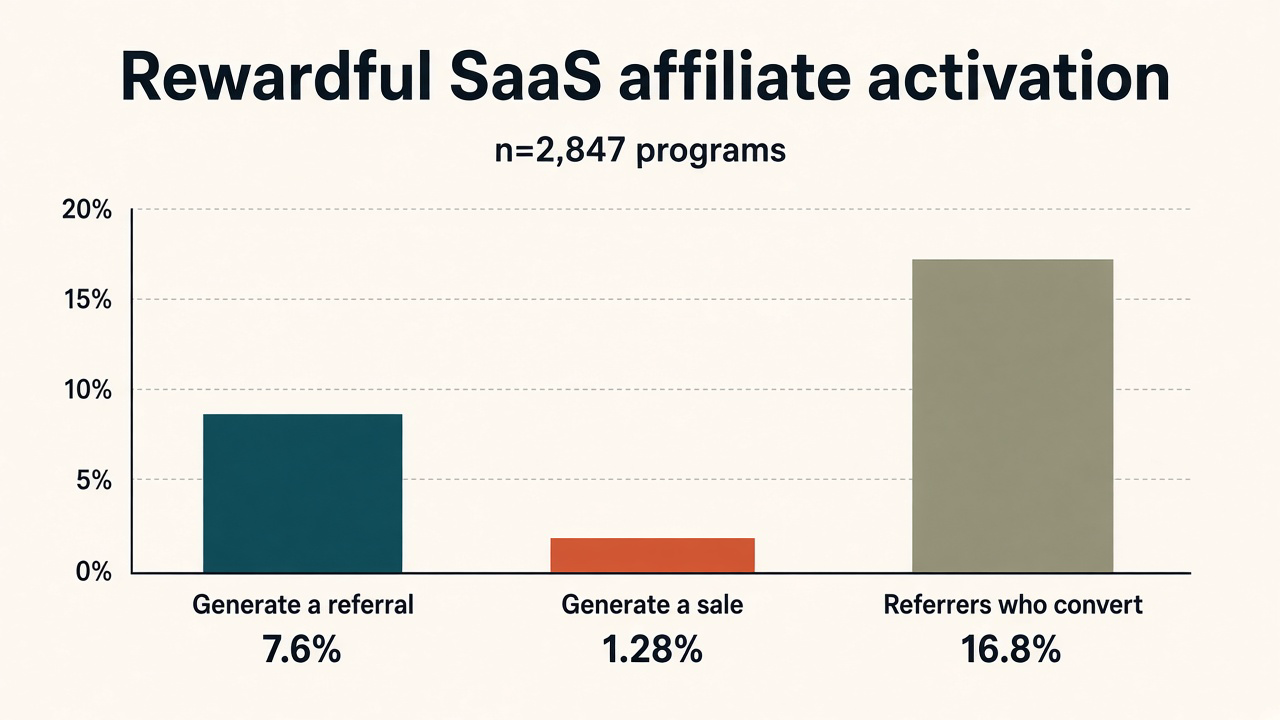
Source: Rewardful, State of SaaS Affiliate Programs Report (n=2,847 programs). https://www.rewardful.com/articles/state-of-saas-affiliate-programs-report.
Affiliate marketing vs storefront works as a stack of six assets. Score each one yes, rented, or no. A classic tracking link is strong at one row (credit) and weak at the rest. A storefront is the attempt to fill the other five without forcing you to manufacture the product.
| Asset | Classic affiliate link | Own-product storefront | Co-branded / marketplace storefront |
|---|---|---|---|
| 1. Traffic you control | You own the post, email, or SEO page | Same | Same |
| 2. Tracked referral | Yes, until the window and last-click rule say otherwise | You are the merchant | Yes, if the marketplace attributes the page |
| 3. Checkout experience | Merchant’s generic cart | Your cart, your copy | Co-branded cart: your face, their SKU |
| 4. Customer relationship | Usually no (Amazon’s customers stay Amazon’s) | Yes, if you capture the list | Shared: you stay visible; merchant still fulfills |
| 5. Offer control | Merchant sets price, stock, refunds | You set the offer | Merchant sets SKU; you curate which SKUs sit on your page |
| 6. Residual cash | Commission % they can change | Gross margin minus fees | Agreed revenue split on tracked sales |
There is no public dataset for the share of affiliates who “own the customer.” Treat that cell as a contract question, not a vibe.
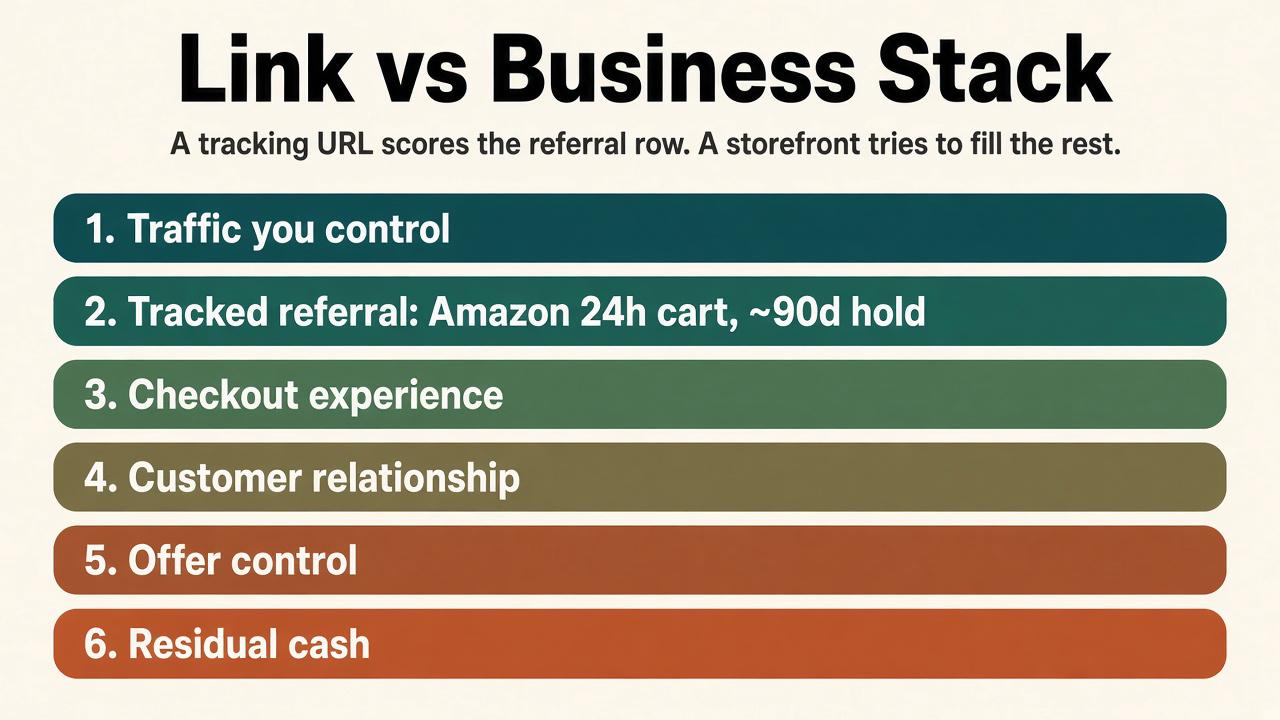
Source: Original Link vs Business Stack. Windows and rates cited from Amazon Associates Help, Rewardful, PMA, and CNBC as logged in the citation file.
A link is a permission slip with an expiry. Amazon: cart within 24 hours of the Associates click, then the cart can still convert for about 90 days if the item was already in it (Amazon Help). Shopify’s own Affiliates program tracks the click for 30 days (Shopify Affiliates). Rewardful’s default cookie is 60 days, configurable per campaign (Rewardful Help). Last-click still hands the sale to whoever closed. Full grammar: affiliate cookie duration and attribution windows.
If your “business” dies when a coupon site fires last, you did not have a business. You had a ranking in a cookie queue.
On April 14, 2020, Amazon told U.S. Associates the Operating Agreement would change on April 21. Furniture, home, and home improvement commissions moved from 8% to 3%. Grocery moved from 5% to 1% (CNBC). Search Engine Land recorded the same cut for headphones, beauty, musical instruments, and business supplies from 6% to 3% (Search Engine Land).
That is the rental agreement in public. Shopify’s planning bands still put many physical goods near 5%-15% and digital near 20%-50% (Shopify). Those bands are also merchant-set. A storefront does not magically raise the percentage. It changes whether your identity and URL still exist if the percentage moves.
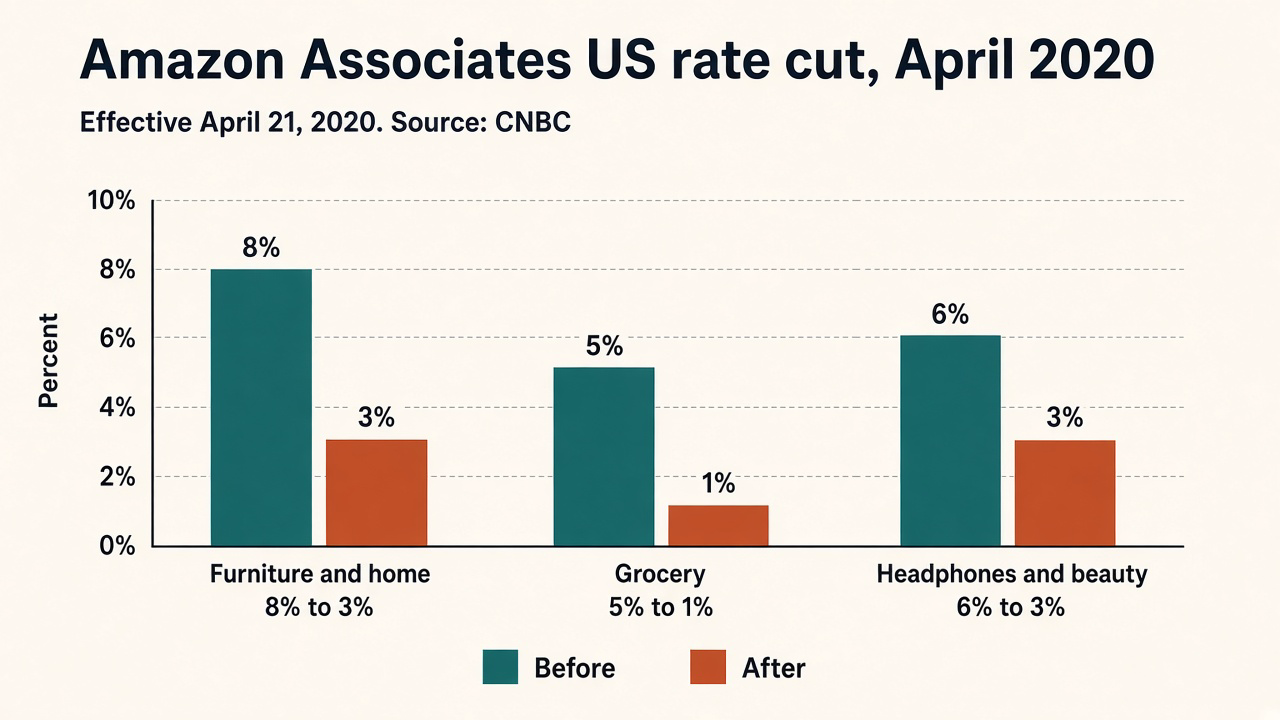
Source: CNBC, April 14, 2020 (Amazon spokesperson confirmation; document obtained by CNBC). Headphones/beauty band also reported by Search Engine Land, April 15, 2020. https://www.cnbc.com/2020/04/14/amazon-slashes-commission-rates-for-affiliate-program.html
Ranking pages flatten this into “affiliate vs ecommerce.” Ecommerce means you fund inventory, support, and refunds. That is a company. Affiliate means you fund content and hope tracking holds. A co-branded storefront sits between them: you still do not manufacture, and you are no longer only a UTM.
Use affiliate links when you are testing a SKU, posting a single product, or the merchant will not give you a page. Use an own-product storefront when you already have a SKU. Use a co-branded storefront when your audience trusts you and the product is someone else’s to fulfill. feat. is that third lane: merchant lists, affiliate promotes, buyer purchases on a generated storefront, with a split on the sale. We do not publish a platform cut here. If a vendor claims 30-214% conversion versus a generic affiliate landing, treat it as marketing until the sample and denominator are public (no public dataset).
FTC rules do not relax because the page looks like a shop. If you are paid, say so, clearly, on the same surface as the endorsement (16 CFR 255.5; FTC FAQ). Pair with affiliate marketing disclosure rules.
Moving from a link to a storefront is a destination change plus an asset score, not a new hustle identity.
Do not confuse this with dropping shipping. Dropshipping is a fulfillment model. Affiliate is a payment model. A storefront is a page. You can combine them badly. Score the stack instead.
Q: Is affiliate marketing a real business or just a link? A: Affiliate marketing is a real performance contract. PMA sized 2024 U.S. spend at $13.62B. For the individual, the asset is usually a tracked URL with an expiry, not a customer file. Call it a business only if you also own traffic, a selling page, and a contract you could survive a rate cut on.
Q: What is the difference between an affiliate link and a storefront? A: An affiliate link changes who gets credit. A storefront changes what the shopper sees after the click. You can use both: the link is distribution, the storefront is the destination. CreatorCommerce-style 30-214% lift claims are not a public census.
Q: Do affiliates own the customer? A: Usually no. Amazon’s program is built around Amazon customers buying on Amazon. A storefront can keep your name in the path and, on some rails, let you capture a relationship. There is no public dataset for a universal “percent who own the customer.” Read the contract.
Q: Is a storefront more expensive or slower than joining an affiliate program? A: Joining a program is faster: you get a link. Standing up a storefront costs time (and sometimes a SaaS fee on sell-own tools). Co-branded marketplace pages exist so you do not have to become the merchant to stop dumping traffic on a generic homepage. Compare published tool fees on Linktree vs storefront platforms. feat. fees are not invented here.
Q: Does a storefront mean I have to create my own product? A: No. Retailer and marketplace storefronts monetize other people’s catalogs. You need your own product only for a sell-own shop. Affiliate marketing vs selling your own products is a later fork, after you decide whether the click lands on a page that still looks like you.
Affiliate marketing vs storefront is not a personality test. A link is a rented claim on a future cart. A storefront is the system that tries to keep your recommendation intact until money moves. Use the Link vs Business Stack, the published clocks, and the 2020 Amazon rate card as the evidence. Then put your audience on a page that behaves like a shop.
If you want a product to sell through a co-branded storefront instead of a naked URL, start on the feat. marketplace.
Affiliate marketing for startups is an operating system—locks, cost, recruit, rates, tracking, first 100 sales, then diagnose a flat roster.
How to track affiliate sales: pick link cookie, coupon, pixel, S2S postback, or storefront checkout—then match Rewardful, Tapfiliate, or Impact.
Best affiliate programs for SaaS companies pass the Recurring Cap Test: labeled duration, cookie, seat type, payout rails—plus Rewardful’s ~24% planning band.