Affiliate Marketing for Startups: Complete Guide
Affiliate marketing for startups is an operating system—locks, cost, recruit, rates, tracking, first 100 sales, then diagnose a flat roster.
FTC affiliate disclosure rules: material connections, clear-and-conspicuous placement by surface, example wording, and advertiser monitoring duties.

TL;DR: Affiliate marketing disclosure rules under the FTC turn on one test: if a commission, gift, or other benefit would change how a significant minority of readers weigh your recommendation, disclose that material connection clearly and conspicuously on the same surface as the endorsement. Merchants must guide affiliates, monitor posts, and fix failures. This is compliance education, not legal advice.
Most affiliate “disclosure” debates are about magic words. The Federal Trade Commission cares about whether ordinary people can notice and understand that you get paid when they buy.
If you are looking up affiliate marketing disclosure rules because you run a program or you promote with tracked links, you need three things: the material-connection rule, a surface-by-surface placement checklist, and the merchant monitoring duty. A footer you wrote in 2019 will not save a TikTok that never says you earn a commission.
Key takeaways:
Affiliate marketing disclosure rules are the FTC’s expectations for telling audiences about unexpected material connections, including commissions earned through tracked links, when you endorse or recommend a product.
In the Endorsement Guides, a material connection is any link between the endorser and the seller that might materially affect the weight or credibility of the endorsement and that the audience would not reasonably expect. That includes monetary payment and free or discounted products (§ 255.5(a)). Example 11 walks through a coffee-maker blogger who earns a portion of the sale through affiliate links and must disclose that compensation clearly and conspicuously.
These Guides sit under Section 5 of the FTC Act. Staff guidance says the Guides themselves do not have the force of law, but practices inconsistent with them can support enforcement alleging Section 5 violations, and Notice of Penalty Offenses can open a civil-penalty path (FTC FAQ). The Commission finalized modernized Guides with an interactive-media disclosure standard in 2023 (Federal Register, July 26, 2023).
This article is for U.S.-facing affiliate programs and creators. It is not a substitute for counsel. Platform contracts (for example Amazon Associates sitewide language) can add requirements on top of FTC principles. Treat those as separate obligations.
The commercial loop underneath the disclosure is still how affiliate marketing works: unique ID, attribution window, qualifying event, approval, payout. Disclosure is the honesty layer on that contract, not a replacement for commission structure design.
Disclosure matters because trust is the product affiliates sell. Hide the commission and you train audiences to treat every recommendation as contaminated once they find out. Merchants inherit that mess: the Guides put guidance, monitoring, and remediation on advertisers, not only on creators.
Why founders and creators should care:
There is no public dataset that states what share of U.S. affiliate posts currently meet the clear-and-conspicuous standard. Do not trust a blog that invents a compliance percentage.
You identify the material connection, write language ordinary people understand, place it so it is unavoidable on that surface, and (if you are the merchant) run a guide-monitor-remedy loop. The legal standard is the same; the UI of each platform changes where “unavoidable” lives.
Under § 255.0(f), clear and conspicuous means the disclosure is difficult to miss (easily noticeable) and easily understandable by ordinary consumers. Match the medium: visual endorsements need a visual disclosure; audible endorsements need an audible one; both need both. On interactive electronic media such as social media or the internet, the disclosure should be unavoidable. It should not be contradicted or diluted by the rest of the post.
That definition is why “we disclosed in the footer” fails so often. Footers are easy to miss when someone lands mid-page from search or opens an app that truncates captions.
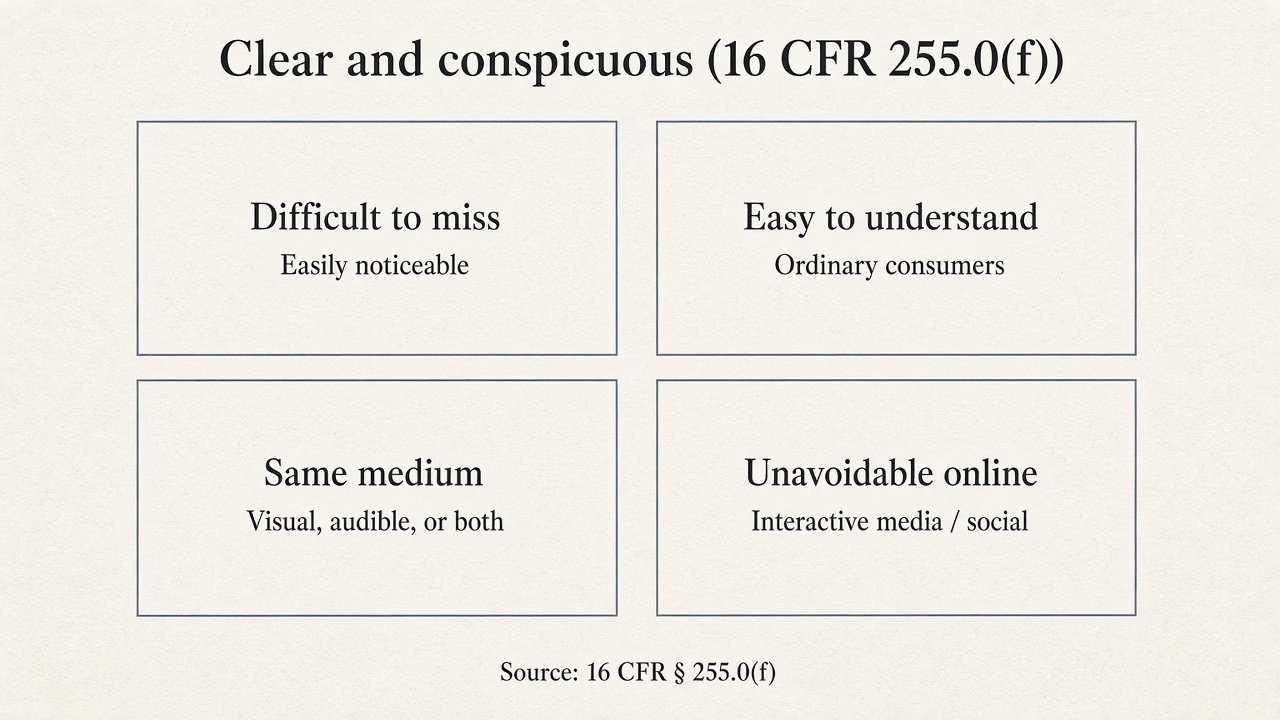
Source: 16 CFR § 255.0(f). https://www.ecfr.gov/current/title-16/chapter-I/subchapter-B/part-255/section-255.0
FTC staff does not mandate one script. For website affiliate marketers, the FAQ offers: “I get commissions for purchases made through links in this post” (FTC FAQ). Disclosures 101 also accepts simple terms such as “advertisement,” “ad,” and “sponsored,” and notes that #ad or #sponsored can accompany a disclosure (Disclosures 101).
What staff warns against:
| Label near the link | FTC staff view |
|---|---|
| “I get commissions for purchases made through links in this post.” | Usable example for site disclosures |
| “Paid link” next to the link | Should be adequate |
| “Affiliate link” alone | Consumers might not understand it means you get paid |
| “Buy now” button | Not an adequate disclosure of the connection |
| “Commissionable link” | Probably not clear |
| “sp,” “spon,” “collab,” stand-alone “thanks” / “ambassador” | Avoid; vague or confusing |
Use the same language as the endorsement. A Spanish caption needs a Spanish disclosure (Disclosures 101).
Build your program playbook from Disclosures 101 and the FAQ, not from whatever a theme plugin dumps in the footer.
| Surface | Put the disclosure… | Common failure |
|---|---|---|
| Blog / long article | Near the recommendation so the reader can see the disclosure and the affiliate link together; closer is better (FTC FAQ) | Only on an About page, or only below the fold after the review |
| Feed caption (IG/TikTok/X) | With the endorsement message, hard to miss, not buried in a hashtag pile or behind “more” (Disclosures 101) | #ad at the end of twenty hashtags |
| Stories / ephemeral images | Superimposed on the image with enough time to read (Disclosures 101) | Tiny text for half a second |
| Pre-recorded video | In the video itself (ideally audio and on-screen). Description alone is not enough (FTC FAQ; Disclosures 101) | Only a line under the YouTube description |
| Livestream | Repeated periodically so late joiners hear/see it (Disclosures 101) | One mention at minute one of a three-hour stream |
| Free product + affiliate links | Disclose free product and commissions in the video and near links in the description (FTC FAQ) | “Thanks for sending this” with silent commission links |
A single disclosure can be enough on a site when the review containing it and the link are visible together. If they are separated, readers may not connect them (FTC FAQ).
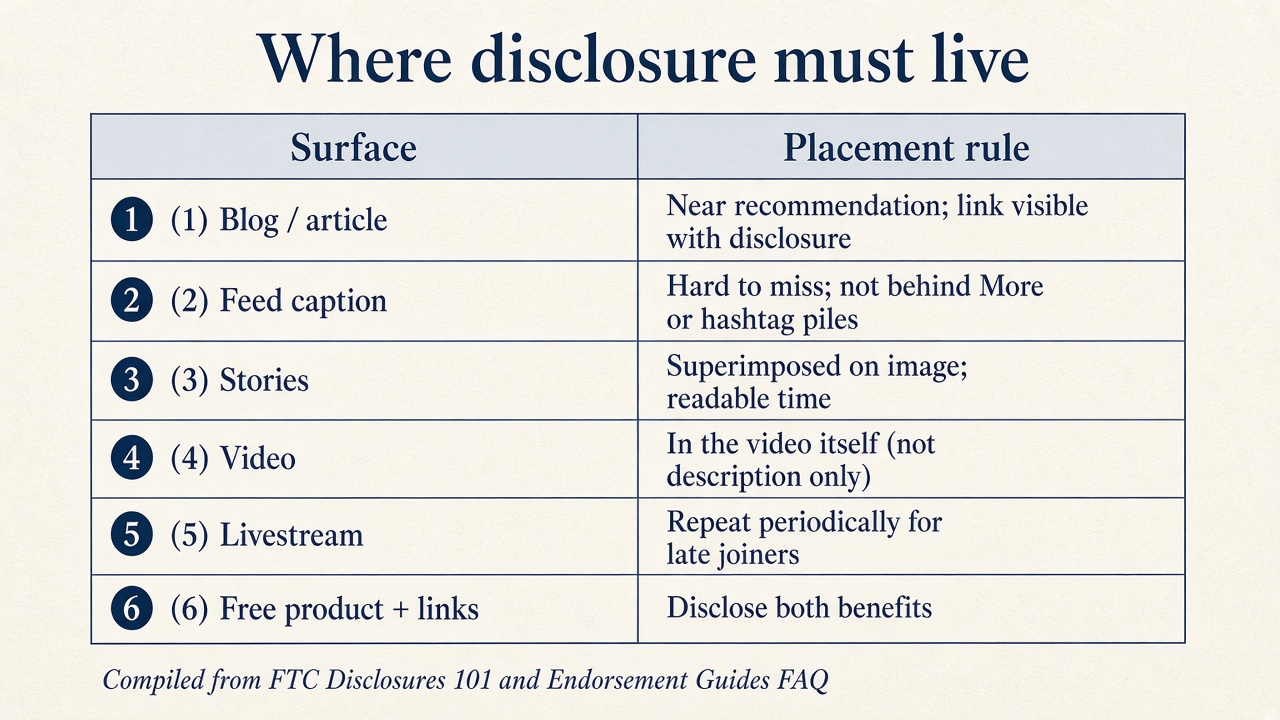
Source: Compiled from FTC Disclosures 101 (2019) and FTC Endorsement Guides FAQ. https://www.ftc.gov/business-guidance/resources/disclosures-101-social-media-influencers · https://www.ftc.gov/business-guidance/resources/ftcs-endorsement-guides-what-people-are-asking
If you pay affiliates or creators, § 255.1(d) is blunt. Advertisers should:
Good-faith guidance, monitoring, and remediation are not a formal safe harbor, but staff notes they should reduce deceptive claims and reduce enforcement odds (§ 255.1(d)). Example 7 ties the same idea to free-product seeding: advise disclosure and keep reasonable monitoring procedures (§ 255.5).
Practical merchant loop:
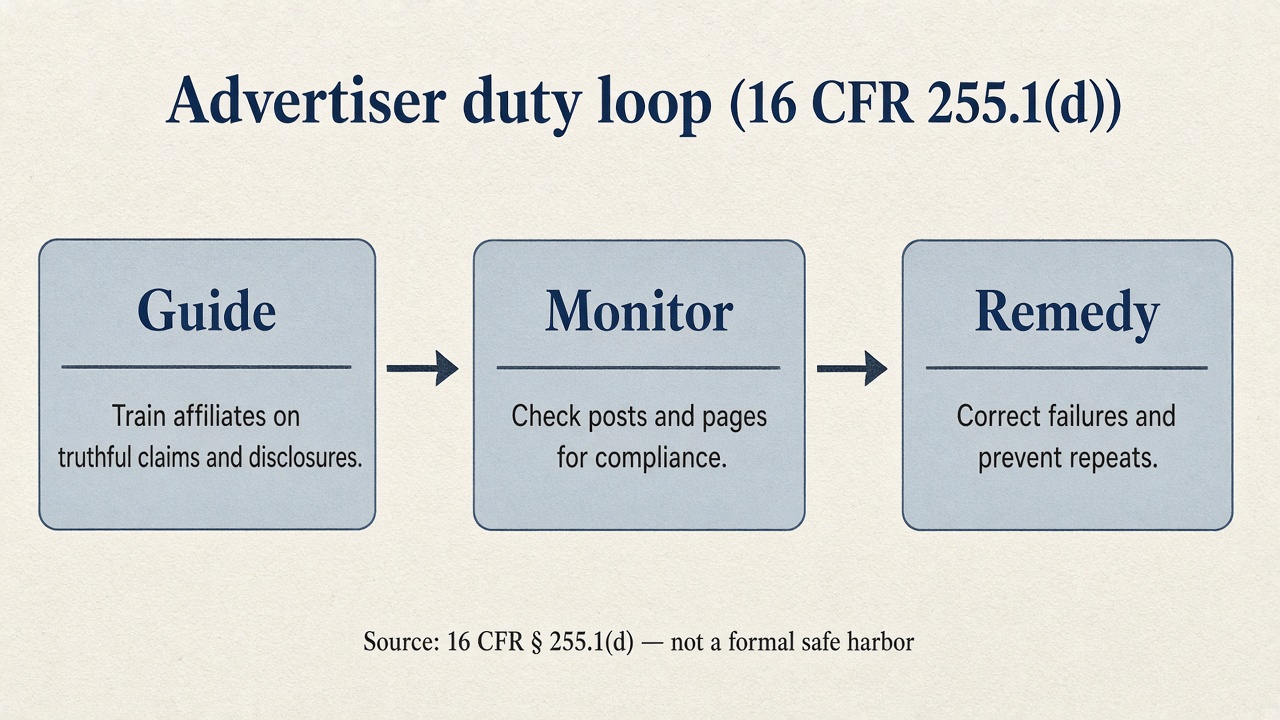
Source: 16 CFR § 255.1(d). https://www.ecfr.gov/current/title-16/chapter-I/subchapter-B/part-255/section-255.1
Creators still own their posts. Endorsers may be liable for failing to disclose unexpected material connections (§ 255.1(e)). “The brand didn’t remind me” is a thin defense when the commission is yours.
Treat disclosure as a pre-publish checklist, then as a merchant ops habit. Five steps keep both sides inside the Guides’ logic.
Fold these failures into the steps rather than a separate mistakes section: footer-only disclosures, description-only video tags, hashtag graves, assuming followers “already know,” and merchants who never open the posts they fund.
Q: Do affiliate marketing disclosure rules require a disclosure on every affiliate link? A: The FTC cares that readers can notice and understand the material connection, not that you stamp a ritual phrase after every URL. A single clear disclosure can suffice when the review and the links are visible together. If the recommendation and the links are separated, you likely need proximity that reconnects them (FTC FAQ).
Q: Is “affiliate link” enough for FTC affiliate disclosure? A: Staff says consumers might not understand that “affiliate link” means you get paid for purchases through the link. “Paid link” placed right next to the link should be adequate. “Commissionable link” is probably not clear (FTC FAQ).
Q: Can I put the disclosure only in a YouTube description? A: No. Many people never see the description. The disclosure has the best chance of being clear and conspicuous when it appears in the video itself, and staff often favors both audio and on-screen text (FTC FAQ; Disclosures 101).
Q: Are brands responsible for affiliate disclosure failures? A: Advertisers can be liable for failing to disclose unexpected material connections made through endorsements, even when the endorser is not liable. They should provide guidance, monitor compliance, and remedy failures (16 CFR § 255.1(d)).
Q: Do I need to disclose if I was not paid and only received a free product? A: Often yes. Free or discounted products are material connections when they might affect how the audience weighs the endorsement, even if the brand did not require a post (§ 255.5; Disclosures 101).
Affiliate marketing disclosure rules are a proximity and clarity problem dressed up as legalese. Name the material connection in plain words. Put that statement where ordinary people cannot miss it on the same surface as the endorsement. If you run the program, guide affiliates, monitor what they publish, and fix what fails. That is how you keep performance marketing honest without pretending a footer is a compliance program.
If you are a merchant building tracked, co-branded affiliate distribution with clearer program ops, start at https://www.feat.press.
Affiliate marketing for startups is an operating system—locks, cost, recruit, rates, tracking, first 100 sales, then diagnose a flat roster.
How to track affiliate sales: pick link cookie, coupon, pixel, S2S postback, or storefront checkout—then match Rewardful, Tapfiliate, or Impact.
Best affiliate programs for SaaS companies pass the Recurring Cap Test: labeled duration, cookie, seat type, payout rails—plus Rewardful’s ~24% planning band.