How to Choose an Affiliate Program to Promote
Choose an affiliate program with five gates—fit, dollars, attribution, settlement, rights. Amazon Table 1 often pays 1%–4% with a 24-hour cart cookie.
Earn your first affiliate sale with a 14-day sprint—one offer, one surface, cookie-matched CTA. Amazon needs cart within 24 hours; personal orders do not count.

TL;DR: How to get your first affiliate sale is a First-Sale Sprint: one Five-Gate offer, one Promotion Surface Ladder rung, one cookie-matched CTA, clear FTC disclosure, and a 14-day review. Amazon needs the item in cart within 24 hours—and that sale can also count toward the 3 qualifying purchases in 180 days. Personal orders do not count. Tip lists that open ten programs first are how you join the 1.28% who never sell.
Most beginners who ask how to get your first affiliate sale already have links—and no locked commission. They confuse activity with attribution. Rewardful’s SaaS sample finds only 1.28% of affiliates ever sell (n=2,847) (Rewardful). That is not a motivation poster. It is a density warning: dilute across ten offers and you will never learn what converted.
This is the seller’s first sale—not the merchant playbook for your first 100 affiliate sales. You already chose (Five-Gate Scorecard), joined (Three-Door Join Map), and know the Promotion Surface Ladder. Now you run one sprint until a sale locks—or you change one variable.
Key takeaways:
A first affiliate sale is the first qualifying event attributed to your tracking ID that the program later locks and pays—not a click, not a pending row you placed yourself, and not “someone said they bought it.”
It is the proof that destination, offer, and cookie lined up once. Everything after that is repetition and densification—not a new personality.
On feat., the first sale is a checkout on your co-branded storefront for a merchant-listed product. Same honesty test; different surface. See what is a creator storefront.
Wrong first-sale advice multiplies channels. Right first-sale advice multiplies learning per week. Cash timing still lags—Amazon pays about 60 days after the earnings month with $10 / $100 floors (Amazon payments)—so you score the sprint on locked attributions, not bank deposits.
Why constraints win:
There is no public dataset for a universal median “days to first affiliate sale.” Refuse invented 7-day / 90-day averages. Run your sprint and log your own.
The First-Sale Sprint is a 14-day, fail-closed plan. Change only one variable between sprints.
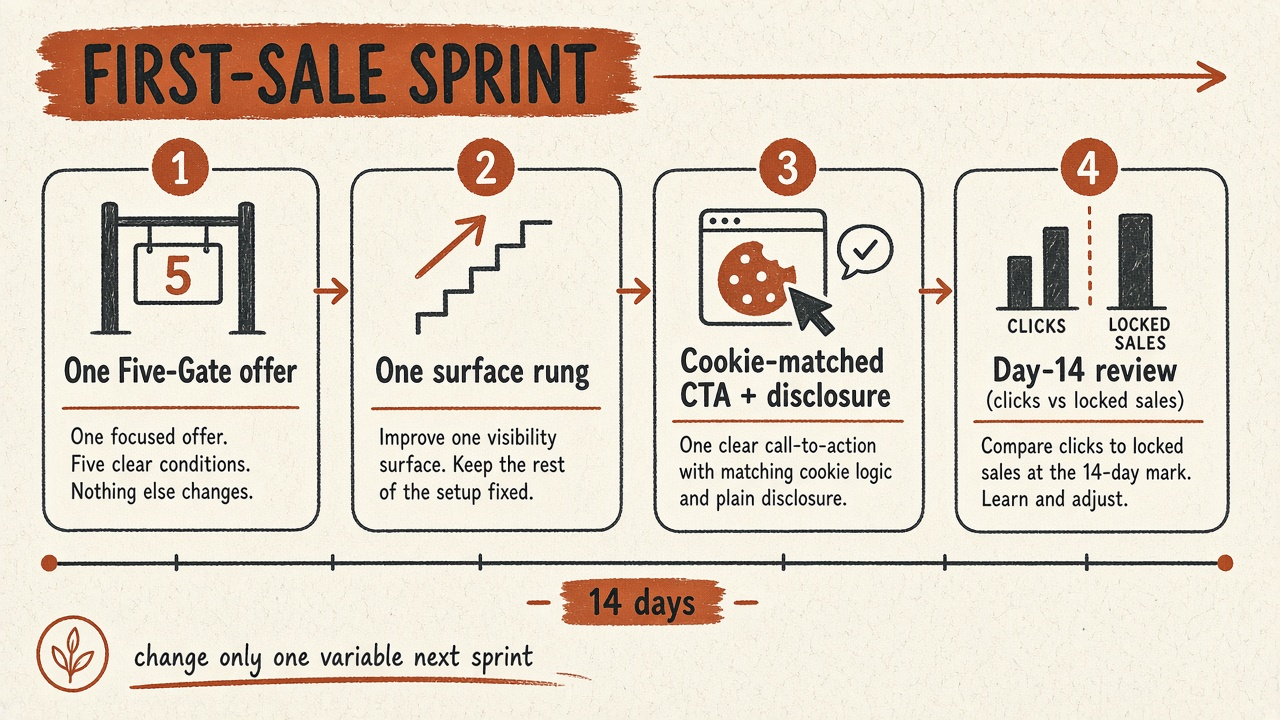
Source: Editorial framework synthesizing Amazon Associates Central help (3/180, 24h cart), Shopify commission bands, Rewardful activation, and FTC endorsement guidance. Taxonomy diagram, no invented days-to-first-sale medians.
One product that cleared the Five Gates. Prefer economics you can feel on a labeled $100 sale: Amazon Table 1 often $1–$4 at 1%–4%; Shopify-style digital midpoints near $35 at 20%–50% (Amazon Table 1; Shopify). Confirm you are approved—or that Amazon provisional sales also feed the 3-in-180 clock without personal orders (Amazon).
Lowest rung that fits from the Promotion Surface Ladder: owned intent page by default; email if you have a list; video if the product must be seen; community only if you already have trust; storefront if the reader needs a shoppable page (Lowe’s up to 20% / Sephora 15% examples (Sprout Social)).
| Surface | First-sale fit | Cookie pressure |
|---|---|---|
| Owned intent page | Best default for strangers via search | Prefer 30d+; Amazon only if cart is near |
| Best if you already have subscribers | Longer windows help considered buys | |
| Video / demo | When the product needs proof | Description + verbal CTA; mind 24h carts |
| Help-first community | Slow; high trust | No spam drops |
| Co-branded storefront | One merchant product needs a page | Storefront checkout attribution |
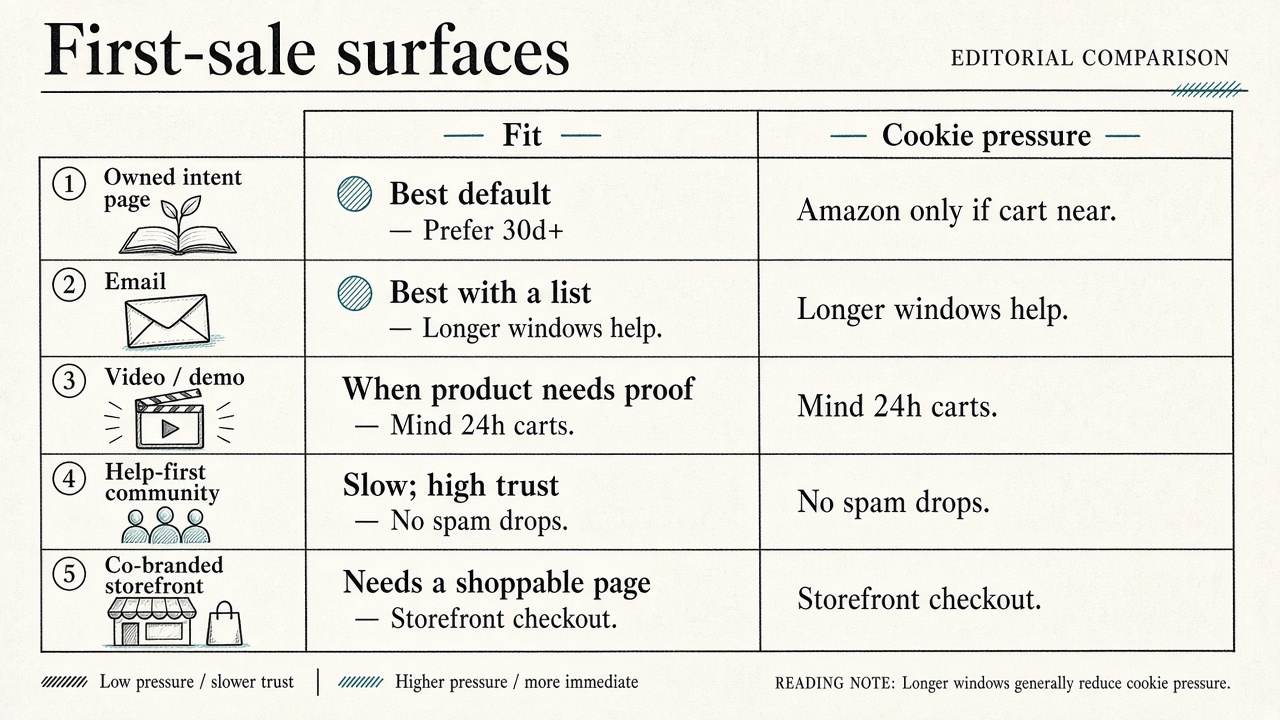
Source: Amazon cookie help; Sprout creator storefronts; FTC Endorsement Guides. Accessed 2026-10-09.
One review, comparison, or tutorial that would still help with every link removed. Structure it as decision help: who the product is for, who it is not for, one concrete use case, and a soft CTA. Place disclosure beside the recommendation—not only in a footer. One sub-ID for this sprint. Test the redirect chain so your ID survives. Cloaking notes: affiliate link cloaking and tracking.
If you are still on Amazon provisional status, treat this asset as dual-purpose: it can earn the first commission and count toward the 3 qualifying sales inside 180 days (Amazon). That only works with real buyers. Personal orders do not qualify (Amazon help).
Promote the same asset—do not invent three new channels mid-sprint. A second angle on the same URL (one follow-up email, one community answer that links back to the page) is allowed. A brand-new TikTok strategy on day 11 is not. On day 14, score: clicks, attributed sales (pending vs locked), which sentence drove the CTA. If Amazon shows zero, check cart timing before you blame the offer—the 24-hour window closes on order or another Associate’s link (Amazon cookie help). Cash may still be ~60 days out (Amazon payments).
Write the post-mortem in three lines: what I promoted, what I measured, what I change next. That note is more valuable than a motivational screenshot.
| Offer shape | Published signal | On $100 labeled sale |
|---|---|---|
| Amazon Table 1 (many retail) | Often 1%–4% | $1–$4 |
| Shopify-style physical | 5%–15% | $5–$15 |
| Shopify-style digital | 20%–50% | $20–$50 |
| Shopify-style subscriptions | 15%–30% recurring | $15–$30 first period |
| Rewardful SaaS average | 24.16% | $24.16 |
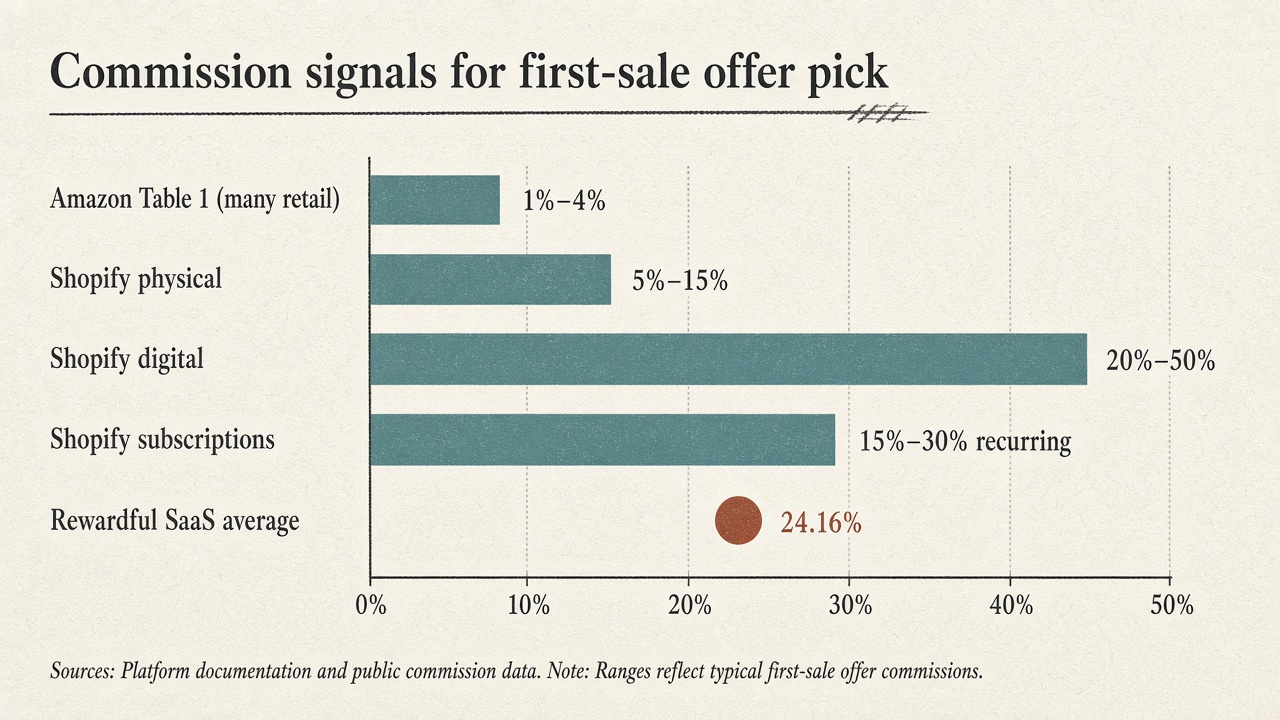
Source: Amazon Table 1. https://affiliate-program.amazon.com/help/node/topic/GRXPHT8U84RAYDXZ · Shopify Affiliate Commission Guide. https://www.shopify.com/blog/affiliate-commission · Rewardful State of SaaS Affiliate Programs. https://www.rewardful.com/articles/state-of-saas-affiliate-programs-report
If the sprint fails: change one of offer, surface, or CTA placement—not all three. Common failure modes: Amazon cart too slow for the content cycle; offer economics too thin to justify the work (Table 1 pennies on cheap SKUs); disclosure missing so the program or the platform flags you; or you measured bank deposit instead of locked attribution. Beginners with no list still start with one owned page—see how to start affiliate marketing with no audience.
When the first locked sale finally lands, do not celebrate by joining twenty more programs. Densify: run the same surface again, or graduate that offer to a co-branded storefront if readers needed a page. Merchant-side scaling is a different job—first 100 affiliate sales is for brands recruiting sellers, not for your second link.
Q: How do you get your first affiliate sale with no audience? A: Publish one buyer-intent page for one offer and share it where the problem already exists—search, a relevant community answer, or a tiny list. Audience size matters less than intent match and a cookie you can survive.
Q: How long does the first affiliate sale take? A: There is no public median. Run a 14-day sprint and measure locked attributions. Amazon cash can lag ~60 days after the earnings month even after a sale attributes.
Q: Can my own purchase count as my first affiliate sale? A: Not on Amazon Associates—personal orders do not qualify. Other programs often forbid self-purchases in their terms. Assume no until the contract says yes.
Q: Should I join many programs before my first sale? A: No. Rewardful finds only 1.28% of SaaS affiliates sell. One cleared offer beats ten idle approvals.
Q: Where does feat. fit for a first sale? A: When the missing piece is a co-branded storefront for a merchant-listed product—not another naked link. Fees stay in-product.
How to get your first affiliate sale is not a hustle collage. It is a First-Sale Sprint: one offer, one surface, one cookie-matched CTA, 14 days of honest review. Amazon’s clocks and Rewardful’s activation meters are constraints, not vibes. Fail a sprint on purpose once and you will stop confusing “I posted” with “a sale locked.”
If that first sale needs a co-branded storefront instead of another tracking link, start in the feat. marketplace.
Choose an affiliate program with five gates—fit, dollars, attribution, settlement, rights. Amazon Table 1 often pays 1%–4% with a 24-hour cart cookie.
Join affiliate programs through three doors—destination, proof, compliance. Amazon needs 3 qualifying sales in 180 days; personal orders do not count.
Promote affiliate products on a five-rung surface ladder—owned intent pages, email, video, community, storefront—matched to cookies and FTC disclosure.