How to Choose an Affiliate Program to Promote
Choose an affiliate program with five gates—fit, dollars, attribution, settlement, rights. Amazon Table 1 often pays 1%–4% with a 24-hour cart cookie.
Join affiliate programs through three doors—destination, proof, compliance. Amazon needs 3 qualifying sales in 180 days; personal orders do not count.

TL;DR: How to join an affiliate program is a Three-Door Join Map: destination (where the link will live), proof (published category content + a specific promo plan), and compliance (disclosure, tax/payment, rights). Amazon Associates requires 3 qualifying sales within 180 days—personal orders do not count—and looks for robust original content (about 10 posts as a rule of thumb). Vague “I’ll post on social” applications fail on purpose.
Most creators who ask how to join an affiliate program treat applications like lottery tickets. They spray fifty networks with a Gmail address and wonder why finance brands and SaaS teams say no. Meanwhile Amazon’s clock is already running: after you apply, you have 180 days to refer 3 qualifying sales before the application can be withdrawn (Amazon Associates Central).
Joining sits between choosing and promoting. Pick the offer with the Five-Gate Program Scorecard, clear the three doors here, then promote on the Promotion Surface Ladder. Shopify’s bands still matter once you are in—physical often 5%–15%, digital 20%–50%, subscriptions 15%–30% recurring (Shopify)—but an unapproved seat earns 0%.
Key takeaways:
Joining an affiliate program is getting contractual permission to promote a merchant’s tracked offer and to be paid for qualifying events under that program’s attribution and payout rules.
It is not “create a network account and you are done.” On CJ, Impact, Awin, and similar platforms, the network login is a hallway; each merchant still reviews you. It is also not the same as Amazon Influencer registration—see Amazon Influencers vs Amazon Associates.
On feat., “joining” looks like approval to sell a merchant-listed product from a co-branded storefront—closer to seating than to a naked tracking link. Compare affiliate marketing vs storefront.
Wrong applications waste weeks and burn brand goodwill. Right applications still fail if you ignore Amazon’s sales clock or apply to a fifty-seat retailer program as if it were auto-approve retail.
Why doors beat spray-and-pray:
There is no public dataset for a universal approval rate by affiliate network. Treat each program’s eligibility page as the source of truth.
The Three-Door Join Map is fail-closed. Fix the failed door before you reapply. Then pick the path type that matches your destination.
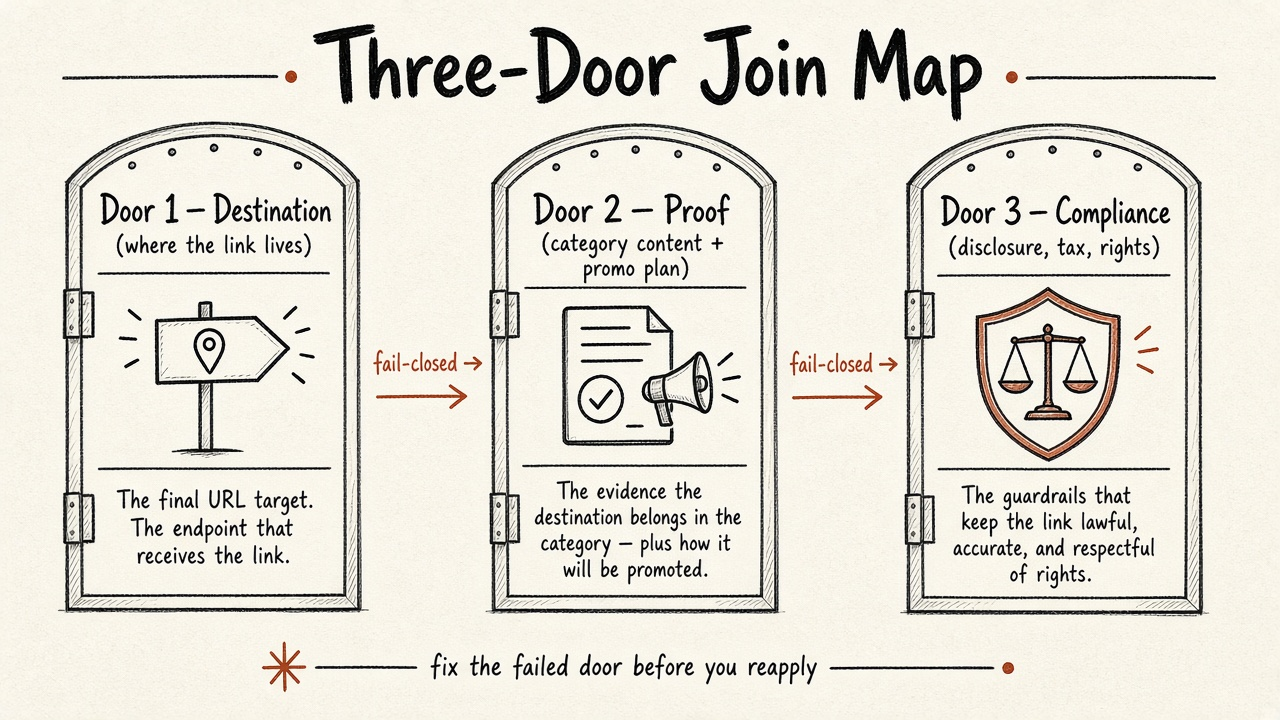
Source: Editorial framework synthesizing Amazon Associates Central help (3 sales/180 days; ~10 posts), Sprout creator-storefront capacity, Rewardful activation, and FTC endorsement guidance. Taxonomy diagram, no invented network approval rates.
Where will the link live? A public site, newsletter archive, YouTube channel, or storefront page. If you cannot paste a live URL in the application, stop. For beginners, how to start affiliate marketing with no audience still starts with one owned surface.
Show category content that already exists—or ship it before you apply. Link two or three pieces. Write five sentences: who you reach, where the product appears, and what “value beyond a link” means (comparison, tutorial, demo).
Read prohibited-channel rules (coupon sites, trademark bidding, paid search). Draft the disclosure you will publish. Complete tax and payout fields so approval can become cash. Rights detail: affiliate program terms of service.
| Path type | How join works | Hard clock / gate | Best when |
|---|---|---|---|
| Amazon Associates–style provisional | Apply → promote → earn 3 qualifying sales in 180 days → review | 3 sales / 180 days; personal orders out; ~10 posts | Catalog retail + public content |
| Network → merchant | Network account, then per-brand applications | Manual review days–weeks | Many brands in one niche |
| Brand-direct / SaaS tracker | Apply on the brand’s page (Rewardful-class, in-house) | Founder or AM inbox timing | One product you already teach |
| Capacity-gated storefront | Apply to a limited creator/storefront cohort | e.g. Sephora ~50 of 14,000+ | You need a shoppable page, not a parameter |
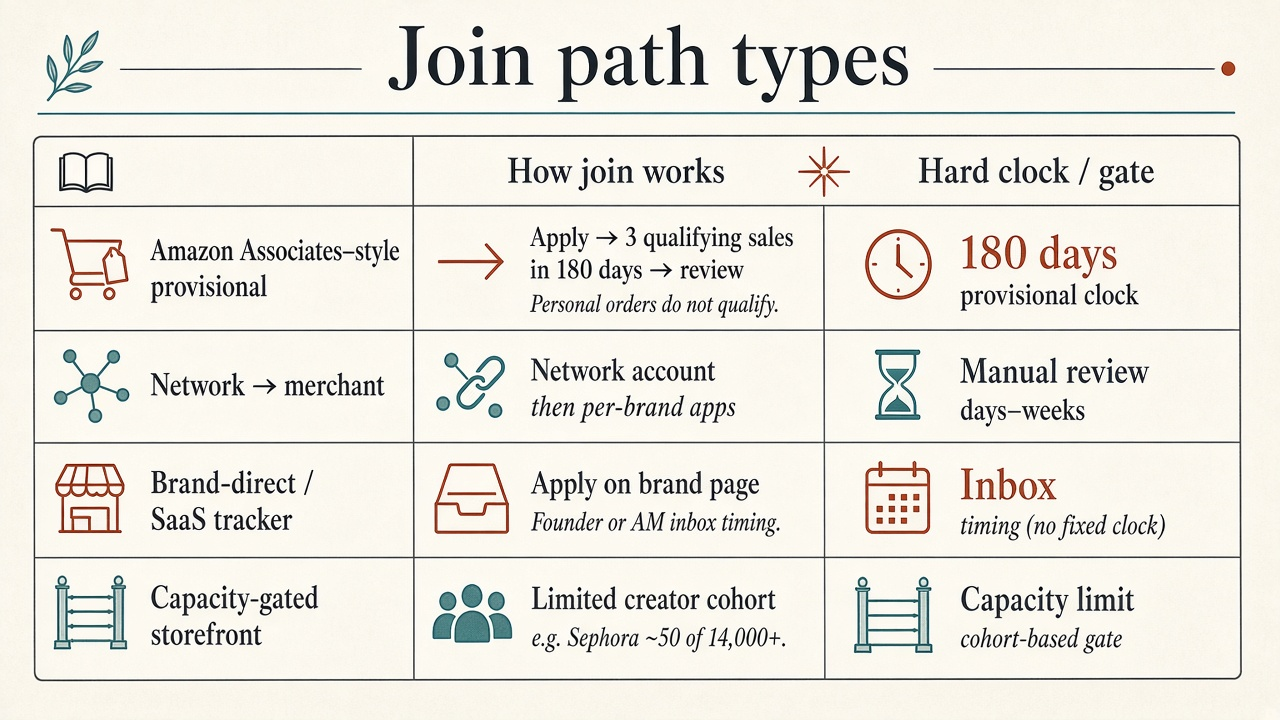
Source: Amazon Associates Central help. https://affiliate-program.amazon.com/help/node/topic/G7MJTPEP9NC3YKMG · https://affiliate-program.amazon.com/help/node/topic/G8TW5AE9XL2VX9VM · Sprout Social creator storefronts. https://sproutsocial.com/insights/creator-storefronts/
Amazon is the most quoted “easy join.” It is easy to start and easy to fail the probation math.
| Amazon join constraint | Published signal | Source |
|---|---|---|
| Qualifying sales to complete review | At least 3 within 180 days of apply | Amazon G7MJTPEP9NC3YKMG |
| Personal / self orders | Do not qualify | Amazon G8TW5AE9XL2VX9VM |
| Content bar (rule of thumb) | ~10 original public posts; Sites publicly available | Amazon G8TW5AE9XL2VX9VM |
| Cart attribution after join | 24 hours to cart; ~90-day cart expiry | Amazon cookie help |
| Everyday retail commission band | Often 1%–4% (Table 1) | Amazon Table 1 |
| Cash after approval | ~60 days after month; $10 / $100 floors | Amazon payments |
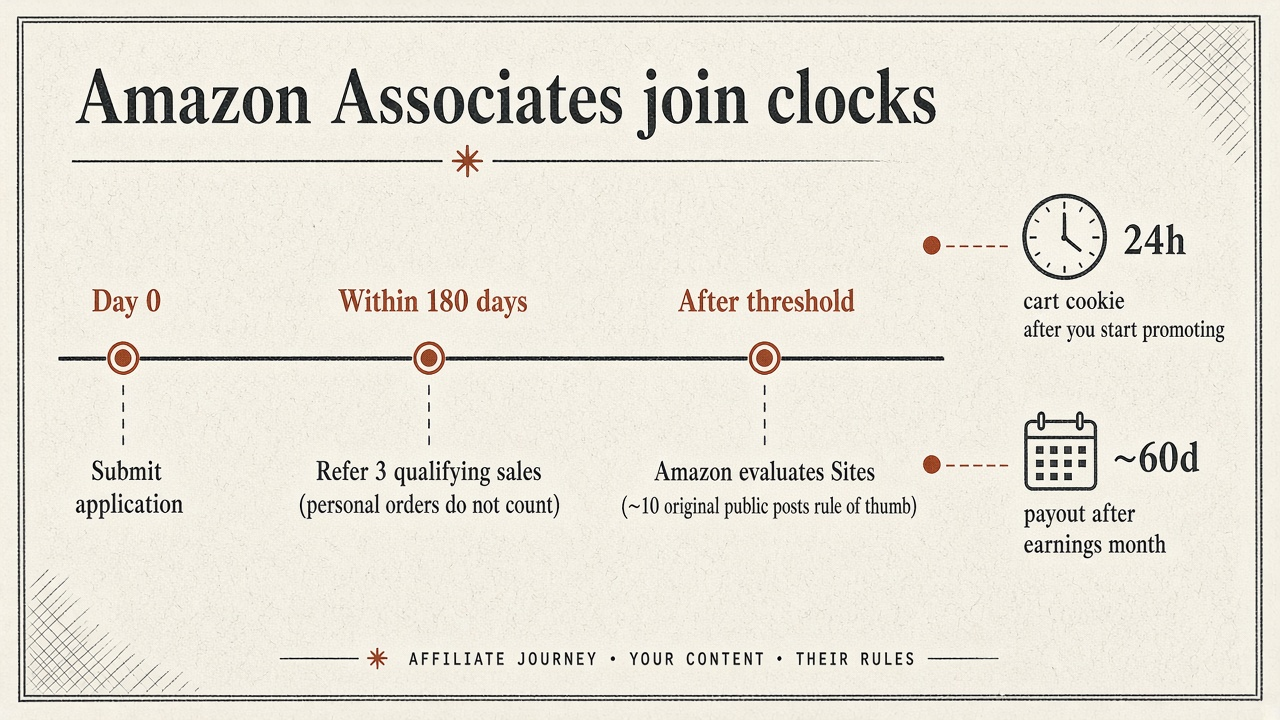
Source: Amazon Associates Central help topics G7MJTPEP9NC3YKMG and G8TW5AE9XL2VX9VM. https://affiliate-program.amazon.com/help/node/topic/G7MJTPEP9NC3YKMG
After you join, promotion still has to match the cookie—Amazon’s 24-hour cart rule fails slow newsletter strategies (Amazon cookie help). Storefront examples like Lowe’s (up to 20%, 30-day window) and Sephora (15%) are different seats entirely (Sprout Social).
If rejected: fix the named gap, ship proof URLs, and send one short appeal. Do not open a second account to dodge a decline.
Q: How do you join an affiliate program if you are a beginner? A: Pick one path, clear destination/proof/compliance, and apply with specific URLs. Amazon’s provisional path is common, but you still need 3 qualifying sales in 180 days and public original content.
Q: Do I need a website to get approved? A: Many programs accept YouTube, newsletters, or social as Sites—if they are public and content-rich. Amazon explicitly reviews the Sites you list; empty or closed destinations fail.
Q: How long does affiliate program approval take? A: Amazon-style paths can move after you hit the sales threshold; network and brand-direct reviews often take days to a few weeks. Capacity-gated storefronts may take a full cohort cycle—or never open a seat.
Q: Why was my affiliate application rejected? A: Usually a failed door: weak destination, no category proof, vague promo plan, or a rights mismatch. Fix the gap and reapply once—do not multiply accounts.
Q: Where does feat. fit when joining programs? A: As marketplace storefront seating: you request to sell a merchant-listed product from a co-branded page. It replaces neither Amazon’s sales clock nor reading each brand’s terms. Fees stay in-product.
How to join an affiliate program is not a hundred tab applications. It is a Three-Door Join Map—destination, proof, compliance—on a path whose clocks you can actually meet. Amazon’s 3-in-180 rule, Sephora-class capacity, and Rewardful’s activation meters are planning constraints. Fail a door on purpose once and you will stop confusing “submitted” with “approved to earn.”
If the seat you want is a co-branded storefront instead of another tracking link, start in the feat. marketplace.
Choose an affiliate program with five gates—fit, dollars, attribution, settlement, rights. Amazon Table 1 often pays 1%–4% with a 24-hour cart cookie.
Earn your first affiliate sale with a 14-day sprint—one offer, one surface, cookie-matched CTA. Amazon needs cart within 24 hours; personal orders do not count.
Promote affiliate products on a five-rung surface ladder—owned intent pages, email, video, community, storefront—matched to cookies and FTC disclosure.