Affiliate Marketing for Startups: Complete Guide
Affiliate marketing for startups is an operating system—locks, cost, recruit, rates, tracking, first 100 sales, then diagnose a flat roster.
Affiliate link cloaking and tracking: branded redirects vs deceptive cloaking, Amazon's obscure/unclear tests, and why FTC disclosure still applies.

TL;DR: Affiliate link cloaking and tracking explained: a branded redirect hides the ugly network URL behind a short link you control. That is usually a presentation and tracking choice, not a disclosure escape hatch. Amazon bans redirects that obscure your site or make the Amazon destination unclear, and FTC material-connection disclosure still applies on the same surface as the link.
People say “cloaking” like it is one crime. Most of the time they mean a Pretty Links-style hop on their own domain. Sometimes they mean showing Google one page and users another. Those are not the same job.
Affiliate link cloaking and tracking explained only helps when you separate three questions: what the shopper sees, what the network can attribute, and what the law and the program contract still require. Mix them up and you either get banned for a shortener that hid “Amazon,” or you skip FTC disclosure because the URL looked “clean.”
Key takeaways:
rel="sponsored" on paid or advertisement links, on the visible <a> the crawler sees (Google Search Central).Affiliate link cloaking is the practice of wrapping a long, parameter-heavy affiliate tracking URL behind a shorter, often branded URL so the visitor sees yoursite.com/go/tool instead of a network click string, while a server-side redirect still sends them through the tracked Special Link.
Tracking is the layer that attributes the click (and later the sale) to your partner ID: query parameters, cookies, click IDs, and the network’s attribution window. Cloaking changes the visible link. It should not erase the tracked hop. If your redirect drops the affiliate parameters, you did not cloak. You broke the commission.
This is different from:
If you only remember one sentence: cloaking is presentation plus redirect control. Disclosure and program rules still sit on top.
Ugly URLs get clipped in DMs. Raw tags get stripped by curious readers. Amazon bans look random until you read the obscure and unclear clauses. Merchants care because cloaked links they cannot audit become a trust and fraud problem.
Why the stack is a founder-level issue:
href. Put rel="sponsored" there for paid placements (Google Search Central).If you run a program, write cloaking rules into your advertiser terms. Open networks do not always ban branded redirects network-wide; individual programs often do. Secondary reviews of Awin and CJ public terms find no Amazon-equivalent network-wide ban, so check the program sheet (Make Influence).
A branded redirect is an owned hop that 301/302s to a network Special Link after the user clicks. Amazon’s tests ask whether Amazon can still see your site and whether the shopper can tell the destination is Amazon. FTC disclosure and Google rel="sponsored" apply to the visible link either way.
| Type | What happens | Usually OK when… | Usually a problem when… |
|---|---|---|---|
| Branded redirect | User clicks your domain; server redirects to tracked affiliate URL | User clicked; destination is clear; network/program allows it | Amazon destination is hidden; Amazon cannot see referring site |
| Tracking hop | Intermediate tracker logs click, then sends to merchant | Affirmative click; parameters preserved | Auto-bounce with no click (Amazon Redirecting Link pattern) |
| Deceptive cloaking | Bots/reviewers see different content or destination than users | Almost never for affiliates | Ad review evasion, SEO cloaking, cookie stuffing |
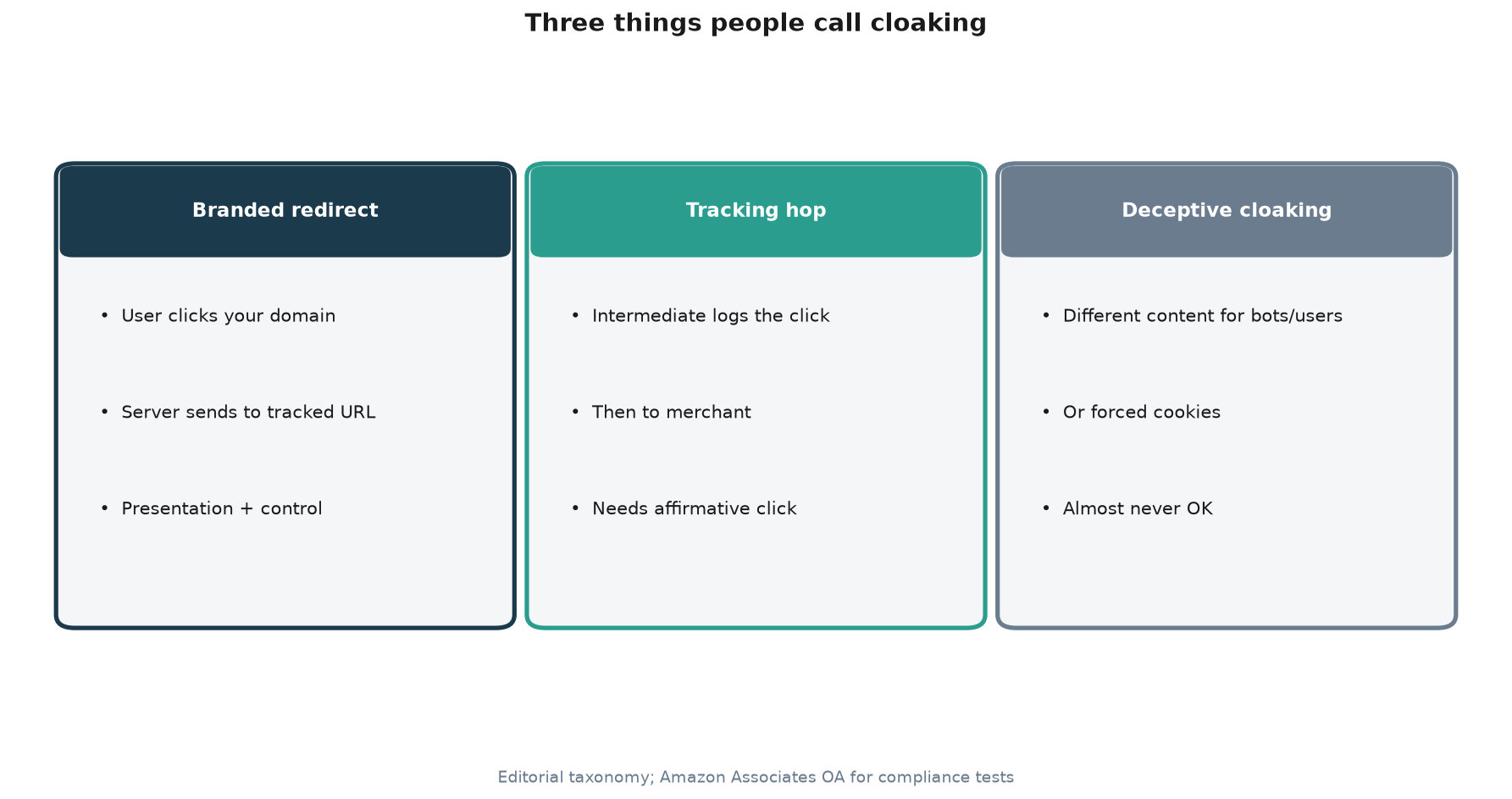
Source: Editorial taxonomy for this article; Amazon tests from Associates Operating Agreement. https://affiliate-program.amazon.com/help/operating/policies
Healthy path:
yoursite.com/go/product.Amazon’s Redirecting Link definition targets the broken version of step 2: an intermediate site that forwards the user to Amazon without requiring a click or other affirmative action on that intermediate page (Amazon Associates policies). If your “cloaker” auto-loads Amazon in an iframe or meta-refresh with no user action, you are not being clever. You are building a Redirecting Link.
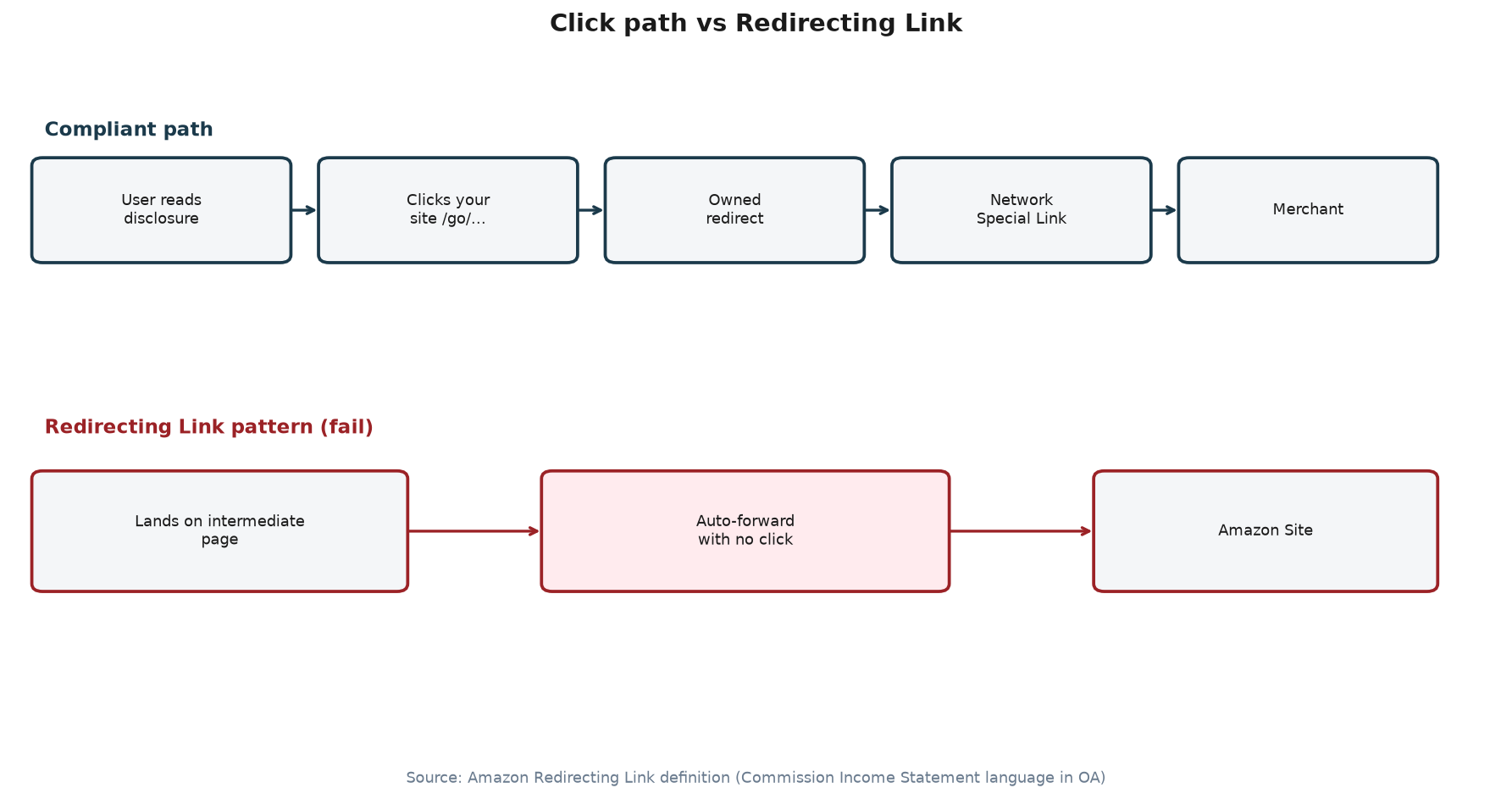
Source: Editorial flowchart; Redirecting Link definition from Amazon Associates Commission Income Statement language in the Operating Agreement. https://affiliate-program.amazon.com/help/operating/policies
Read the Operating Agreement as three related tests, not one vague “no cloaking” myth.
| Test | Contract language (paraphrased from Amazon OA) | Practical pass | Practical fail |
|---|---|---|---|
| Obscure referring site (v) | Do not cloak, hide, spoof, or obscure your Site URL (including via Redirecting Links) or user agent so Amazon cannot reasonably determine the referring site/app | Amazon can attribute the click to your registered site | Spoofed referrers, hidden origins, hops that erase your site identity |
| Unclear Amazon destination (w) | Do not use shorteners, buttons, or hyperlinks in a manner that makes it unclear the user is linking to an Amazon Site | Anchor, button, or URL context says Amazon | “Secret deal” buttons with no Amazon signal; shorteners that hide the merchant |
| Redirecting Link | Intermediate hop to Amazon without affirmative user action on that intermediate site | User clicks on your page before leaving | Auto-redirect landers, silent forwards |
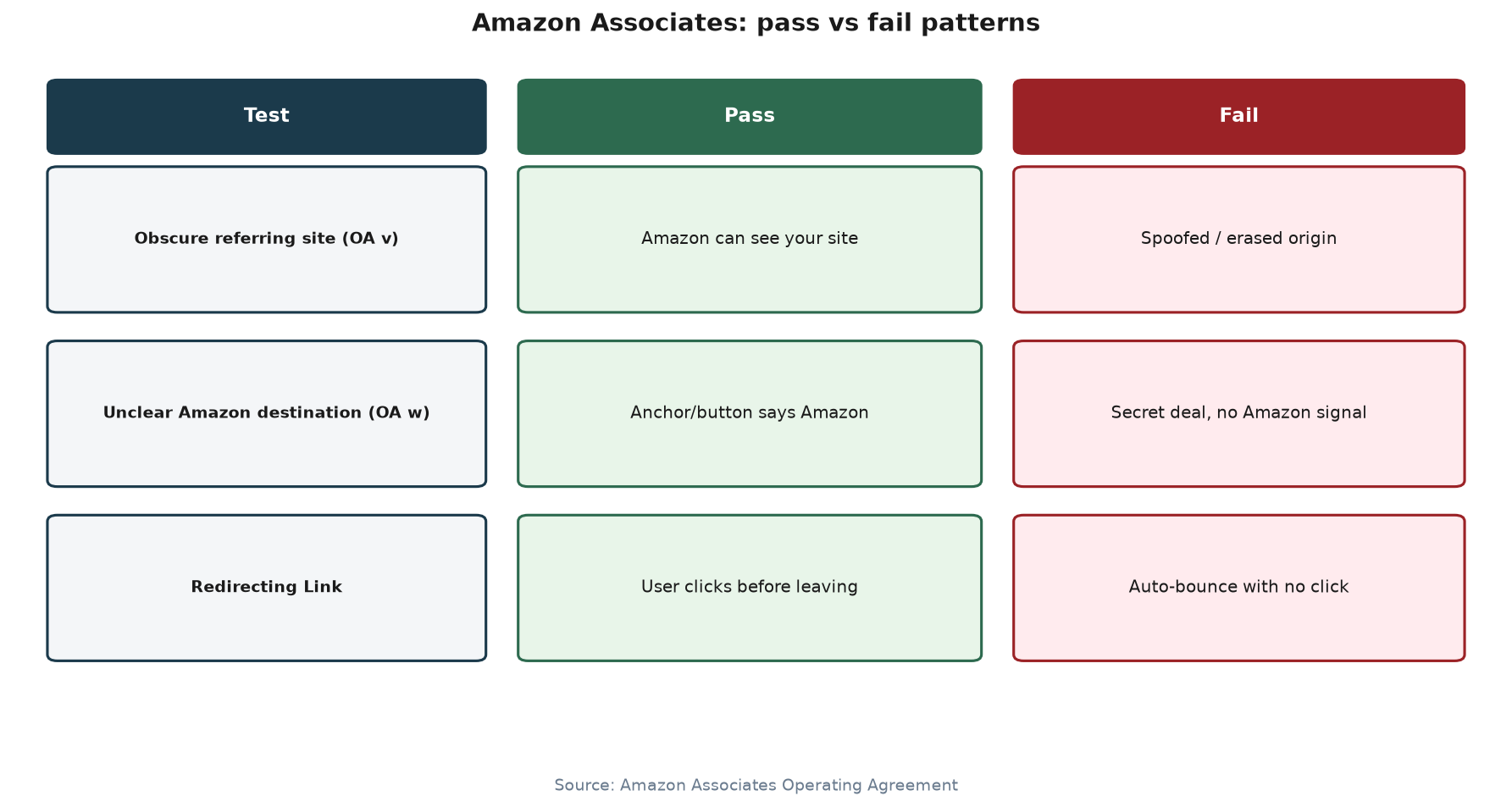
Source: Amazon Associates Operating Agreement sections on cloaking, link shortening, and Redirecting Links. https://affiliate-program.amazon.com/help/operating/policies
Community enforcement stories match the unclear-destination test: people report Amazon asking them to put “Amazon” in the visible link or button text after shortener crackdowns. Use that as operational hygiene. Do not invent a ban-rate percentage.
Amazon also requires a sitewide Associates statement such as “As an Amazon Associate I earn from qualifying purchases” (or a substantially similar statement previously allowed) (Amazon Associates policies). That is program disclosure on top of FTC principles, not a substitute for them.
A cloaked URL does not change whether a commission is a material connection. The Endorsement Guides (modernized in 2023) still expect clear and conspicuous disclosure when that connection would affect how people weigh the endorsement (Federal Register; FTC FAQ).
Staff example language for sites includes lines like “I get commissions for purchases made through links in this post.” “Paid link” near a link can work; vague labels can fail. Full surface checklist lives in affiliate marketing disclosure rules. This article’s point is narrower: cloaking does not buy you an exemption.
rel="sponsored" on the outer linkGoogle Search Central tells you to mark advertisements or paid placements with rel="sponsored". nofollow remains acceptable; sponsored is preferred (Google Search Central). On a cloaked link, the crawler reads the visible href on your page. Put the attribute on that outer tag. Do not assume a network destination you never expose in HTML is “already marked.”
Helps:
Theater or risk:
For platform choice context (Amazon vs networks), see best affiliate marketing platforms. For how the performance contract works end to end, see how affiliate marketing works.
Use a redirect for cleanliness and tracking control. Pass Amazon’s tests if you promote Amazon. Disclose every time.
yoursite.com/go/... is auditable. Mystery shortener domains are harder to defend when a program asks where traffic came from.rel="sponsored" on the visible link.Q: What is affiliate link cloaking and tracking? A: Cloaking wraps a long affiliate tracking URL behind a shorter, often branded link on a domain you control. Tracking is the partner ID and attribution system that still needs to fire on the redirect. Cloaking changes what people see; it should not erase the tracked hop or your disclosure duty.
Q: Is affiliate link cloaking legal? A: Branded redirects are not illegal by default in the U.S. Deceptive practices (different content for bots and users, forced cookies, hidden commercial relationships) can violate FTC rules and program contracts. Amazon Associates adds contractual tests about obscuring your site and making the Amazon destination unclear.
Q: Does Amazon ban cloaked affiliate links? A: Amazon does not publish a blanket “no short URLs” rule. It bans cloaking that prevents Amazon from determining your referring site, shorteners used in a manner that makes the Amazon destination unclear, and Redirecting Links that auto-forward without an affirmative user action. Clarity and a real click are the operational answers.
Q: Do I still need FTC disclosure if my affiliate links are cloaked? A: Yes. Disclosure depends on the material connection (including commissions), not on whether the URL is pretty. Place a clear disclosure on the same surface as the endorsement. Amazon’s required Associates statement is additional program language, not a substitute for FTC principles.
Q: Does cloaking protect commissions from browser extensions? A: No. Owned redirects can reduce accidental parameter clipping on shares. They do not stop a checkout extension from competing for last-click credit. That is a different mechanism from URL presentation.
Affiliate link cloaking and tracking is a stack: owned redirect for cleanliness, preserved Special Link for attribution, Amazon’s obscure/unclear/Redirecting Link tests when you sell Amazon, and FTC disclosure on the same surface every time. Cloaking is not a costume for a secret ad. It is plumbing. Build it so the shopper, the network, and the regulator can all see what is going on.
If you want affiliates promoting through co-branded storefronts with clearer commerce surfaces than a soup of raw tracking URLs, explore products on the feat. marketplace.
Affiliate marketing for startups is an operating system—locks, cost, recruit, rates, tracking, first 100 sales, then diagnose a flat roster.
How to track affiliate sales: pick link cookie, coupon, pixel, S2S postback, or storefront checkout—then match Rewardful, Tapfiliate, or Impact.
Best affiliate programs for SaaS companies pass the Recurring Cap Test: labeled duration, cookie, seat type, payout rails—plus Rewardful’s ~24% planning band.