Affiliate Marketing for Startups: Complete Guide
Affiliate marketing for startups is an operating system—locks, cost, recruit, rates, tracking, first 100 sales, then diagnose a flat roster.
Start affiliate marketing with no audience by borrowing search and community traffic. Compare four paths and plan clicks with median EPC data.

TL;DR: You can start affiliate marketing with no audience by borrowing distribution from search, video search, communities, or a marketplace instead of waiting for followers. Pick one path, promote offers inside Shopify-style commission bands, and plan with public EPC math (median about $0.14 per click on one large network sample). Audience size is the output of useful content, not the entry ticket.
The most common objection I hear from people who want to start affiliate marketing with no audience is that Instagram or TikTok comes first. That framing is backwards. Followers are one distribution channel. They are not the mechanism that pays.
Affiliate marketing pays when a tracked click becomes a qualifying action. Search, tutorials, niche forums, and co-branded storefronts can deliver those clicks before anyone follows you. The trap is treating “no audience” as a reason to buy a course that promises overnight income, or to spray coupon links into communities that ban you.
Key takeaways:
Affiliate marketing with no audience is starting performance referrals by using search, communities, or marketplaces for reach instead of an existing social following.
You still need the same contract described in how affiliate marketing works: a merchant offer, a unique tracking ID, an attribution window, a qualifying event, approval, and payout. What changes is the traffic source. Instead of posting to people who already know you, you publish answers where buyers already look, or you join a surface that routes buyers to you.
This is not a loophole around trust. Cold traffic is less forgiving than a warm following. Your review has to be clearer, your comparison table has to be fairer, and your disclosure has to be obvious. The upside is that you do not wait years to “build a brand” before you learn whether an offer converts.
Reddit threads put the same idea in plainer words. In r/Affiliatemarketing, the working advice clusters around one problem, long-tail searches, and a tiny email list rather than viral follower counts. In r/AffiliateMarket, beginners who cannot record video still get pointed at SEO blogs, Pinterest, and value-first Reddit answers. The language is consistent: intent over vanity metrics.
Starting without an audience matters because most people who want the channel do not have a creator career, and waiting for one is a fake prerequisite.
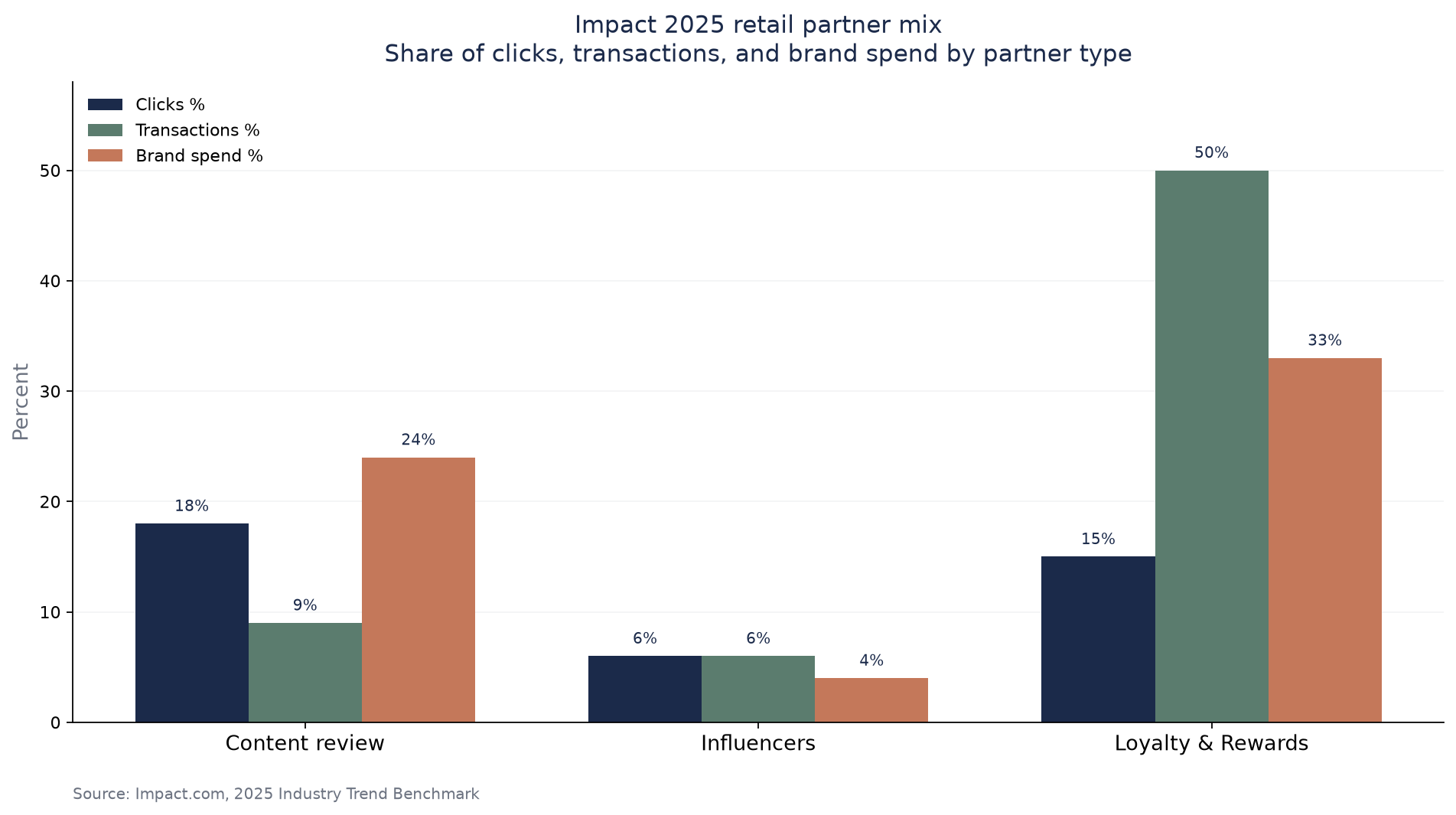
Source: Impact.com, 2025 Industry Trend Benchmark. https://impact.com/affiliate/affiliate-marketing-benchmark/
How to start affiliate marketing with no audience is a path choice plus click math: pick one distribution surface you can sustain, join offers that fit Shopify-style bands and EPC reality, then publish buyer-intent answers until tracked clicks compound.
Treat “no audience” as a constraint on distribution, not as a personality flaw. These four paths show up again and again in beginner threads and ranking guides. They are not equal.
| Path | What you borrow | Control | Speed to first clicks | Capital / skill | Best first use |
|---|---|---|---|---|---|
| Owned SEO site | Google (and AI citations later) | High (you own the URL) | Slow (weeks to months) | Domain, hosting, writing | Long-term money pages: “best X for Y,” “X vs Y,” reviews |
| YouTube / search video | Platform search, not your subscriber count | Medium | Medium | Camera optional; scripts required | Tutorials and demos where showing the product matters |
| Rented communities | Reddit, forums, Quora, niche Discords | Low (rules and bans) | Fast when a thread is live | Time and restraint | Answer first; link only when it solves the ask |
| Marketplace co-selling | Catalog + storefront rails | Medium | Fast once approved | Product fit, not follower count | Sell others’ products through a co-branded surface without building a full media brand first |
Owned SEO compounds and is the asset I would fund if I could pick only one. Communities are for learning language and testing offers, not for dumping links. YouTube works when the product needs a demo. Marketplace co-selling fits when you would rather pick products than build a media company from scratch. For surface types, see what is a creator storefront. For platform jobs, see best affiliate marketing platforms compared.
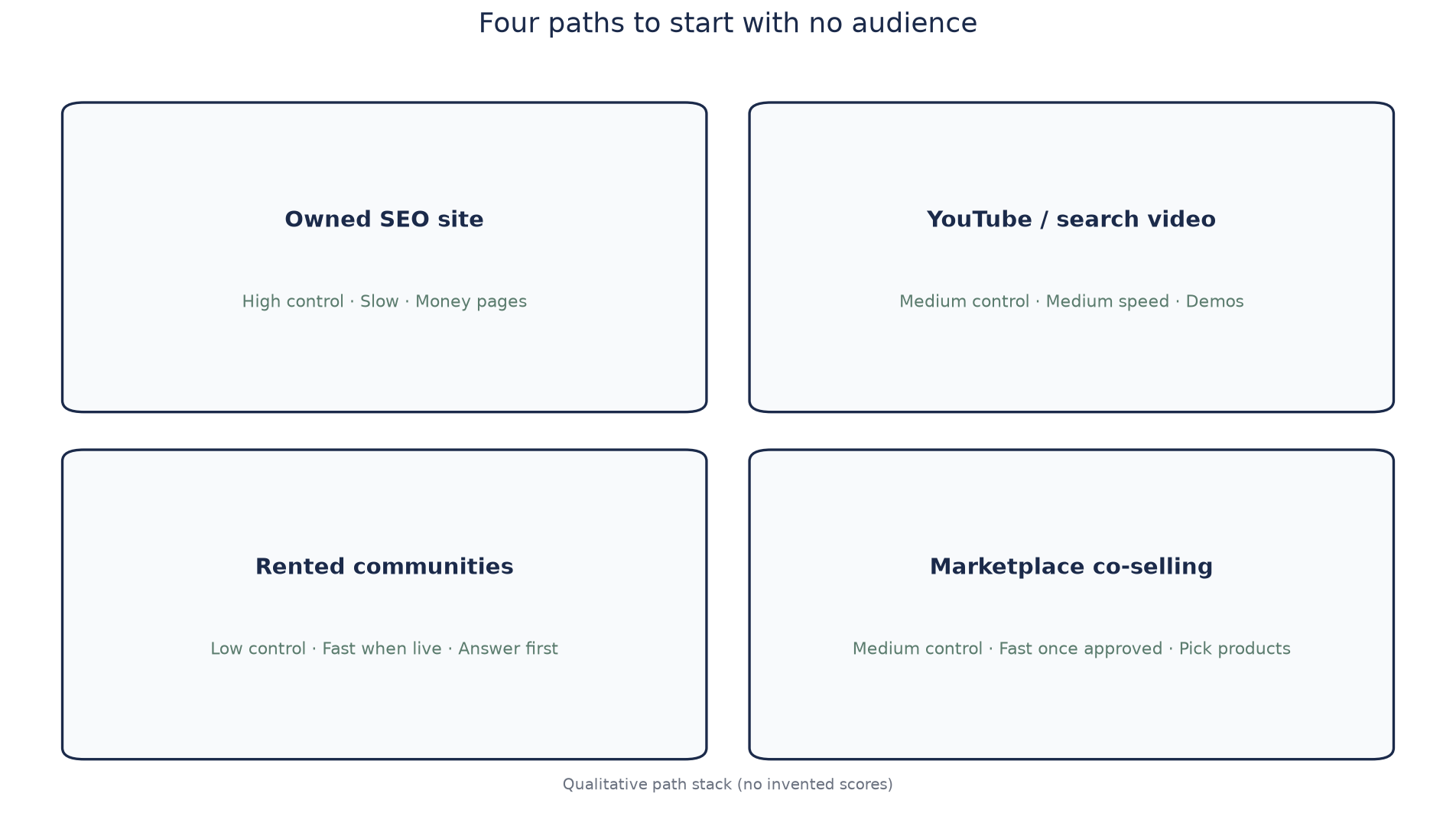
Source: Editorial path stack for this article; qualitative comparison only (no invented scores). Supporting economics: AvidAffiliate Skimlinks EPC sample and Impact.com 2025 partner mix. https://avidaffiliate.com/research/skimlinks-network-analysis/
Beginners ask for income timelines. There is no public census that maps month-one through month-twelve earnings for new affiliates across niches. Anyone publishing a universal curve is guessing or narrating their own ledger. What you can do is invert EPC.
At a $0.14 median EPC, planning targets look like this (target dollars ÷ 0.14):
| Monthly earnings target (planning) | Approx. clicks at $0.14 EPC |
|---|---|
| $50 | 357 |
| $100 | 714 |
| $250 | 1,786 |
| $500 | 3,571 |
That math assumes you sit at the median of programs that already report EPC. Nearly half of those programs sit under $0.10 EPC, and only 5.7% clear $1.00 (AvidAffiliate). Niche averages also diverge: Pets averaged about 6.1% conversion in that sample while Software & Technology averaged about 2.1%, yet Software’s average EPC ($0.22) still trailed Finance & Insurance ($0.66) despite Software’s higher average commission percentage (31.6% vs 12.2%). High commission rate is not the same as high EPC. For the niche ladder and traps, use affiliate marketing conversion rate benchmarks by niche.
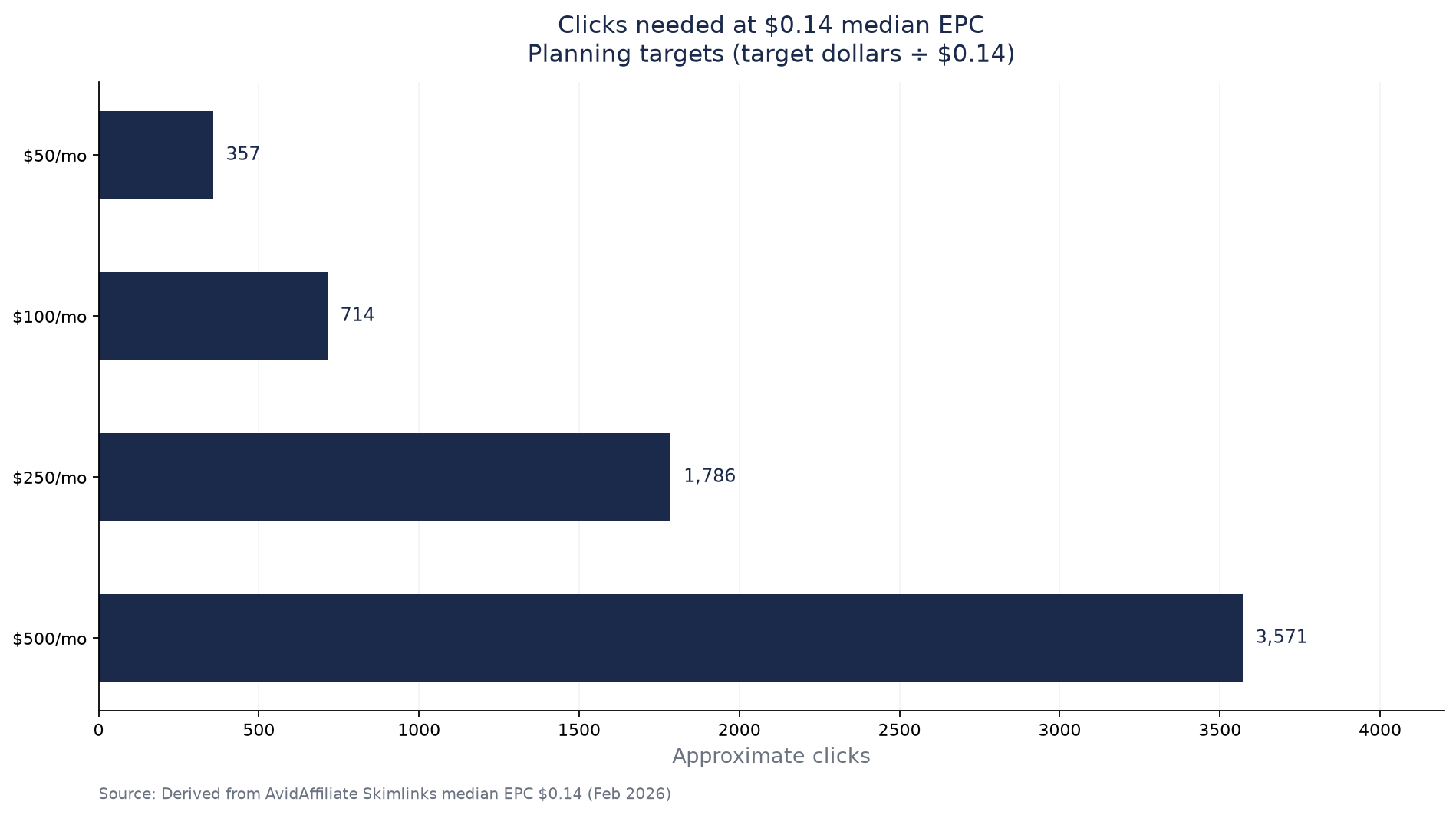
Source: Derived from AvidAffiliate Skimlinks network analysis median EPC $0.14 (February 2026). https://avidaffiliate.com/research/skimlinks-network-analysis/
Pick offers the way a merchant would underwrite you. Prefer products you can evaluate honestly. Prefer digital or SaaS when you need margin headroom inside Shopify’s 20%-50% digital band or 10%-30% B2B software band, and accept that physical goods in the 5%-15% band need more volume or higher AOV (Shopify). Expect payout holds of 30-60 days on many programs so returns settle (Shopify).
Join one or two programs, not twelve. Rewardful’s activation numbers are the warning label: most affiliates in SaaS samples never produce a sale (Rewardful). Depth beats a directory of dead links.
When you have no audience, every URL has to earn its ranking chance. Prioritize commercial investigation queries: “best X for Y,” “X vs Y,” “X alternatives,” “X pricing,” “is X worth it.” Informational posts can support those money pages with internal links, but they are not where you should plant your only affiliate links in month one.
Write the gap you can see on page one: missing screenshots, missing “who this is wrong for,” missing pricing honesty, missing update dates. That is the same editorial standard we use on this blog for answer engines. Thin roundups without evidence are how new sites stay invisible.
These steps are the minimum sequence I would run if I had no followers and one free evening a week.
Q: Can you start affiliate marketing with no audience or followers? A: Yes. You borrow distribution from search, video search, communities, or marketplaces while you build an owned site and email list. Followers help later; they are not required to place a tracked link in front of a buyer who is already searching.
Q: How do I start affiliate marketing as a beginner without social media? A: Pick a narrow niche, join one or two programs, and publish buyer-intent pages or searchable tutorials. Use Reddit or forums to learn language and test demand, not as your only “strategy” of dropping links. Capture email from the first useful page.
Q: How long does it take to make money with affiliate marketing from zero? A: There is no public census of beginner monthly income by month across niches, so treat any universal timeline as anecdote. Use EPC planning instead: at a $0.14 median EPC, about 714 clicks maps to roughly $100 in planning math, which still depends on your niche, offer, and page (AvidAffiliate).
Q: Do I need a website to start affiliate marketing? A: A website is the highest-control path and the one I recommend funding first, but it is not the only door. YouTube search, Pinterest, and careful community answers can produce early clicks. Medium-term, you want a URL you control for tracking, email, and compounding internal links.
Q: Is affiliate marketing without an audience a get-rich-quick model? A: No. Rewardful’s SaaS sample shows only 1.28% of affiliates generate a sale, which is a reminder that enrollment is easy and selling is not (Rewardful). The honest model is slow compounding of useful pages plus tracked offers, with disclosure on every recommendation.
How to start affiliate marketing with no audience is not a secret hack. It is a decision to stop waiting for followers and start publishing where intent already exists, then to measure clicks with public EPC reality instead of motivational income charts. Pick one path from the stack, one niche you can judge, and one money page that deserves to rank. If you want products to promote through a co-branded storefront rather than building every rail yourself, browse the feat. marketplace at https://www.feat.press/marketplace.
Affiliate marketing for startups is an operating system—locks, cost, recruit, rates, tracking, first 100 sales, then diagnose a flat roster.
How to track affiliate sales: pick link cookie, coupon, pixel, S2S postback, or storefront checkout—then match Rewardful, Tapfiliate, or Impact.
Best affiliate programs for SaaS companies pass the Recurring Cap Test: labeled duration, cookie, seat type, payout rails—plus Rewardful’s ~24% planning band.