Affiliate Marketing for Startups: Complete Guide
Affiliate marketing for startups is an operating system—locks, cost, recruit, rates, tracking, first 100 sales, then diagnose a flat roster.
Amazon Associates vs feat: catalog links pay Table 1 rates (often 1–4%) with a 24-hour cart cookie. When a co-branded storefront beats the catalog.

TL;DR: Amazon Associates vs feat is a catalog-link vs co-branded-storefront choice. Amazon pays fixed US Table 1 rates—often 1%–4% on everyday retail, up to 10% on luxury beauty—and requires the item in cart within 24 hours. Use Amazon when the click needs assortment and checkout trust. Use feat. when you sell a merchant-listed product from your own co-branded page under a revenue split.
Most creators who ask about Amazon Associates vs feat are really asking whether another ASIN link is enough. Amazon is the default affiliate program for a reason: the catalog is huge, buyers already trust the checkout, and you can join without inventing a product. The money is the catch. Conversion can look fine while Table 1 pays pennies on cheap physical goods—exactly the complaint that shows up whenever someone posts “conversion looks nice but the money doesn’t seem worth it” on r/Affiliatemarketing.
feat. is not a second Amazon catalog. It is a marketplace where a merchant lists a product, an approved creator gets a co-branded storefront for that product, and a revenue split applies on the attributed sale. If what you need is “link any SKU on earth,” stay on Associates. If what you need is “my page, this product, our split,” the job is different.
Key takeaways:
Amazon Associates vs feat is a comparison between Amazon’s catalog affiliate program—tracked Special Links into Amazon product pages paid on the published US Table 1 rate card—and feat., a marketplace that gives each approved creator a co-branded storefront for a merchant-listed product with a revenue split on the attributed sale.
Amazon Associates is a publisher seat on someone else’s catalog. You do not set the rate. You do not own the product page. You earn when a qualifying purchase follows Amazon’s cookie and category rules. The Influencer Program is a related but different traffic surface: it adds an Amazon storefront and a separate onsite meter. That fork is covered in Amazon influencers vs Amazon Associates. This page is the offsite catalog choice versus a marketplace storefront outside Amazon.
feat. starts with a merchant listing and a split the merchant sets. The creator’s job is to sell that listed product from a page that carries both brands. What is a creator storefront maps the four storefront types; feat. sits in the marketplace co-branded bucket, not the retailer affiliate page bucket Amazon uses.
The choice matters because Amazon wins on trust and assortment while often losing on margin per click, and a co-branded storefront only wins when you have a specific product worth selling under your name. Treating them as interchangeable “affiliate links” is how creators stay stuck on 1% grocery math.
Why it shows up in real creator P&Ls:
| Table 1 rate | Labeled earnings on $100 Qualifying Revenue |
|---|---|
| 10% | $10.00 |
| 5% | $5.00 |
| 4.5% | $4.50 |
| 4% | $4.00 |
| 3% | $3.00 |
| 2.5% | $2.50 |
| 2% | $2.00 |
| 1% | $1.00 |
| 0% | $0.00 |
Source: Arithmetic on Amazon Associates US Table 1 fixed rates. https://affiliate-program.amazon.com/help/node/topic/GRXPHT8U84RAYDXZ
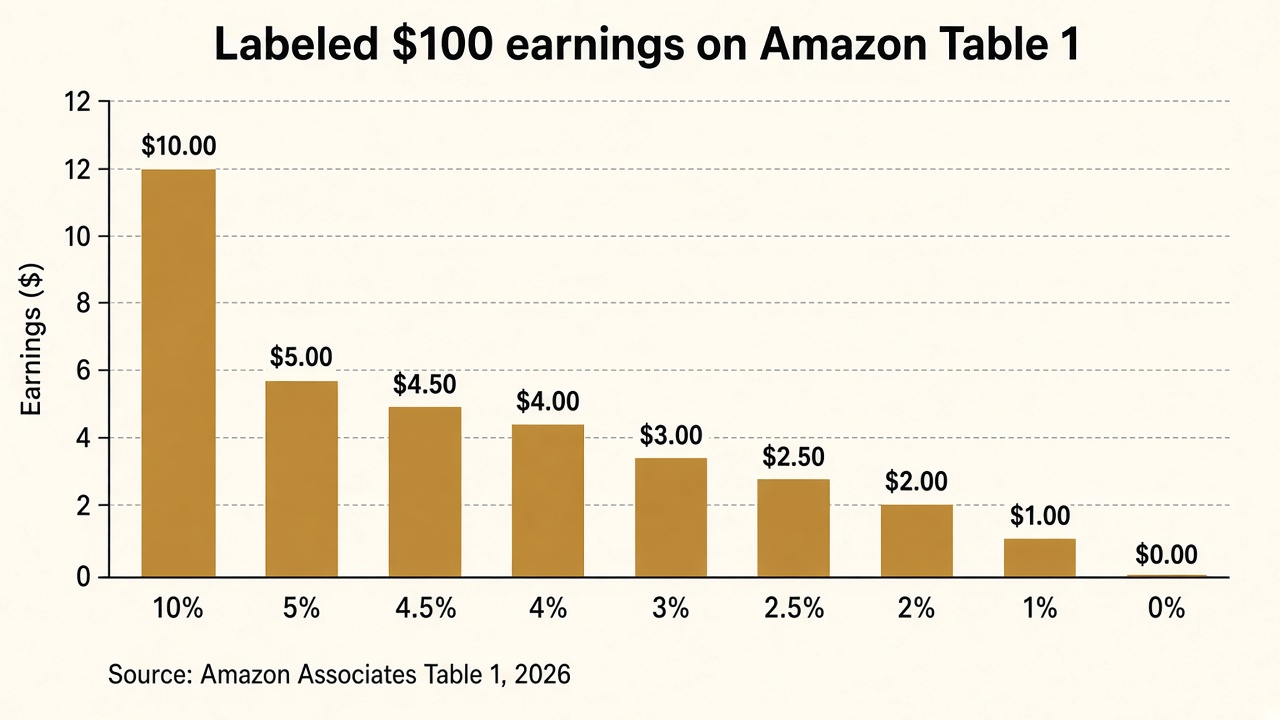
Source: Amazon Associates Program Standard Commission Income Statement (US), Table 1, 2026. https://affiliate-program.amazon.com/help/node/topic/GRXPHT8U84RAYDXZ
A $500 standing desk at 3% is $15. A $20 grocery item at 1% is $0.20. That arithmetic is why “go high-ticket” advice keeps circulating—and why a merchant-set split on a listed digital or DTC product can beat Amazon on the same audience without inventing traffic numbers.
The Catalog Link vs Co-Branded Storefront Test is three questions. Does this click need Amazon’s catalog and checkout trust? Is the published Table 1 rate on the real ASIN enough for the content hour? Does the creator need their own co-branded page for a merchant-listed product under a revenue split? Amazon wins when the first is yes and the second still clears. feat. earns the recommendation when the third is yes.
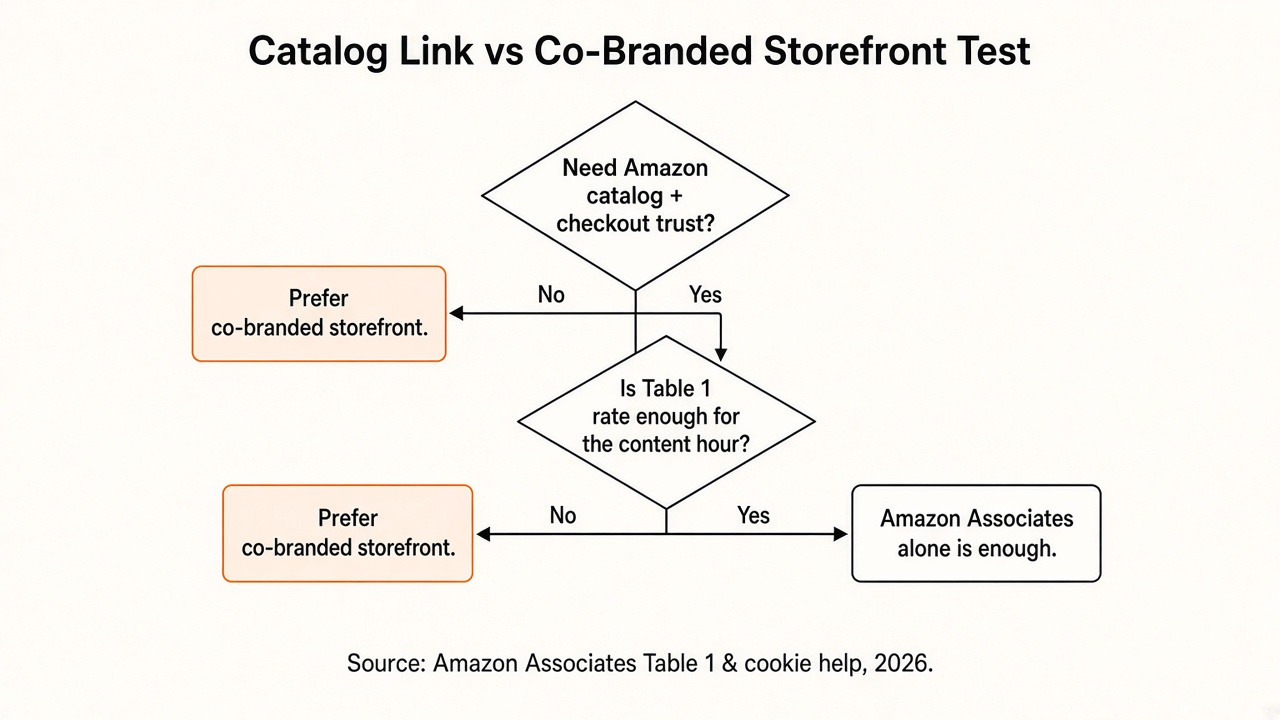
Source: Editorial decision flow from Amazon Associates Table 1, cookie help, and payment facts, 2026. https://affiliate-program.amazon.com/help/node/topic/GRXPHT8U84RAYDXZ
If that is your job, keep Associates. Do not migrate for the sake of a vs page.
That is the gap feat. is built for. I will not invent a feat. fee percentage to “win” the table. The honest claim is structural: approved seller, co-branded storefront, merchant-set revenue split. Live terms are in the product.
| Amazon Associates | feat. | |
|---|---|---|
| Job | Catalog affiliate links into Amazon | Co-branded storefront for a listed product |
| Who sets the rate | Amazon (Table 1 fixed category %) | Merchant sets the revenue split |
| Typical published retail rates | Often 1%–4%; up to 10% luxury beauty; 0% gift cards | Not published as a public fee sheet here — do not invent |
| Attribution | 24h to cart; cart hold ~90 days | Program terms in-product (not Amazon’s cookie) |
| What the creator shares | Special Link / Amazon destination | Creator’s co-branded storefront URL |
| Catalog size | Amazon’s assortment | Products merchants list and approve you for |
| Payout floor (US) | $10 deposit/gift card; $100 check ($15 fee) | Do not invent |
| Payment timing | ~60 days after month end | Do not invent |
| Influencer storefront | Separate Amazon Influencer surface | Marketplace storefront outside Amazon |
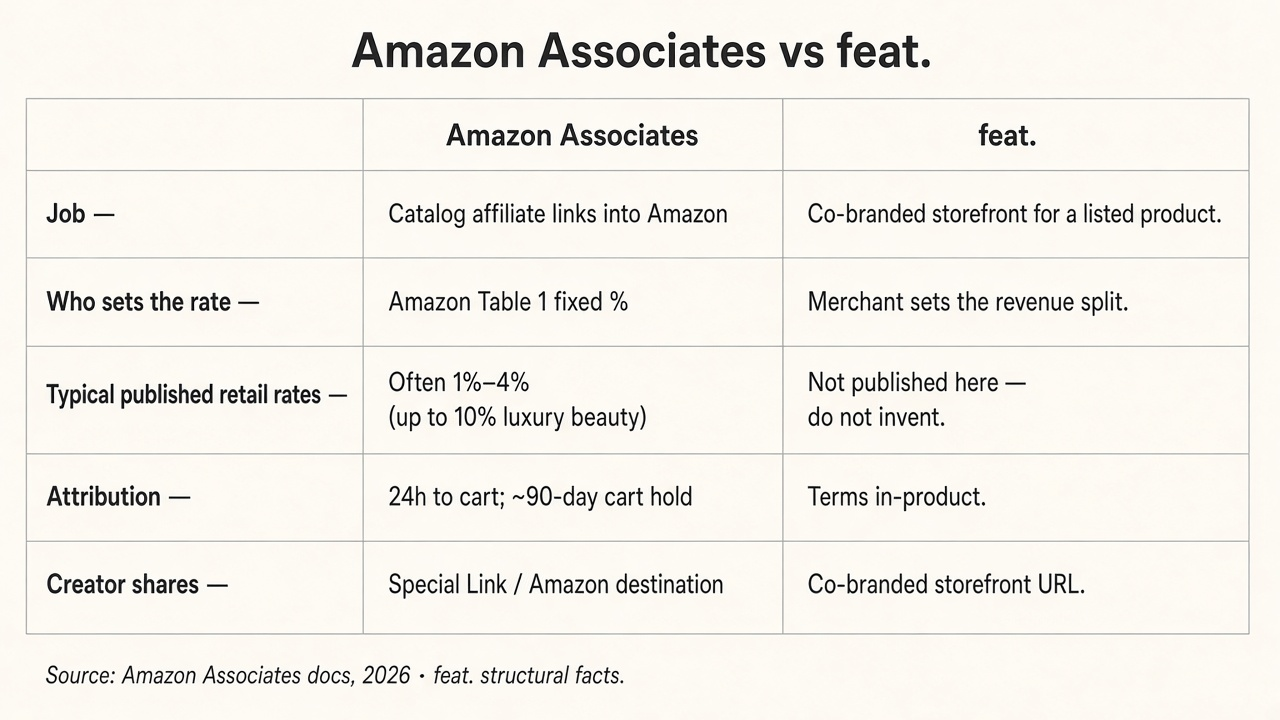
Source: Amazon Associates Table 1, cookie help, and payment minimums, 2026. https://affiliate-program.amazon.com/help/node/topic/GRXPHT8U84RAYDXZ · feat. structural product facts (no public fee sheet invented).
The feat. column is thin on money on purpose. A comparison table is where people invent a platform cut that makes their product look cheaper. I’d rather leave fees blank and tell you the live split is set by the merchant and shown in-product. For tracker-software pricing instead of catalog programs, see Rewardful vs feat and Tapfiliate vs feat.
Amazon’s Influencer Program can give you an Amazon storefront and Unique Creator Link. That is still Amazon inventory, Amazon checkout, and Amazon’s commission meters—including onsite rules tightened in the April 14, 2026 operating-agreement update (180-day qualify path, paid/boosted ad disqualifiers, same-ASIN onsite scope) (Amazon OA compare). feat. is not an Amazon storefront with different CSS. It is a marketplace page for a merchant-listed product under a split. If your question is Influencer vs Associates inside Amazon, read Amazon influencers vs Amazon Associates. If your question is catalog link vs selling someone else’s listed product under your brand, stay on this page.
Yes. Most serious creators already stack programs (r/Affiliatemarketing). Use Amazon when the reader needs that ASIN and Prime checkout. Use a co-branded storefront when you are selling a specific listed product and the split beats Table 1 on that intent. Keep disclosures clean on every surface (FTC affiliate disclosure rules). Attribute each sale once.
These five steps settle Amazon Associates vs feat for a real creator week. Each step is at most two sentences.
Q: What is the difference between Amazon Associates and feat.? A: Amazon Associates is a catalog affiliate program: you earn Table 1 commissions when buyers purchase on Amazon through your tracked links. feat. is a marketplace that gives approved creators a co-branded storefront for a merchant-listed product under a revenue split. Amazon monetizes assortment; feat. monetizes a named product page.
Q: How do Amazon Associates commission rates compare to a storefront split? A: Amazon’s US standard rates are fixed on Table 1—often 1%–4% for everyday retail categories, up to 10% for luxury beauty, and 0% for gift cards. A merchant-set storefront split can be higher or lower; feat. does not publish a public fee sheet here, so compare the live split on the listed product to Table 1 for the same intent.
Q: How long is the Amazon Associates cookie window? A: Qualifying items must be added to the Shopping Cart within 24 hours of the customer arriving through your Associates link. If carted in that window, you can still earn when the order is placed before the cart expires (usually about 90 days), after delivery and full payment.
Q: When should a creator choose feat. over Amazon Associates? A: Choose feat. when you are selling a specific merchant-listed product and need a co-branded page under your name, especially when the merchant’s split beats Table 1 on that click. Stay on Amazon when the buyer needs catalog breadth, Prime checkout trust, or multi-ASIN deal content.
Q: Is an Amazon Influencer storefront the same as feat.? A: No. An Amazon Influencer storefront still sells Amazon inventory under Amazon’s commission rules. feat. is a marketplace co-branded storefront for products merchants list outside that catalog. Use our Influencer vs Associates guide for the Amazon-internal fork.
Amazon Associates vs feat comes down to catalog link or co-branded storefront. Amazon is enough when assortment and checkout trust matter more than margin, and you can live with Table 1 rates, a 24-hour cart cookie, and a slow payout clock. When the product is a listed merchant offer and your page is part of the sale, browse products worth selling on feat. marketplace.
Affiliate marketing for startups is an operating system—locks, cost, recruit, rates, tracking, first 100 sales, then diagnose a flat roster.
How to track affiliate sales: pick link cookie, coupon, pixel, S2S postback, or storefront checkout—then match Rewardful, Tapfiliate, or Impact.
Best affiliate programs for SaaS companies pass the Recurring Cap Test: labeled duration, cookie, seat type, payout rails—plus Rewardful’s ~24% planning band.