beehiiv vs Kit for Newsletter Monetization
beehiiv vs Kit compared for newsletter monetization: free tiers, paid scale pricing, Ad Network vs Sponsor Network, and which model each platform fits.
A creator storefront is a shoppable page tied to a creator. Four surfaces: link hub, sell-own shop, retailer affiliate page, marketplace co-branded page.

TL;DR: A creator storefront is a shoppable page tied to a named creator. The same label covers four surfaces: a link hub, a sell-own shop, a retailer affiliate page on the brand’s site, and a marketplace co-branded sell page. Name the surface before you pick a tool. Sephora’s program pays 15% with a 15-day window.
Creators ask what is a creator storefront as if the answer is one app logo. It is not. Amazon, Sephora, Stan, Linktree, and co-branded affiliate pages all use the same noun for different money paths.
If you treat every “storefront” as the same product, you will optimize themes while the commission, attribution, and customer ownership sit on the wrong rails. Merchants make the same mistake when they fund a bio theme and expect retailer-grade attribution.
Key takeaways:
A creator storefront is a shoppable web surface tied to a named creator, where visitors can browse curated offers and either buy or click through to buy with tracking that can pay that creator.
That one sentence is the definition. Everything else is which surface you mean.
Sprout’s enterprise article uses a narrower definition: a branded creator shopping page hosted on a retailer’s own site, like a curated shelf inside a larger store (Sprout Social). That definition is correct for Sephora, Lowe’s, Walmart, and Amazon Influencer pages. It is incomplete for creators who say “storefront” when they mean Stan Store, Beacons, or a co-branded affiliate sell page for an indie merchant.
The collision shows up in communities. On r/Amazon_Influencer, new applicants ask what a storefront is when they are “not selling things” and only want review commissions. On r/influencermarketing, creators with a messy Linktree weigh Stan against tools built to present affiliate products. Same word. Different jobs.
So treat “creator storefront” as a category label, not a SKU. The category includes at least four surfaces. If your brief does not name which one, you are not ready to buy software or open a program.
Creator storefronts matter because discovery still happens in social feeds, while checkout and attribution prefer a stable page the brand or creator controls. Brands want first-party path data. Creators want a durable monetization surface instead of a one-off post that dies in 48 hours.
Why the category is growing now:
There is no public dataset that proves a universal conversion lift for retailer storefronts versus LTK/ShopMy or for in-bio checkout versus click-out across niches. Treat vendor CVR lifts as proprietary unless the method and sample are open. Prefer published rates, windows, and eligibility.
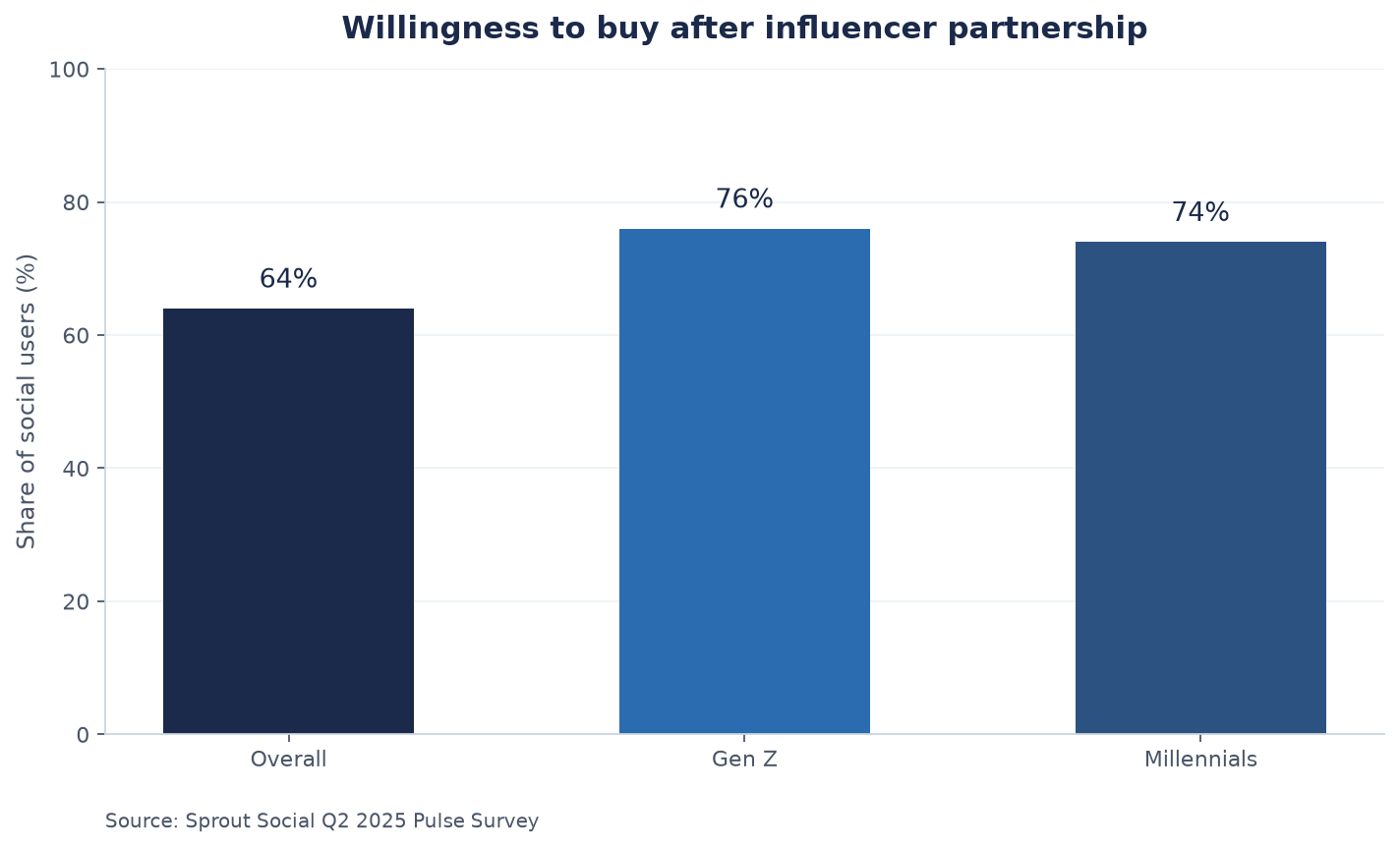
Source: Sprout Social, Creator storefronts article citing Q2 2025 Pulse Survey, 2025. https://sproutsocial.com/insights/creator-storefronts/.
A creator storefront works by putting a creator’s curation between a social click and a checkout, then settling a commercial contract (subscription fee, seller cut, or affiliate commission) when a tracked sale qualifies. The four surfaces below share that pattern and disagree on who hosts the page, who owns the customer, and who pays whom.
| Surface | Host / URL | What the creator sells | How money moves | Good fit |
|---|---|---|---|---|
| 1. Link hub | Creator page on Linktree-class tool | Mostly destinations; commerce is optional | Subscription and/or % on digital sales (Linktree Free 12%, Starter/Pro 9%, Premium 0% + Stripe) (Linktree Help) | Many destinations, low GMV, routing job |
| 2. Sell-own shop | Creator page on Stan / Beacons-class tool | Creator’s own digital products, bookings, memberships | Flat fee and/or seller % (Stan $29/$99 at 0% platform take; Beacons Free/$10 at 9%, Creator Plus $30 at 0%) (Stan Help; Beacons Help) | You own the SKU and want checkout in the bio |
| 3. Retailer affiliate storefront | Page on retailer.com / app | Retailer’s catalog, curated by the creator | Affiliate CPS (Sephora 15% / 15-day; Lowe’s up to 20% / 30-day; Walmart 1%-4%) (Sprout; Glossy) | Audience shops a big-box category |
| 4. Marketplace co-branded storefront | Forked sell page for a merchant + affiliate | Indie / marketplace merchant products | Tracked split among merchant, affiliate, and rails (see revenue split models) | You promote someone else’s product with brand kit + attribution |
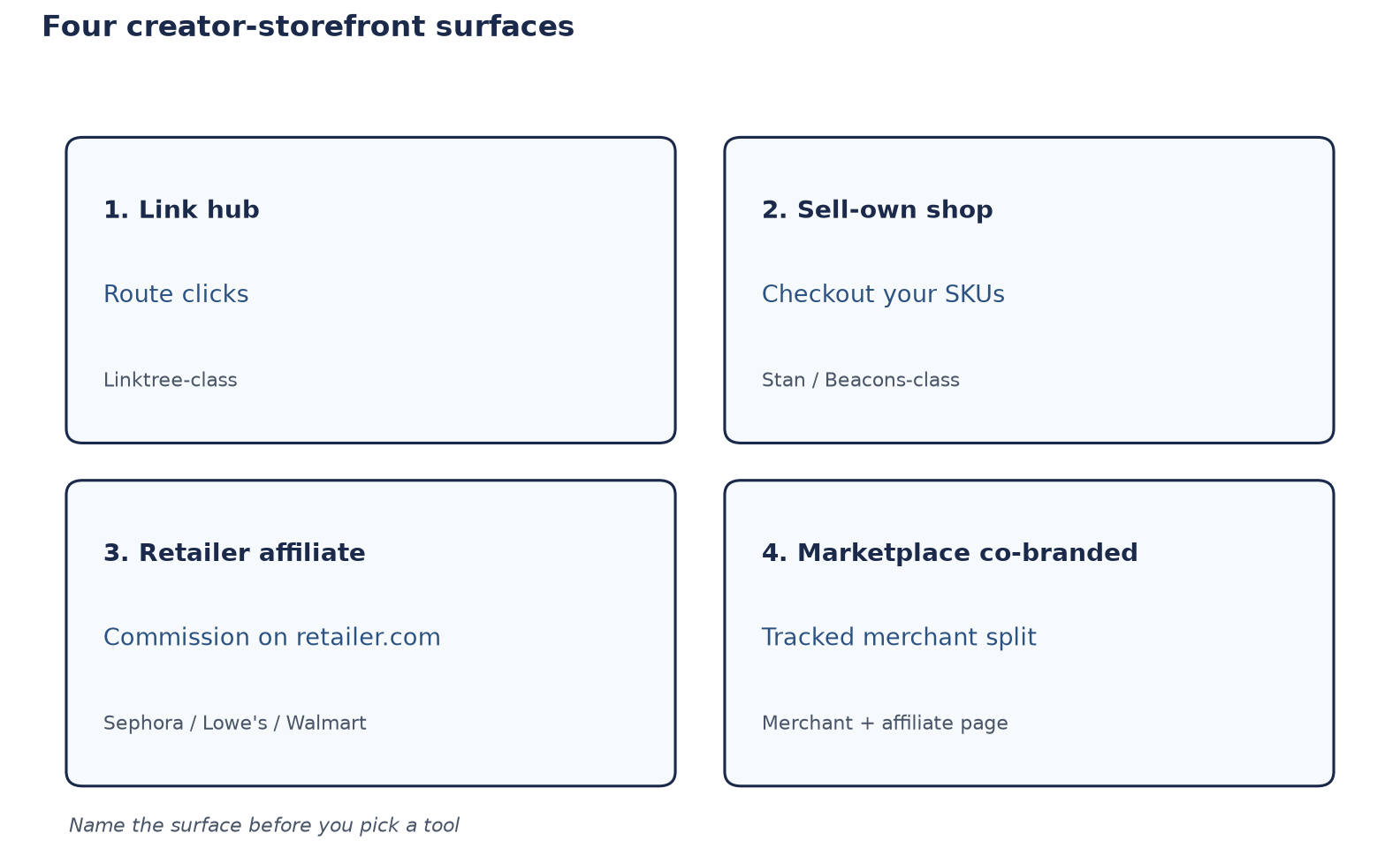
Source: feat. four-surface taxonomy synthesized from Sprout retailer definition, published Linktree/Stan/Beacons help fees, and marketplace co-selling patterns. Commission figures from sources in the citation log.
Surface 1 and Surface 2 are the Linktree vs storefront platforms decision. Surface 3 is what Sprout means when enterprise brands claim “creator storefronts.” Surface 4 is the merchant-plus-affiliate loop feat. is built for: list, pitch, approve, then fork a co-branded sell page. Do not force Surface 4 work into a Surface 1 theme.
Retailer storefronts put the creator’s shelf inside the retailer’s domain. Attribution, inventory, and checkout stay with the retailer. The creator earns when a tracked purchase qualifies.
Published program facts worth comparing:
| Program | Commission | Attribution window | Eligibility notes | Scale signal |
|---|---|---|---|---|
| My Sephora Storefront | 15% | 15 days (Glossy) | U.S.; 3,000+ followers on IG, TikTok, or YouTube | 1,000 live storefronts (Marketing Brew) |
| Lowe’s Creator Program | Up to 20% | 30 days (Sprout) | Project / DIY storytelling fit; samples and training | 17,000+ enrolled in beta (Digital Commerce 360) |
| Walmart Creator | 1%-4% by category (Sprout) | Not published as a single public constant in Sprout’s summary | No minimum follower count; launched 2022; tiered bonuses and Creator Collabs (Walmart) | Open category program; rates vary by SKU |
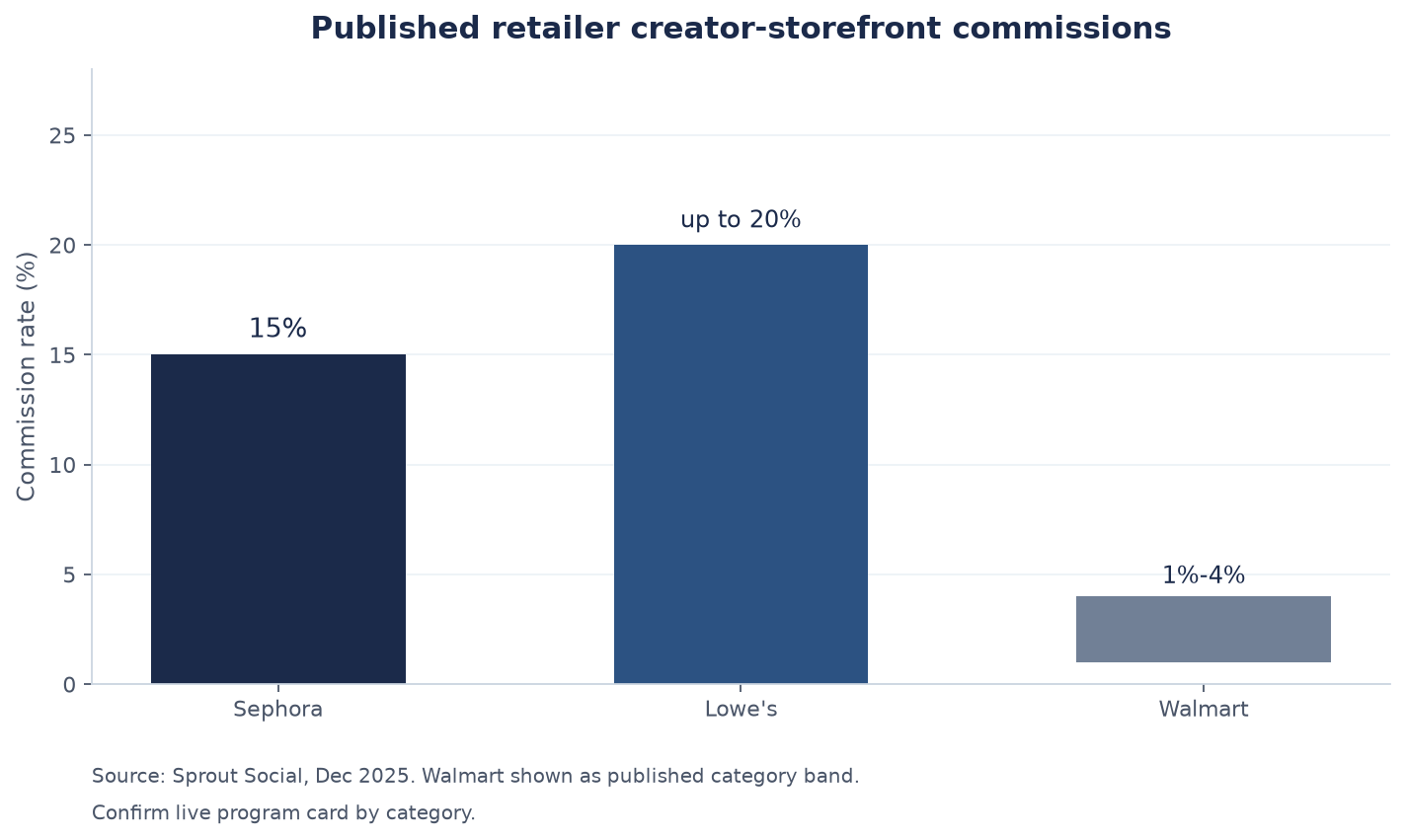
Source: Sprout Social, 2025 (Sephora 15%, Lowe’s up to 20%, Walmart 1%-4%); Glossy, 2025 (Sephora 15-day window). https://sproutsocial.com/insights/creator-storefronts/.
Third-party storefronts such as ShopMy and LTK still sit beside these programs. Sprout and Marketing Brew place those platform commissions roughly in a 10%-30% band depending on brand deals (Sprout Social; Marketing Brew). Retailer storefronts compete by keeping the click on the retailer’s site. Creators often run both. Additive, not either-or, is the honest default until you measure cannibalization yourself.
Sephora’s Mitchell told Marketing Brew that storefront creators are not Squad ambassadors, but they do get a Sephora.com URL (Marketing Brew). That sentence is the product: affiliate economics with retailer domain trust, without a paid ambassador seat for every applicant.
Surface 2 is checkout for your catalog. Stan and Beacons-class tools win when the bio click should open a product, not a directory. Fee shapes and GMV break-even are covered in Linktree vs storefront platforms and creator platform fee comparison. Do not confuse a $29 flat fee with a 15% Sephora commission. One is rent for your shop. The other is a share of someone else’s GMV.
Surface 4 is collaborative selling for merchants who are not Sephora. The plumbing is how affiliate marketing works: unique ID, attribution window, qualifying event, approval, payout, disclosure. The commercial layer is revenue split models for collaborative selling and affiliate commission structures. A co-branded storefront is the packaging. It does not repeal COGS, refund holds, or FTC disclosure rules (affiliate marketing disclosure rules).
Creators and brands lose money on storefronts when they buy the label and skip the contract.
Q: What is a creator storefront in simple terms? A: It is a shoppable page tied to a creator. Visitors browse that creator’s picks and buy (or click through to buy) with tracking that can pay the creator. The host may be a link tool, the creator’s shop software, a retailer site, or a marketplace co-branded page.
Q: How is a creator storefront different from a link in bio? A: A link-in-bio hub’s core job is routing. A storefront’s core job is selling or affiliate-attributed selling. Many tools blur the lines, so compare the fee model and the checkout path, not the marketing name. See Linktree vs storefront platforms for the fee break-even.
Q: How much commission do retailer creator storefronts pay? A: Published figures vary by retailer. Sephora lists 15% on storefront sales with a 15-day window (Glossy). Lowe’s goes up to 20% with a 30-day window, and Walmart’s category band is often cited at 1%-4% (Sprout Social). Always confirm the live program card for your category.
Q: Do I need my own products to have a creator storefront? A: No for Surfaces 3 and 4. Retailer and marketplace affiliate storefronts monetize other people’s catalogs. You need your own products for Surface 2 (sell-own). Surface 1 can work with zero products if routing is the job.
Q: Is a creator storefront the same as a brand ambassador program? A: Usually no. Sephora’s Mitchell separates storefront affiliates from Squad ambassadors while noting storefront creators still get a Sephora.com URL (Marketing Brew). Ambassadors often include paid seats, exclusivity, or gratis. Storefronts are typically commission seats with a curated page.
A creator storefront is a shoppable page tied to a creator, not a single vendor. Pick among link hub, sell-own shop, retailer affiliate page, and marketplace co-branded page before you argue about themes or fees. Use published retailer ladders (Sephora 15%, Lowe’s up to 20%, Walmart 1%-4%) when the job is Surface 3, and use fee break-even math when the job is Surface 1 or 2.
If you want a co-branded storefront to sell other merchants’ products with a tracked split, browse the feat. marketplace.
beehiiv vs Kit compared for newsletter monetization: free tiers, paid scale pricing, Ad Network vs Sponsor Network, and which model each platform fits.
Storefront vs landing page for selling digital products: Unbounce's 6.6% median LP CVR, Monetate-cited 2x vs stores, and when a multi-SKU shop wins.
Linktree vs storefront platforms: three jobs (link hub, sell-own, sell-others), published fees for Linktree, Beacons, and Stan, plus GMV break-even math.