How to Get Your First Affiliate Sale
Earn your first affiliate sale with a 14-day sprint—one offer, one surface, cookie-matched CTA. Amazon needs cart within 24 hours; personal orders do not count.
Choose an affiliate program with five gates—fit, dollars, attribution, settlement, rights. Amazon Table 1 often pays 1%–4% with a 24-hour cart cookie.

TL;DR: How to choose an affiliate program to promote is a Five-Gate Program Scorecard: honest audience fit, economics in dollars, attribution surface, settlement clocks, then promotion rights and disclosure. Fail a gate and walk away. Amazon’s US Table 1 often pays 1%–4% with a 24-hour cart cookie and cash about 60 days after the month—so a “high converting” link can still be a bad job.
Most creators who ask how to choose an affiliate program to promote start with the wrong number: the commission percentage on the signup page. That is how you end up in the Reddit trap—“conversion looks nice but the money doesn’t seem worth it”—after weeks of Amazon links that pay pennies on cheap SKUs (r/Affiliatemarketing).
A program is a job offer. Jobs have hours (content work), pay (net of refunds), and rules (what you may say and where). Review sites and tip lists still mash those into “find high commissions.” Shopify’s published bands show why the mash fails: physical goods often sit at 5%–15%, digital at 20%–50%, subscriptions at 15%–30% recurring (Shopify). Amazon’s Table 1 is a different animal entirely—fixed category rates, short cart rules, slow cash (Amazon Table 1). You need a scorecard that survives all three.
Key takeaways:
Choosing an affiliate program to promote is the decision to attach your reputation and distribution surface to a merchant’s tracked offer under a written contract for commission, attribution, and payout.
It is not “join every network and paste links.” It is not picking the highest % on a directory. Matt McWilliams’s classic advice still holds: earnings per click (EPC) beats vanity commission when you can get the number (Matt McWilliams). When merchants will not share EPC, reverse-engineer dollars: price × rate × your realistic conversion, then subtract refund risk and waiting time.
feat. changes the surface, not the honesty test. On the marketplace, you still pick products you would recommend. The difference is a co-branded storefront instead of a naked tracking link—see affiliate marketing vs storefront and what is a creator storefront.
Wrong programs waste the scarcest asset you have: audience trust. Right programs still fail if settlement traps your cash under a high threshold or a 24-hour cookie on a considered purchase.
Why gates beat rate shopping:
There is no public dataset for a universal “good EPC” across niches. Demand the number from the program or compute your own after a test week.
The Five-Gate Program Scorecard is a fail-closed checklist. Run the gates in order. A program that fails Gate 1 is not rescued by a 50% commission.
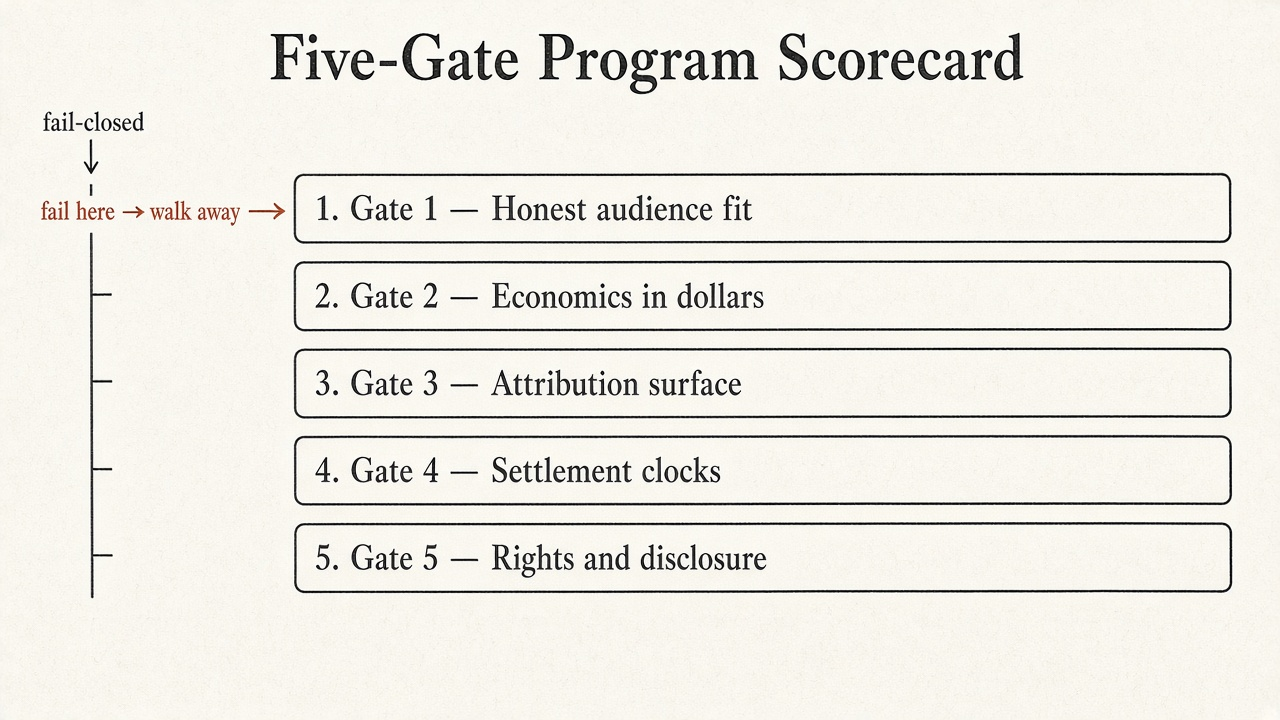
Source: Editorial framework synthesizing Amazon Associates help, Shopify commission bands, Rewardful benchmarks, Impact payout docs, and FTC endorsement guidance. Taxonomy diagram, no invented EPC averages.
Would you recommend this product in a room with your best readers watching? If the answer needs a script, fail the gate. Fit beats niche fashion. How to start affiliate marketing with no audience still starts here—owned trust before cold traffic.
Convert the offer to dollars per expected sale, then compare cash timing. Use published bands as envelopes, not targets.
| Shape | Published economics signal | Source |
|---|---|---|
| Amazon US Table 1 (many retail lines) | Often 1%–4%; some luxury beauty 10%; gift cards 0% | Amazon Table 1 |
| Shopify-style physical brand programs | 5%–15% per sale | Shopify, 2026 |
| Shopify-style digital | 20%–50% per sale | Shopify, 2026 |
| Shopify-style subscriptions | 15%–30% recurring | Shopify, 2026 |
| SaaS programs on Rewardful (average) | 24.16% | Rewardful, n=2,847 |
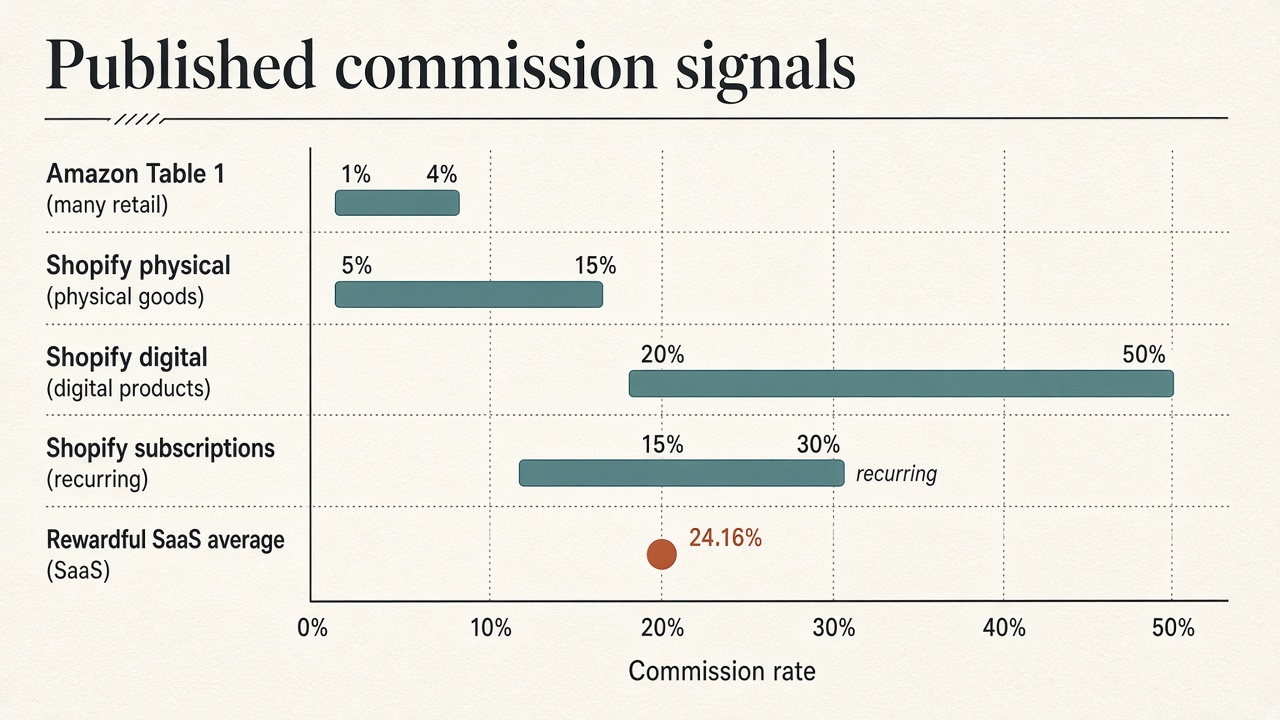
Source: Amazon Associates US Table 1. https://affiliate-program.amazon.com/help/node/topic/GRXPHT8U84RAYDXZ · Shopify Affiliate Commission Guide. https://www.shopify.com/blog/affiliate-commission · Rewardful State of SaaS Affiliate Programs. https://www.rewardful.com/articles/state-of-saas-affiliate-programs-report
On a labeled $100 Amazon qualifying purchase at 4%, you earn $4 before refunds—not “competitive with SaaS.” At Rewardful’s 24.16% average on a $100 SaaS charge, the headline is $24.16, still subject to churn and clawbacks. Structure detail: affiliate commission structures and recurring vs one-time.
Know the cookie or click window, first- vs last-touch, coupon overrides, and whether you get a link, a code, or a page. Amazon’s 24-hour cart rule fails many slow-content strategies. Brand programs with 30–60 day windows fit newsletters better. If your audience needs a storefront, a parameter is the wrong surface—compare Amazon Associates vs feat and affiliate software vs storefront.
Map lock/hold, period close, threshold, and rail. Amazon: ~60 days after month end, $10 / $100 floors. Impact: autopay paths from $10 after lock and brand funding. Merchant-paid trackers (Rewardful-class) depend on the brand’s bank discipline. If you cannot explain when cash hits your account, fail the gate. Deep dive: how do affiliate marketers get paid.
| Program example | Attribution highlight | Settlement highlight |
|---|---|---|
| Amazon Associates | 24h to cart; ~90d cart expiry | ~60d after month; $10 DD/gift; $100 check |
| Impact brand contracts | Contract cookie / locking period | Balance then autopay; Fixed Day from $10 |
| Shopify-band DTC programs | Often 30d-class cookies (program-specific) | Merchant or network schedule |
| feat. marketplace storefront | Attributed storefront checkout | Automatic split; fees in-product |
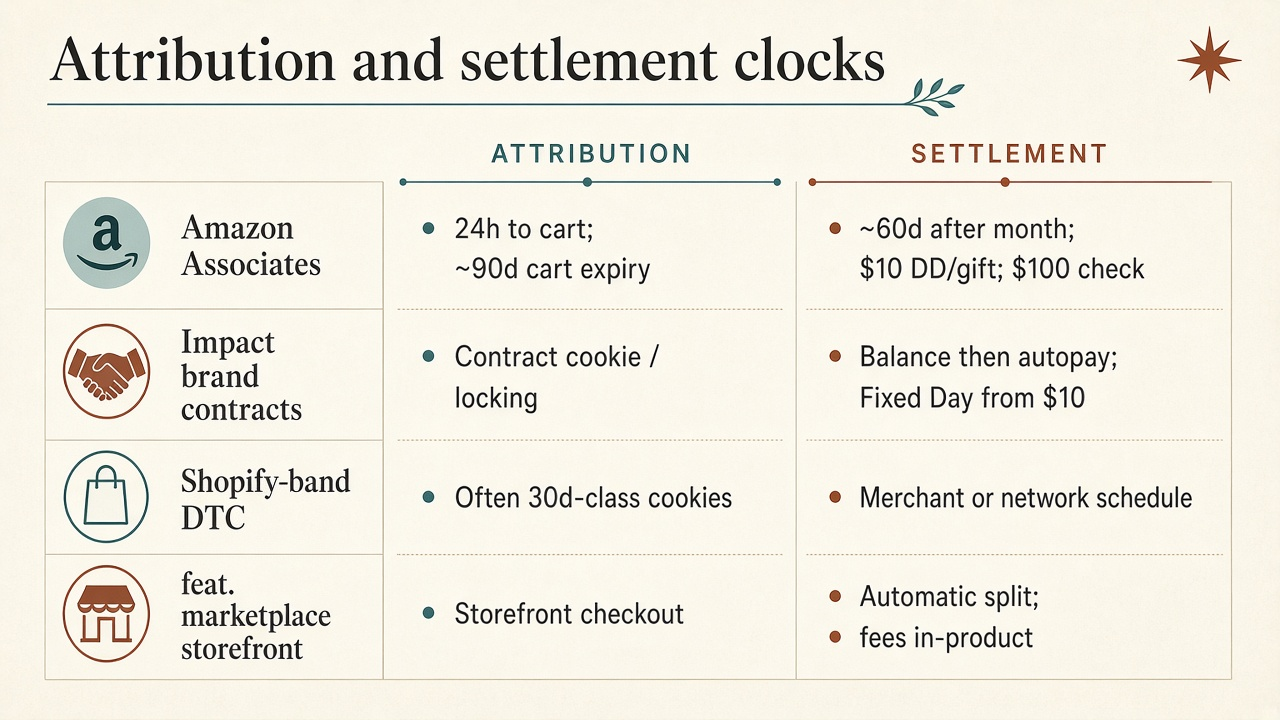
Source: Amazon Associates payment and cookie help; Impact partner payments explained; Shopify commission guide; feat. product mechanics. Accessed 2026-10-09.
Read the agreement for trademark bidding, coupon sites, paid search, social rules, and creative restrictions. GSC already shows demand for “finance affiliate programs that allow trademark bidding”—that is a Gate 5 question, not a niche tip. If your channel is banned, the rate is irrelevant. Then write the disclosure you will actually publish. FTC clear-and-conspicuous remains the floor (FTC).
Q: How do you choose an affiliate program to promote if you are a beginner? A: Run the Five-Gate Scorecard on two or three offers you would honestly recommend. Prefer clear settlement and a cookie that matches your content cycle over the highest percentage on a directory.
Q: Is a higher commission rate always better? A: No. Dollars per sale and cash timing beat headline %. Amazon Table 1 can convert well while paying 1%–4% on many retail lines with a 24-hour cart rule and ~60-day payout.
Q: What cookie length should I look for? A: Match the window to how your audience buys. Impulse offers can survive shorter cookies; considered purchases usually need 30+ days. Amazon’s 24-hour cart rule is a hard constraint, not a suggestion.
Q: Should I join Amazon Associates or a brand storefront program? A: Use Amazon when assortment and checkout trust matter more than rate. Use a brand or co-branded storefront when you sell a specific merchant’s product and need a page, not a catalog parameter.
Q: Where does feat. fit when choosing programs? A: On the marketplace as a storefront-shaped offer: you pick a merchant-listed product, get a co-branded page, and earn on the attributed split. It does not replace reading Gates 1–5. Fees stay in-product.
How to choose an affiliate program to promote is not a hunt for the loudest commission badge. It is a Five-Gate Program Scorecard: honest fit, dollars, attribution, settlement, rights. Amazon’s Table 1, Shopify’s bands, and Rewardful’s activation meters are planning constraints. Fail a gate on purpose once and you will stop wasting months on pretty dashboards that never pay.
If the offers you want to promote need a co-branded storefront instead of another tracking link, start in the feat. marketplace.
Earn your first affiliate sale with a 14-day sprint—one offer, one surface, cookie-matched CTA. Amazon needs cart within 24 hours; personal orders do not count.
Join affiliate programs through three doors—destination, proof, compliance. Amazon needs 3 qualifying sales in 180 days; personal orders do not count.
Promote affiliate products on a five-rung surface ladder—owned intent pages, email, video, community, storefront—matched to cookies and FTC disclosure.