How to Turn Your Audience Into a Distribution Channel
Turn your audience into a distribution channel with a five-rung ladder—attention, trust, offer, sales surface, and economics—not follower vanity.
No fee to join an Amazon Influencer storefront. Associates alone has no shop page. Compare gates, Table 1 pay, and paid bio tools.

TL;DR: Do you have to pay for an Amazon storefront? No—Amazon does not charge a join or monthly fee for an Influencer Program storefront. Associates alone does not give you
amazon.com/shop/.... The real cost is approval, disclosure, a 24-hour cart cookie, and Table 1 rates (often 1%–4%). Paid bio tools charge subscriptions; Amazon charges gates.
Creators ask do you have to pay for an Amazon storefront because every other “shop” in the bio link stack has a price sticker. Stan wants $29 a month. Linktree Free takes 12% of digital products. Beacons Free still takes 9%. Amazon’s Influencer storefront looks like a product you should invoice for—until you read the program pages and realize the bill is not a subscription.
The confusion is structural. Amazon Associates is free to join and pays category commissions. The Amazon Influencer Program is an official extension that adds a personalized storefront. People mash those two into one question and then wonder why their Associates account has no shop URL. This page answers the fee question first, then the gate question, then when a co-branded marketplace page is the better job. Sibling forks: Amazon influencers vs Amazon Associates, Amazon Associates vs feat, and what is a creator storefront.
Key takeaways:
amazon.com/shop/yourhandle. That vanity page is an Influencer Program asset (Amazon Influencer overview).An Amazon storefront is the personalized Influencer Program page on Amazon—commonly shared as amazon.com/shop/yourhandle—where an approved creator curates product lists, photos, and videos and earns commission on qualifying purchases through that page or related Special Links.
It is not a Shopify shop you rent. You do not upload your own SKUs or run Amazon’s checkout as a merchant of record. You curate Amazon’s catalog. About Amazon describes the program as an extension of the broader affiliate network with a personalized storefront, Idea Lists, and shoppable media, available in more than 20 countries since the 2017 launch (About Amazon).
Associates remains the underlying affiliate contract: tagged links, Table 1 (or onsite) rates, disclosure language, and payout rails. Influencer adds the on-Amazon shop surface—and, when Amazon places your content, a separate onsite meter. That traffic fork is already mapped in Amazon influencers vs Amazon Associates. This article stays on the money question: what you pay to have the page at all.
Wrong answers waste a month. Creators either refuse a free storefront because they expect a SaaS invoice, or they assume Associates automatically includes a shop and bounce when the URL never appears. Retailer storefronts elsewhere are gated too—Sprout notes Sephora’s My Storefront at 15% with a hard acceptance funnel, Lowe’s up to 20% with a 30-day window, Walmart 1%–4% by category (Sprout Social). Amazon’s version is free in dollars and expensive in approval and rate design.
Why the distinction pays:
There is no public dataset for a universal median “Amazon storefront monthly income.” Refuse invented averages. Score your own storefront on locked commissions and traffic you can name.
Amazon storefront cost is a three-layer stack: $0 platform fee for the Influencer seat, non-cash gates (approval, content, compliance), and variable economics (Table 1 rates, 24-hour cart rule, payout floors). Confusing layer one with layer three is how “free” becomes a bad spreadsheet.
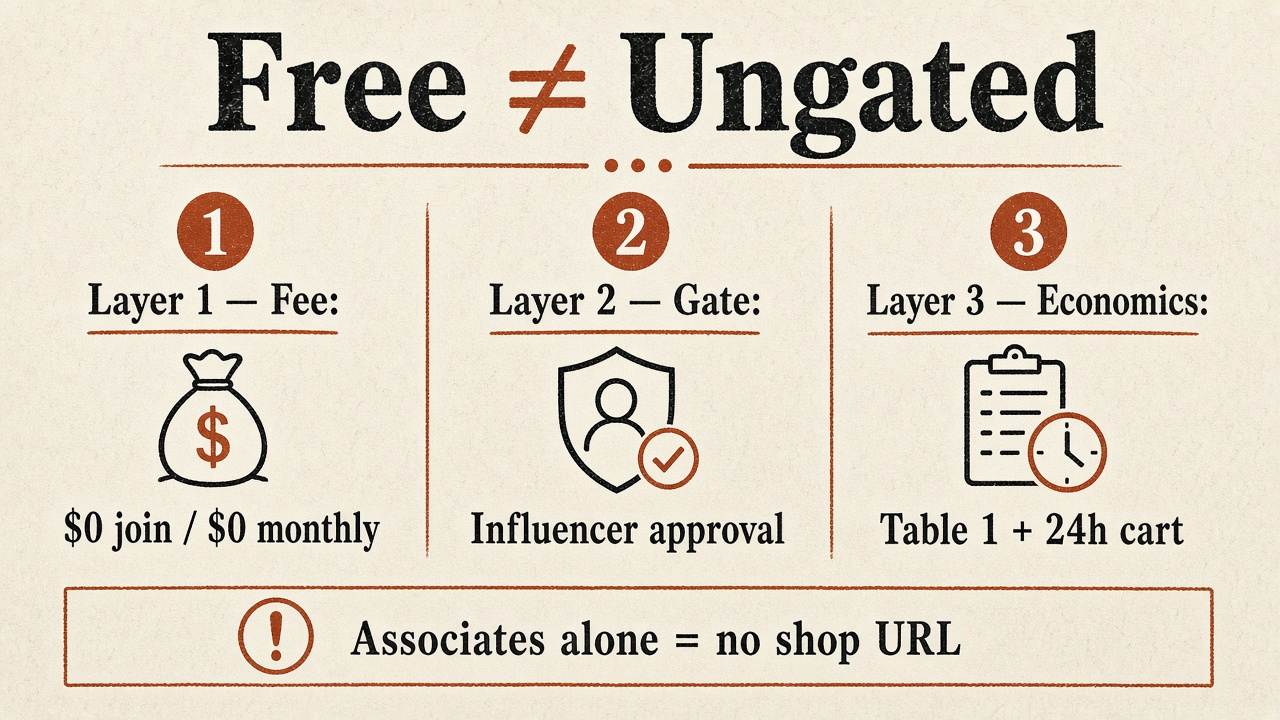
Source: Editorial framework from About Amazon Influencer Program explainer, Associates Central Influencer Policy, and US Table 1 / cookie / payment help. Taxonomy diagram; no invented income medians.
Amazon does not publish a creator subscription for the Influencer storefront the way Stan or Beacons publish plan stickers. Official materials frame the program as a free way for creators to earn commissions when followers make qualifying purchases (About Amazon). Associates Central’s Influencer Program Policy defines eligibility, the Influencer Page, content rules, and compensation mechanics—not a monthly SaaS invoice (policies).
So the direct answer to do you have to pay for an Amazon storefront is: you do not pay Amazon a storefront fee to open or keep the page. You earn when Amazon’s rules say a purchase qualifies.
Free is not open enrollment with a credit card.
If Amazon rejects the social account, you cannot buy your way onto amazon.com/shop/.... That is the opposite of a paid storefront SaaS.
On a labeled $100 qualifying purchase under US Table 1:
| Table 1 band (examples) | Rate | Earnings on $100 |
|---|---|---|
| Luxury beauty / Explore | 10% | $10 |
| All Other Categories (default band) | 4% | $4 |
| Toys / Home / Beauty (non-luxury) band | 3% | $3 |
| Fresh / Grocery / Health band | 1% | $1 |
| Gift cards / listed exclusions | 0% | $0 |
Source: Amazon Associates Commission Income Statement (Table 1). Arithmetic is labeled revenue × published rate.
Cookie pressure is brutal for long reads: the item must enter the Shopping Cart within 24 hours of the Associates-link arrival (cookie help). Full window detail: affiliate cookie duration and attribution windows. Category depth: Amazon Associates commission rates by category.
| Surface | Cash fee to open | What you sell | Gate |
|---|---|---|---|
| Amazon Influencer storefront | $0 join / $0 monthly (no SaaS sticker in official policy) | Amazon catalog curation | Influencer approval + Associates rules |
| Amazon Associates only | $0 | Special Links (no vanity storefront) | Associates review (3-in-180) |
| Stan Creator | $29/mo (or $300/yr); 0% platform cut | Your own products | Card + account |
| Beacons Free / Creator | $0 / $10; 9% seller fee | Your own products | Account |
| Beacons Creator Plus | $30/mo; 0% seller fee | Your own products | Card + account |
| Linktree Free | $0; 12% on digital products + Stripe | Links + optional commerce | Account |
Sources: Stan plan comparison; Beacons fees; Linktree fees; Amazon sources in Layers 1–2. Stripe/processor fees still apply on creator-owned checkouts; Amazon checkout is Amazon’s.
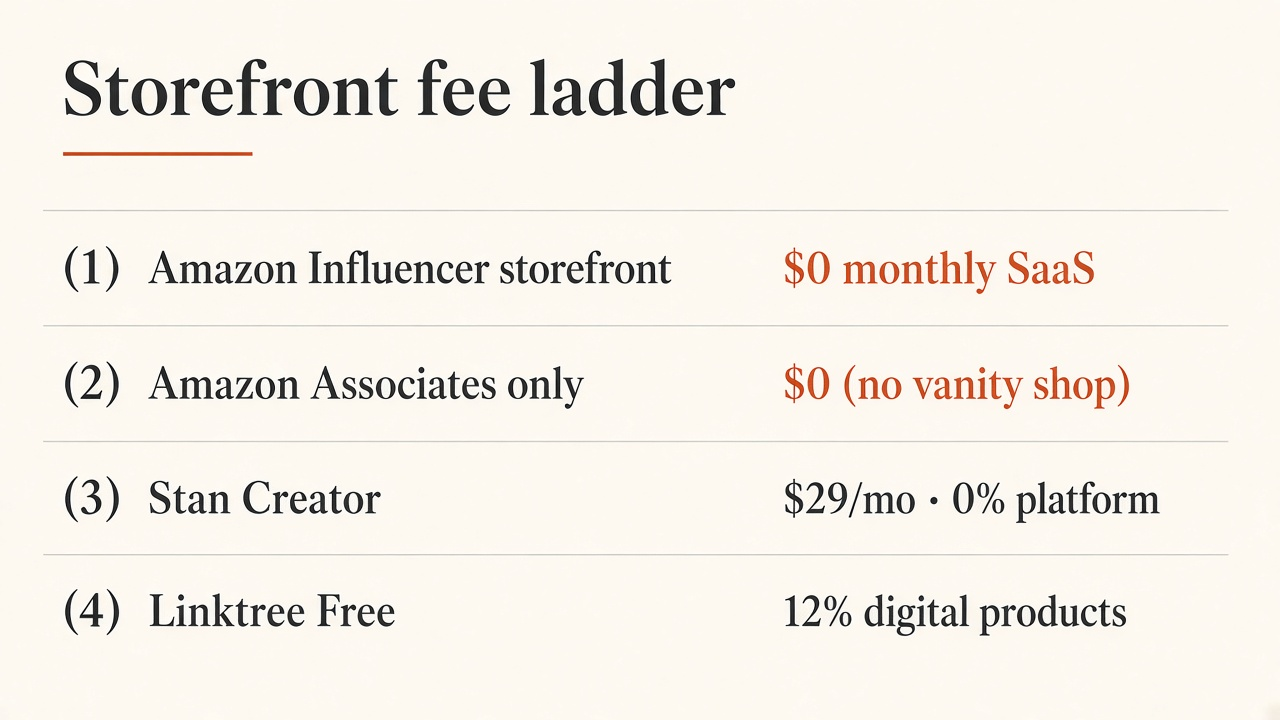
Source: Stan Help, Beacons Help, Linktree Help (Oct/Nov 2025 fee pages), About Amazon Influencer Program, Associates Central Influencer Policy. Accessed 2026-10-09.
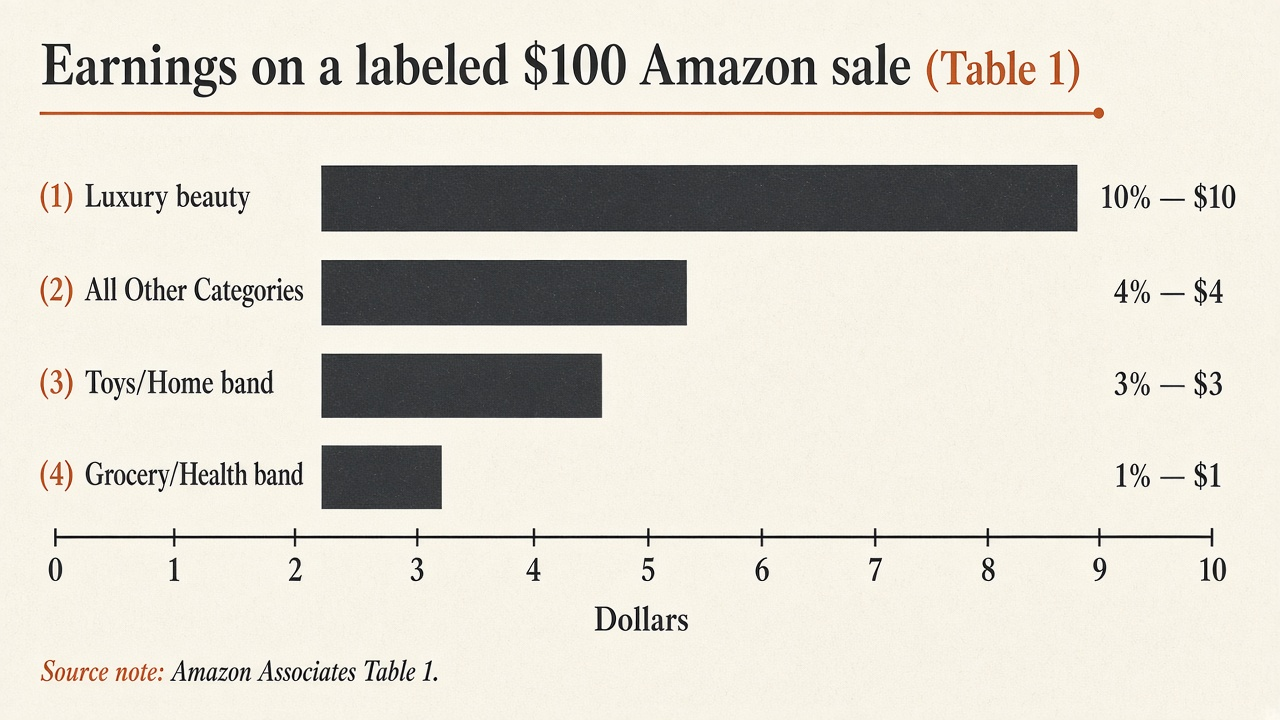
Source: Amazon Associates Commission Income Statement Table 1. https://affiliate-program.amazon.com/help/node/topic/GRXPHT8U84RAYDXZ. Arithmetic on labeled $100 Qualifying Revenue.
Pick Amazon when the buyer needs Amazon’s catalog and checkout trust, and you can win verbal or social CTAs to a vanity URL. Pick a paid bio storefront when you sell your course or download and the monthly GMV clears the flat fee—see Linktree vs storefront platforms. Pick a co-branded marketplace page when a merchant lists a product and you need a sell surface that is not Amazon’s ASINs—that is feat.’s job, mapped against catalog links in Amazon Associates vs feat.
Use this when the fee question is really a surface question.
Q: Do you have to pay for an Amazon storefront? A: No. Amazon does not charge a published join or monthly SaaS fee for an Influencer Program storefront. You earn commissions on qualifying purchases under Associates rules. The cost is approval, compliance, short cookies, and Table 1 rates—not a subscription invoice.
Q: Do Amazon Associates accounts include a storefront?
A: Not automatically. Associates gives Special Links and reporting. The vanity amazon.com/shop/... page is an Amazon Influencer Program asset. Existing Associates still complete Influencer registration for the storefront.
Q: Is the Amazon Influencer Program free to join? A: Official About Amazon and Associates Central materials frame the program as free for eligible creators—no storefront subscription sticker. Eligibility still requires meeting Amazon’s qualitative and quantitative thresholds on a qualifying social account.
Q: How does Amazon storefront cost compare to Stan or Linktree? A: Amazon’s Influencer seat is $0 monthly SaaS with catalog commissions. Stan Creator is $29/mo at 0% platform cut for your own products. Linktree Free takes 12% of digital products plus Stripe. Different jobs: Amazon curates their catalog; Stan/Linktree sell yours.
Q: Can I buy an Amazon storefront if I get rejected? A: No. There is no official “pay to unlock shop URL” path in Associates Central policy. Improve the public social account and reapply when Amazon’s eligibility signals change, or promote with Associates Special Links without a vanity storefront.
You do not pay Amazon a storefront subscription. You pay with an Influencer approval gate, FTC-clear disclosure, a 24-hour cart clock, and Table 1 percentages that often land at 1%–4% on everyday goods. Associates alone will not mint amazon.com/shop/.... When the job is a co-branded page for a merchant-listed product outside Amazon’s catalog, browse offers on the feat. marketplace.
Turn your audience into a distribution channel with a five-rung ladder—attention, trust, offer, sales surface, and economics—not follower vanity.
Affiliate marketing for small creators works on trust density: one problem, one offer class, one surface, EPC math (median ~$0.14), FTC disclosure—not a follower floor.
How to create a storefront as a creator: name the job (route, sell-own, sell-others), pick Linktree, Stan, Beacons, or a co-branded page, then ship one hero offer.