Affiliate Marketing for Startups: Complete Guide
Affiliate marketing for startups is an operating system—locks, cost, recruit, rates, tracking, first 100 sales, then diagnose a flat roster.
Amazon Associates commission rates by category: official US Table 1 from 10% luxury beauty to 0% gift cards, plus the 24-hour cart rule and bounty fees.

TL;DR: Amazon Associates commission rates by category are fixed US percentages on qualifying revenue: 10% for luxury beauty and Amazon Explore down to 1% for grocery and health, and 0% on gift cards and other excluded lines. Items must enter the cart within 24 hours of your link. Plan with Table 1, then leave Amazon when a higher CPS offer wins the same click.
Creators still pitch “Amazon affiliate money” as if one rate paid every ASIN. It does not. Luxury beauty and grocery are not the same business. A $20 gadget at 3% and a $20 gift card at 0% prove the point in one scroll.
Amazon Associates commission rates by category are the official US rate card for standard offsite product commissions. This page sits next to best affiliate marketing platforms, digital product affiliate marketing vs physical goods, affiliate commission structures, how affiliate marketing works, and how to negotiate affiliate commission rates.
Amazon Associates commission rates by category means the fixed percentage of Qualifying Revenue Amazon publishes for each product category under the US Standard Commission Income Statement. The rate follows the purchased product’s category, not your follower count. Same click, different ASIN, different pay.
Amazon’s help page is the source of truth. Secondary blogs copy it, then drift. Some invent categories that are not on the live table. This article quotes Table 1 for standard offsite product commissions. Separate onsite Associates and Creator Ads schedules exist and often pay less per category. Do not mix those tables into one fake ladder (Amazon onsite tables).
For program-type context (why Amazon is a catalog marketplace seat), see best affiliate marketing platforms. For how thin retail floors compare with digital CPS bands, see digital vs physical affiliate offers.
Category rates matter because Amazon’s advantage is trust and assortment, not creator-friendly margin. Pick the wrong niche and high conversion still pays pennies. Pick an excluded category and conversion pays nothing. The official ladder is how you stop guessing.
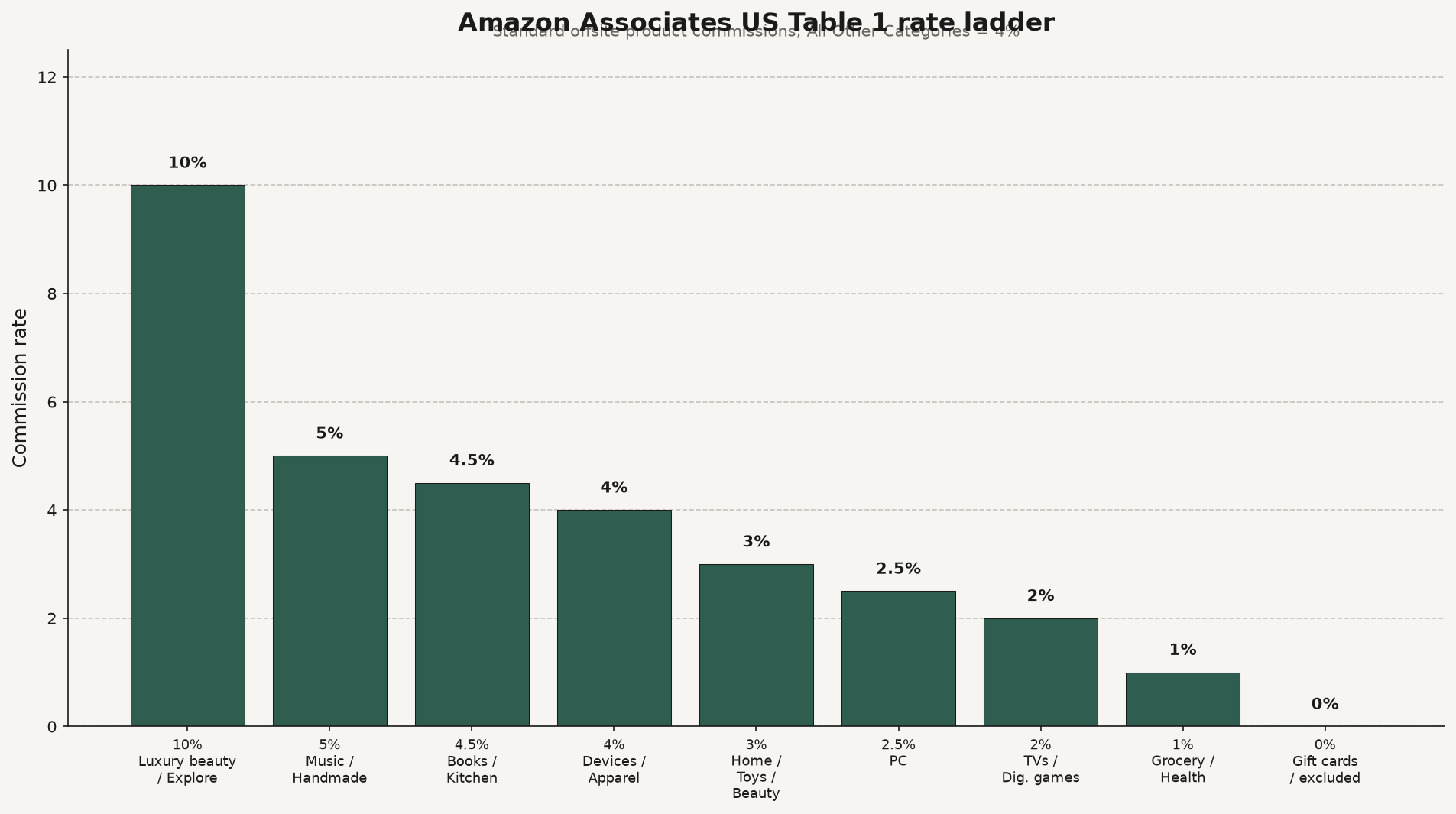
Source: Amazon Associates Program Standard Commission Income Statement (US), Table 1. https://affiliate-program.amazon.com/help/node/topic/GRXPHT8U84RAYDXZ
Amazon Associates category commissions work as a fixed-rate lookup on qualifying product revenue, plus optional bounty fees, inside a strict cart-attribution window. Read Table 1 first. Price a real order second. Only then decide whether Amazon or a higher CPS program owns the click.
| Product category (summary) | Fixed rate |
|---|---|
| Luxury Beauty, Luxury Stores Beauty, Amazon Explore | 10.00% |
| Digital Music, Physical Music, Handmade, Digital Videos | 5.00% |
| Physical Books, Kitchen, Automotive | 4.50% |
| Amazon devices (Fire, Kindle, Echo, Ring, Fire TV, Cloud Cam), Luxury Stores Fashion, Apparel, Watches, Jewelry, Luggage, Shoes, Handbags & Accessories | 4.00% |
| Toys, Furniture, Home, Home Improvement, Lawn & Garden, Pets, Headphones, Beauty (non-luxury), Musical Instruments, Business & Industrial, Outdoors, Tools, Sports, Baby, Amazon Coins | 3.00% |
| PC, PC Components, DVD & Blu-Ray | 2.50% |
| Televisions, Digital Video Games | 2.00% |
| Amazon Fresh, Physical Video Games & Consoles, Grocery, Health & Personal Care | 1.00% |
| Gift Cards; Wireless Service Plans; Alcoholic Beverages; Digital Kindle subscription products; Vehicles (leasing/sales); Pet Prescription Medications; restaurant-delivered food; Amazon Appstore, Prime Now, Amazon Pay Places; Coach | 0.00% |
| All Other Categories | 4.00% |
Source: Amazon Associates Standard Commission Income Statement, Table 1 (accessed 2026-09-27). Re-check before you publish a rate graphic. Amazon updates the statement.
Cut from this page: “Amazon Games 20%” and other rates that do not appear on the live Table 1 scraped into listicles. If Amazon adds a row later, update from the primary URL, not from memory.
| Table 1 rate | Labeled earnings on $100 Qualifying Revenue |
|---|---|
| 10% | $10.00 |
| 5% | $5.00 |
| 4.5% | $4.50 |
| 4% | $4.00 |
| 3% | $3.00 |
| 2.5% | $2.50 |
| 2% | $2.00 |
| 1% | $1.00 |
| 0% | $0.00 |
This is arithmetic on Amazon’s published percentages, not a promise of conversion. A $500 standing desk at 3% is $15. A $20 grocery item at 1% is $0.20. Community advice to “go high-ticket” is just this table with fewer decimals (r/AffiliateOps).
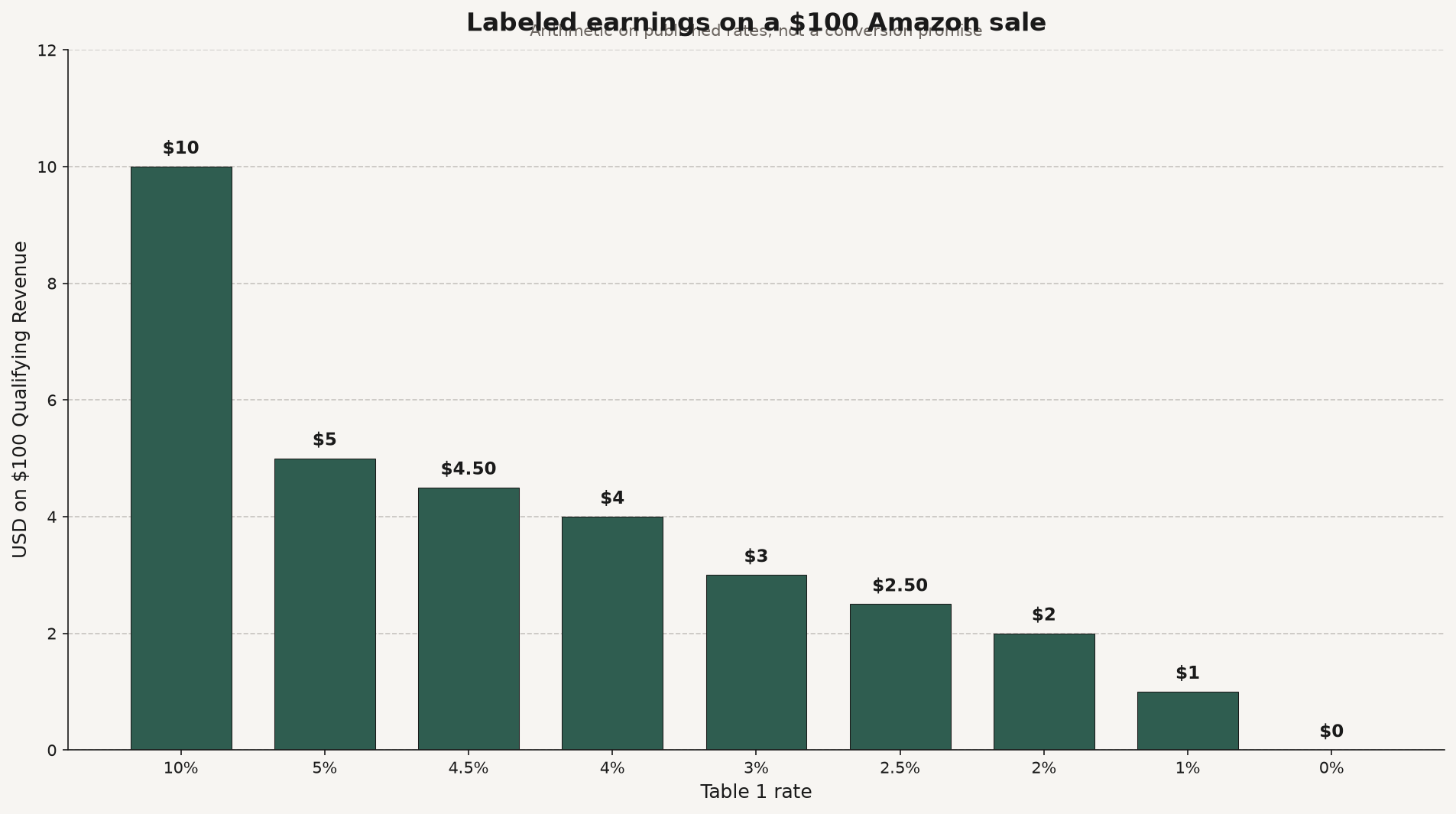
Source: Labeled calculation from Amazon Associates Table 1 fixed rates. https://affiliate-program.amazon.com/help/node/topic/GRXPHT8U84RAYDXZ
Amazon’s published cookie FAQ is tighter than most DTC programs:
Source: Amazon Associates Help: cart timing.
That is why Amazon can still monetize “they clicked my toaster and also bought headphones”: other cart lines can pay if they were added in your window under program rules. It is also why a reader who bookmarks and returns a week later without your link may pay you nothing. Model conversion conservatively.
Product commissions are not the whole statement. Selected bounty actions from Amazon’s published table:
| Bounty action | Fee |
|---|---|
| Prime Free Trial / Prime Paid Membership | $3.00 |
| Prime for Young Adults Trial or Paid Membership | $30.00 |
| Audible Standard Free Trial / Standard Monthly Membership | $20.00 |
| Audible Premium Plus Free Trial | $5.00 |
| Audible Premium Plus Monthly / Annual Membership | $10.00 / $25.00 |
| Kindle Unlimited Free Trial | $3.00 |
| Amazon Music Unlimited Free Trial or Paid Subscription | $3.00 |
| Amazon Business account registration | $15.00 |
| Baby or Wedding Registry create (+ ≥1 item) | $3.00 |
| Amazon Haul first purchase | $4.00 |
Source: Amazon Associates Bounty Events table on the Commission Income Statement. Eligibility rules apply; treat these as fee anchors, not guarantees.
One Audible Standard trial at $20 out-earns twenty successful $100 grocery referrals at 1%. Track bounties separately so seasonal product spikes do not hide a signup machine.
| Constraint | Prefer Amazon Associates | Prefer higher CPS (Shopify-band / network / direct) |
|---|---|---|
| Offer | Broad catalog the reader already trusts | Your own SKU or a niche merchant with margin |
| Rate reality | Table 1 1%-10% (often 1%-4% retail) | Shopify physical ~5%-15%, digital ~20%-50% (Shopify) |
| Attribution | 24h to cart; cart hold ~90 days | Often multi-week cookies on brand programs |
| Content type | Reviews, roundups, “best of” commerce | Deep education, SaaS trials, owned funnels |
| Ops | One tag, huge catalog | Approvals, creatives, partner managers |
Amazon wins when assortment and checkout trust beat percentage. Amazon loses when the same click can earn a Shopify-band commission on a merchant you can enable. That exit decision is why negotiate affiliate commission rates and revenue split models exist as separate jobs. Disclosure still applies on Amazon links (FTC disclosure rules).
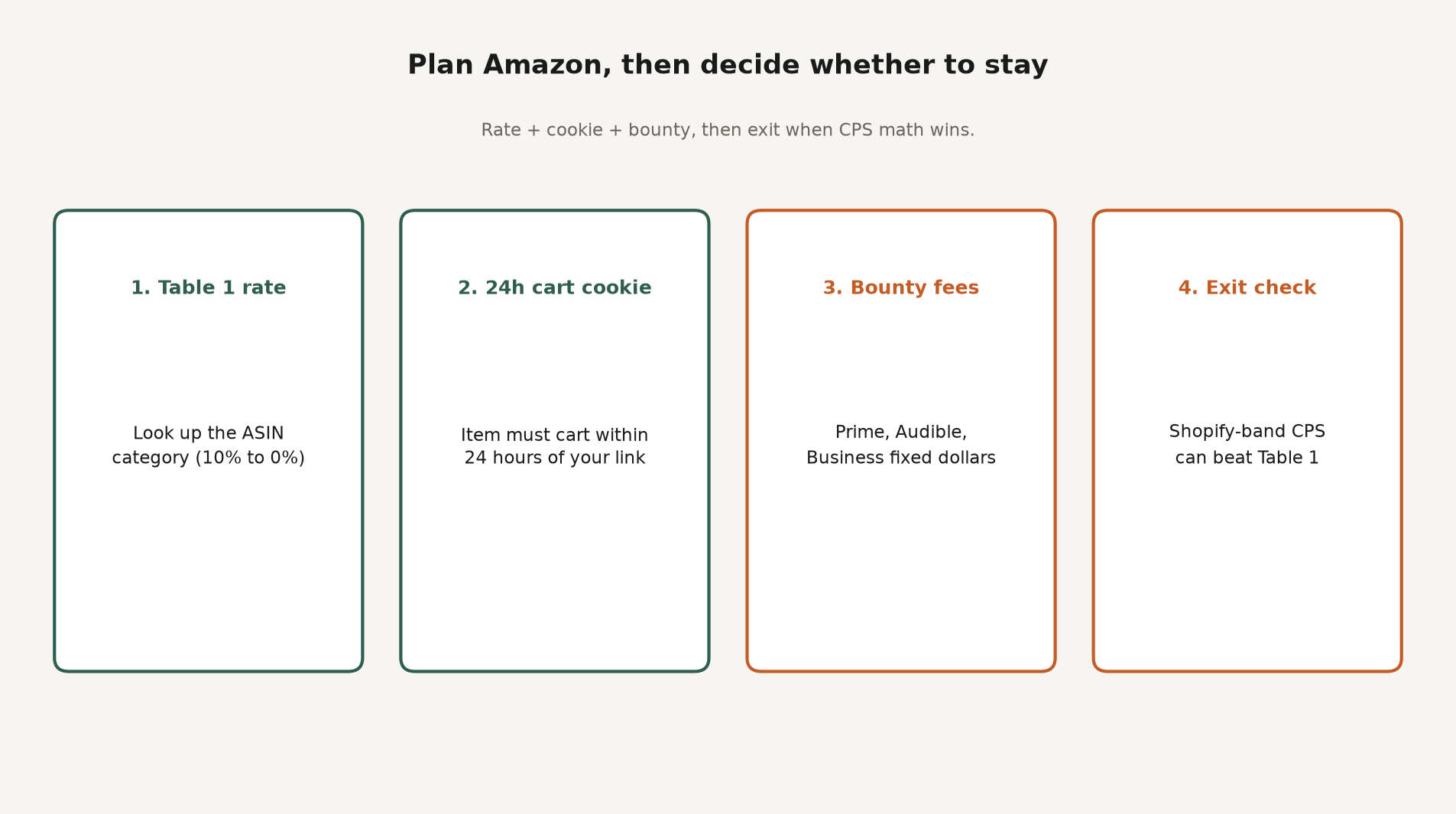
Source: Editorial framework from Amazon Table 1, Amazon cookie help, Amazon bounty table, and Shopify commission bands. https://affiliate-program.amazon.com/help/node/topic/GRXPHT8U84RAYDXZ
Q: What are Amazon Associates commission rates by category in 2026? A: US standard product commissions are fixed on Amazon’s Table 1, from 10% (Luxury Beauty, Luxury Stores Beauty, Amazon Explore) down through 5%, 4.5%, 4%, 3%, 2.5%, 2%, and 1% bands, with 0% on gift cards and other excluded categories, and 4% for All Other Categories. Re-check the live Amazon statement before you publish rates.
Q: How does the Amazon Associates cookie window work? A: Qualifying items must be added to the Shopping Cart within 24 hours of the customer arriving through your Associates link. If carted in that window, you can still earn when the order is placed before the cart expires (usually about 90 days), after delivery and full payment.
Q: How much do you earn on a $100 Amazon Associates sale? A: Multiply $100 by the Table 1 rate for that product’s category. Examples: $10 at 10%, $4 at 4%, $3 at 3%, $1 at 1%, and $0 at 0%. Conversion and returns still decide whether that line ever posts.
Q: What are Amazon Associates bounties? A: Bounties are fixed fees for specific actions such as Prime signup ($3), Audible Standard free trial ($20), or Amazon Business registration ($15), per Amazon’s bounty table. They sit beside product commissions and have their own eligibility rules.
Q: Are Amazon Associates rates high enough compared with other affiliate programs? A: Often not on percentage alone. Shopify’s published bands put many physical programs near 5%-15% and digital near 20%-50%. Use Amazon for catalog coverage and trust. Move high-intent niche traffic to higher CPS offers when you can.
Amazon Associates commission rates by category are a published ladder, not a vibe. Plan with Table 1, respect the 24-hour cart clock, count bounties as a separate line, and exit to a higher CPS offer when the math says so.
If you want products to sell through co-branded storefronts instead of Amazon’s catalog cut alone, start in the feat. marketplace.
Affiliate marketing for startups is an operating system—locks, cost, recruit, rates, tracking, first 100 sales, then diagnose a flat roster.
How to track affiliate sales: pick link cookie, coupon, pixel, S2S postback, or storefront checkout—then match Rewardful, Tapfiliate, or Impact.
Best affiliate programs for SaaS companies pass the Recurring Cap Test: labeled duration, cookie, seat type, payout rails—plus Rewardful’s ~24% planning band.