Affiliate Marketing for Small Creators
Affiliate marketing for small creators works on trust density: one problem, one offer class, one surface, EPC math (median ~$0.14), FTC disclosure—not a follower floor.
Turn your audience into a distribution channel with a five-rung ladder—attention, trust, offer, sales surface, and economics—not follower vanity.

TL;DR: How to turn your audience into a distribution channel is a five-rung ladder—attention inventory, trust proof, a sellable offer, a sales surface (bio link vs storefront), and economics (split vs sponsorship)—not a follower milestone. Sprout’s 2025 Pulse found 80% of consumers more willing to buy from brands that work with influencers beyond posts; Lowe’s pays up to 20% on storefront sales while Sephora prints 15%. Followers who only hear about you are not a channel.
Most founders with an audience ask for more reach. The real job is distribution: people who can buy through a surface you control or earn on.
How to turn your audience into a distribution channel is different from turning customers into a sales channel (buyers promoting you) and different from monetizing under 10K (which path pays first). Here you already have attention. The question is whether that attention can sell—and through what page.
Turning an audience into a distribution channel means converting people who already pay attention to you into a repeatable path to purchase—through a tracked link, curated storefront, or co-branded shop—so sales (not only views) can be attributed and paid.
Distribution here is commerce logistics for trust: the audience does not merely hear a message; they can complete a buy on a surface tied to you. That is why Sephora, Lowe’s, and Walmart host creator pages on their own domains (Sprout), and why marketplace storefronts exist for builders who are not big-box retailers (what is a creator storefront).
Turning your audience into a distribution channel matters because rented reach decays and paid media prices keep rising—while a trusted curator can keep selling without a new awareness campaign every week.
?via= links, Rewardful’s SaaS sample still finds 1.28% of affiliates sell (n=2,847) (Rewardful)—surface design and enablement matter.How to turn your audience into a distribution channel works as an Attention-to-Distribution Ladder: inventory the attention you actually own, prove trust, pick one sellable offer, choose the sales surface, then lock economics and attribution.
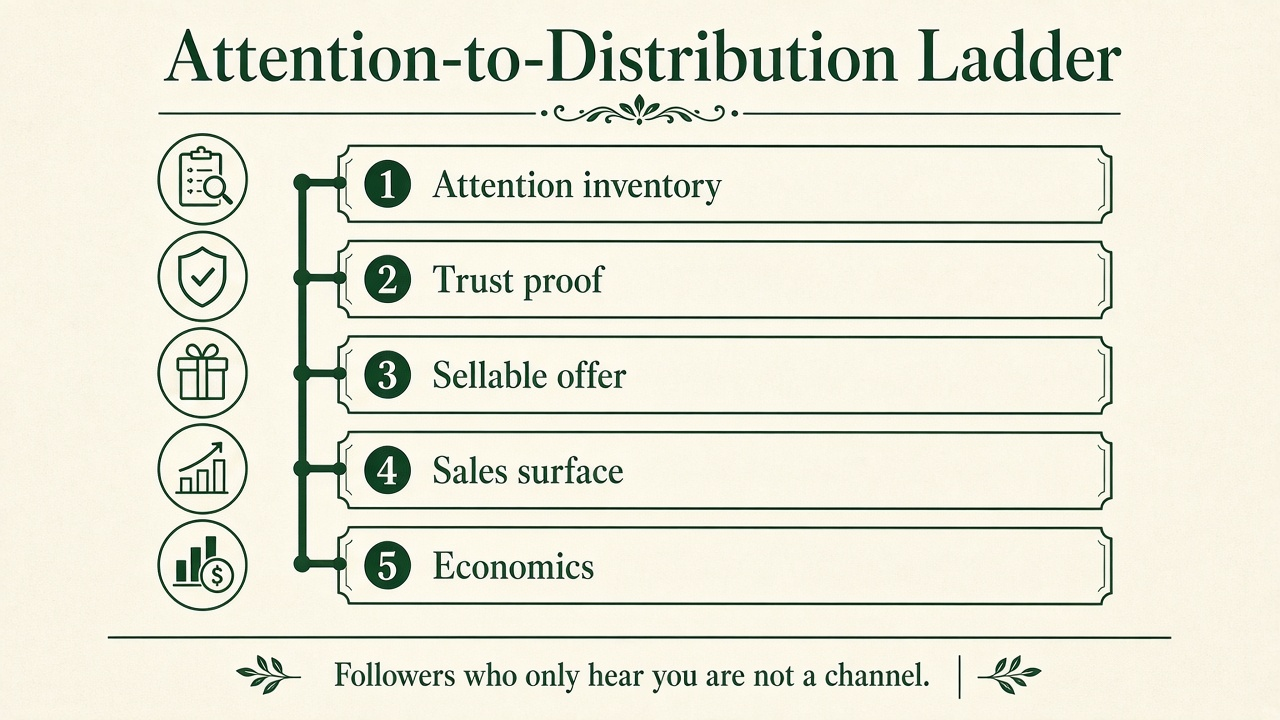
Source: Editorial Attention-to-Distribution Ladder for creators and founders with existing audiences; retail storefront examples from Sprout Social (Dec 5, 2025). Accessed 2026-10-08.
Count owned reach you can message without a feed algorithm: email, community, SMS, podcast. Rented followers are a top-of-funnel tip, not the bank. If the inventory is mostly rented, build one owned list before you call yourself a channel.
Write the number you can actually ping this week. “Forty thousand Instagram” with a 2% reach is not forty thousand distribution units. An eight-thousand-person email list you can email tomorrow is. Founders who skip this inventory end up optimizing posts that never hit the people who already said they care.
Distribution needs a reason to buy from your recommendation: demos, before/after, “what I use,” project builds. Sprout notes product reviews and recommendations as a top social search topic—and that storefronts work when creators curate what they actually use (Sprout).
If you cannot point to a clip, teardown, or routine that justifies the pick, you do not have a channel yet—you have a shout. Trust proof is the difference between a follower scrolling past and a buyer opening a storefront tab.
Pick one primary SKU or bundle. Your product, a merchant’s product on affiliate/revshare, or a digital offer. Do not open five paths on day one—that job lives on the under-10K monetization stack. Here the offer must match the trust proof on rung 2.
A channel with three conflicting CTAs is a brochure. One offer, one destination, fourteen days of consistent pointing beats a Linktree that looks busy and converts nothing.
| Surface | What the audience gets | When it wins | When it loses |
|---|---|---|---|
| Bio / single affiliate link | One tracked URL | One SKU, simple CTA | Multi-product curation; trust drops on generic homepage |
| Third-party hub (LTK, ShopMy, Linktree-class) | Mini shopping hub | Multi-brand lifestyle picks | Brand wants first-party checkout data |
| Retailer creator storefront | Page on brand.com (Sephora, Lowe’s, Walmart) | You are accepted into that program | Capacity gates (e.g. Sephora’s acceptance story) |
| Co-branded merchant storefront | Shop under your name for a listed product | Independent builders / marketplace selling | You need enterprise PRM deal registration |
Link vs business framing: affiliate marketing vs storefront. How to stand one up: how to create a storefront as a creator. Landing page vs shop: storefront vs landing page.
Publish the cut and the window. Retail examples from Sprout’s Dec 2025 roundup:
| Program | Published commission signal | Notes |
|---|---|---|
| Lowe’s Creator | Up to 20% | 30-day attribution window |
| Sephora storefront | 15% | U.S. creators; ≥3,000 followers |
| Walmart Creator | 1%–4% by category | No minimum follower count |
| ShopMy / LTK (Sprout framing) | 10%–30% range | Third-party hubs, not brand.com |
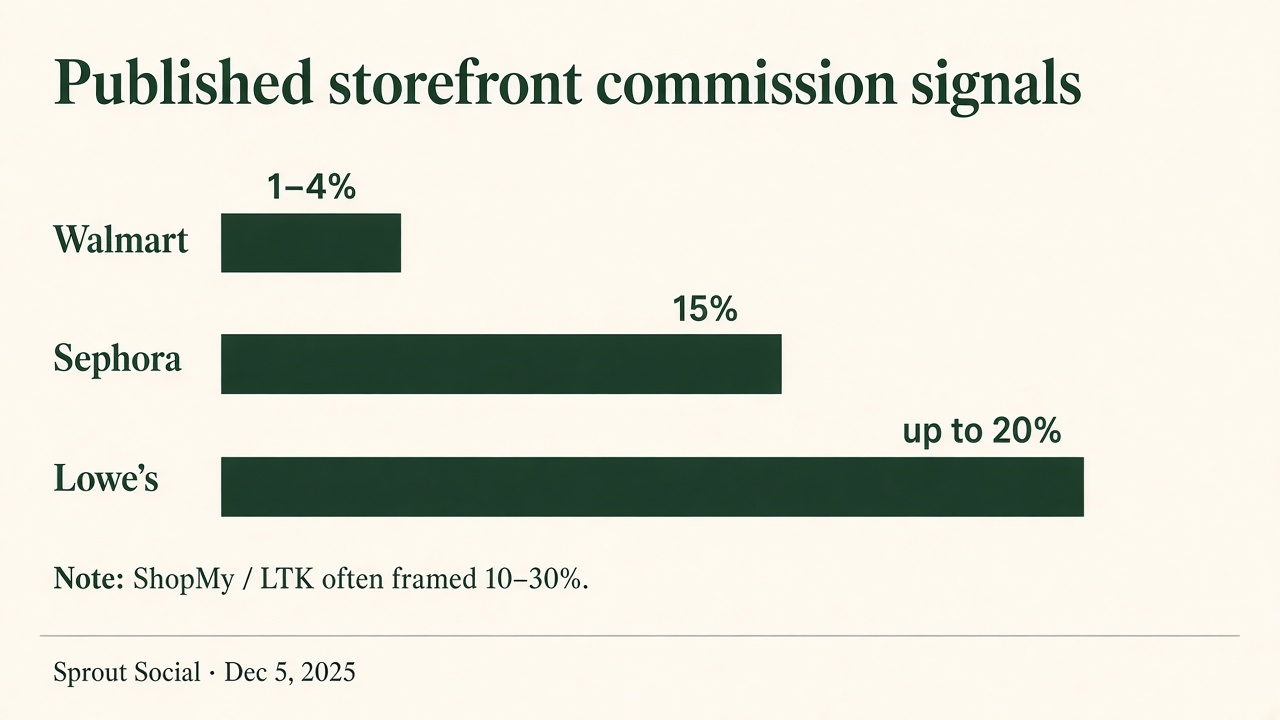
Source: Sprout Social, “Creator storefronts in 2026” (Dec 5, 2025). https://sproutsocial.com/insights/creator-storefronts/
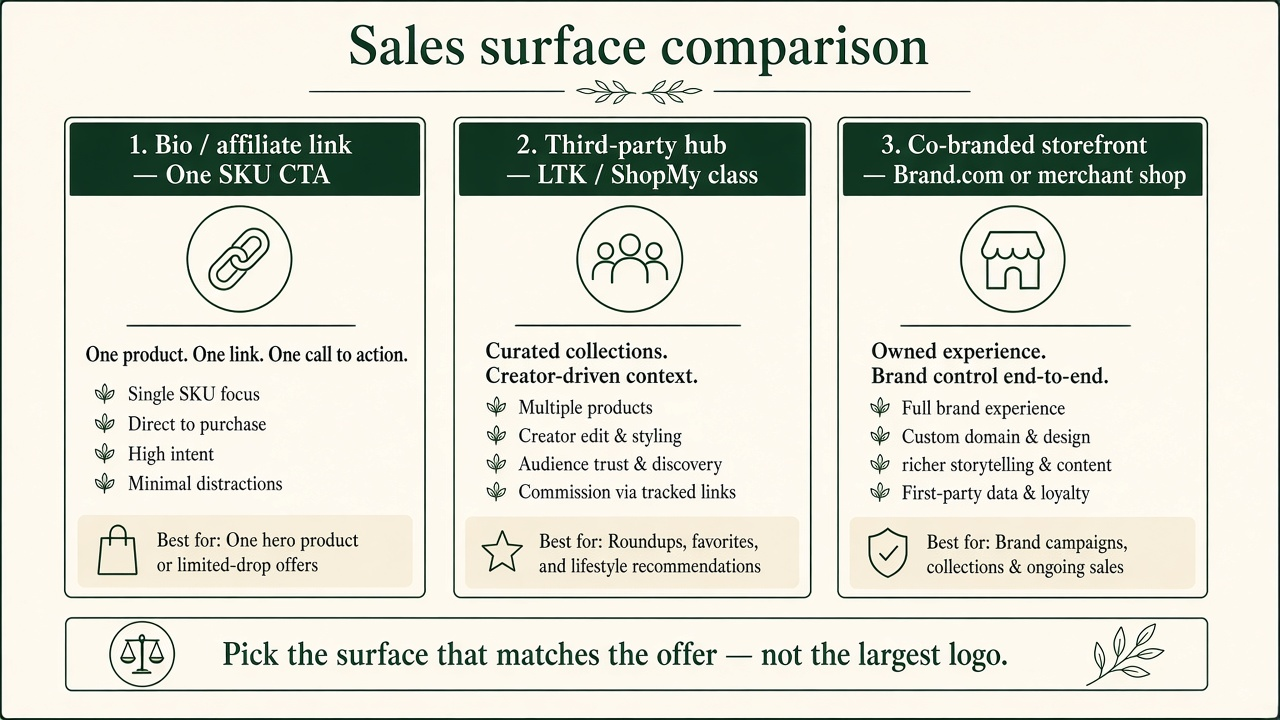
Source: Editorial surface comparison aligned with Sprout’s bio→LTK/ShopMy→brand storefront progression and feat. co-branded storefront positioning. Accessed 2026-10-08.
For independent products, pair the surface with revenue split models and how to track affiliate sales. Do not invent feat. fees.
Q: How do I turn my audience into a distribution channel? A: Inventory owned attention, prove trust, pick one sellable offer, choose a sales surface (link, hub, retailer storefront, or co-branded shop), and publish commission plus attribution rules. Measure sold orders, not only reach.
Q: Is a large following required? A: No. Walmart’s creator program has no minimum follower count; Sephora’s storefront program asks for at least 3,000 U.S. followers. Independent storefronts and owned lists matter more than a vanity ceiling.
Q: How is this different from turning customers into a sales channel? A: Customers-as-channel recruits buyers to promote you. Audience-as-distribution converts people who already follow you into a purchase path. Different roster, different enablement.
Q: What commission do creator storefronts pay? A: It depends on the program. Sprout’s 2025 roundup cites Lowe’s up to 20%, Sephora 15%, Walmart 1%–4% by category, and ShopMy/LTK often in a 10%–30% band. Always read the live program terms.
Q: Should I use a bio link or a storefront? A: Bio links win for one SKU and a sharp CTA. Storefronts win when you curate multiple products or need a branded shopping context that survives after a single post.
How to turn your audience into a distribution channel is a ladder: attention, trust, offer, surface, economics. Climb it once. Stop mistaking a follower graph for a sales channel.
If you want a co-branded storefront where your audience can buy a merchant-listed product under a revenue split, start at the feat. marketplace.
Affiliate marketing for small creators works on trust density: one problem, one offer class, one surface, EPC math (median ~$0.14), FTC disclosure—not a follower floor.
How to create a storefront as a creator: name the job (route, sell-own, sell-others), pick Linktree, Stan, Beacons, or a co-branded page, then ship one hero offer.
How to sell someone else's product online: affiliate link, co-branded storefront, dropshipping, or reselling. Compare what you own, risk, and keep.