How to Turn Your Audience Into a Distribution Channel
Turn your audience into a distribution channel with a five-rung ladder—attention, trust, offer, sales surface, and economics—not follower vanity.
Affiliate marketing for small creators works on trust density: one problem, one offer class, one surface, EPC math (median ~$0.14), FTC disclosure—not a follower floor.

TL;DR: Affiliate marketing for small creators is a trust-density job, not a follower race. Name one problem your audience already brings you, pick one offer class you can defend with published rates, put it on one surface, plan with median EPC near $0.14 and Rewardful’s 1.28% sale activation, disclose every paid link, and ship weekly.
Affiliate marketing for small creators dies in the same place every time: the follower floor. Creators wait for 10K, then 50K, then “enough” engagement. Meanwhile they paste twelve Amazon links into a bio and call it a program.
Small is not the blocker. Vague is. A few hundred people who trust you on one problem will out-convert a cold list of ten thousand strangers. Operators on Reddit say it plainly: you do not need 10K followers—you need people who actually care (r/thesidehustle).
This page is for creators who already have some trust—comments, DMs, a tiny list—and want affiliate as the money path. If you have zero distribution, start on how to start affiliate marketing with no audience. If you need the full monetization stack (products, memberships, sponsorships), use how creators monetize a small audience under 10K.
Affiliate marketing for small creators is recommending a merchant’s product with a tracked link or co-branded storefront, earning a commission on qualifying sales, while working from a niche audience that trusts you more than it follows you.
It is not “become an influencer first.” It is not pasting every network’s top deal into Stories. It is a performance contract: unique ID, attribution window, qualifying event, approval, payout, and FTC disclosure on the same surface as the endorsement.
The small-creator version of that contract is stricter on focus. You cannot bury a weak offer under reach. You pick one problem, one offer class, and one surface—then you measure clicks and commissions like an adult.
Affiliate marketing for small creators matters because most creators already live under the earnings barrier, and affiliate is the lowest-capital path that still teaches offer selection and tracking.
Affiliate marketing for small creators works when you climb the Trust Density Ladder: name the problem, pick the offer class, pick the surface, underwrite with EPC math, then disclose and ship. Skip a rung and you decorate a bio that cannot take money honestly.
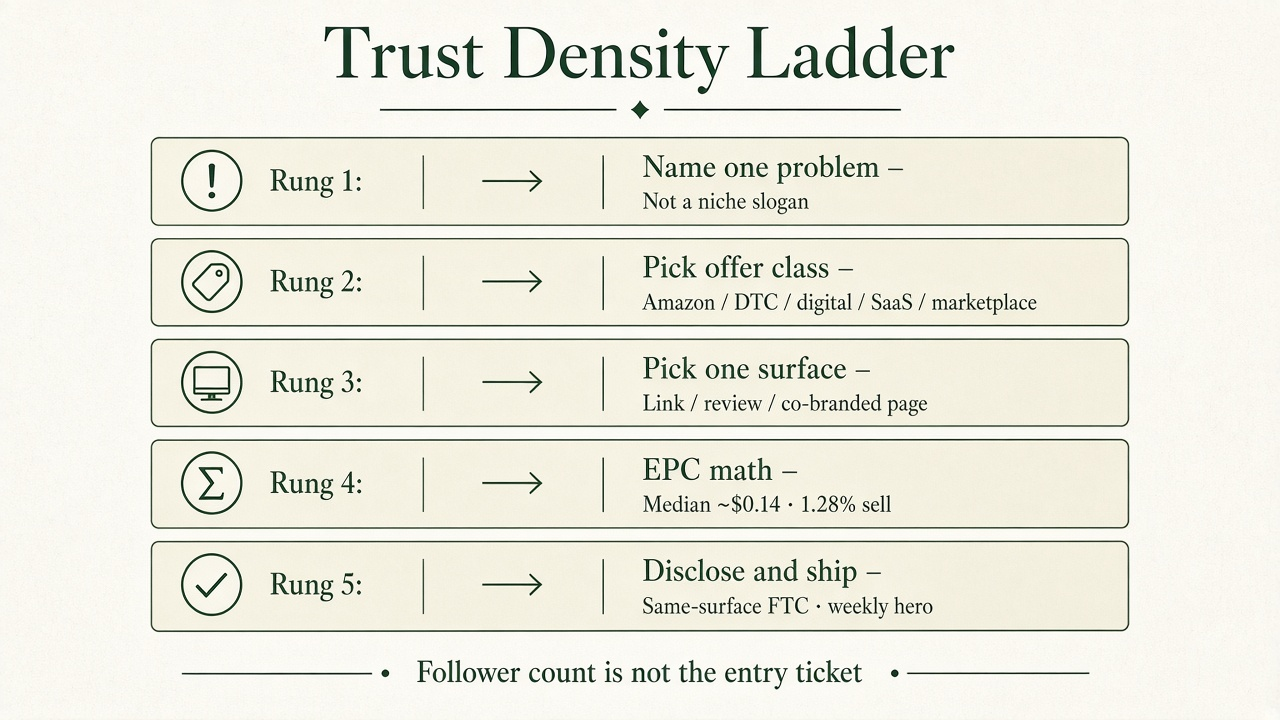
Source: Editorial framework synthesizing Rewardful activation, AvidAffiliate EPC, Shopify/Amazon published rates, and FTC disclosure. https://www.rewardful.com/articles/state-of-saas-affiliate-programs-report · https://avidaffiliate.com/research/skimlinks-network-analysis/
“Fitness” is a slogan. “Home workouts for new parents with twenty minutes” is a problem. Reddit’s micro-audience operators obsess over one specific problem until fifty to a few hundred people treat them as the obvious recommender (r/digitalproductselling).
Write the problem in one sentence. If you cannot, you are not ready to pick an offer.
Use help-center and industry bands, not TikTok screenshots.
| Offer class | Published rate shape | When a small creator wins | When it fails |
|---|---|---|---|
| Amazon Associates (catalog) | Table 1 often 1%–10% by category + 24h cart cookie | Broad SKUs, proof content, low approval friction | High-ticket trust sales that need a branded page |
| Physical DTC / retail | Shopify band ~5%–15% | Higher AOV, clear use-case demos | Thin margins + short cookies + returns holds |
| Digital products / courses | Shopify band ~20%–50% | Review depth, tutorials, comparisons | Junk PLR with no personal use |
| SaaS / subscriptions | Shopify B2B ~10%–30%; Rewardful sample avg 24.16% | Recurring when the tool is in your workflow | Promoting tools you never open |
| Marketplace co-branded | Revenue split on a listed product (live terms at signup) | One hero merchant SKU on your page | Treating it like a raw link directory |
Sources: Amazon Associates; Shopify commission guide; Rewardful. Do not invent feat. fees on this page—live commercial terms appear at signup.
$100 qualifying sale, platform cut only (illustrative):
| Rate reference | Commission on $100 |
|---|---|
| Amazon grocery band 1% | $1 |
| Amazon luxury beauty 10% | $10 |
| Rewardful SaaS average 24.16% | ~$24 |
| Shopify digital midpoint 35% (of 20%–50%) | $35 |
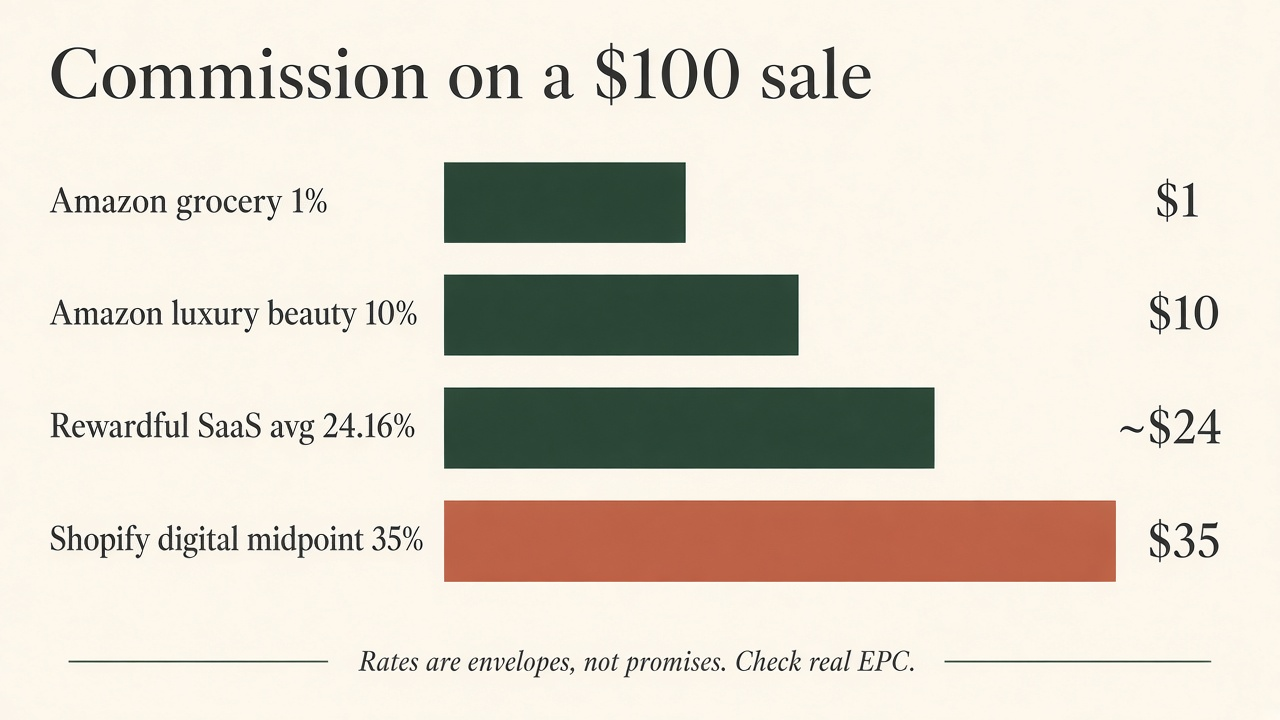
Source: Amazon Associates Table 1; Rewardful State of SaaS Affiliate Programs; Shopify Affiliate Commission Guide midpoint of digital band. https://affiliate-program.amazon.com/help/node/topic/GRXPHT8U84RAYDXZ · https://www.rewardful.com/articles/state-of-saas-affiliate-programs-report · https://www.shopify.com/blog/affiliate-commission
Percentage is not EPC. Finance can show a lower rate and a higher EPC than software in AvidAffiliate’s vertical table—always check the program’s real click economics (AvidAffiliate).
| Surface | Job it finishes | Small-creator rule |
|---|---|---|
| Raw tracked link in bio / caption | Route to a known SKU | One hero link, not twelve |
| Long-form review / comparison | Search + trust for consideration | One primary CTA offer |
| Link hub | Route to many destinations | Temporary; graduate the money path |
| Creator shop (sell-own) | Checkout your product | Wrong tool for someone else’s SKU |
| Co-branded marketplace storefront | Sell a merchant-listed product under your brand | Use when the product is not yours but the page should feel like yours |
If the job is sell-own digital goods, read how to create a storefront as a creator. If the job is catalog links versus a co-branded page, read Amazon Associates vs feat.
Hold the fantasy spreadsheet. Use public floors.
| Monthly commission target | Tracked clicks at $0.14 median EPC |
|---|---|
| $50 | ~357 |
| $100 | ~714 |
| $250 | ~1,786 |
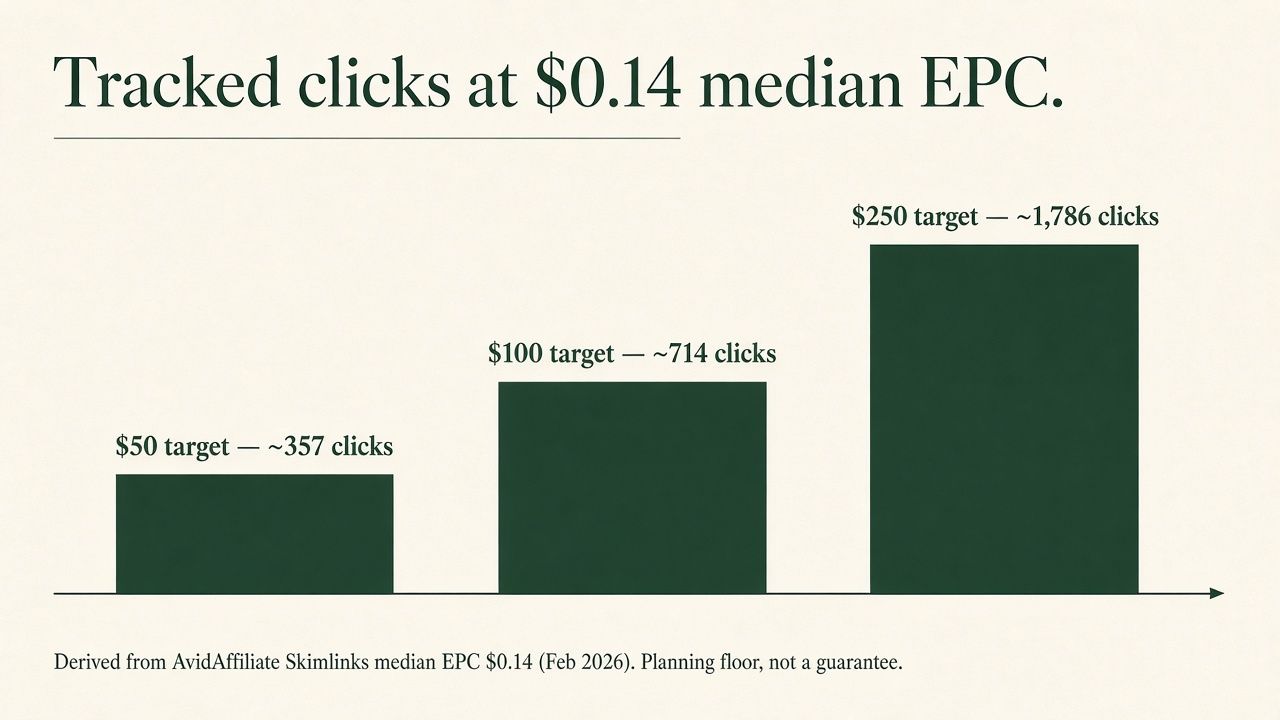
Source: Derived from AvidAffiliate Skimlinks median EPC $0.14 (Feb 2026). https://avidaffiliate.com/research/skimlinks-network-analysis/
Rewardful’s SaaS sample is the second warning label: most enrolled affiliates never sell (Rewardful). Depth on one offer beats a directory of dead links. Expect payout holds of 30–60 days on many retail programs while returns settle (Shopify).
Put the disclosure on the same surface as the endorsement—caption, pin, or above the fold—not in a footer scavenger hunt (FTC). Then ship one useful asset per week: a review, a comparison, a demo, or a problem-solving post with one honest CTA. Measure clicks to the hero, attributed orders, and unsubscribes—not likes on the “I joined Amazon” Story.
If you are browsing a giant retailer catalog, Amazon Associates (or that retailer’s creator storefront) is usually the right tool. If you want to sell a merchant’s listed product from a page that still feels like yours, with tracking and a revenue split, that is the feat. marketplace job. Browse feat. marketplace, pick a product you can stand behind, and use the co-branded storefront the platform generates. Live fees appear at signup—never invented here.
Q: What is affiliate marketing for small creators? A: It is recommending a merchant’s product with tracked attribution and earning a commission, while working from a niche audience that trusts you. Follower count is not the entry ticket—offer fit, surface, and disclosure are.
Q: Can affiliate marketing work with under 10K followers? A: Yes, when the audience is specific and you promote one honest offer on one clear surface. Plan with median EPC near $0.14 and expect most affiliates in SaaS samples never to sell (1.28% in Rewardful’s data)—depth beats reach theater.
Q: Should small creators start with Amazon Associates? A: Amazon is a fine catalog on-ramp: Table 1 rates often land 1%–10% by category with a 24-hour cart cookie (Amazon Associates; cookie help). Graduate to higher-band digital/SaaS or a co-branded marketplace page when you have a hero SKU that deserves more than a deep link.
Q: How is this different from influencer marketing? A: Affiliate pays for a tracked result. Influencer marketing often pays for a post up front. Hybrids exist. For the risk split, see affiliate vs influencer marketing.
Q: Do small creators need a storefront to do affiliate marketing? A: No. A tracked link plus a strong review can be enough. Use a co-branded storefront when the product is merchant-listed and you want the page to feel like yours—see how to create a storefront as a creator.
Affiliate marketing for small creators is a trust-density ladder, not a follower waiting room. Name one problem. Pick one offer class with published rates. Put it on one surface. Underwrite with EPC and activation math. Disclose. Ship weekly.
If the product you want to sell is already listed by a merchant and you want a co-branded page instead of a raw affiliate link, start on the feat. marketplace.
Turn your audience into a distribution channel with a five-rung ladder—attention, trust, offer, sales surface, and economics—not follower vanity.
How to create a storefront as a creator: name the job (route, sell-own, sell-others), pick Linktree, Stan, Beacons, or a co-branded page, then ship one hero offer.
How to sell someone else's product online: affiliate link, co-branded storefront, dropshipping, or reselling. Compare what you own, risk, and keep.