Affiliate Marketing for Startups: Complete Guide
Affiliate marketing for startups is an operating system—locks, cost, recruit, rates, tracking, first 100 sales, then diagnose a flat roster.
How to get your first 100 affiliate sales: Rewardful finds 0.8% of referrals convert, so 100 sales means about 12,500 referrals from a few named sellers.

TL;DR: You get your first 100 affiliate sales from a handful of named sellers, not a big roster. Rewardful’s SaaS data puts referral-to-sale conversion at 0.8% and finds only 1.28% of affiliates ever sell. That math means about 12,500 referred visits for 100 sales. Activate ten people inside 14 days, then add one dated promotion.
Your program is live, forty people joined, and the dashboard says zero. That is the normal starting state, not a bug. Learning how to get your first 100 affiliate sales is learning that a join is not a seller and that a seller needs a page, an offer, and a reason to post this week.
Rewardful studied 2,847 SaaS affiliate programs and found that 7.6% of affiliates make at least one referral and 1.28% generate at least one sale. Average referral-to-sale conversion over 90 days is 0.8% (Rewardful, checked 2026-10-06). Those three numbers are the whole plan. Everything else is how you beat them.
Key takeaways:
Your first 100 affiliate sales are the first hundred paid orders attributed to partners who promote your product for a commission, counted after refunds, excluding self-referrals and coupon leakage.
That definition does real work. The r/PPC thread that keeps resurfacing is a DTC skincare brand five weeks into a network program: “One sale attributed to an affiliate the whole time, and it was a self-referral from someone clearly chasing the signup bonus” (r/PPC). The same founder found a job board approved as a publisher and a third of budget routed to one cashback site with “lots of clicks, almost no add-to-carts.” Clicks are not sales. Self-referrals are not sales. Coupon-site last clicks on buyers who were already checking out are not new sales either.
So count clean. A sale is an order the partner caused, from a buyer who was not already in your cart. If you need the fraud side of that rule, affiliate fraud and how to detect it owns it.
The first 100 is also a different job from the first 10 recruits. How to recruit affiliates for your product owns who to ask. This page owns what happens after they say yes.
The first 100 sales are the proof threshold. Before it, content publishers will not promote you, commission math is theory, and you cannot tell a weak offer from weak activation. After it, you have per-seller conversion data and a story other partners will believe.
Why the number changes your next move:
The First 100 Sales Ladder splits the target into three rungs with different sellers. Sales 1–10 are proof sales from customers you activate by hand. Sales 11–40 come from about ten named sellers with a shareable page. Sales 41–100 come from one dated promotion plus the content partners who join once proof exists.
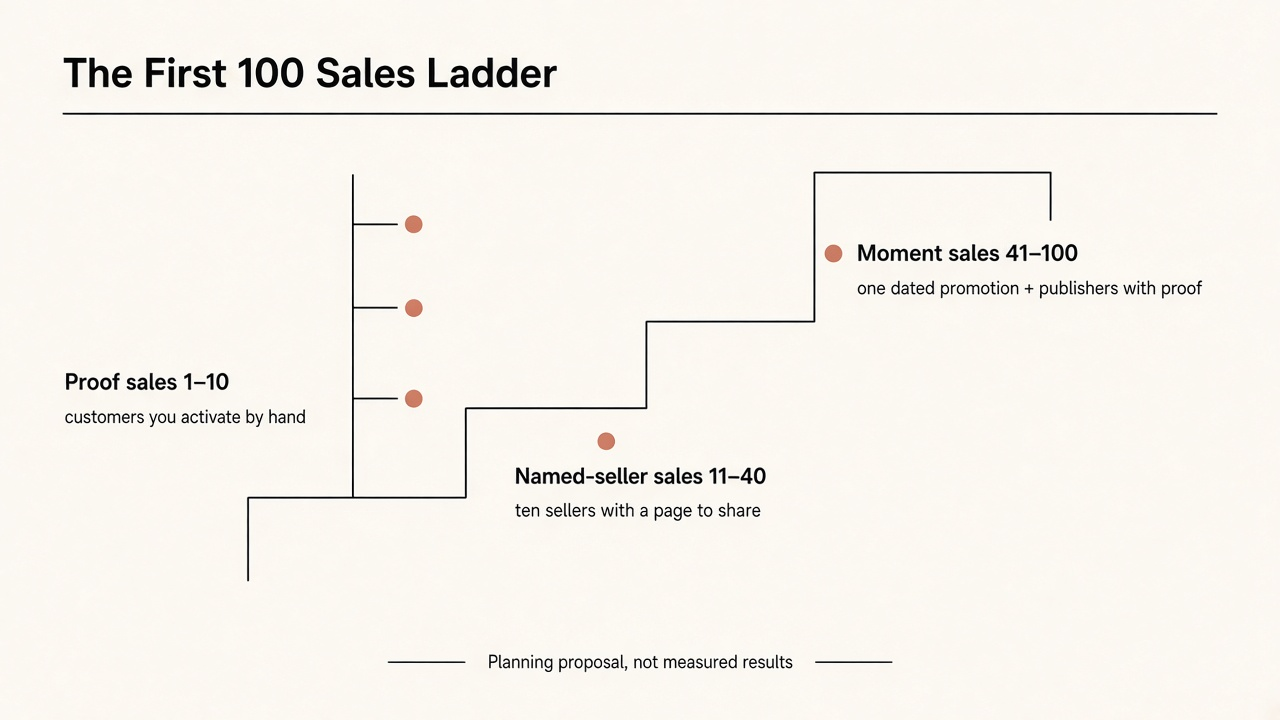
Source: Editorial framework built on Rewardful, 2026. https://www.rewardful.com/articles/state-of-saas-affiliate-programs-report. Rung boundaries are a planning proposal, not measured results.
Sales equal selling affiliates times sales per seller. Rewardful gives you both sides of the cold-water version.
| Path to 100 sales | Recruits needed | Sellers | Sales per seller | Basis |
|---|---|---|---|---|
| Open roster at average activation | ~781 | ~10 | ~10 | 1.28% sale activation (Rewardful) |
| Open roster, one sale each | ~7,813 | ~100 | 1 | 1.28% sale activation (Rewardful) |
| Named roster you hand-pick | 10 to 15 | 10 | 10 | Proposal; no public dataset for named-roster activation |
| Referred visits needed at average conversion | — | — | — | 100 ÷ 0.8% = 12,500 visits (Rewardful) |
The first two rows are division on Rewardful’s averages. The third row is the bet this page argues for, and it has no public dataset behind its activation rate. Treat it as a plan to measure, not a promise.
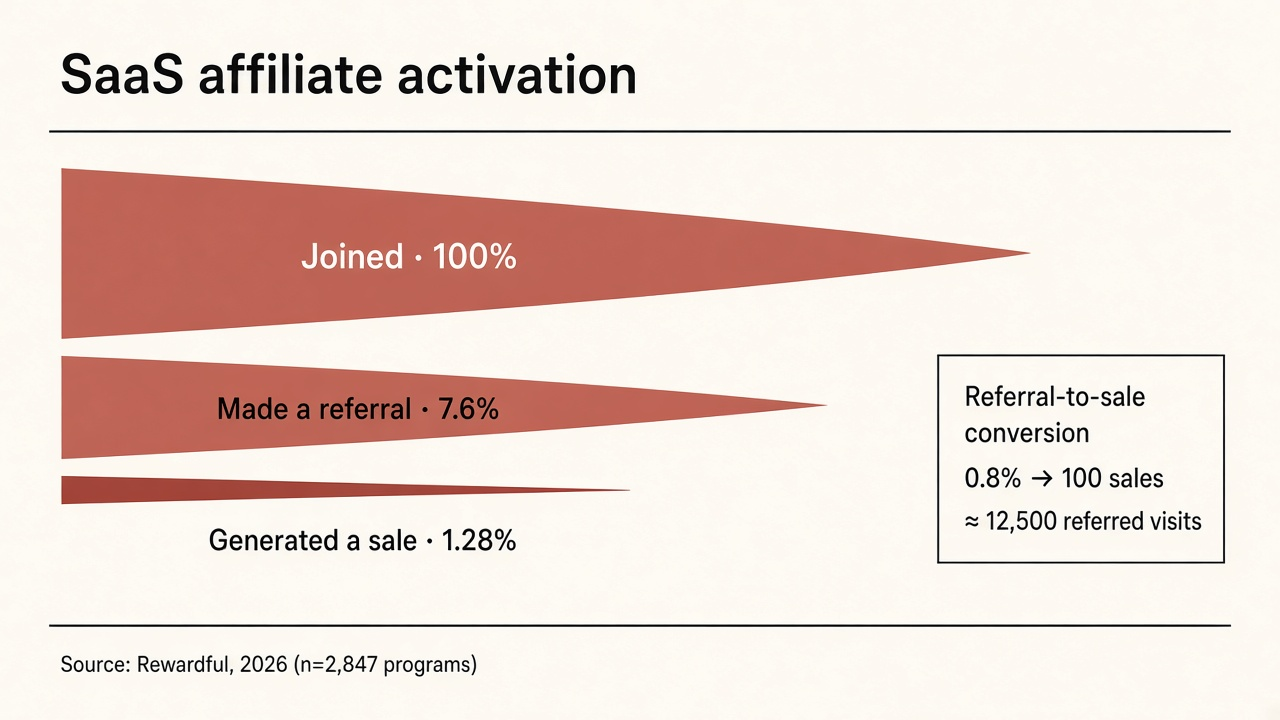
Source: Rewardful, 2026. https://www.rewardful.com/articles/state-of-saas-affiliate-programs-report.
Your first ten sales come from people who already recommend you. The r/growthmarketing operator who restarted a program from zero put it plainly: treat “affiliates” as “10-15 key partners, not a giant directory,” and start “with customers who were already sending referrals in Slack/email” (r/growthmarketing).
Do the work for them. Write the first post with them. Get on a 20-minute call. The Rewardful community’s 14-day activation timeline is the right shape: a personalized welcome on day 1, a getting-started guide on day 2, a case study on day 3, a check-in on day 7, early performance on day 14 (r/rewardful). “A welcome email is great, but a call is better.”
Rung two is about ten sellers, each with a destination worth sharing. A bare tracked link to your homepage asks their audience to trust your page. A co-branded page asks them to trust the seller. That is the gap feat. was built for: the merchant lists an offer, an approved seller gets a co-branded storefront, and the revenue split is set per sale.
Give each seller a one-pager with money math. The same operator: “vague commissions kill momentum. Once I published a simple one-pager with examples (if a user stays 12 months, you make $X), people actually started pushing.” If the plan is recurring, recurring vs one-time affiliate commissions shows how to cap it.
The last sixty sales need a reason to post on a date. Run one limited-time offer your ten sellers can all announce in the same week. By then you have 40 clean sales, so you can pitch content publishers with per-seller conversion data instead of a deck.
Watch where the money goes. Coupon and cashback sites will show up as soon as you have a code. They can win last click on buyers who were already checking out. Decide your coupon and brand-bidding rules before the promotion, not after.
| Lever | Effect on first 100 | Why |
|---|---|---|
| Raising commission 20% → 30% | Low | Rewardful: commission rarely separates high performers |
| Recruiting 200 more open signups | Low | 1.28% sell; most add noise and review work |
| Network listing on day one | Low to negative | Publishers wait for conversion history |
| 14-day activation calls | High | Turns joins into first posts |
| Shareable co-branded page per seller | High | Removes the “trust my link to their homepage” step |
| One dated group promotion | High | Gives every seller the same reason to post |
The “Low” and “High” labels are editorial judgment from the cited sources, not a measured lift. There is no public dataset that ranks these levers for first-100 programs.
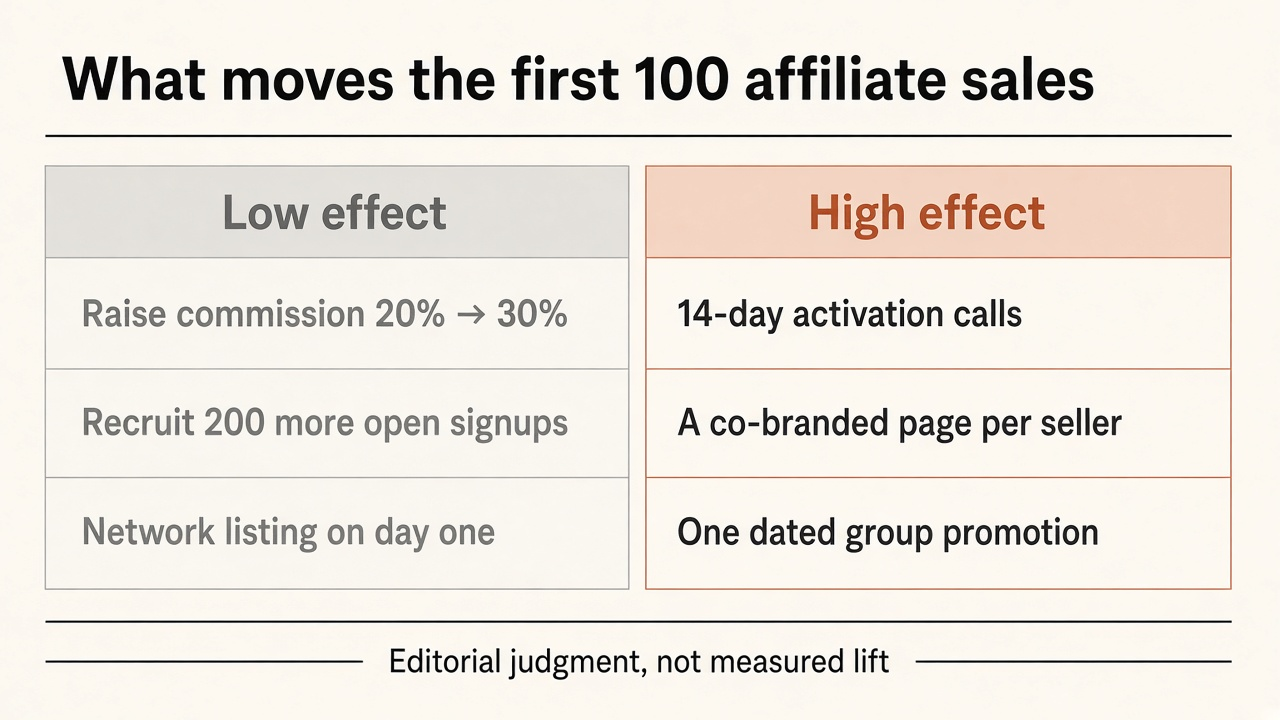
Source: Editorial comparison citing Rewardful, 2026. https://www.rewardful.com/articles/state-of-saas-affiliate-programs-report. Effect labels are judgment, not measured lift.
Sometimes the sellers posted and nobody bought. One r/Affiliatemarketing commenter diagnosed a zero-sale creator as “not a traffic problem, it’s a path problem,” and the fix was a focused page per intent instead of a generic list (r/Affiliatemarketing). If referred visits are in the thousands and sales are near zero, check the landing page, the price, and checkout before you touch the roster. Why is our affiliate program flat covers that diagnosis.
These seven steps run the ladder in order. Each step is at most two sentences.
Q: How do I get my first 100 affiliate sales? A: Activate ten to fifteen named sellers by hand inside 14 days, give each a page worth sharing, then run one dated promotion. Rewardful’s SaaS data shows 0.8% referral-to-sale conversion, so plan for about 12,500 referred visits. A small engaged roster beats a large open one.
Q: Why does my affiliate program have no sales? A: Usually because joins never became posts. Rewardful finds only 7.6% of affiliates make a referral and 1.28% make a sale. Check activation first, then the landing path if referred visits are high but sales are flat.
Q: How many affiliates do I need for 100 sales? A: At Rewardful’s 1.28% sale activation, an open roster needs roughly 781 recruits to yield about ten sellers. Ten hand-picked sellers making ten sales each is the cheaper target. There is no public dataset for named-roster activation, so measure yours.
Q: How long does it take to get the first 100 affiliate sales? A: There is no public dataset for days to 100 affiliate sales. Rewardful shows only 12–18% of new merchants confirm installation within 7 days, so most of the delay is setup and activation. Plan in 14-day activation cycles and measure.
Q: Will a higher commission get my first affiliate sales faster? A: Rarely. Rewardful’s average commission is 24.16%, and its data says commission structure alone rarely separates high performers. Activation, a shareable page, and a dated offer move the first 100 more than an extra ten points.
The first 100 affiliate sales come from concentration, not headcount. Rewardful’s averages say 0.8% of referrals buy and 1.28% of affiliates ever sell. So pick ten people, activate them inside two weeks, give each a page, and run one promotion with a date on it. Then bring that proof to publishers. If you want named sellers to share a co-branded page for your offer, list it on feat.
Affiliate marketing for startups is an operating system—locks, cost, recruit, rates, tracking, first 100 sales, then diagnose a flat roster.
How to track affiliate sales: pick link cookie, coupon, pixel, S2S postback, or storefront checkout—then match Rewardful, Tapfiliate, or Impact.
Best affiliate programs for SaaS companies pass the Recurring Cap Test: labeled duration, cookie, seat type, payout rails—plus Rewardful’s ~24% planning band.