How to Turn Your Audience Into a Distribution Channel
Turn your audience into a distribution channel with a five-rung ladder—attention, trust, offer, sales surface, and economics—not follower vanity.
How creators monetize a small audience under 10K: five paths, Circle adoption rates, NeoReach's $15K barrier, and planning math without fake timelines.

TL;DR: How creators monetize a small audience under 10K is a stack choice, not a follower gate. Use five paths (affiliate/co-sell, digital product, membership, nano sponsorship/gifting, services), prioritize owned offers when you can, and plan with public barriers: NeoReach finds 50.71% of creators under $15K/year, while Circle’s community builders adopt memberships far more than sponsorships.
The internet sold a myth: hit 10K, then monetize. Most people who wait for that number never build a checkout.
How creators monetize a small audience under 10K is a different job from starting affiliate marketing with no audience and a different job from proving Kelly’s 1,000 true fans. You already have some trust. The question is which revenue path fits that trust without inventing a monthly income promise.
Key takeaways:
Monetizing a small audience under 10K means turning a nano-sized following (under about 10,000 followers on a primary platform, in Sprout’s practitioner bands) into revenue through offers that do not require mega reach: affiliate or co-selling commissions, digital products, paid memberships, limited sponsorships or gifting, and services.
It is not “wait for brand deals.” It is not “post more and hope the algorithm pays you.” It is matching one clear problem your audience already has to one offer you can deliver or responsibly recommend.
This article owns the under-10K stack. The digital product vs sponsorship piece owns the revenue-mix tradeoff. The 1,000 true fans piece owns whether Kelly’s $100K living still pencils against survey distributions. Keep those ledgers separate.
Follower vanity delays cash. Barrier data says most creators are already in the low-earnings mass. Small audiences can still convert when engagement is dense and the offer is specific.
Why this job is urgent before 10K:
If you only chase follower milestones, you optimize for rented attention. If you pick a path and measure conversion, you can earn while the graph is still small.
Under 10K, monetization works by picking a primary path that matches what you own (product, community, skill) versus what you recommend (affiliate/co-sell), then proving conversion with small numbers before you stack a second path. Public data frames the odds: most creators sit under NeoReach’s ~$15K barrier, and community builders adopt memberships and products more than sponsorships.
| Path | What you sell | Capital needed | Works under 10K when… | Watch-outs |
|---|---|---|---|---|
| Affiliate / co-sell | Someone else’s product for commission | Low | You have intent content or a trusted niche recommendation | Median EPC can be ~$0.14; activation is low in SaaS samples |
| Digital product | Your template, guide, course, tool | Medium (build time) | You can name one transformation | Launch once; do not build a 40-module course first |
| Membership / community | Recurring access, updates, peer group | Medium | You can show up weekly and moderate | Churn kills vanity MRR |
| Sponsorship / gifting | Attention to a brand | Low to start (gifting) | A brand values your niche density | Traackr: 61% of marketers say less than half of gifted creators post |
| Services / coaching | Your time (audit, call, done-with-you) | Low setup, high time | Buyers will pay for speed | Caps at your calendar |
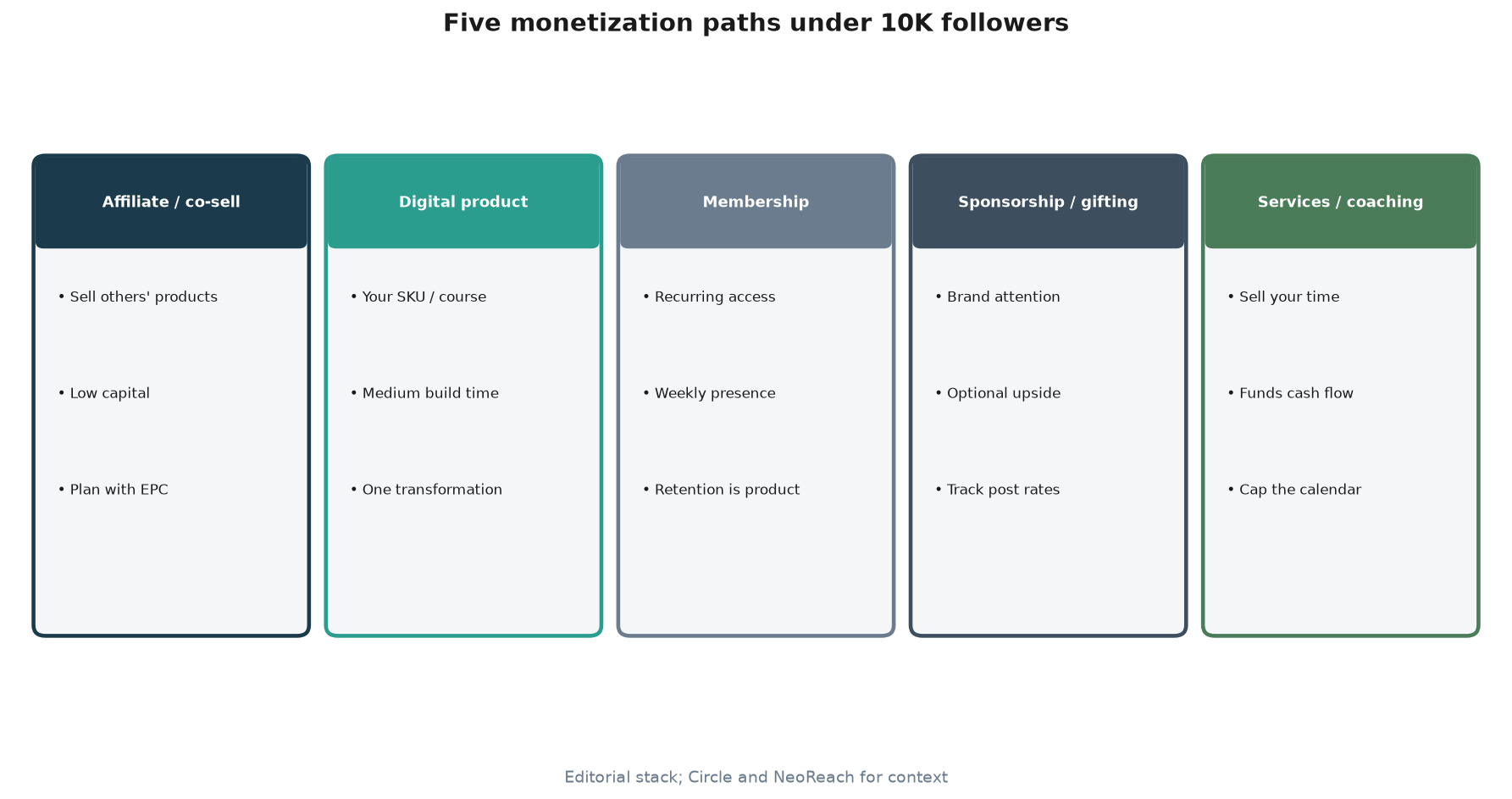
Source: Editorial five-path stack for this article; adoption and earnings context from Circle 2026 and NeoReach 2025. https://circle.so/blog/creator-economy-statistics ; https://neoreach.com/reports/creator-earnings-report-2025/
Most under-10K creators should pick one primary and one secondary. Affiliate plus a small digital product is a common pair. Membership plus coaching is another. Trying all five in month one is how you ship nothing.
Circle’s 2026 statistics (750+ community builders) show where operators put energy when they already think in communities (Circle):
| Monetization type | Share of Circle community builders |
|---|---|
| Paid memberships | 88% |
| Courses | 53% |
| Coaching / services | 51% |
| Digital products | 37% |
| Affiliate | 22% |
| Sponsorships | 18% |
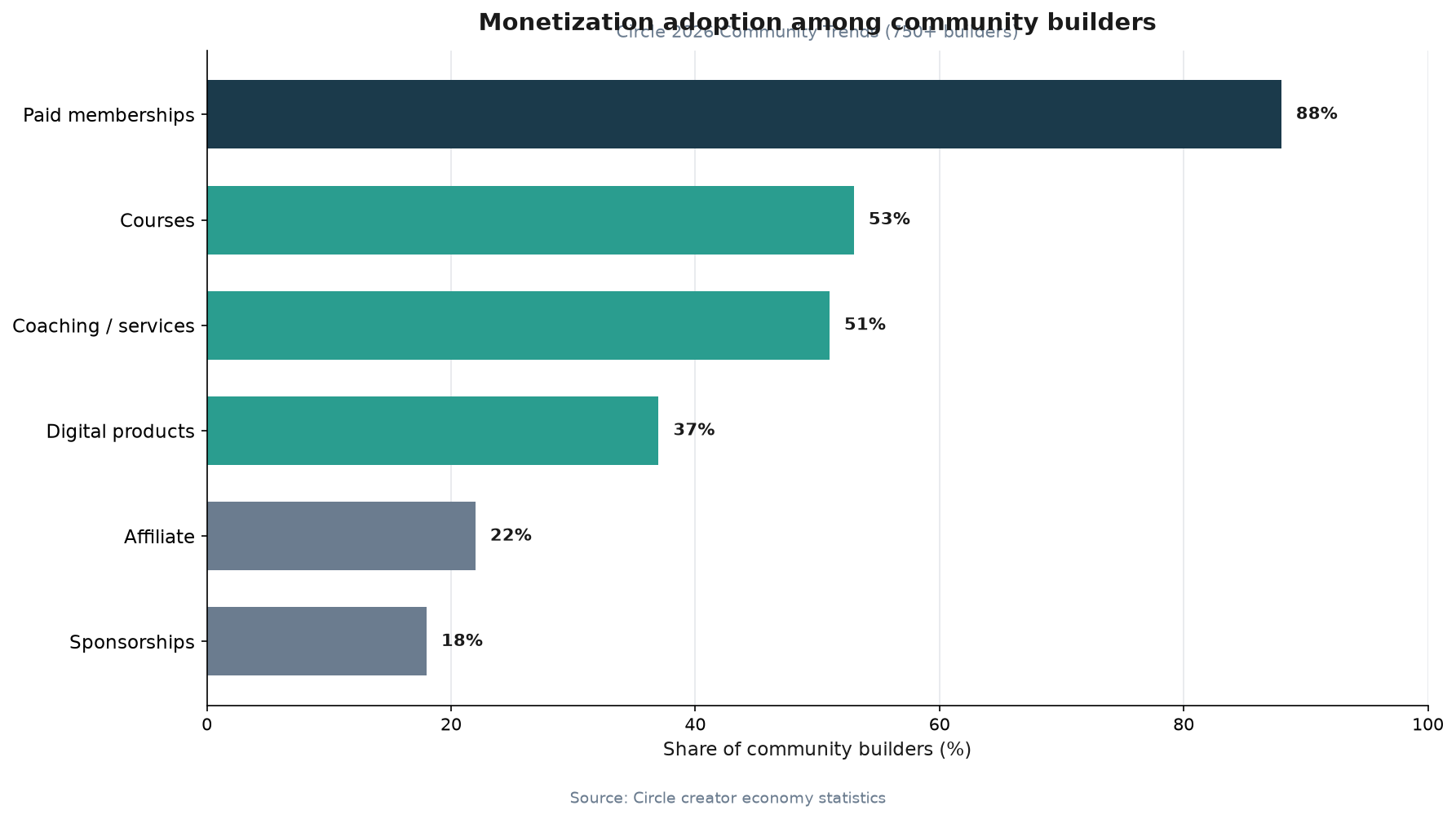
Source: Circle, creator economy statistics (2026 Community Trends). https://circle.so/blog/creator-economy-statistics
Read this as an adoption ladder among community builders, not as “sponsorships never work under 10K.” Sponsorships can work. They are simply not the default path for people who already run communities. If you have no product and no affiliate offer, you are optimizing for the least-adopted row in this sample.
NeoReach’s Monetization Barrier sits near $15,000 annual creator revenue. Below it, many stall. Above it, income tends to accelerate through better deals, visibility, and systems. In the 2025 survey, 50.71% of creators were still under that line (NeoReach).
IMF’s 2026 US sample sharpens the floor and ceiling: 48.7% under $10K, 45.6% between $10K and $100K, 5.7% at $100K+ (IMF).
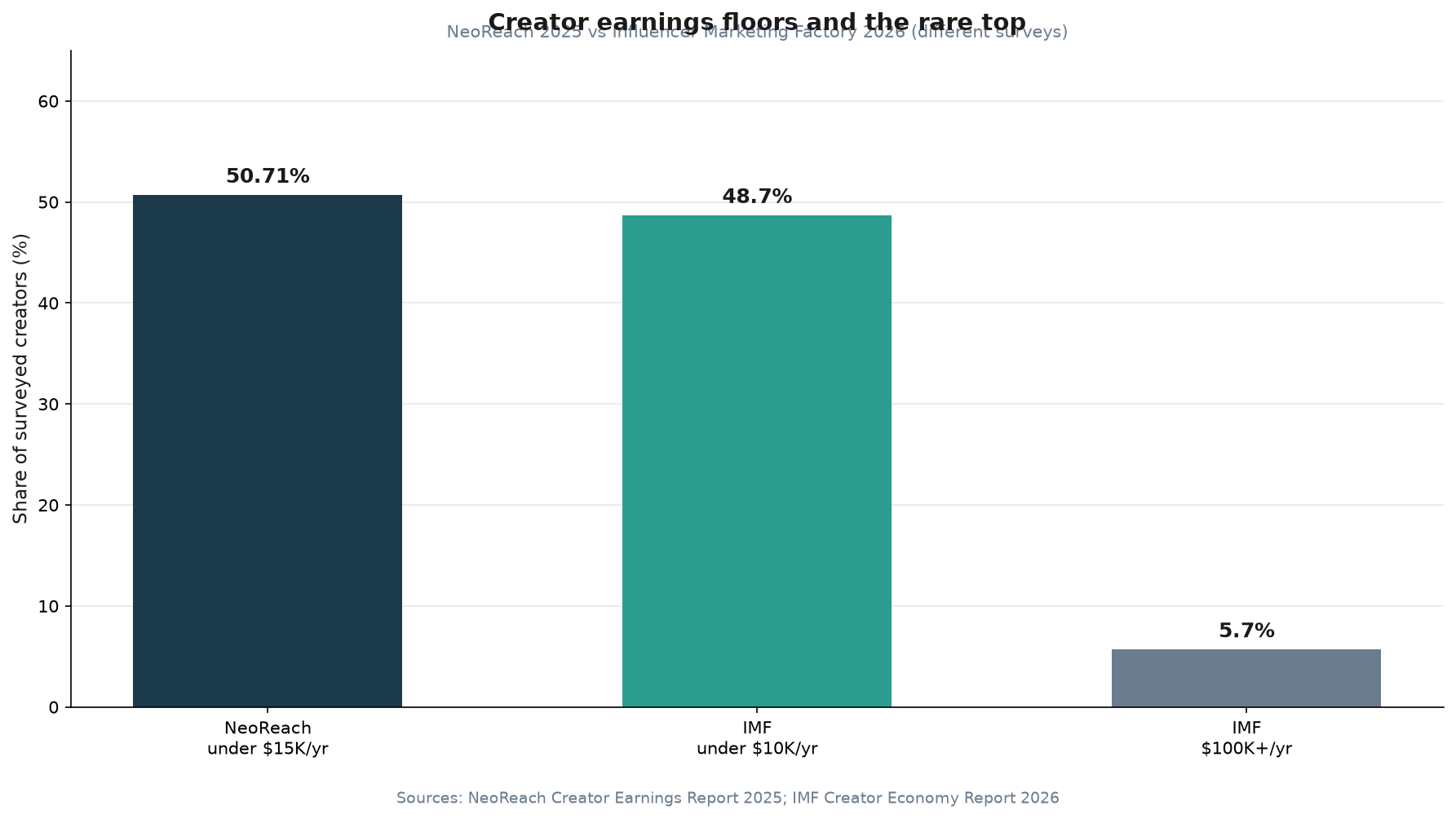
Source: NeoReach Creator Earnings Report 2025; Influencer Marketing Factory Creator Economy Report 2026. https://neoreach.com/reports/creator-earnings-report-2025/ ; https://theinfluencermarketingfactory.com/creator-economy/
These surveys are not “under 10K followers only” cuts. They still answer the myth: most creators are not clearing a living from content, so your under-10K plan must assume barrier odds, not influencer-movie odds. Pair this with the 1,000 true fans math if you are chasing a $100K living from a few hundred buyers.
Affiliate is the low-capital on-ramp. Shopify’s published bands put many physical offers near 5%-15% commission and digital near 20%-50% (Shopify). Higher percentages help when your traffic is small.
Plan clicks, not vibes. At a median EPC near $0.14, about 714 tracked clicks plan to roughly $100 in commission (100 ÷ 0.14) (AvidAffiliate). Rewardful’s SaaS sample shows only 1.28% of affiliates generate a sale, so expect silence until you earn trust and intent (Rewardful).
Co-branded storefronts and marketplace rails matter here: you are selling with a small audience, not waiting to become a billboard. See what a creator storefront is and revenue split models.
A small audience can buy a focused SKU. Circle shows 37% of community builders sell digital products (Circle). Price for the transformation, not for your follower count. One checklist, template pack, or short course beats a bloated academy. For pricing shape, use one-time vs subscription digital product pricing.
Memberships lead Circle’s adoption (88%). Under 10K, membership works when the promise is narrow (weekly office hours, niche deal flow, accountability) and you can retain. A $10/month tier needs 100 paying members for $1,000 MRR. That is planning arithmetic, not a forecast that you will hit it. Retention is the product.
Nano creators can get gifted product and occasional paid posts, especially in tight niches. Do not make this path one until you have a media kit and proof of engagement. Traackr’s marketer survey found 61% report that less than half of gifted influencers post (Traackr). Gifting without a post rate is a hobby, not a P&L. See gifting vs paid partnerships and influencer rates by follower count.
If people already ask you for help in DMs, sell the call. Coaching sits at 51% adoption among Circle community builders (Circle). It funds the business while you build productized offers. Cap your hours or you will trade all growth time for delivery.
| If your constraint is… | Start with… | Add second when… | Avoid first |
|---|---|---|---|
| No product, low cash | Affiliate / co-sell on one problem | You have 10+ sales or clear FAQ demand for a SKU | Building a membership before proof |
| One clear expertise | Digital product (narrow) | Buyers ask for ongoing access → membership | Mega course with no waitlist proof |
| High engagement community | Membership or coaching | Affiliate offers that serve members | Random sponsorship spam |
| Brands already DMing you | Selective gifting → paid | You have post rates and rates sheet | Quitting product work for free product |
| Calendar flexibility | Services | Productize the repeat deliverable | Unlimited 1:1 forever |
Ship one offer with proof, then layer. Five steps keep the stack honest.
Q: How do creators monetize a small audience under 10K? A: They pick a stack that fits trust and capital: affiliate or co-selling, a narrow digital product, a paid membership, selective sponsorship or gifting, and services. Under 10K is a Sprout-style nano band, not a gate that blocks checkout. Owned offers and intent traffic usually beat waiting for brand deals.
Q: Can you make money with under 10,000 followers? A: Yes, but public earnings surveys show most creators still sit under NeoReach’s ~$15K Monetization Barrier or IMF’s under-$10K band. Small can work. Guaranteed income at a follower count does not. Treat vendor “$X/month by month Y” claims as marketing.
Q: Is affiliate marketing good for a small following? A: It is often the lowest-capital start. Plan with median EPC near $0.14 and low activation rates (Rewardful’s SaaS sample: 1.28% of affiliates generate a sale). Trust, niche fit, and intent content matter more than follower vanity.
Q: Should nano creators chase sponsorships first? A: Usually no. Circle’s community-builder sample shows sponsorships at 18% adoption versus 88% for memberships and 37% for digital products. Use gifting carefully (many gifted creators never post) and treat paid sponsorships as upside once you have engagement proof.
Q: How is this different from the 1,000 true fans model? A: Kelly’s model asks whether a few hundred true fans can fund a living at a given price. This article asks which monetization paths fit a nano audience before or without that living. Use both: stack for cash flow now, true-fans math for the long-term living target.
How creators monetize a small audience under 10K is a funding and offer design problem. Follower count is not the unlock. A clear buyer problem, one primary path, owned distribution, and honest planning math are. NeoReach and IMF show how many creators stay under the barrier. Circle shows which models community builders actually run. Pick a path before you pick a vanity milestone.
If you want to sell other builders’ products through a co-branded storefront while your audience is still small, browse the feat. marketplace.
Turn your audience into a distribution channel with a five-rung ladder—attention, trust, offer, sales surface, and economics—not follower vanity.
Affiliate marketing for small creators works on trust density: one problem, one offer class, one surface, EPC math (median ~$0.14), FTC disclosure—not a follower floor.
How to create a storefront as a creator: name the job (route, sell-own, sell-others), pick Linktree, Stan, Beacons, or a co-branded page, then ship one hero offer.