How to Build a Digital Product Funnel
How to build a digital product funnel: stages, Unbounce's 6.6% LP median, Baymard's ~70% cart abandon, and when to skip tripwire theater.
One-time vs subscription digital product pricing: Recurly annual plans lift revenue per user 50-60% vs monthly. Pick by usage arc, churn, and cash timing.

TL;DR: One-time vs subscription digital product pricing is a usage-arc choice, not a fashion contest. Finite deliverables (templates, recorded courses) lean one-time or installment. Ongoing access (community, updates, tool seats) leans subscription. Recurly’s 2026 data shows annual plans lift revenue per user 50-60% vs monthly, while failed renewals recover at ~23% vs 53% for monthly.
Creators keep asking whether to sell the PDF once or bill every month. Forums answer with screenshots from a warm launch week. That is how you price a cohort, not a business.
One-time vs subscription digital product pricing only makes sense when you name what the buyer is hiring: a finished asset, or ongoing access. Get that wrong and you either leave LTV on the table or train buyers to resent a meter on a product that never changes.
Key takeaways:
One-time vs subscription digital product pricing is the choice between charging a single purchase price for a digital SKU and charging a recurring fee for ongoing access, updates, or membership benefits.
One-time means the buyer pays once (or on a short installment schedule) and owns access under your license terms. Subscription means the buyer pays on a billing cycle (weekly, monthly, annual) and keeps access while the plan is active. Lifetime deals are a marketing label for a large one-time price that promises long or perpetual access. They are still one-time economics with long support risk.
This is not the same as recurring vs one-time affiliate commissions, which prices the partner payout duration after a sale. This page prices the product itself. Platform fee shape (percentage vs flat) still matters after you pick the model. See creator platform fee comparison.
Wrong model burns trust faster than wrong ad creative. Buyers remember feeling metered for a static file. Operators remember watching annual renewals fail with almost no recovery runway.
Why the choice is a P&L decision:
There is no honest single winner for every SKU. There is an honest way to choose.
Price the usage arc first. If the buyer finishes the job in days (download a template, watch a recorded course), one-time or installment usually fits. If the buyer needs ongoing access (community, continuous updates, tool seats), subscription usually fits. Inside subscriptions, treat monthly as the acquisition on-ramp and annual as the LTV lock, because Recurly shows annual lifts revenue per user 50-60% while recovery drops from 53% to about 23% on failed renewals.
Ask one question before you open Stripe: Does value keep arriving after week one?
| Usage arc | What the buyer gets after day 30 | Default model | Common failure mode |
|---|---|---|---|
| Finite deliverable | A finished asset (template, recorded course, prompt pack) that rarely changes | One-time (or short installment) | Forcing a monthly fee on a static file |
| Living library | Continuous updates, new modules, versioned files | Subscription or annual membership | One-time lifetime with unbounded update promises |
| Community / cohort access | Peers, office hours, live calls, moderated space | Subscription (pause-friendly) | Lifetime community seats you cannot staff |
| Tool / seat access | Login that must stay provisioned | Subscription | Lifetime logins that become support liabilities |
| Hybrid | Core SKU owned + optional ongoing layer | One-time core + membership add-on | Bundling everything into one opaque meter |
That table is a decision framework, not a survey result. The Recurly and Adapty figures below price the subscription branch after you choose it.
| Dimension | One-time purchase | Subscription (monthly / annual) | Lifetime deal |
|---|---|---|---|
| Cash | Front-loaded | Spread across renewals | Large front-loaded spike |
| Buyer commitment | Lower recurring anxiety | Higher commitment / cancel habit | High sticker, high expectation |
| Your support duty | License + reasonable updates you define | Continuous delivery while paid | Often unbounded in the buyer’s mind |
| LTV path | Upsell next SKU or membership | Plan mix and retention | Hard to re-monetize the same buyer |
| Best when | Finite arc, clear deliverable | Ongoing value and engagement | Launch cash need + you can cap support |
Lifetime access is not a third physics. It is one-time pricing with marketing language that can bankrupt your support queue. If you sell it, write the support and update boundary in plain language.
Recurly’s 2026 analysis treats plan structure as a strategic asset, not a preference toggle. Annual plans generate 50-60% higher revenue per user than monthly. Recovery tells the other half: about 23% of failed annual renewals come back, versus 53% of failed monthly payments. 78% of merchants in that dataset already offer both (Recurly).
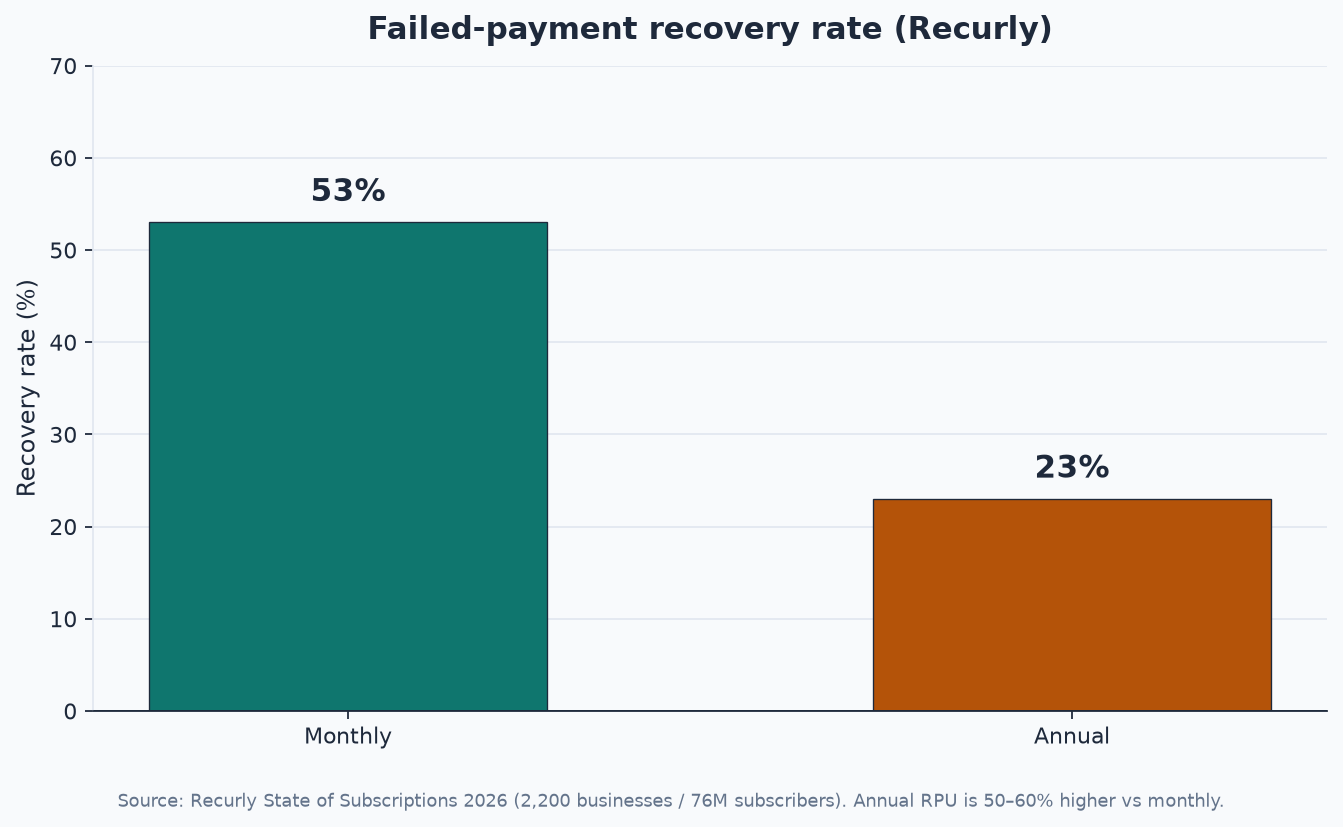
Source: Recurly, Analyzing the trends of 76 million subscribers (State of Subscriptions 2026), 2026-01-14. https://recurly.com/blog/analyzing-trends-of-76-million-subscribers/
Practical read for digital-product operators:
Pause is part of the same story. Recurly reports pause usage up 337% among top brands that offered pause-before-cancel, with three of four pausers returning, and 38% of consumers preferring pause over cancel (Recurly). For community and membership products, pause is often cheaper than a refund war.
Adapty’s State of In-App Subscriptions 2026 covers 16,000+ apps and over $3B in processed subscription revenue. In that app sample, weekly plans generate 55.5% of revenue (up from 43.3% two years earlier), while Day 380 retention for trial subscribers ranks annual 19.9%, monthly 14.2%, and weekly 5.5% (Adapty).
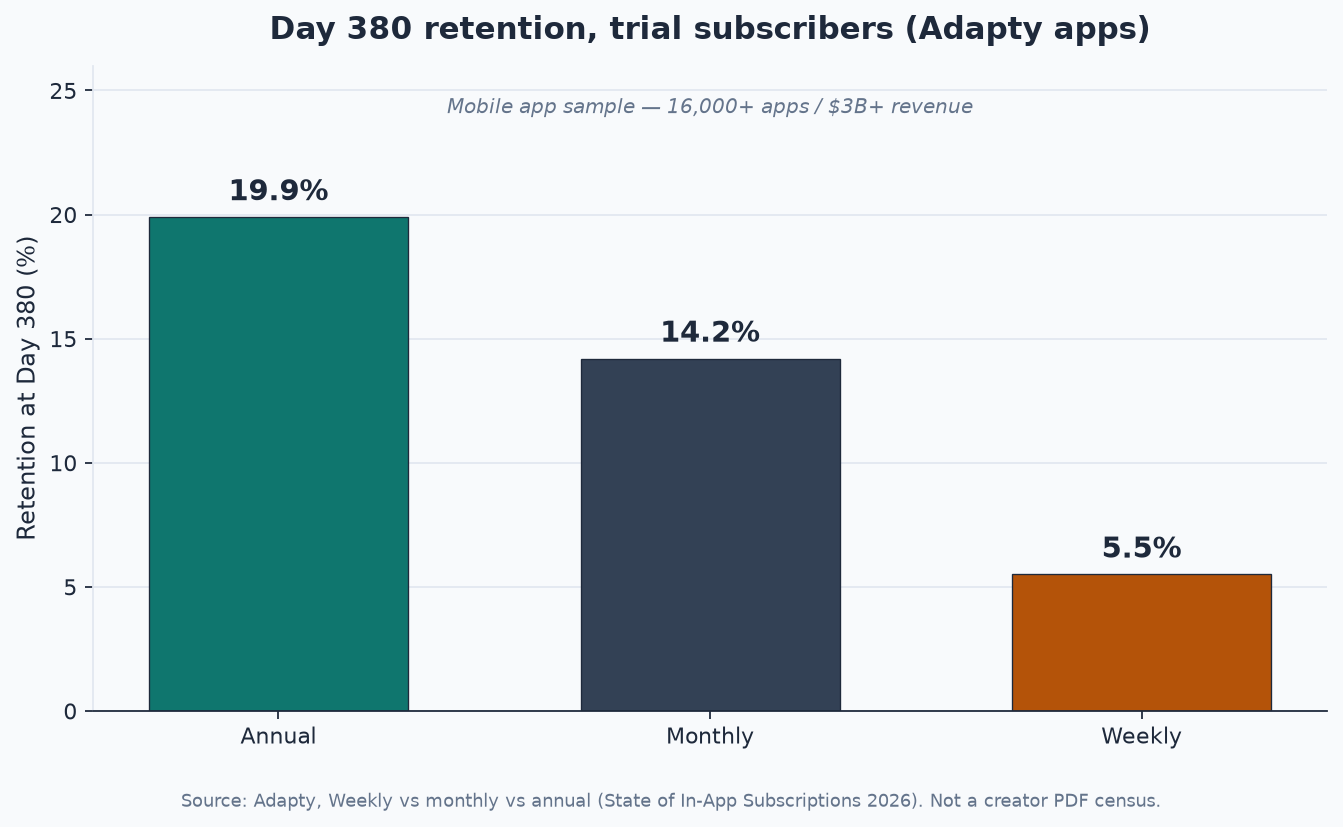
Source: Adapty, Weekly vs monthly vs annual (citing State of In-App Subscriptions 2026). Mobile app sample (16,000+ apps). https://adapty.io/blog/weekly-monthly-annual-subscription-plan/
Do not copy weekly app pricing onto a $199 recorded course by default. Weekly wins in apps partly because short cycles and trials drive volume. A creator membership with weekly billing inherits the same retention cliff Adapty measures (5.5% at Day 380 for weekly trial users) unless your product creates weekly habit. Use Adapty to respect billing-period physics. Use Recurly for merchant subscription RPU and recovery. Use your own cohort math for the SKU.
| If your constraint is… | Lean one-time when… | Lean subscription when… | Prefer hybrid when… |
|---|---|---|---|
| Usage arc | Buyer finishes the job quickly | Value keeps arriving (updates, community, seats) | Core asset is finite but extras are ongoing |
| Cash this quarter | You need launch GMV and can upsell later | You can fund CAC across months | Sell the SKU now, membership for the retained core |
| Churn / unused access risk | You refuse to meter unused static files | You can drive engagement (Recurly: 51% cancel for low usage) | Membership is optional, not required for the file |
| Support load | License terms are closed-ended | You staff continuous delivery | One-time includes version N; membership unlocks N+1 |
| Acquisition friction | Buyers reject recurring commitment | Monthly on-ramp + annual upsell (Recurly dual-offer pattern) | Micro-pass or short paid trial before full membership |
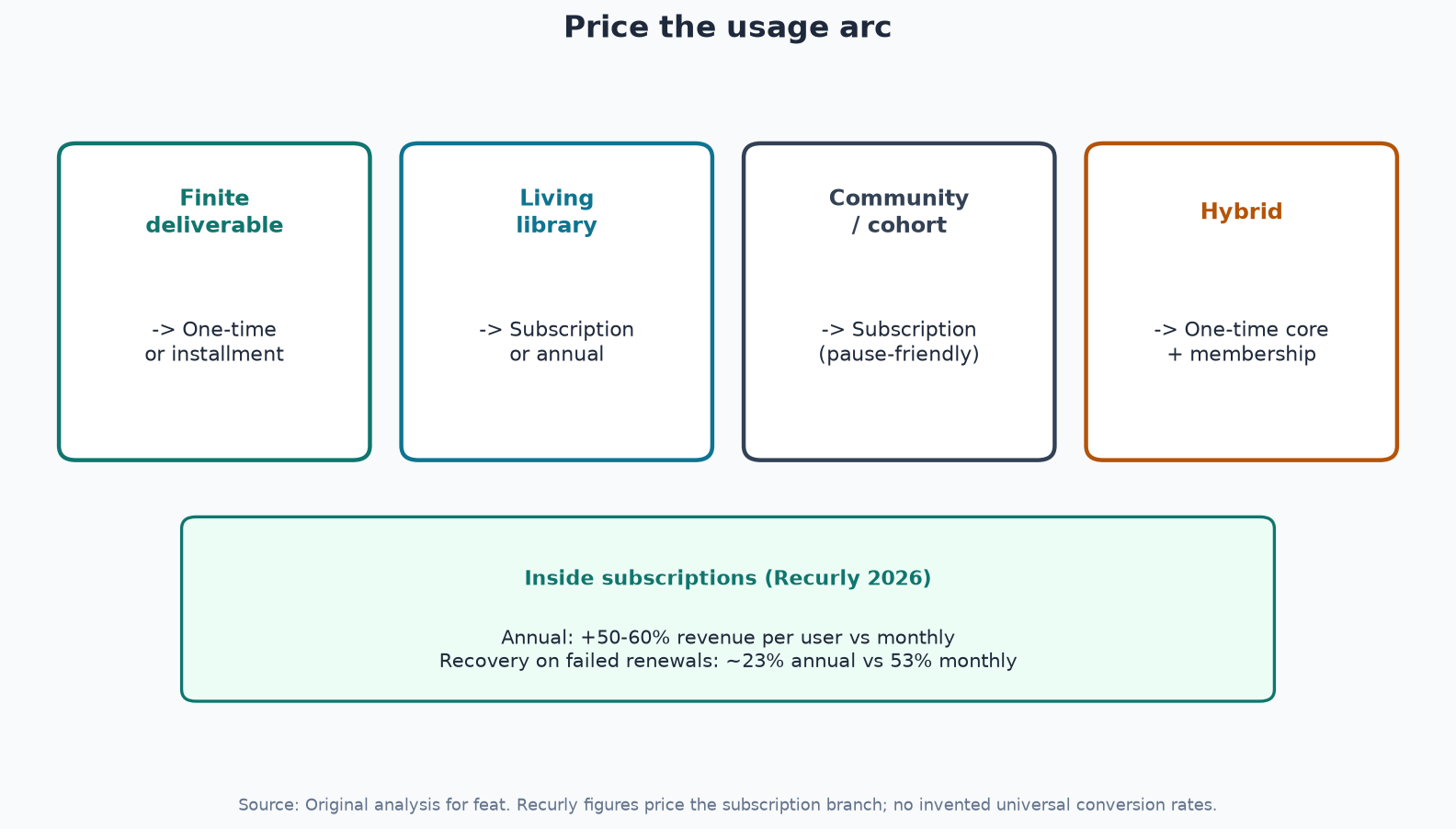
Source: Original analysis for feat. (decision framework). Recurly (2026) and Adapty (2026) figures cited in the article price the subscription branch; this diagram does not invent a universal conversion-rate winner.
Assumptions for a thought experiment, not a survey:
Months until subscription gross catches the one-time price for a single retained buyer: 149 ÷ 29 ≈ 5.1 months. If median membership life is under five months, the one-time SKU wins on that buyer. If median life clears eight to twelve months (and annual upsells land), subscription wins on LTV. What this does not prove: your niche’s real conversion or churn. Run your cohort. There is no public dataset that publishes one creator-course conversion rate that settles every niche.
Checkout and bio-link shape still matter after you pick the price model. Route-only hubs and sell-ready storefronts are different jobs (Linktree vs storefront platforms). If partners sell the same SKU, decide whether their cut is one-time or recurring (recurring vs one-time affiliate commissions). If the bigger question is owned products versus brand deals, read digital product vs sponsorship revenue.
Q: Is one-time or subscription better for digital products? A: Neither is universally better. Finite deliverables usually fit one-time or installment pricing. Ongoing access (community, updates, seats) usually fits subscription. Recurly’s 2026 data then helps you structure monthly vs annual inside the subscription branch (50-60% higher RPU for annual, with lower recovery on failed renewals).
Q: Should I sell my course as a membership? A: Only if value keeps arriving after the recorded lessons end (live calls, community, continuous modules). A finished cohort course sold as endless monthly access trains cancel-for-non-use behavior. Circle’s community builders lean hard into memberships (88%), which fits community products more than static downloads (Circle).
Q: How do annual and monthly subscription pricing compare for LTV? A: In Recurly’s 76-million-subscriber analysis, annual plans deliver 50-60% higher revenue per user than monthly, while failed annual renewals recover around 23% versus 53% for failed monthly payments. Use monthly to acquire, annual to lock engaged cohorts, and pre-renewal sequences to protect the annual book.
Q: Are lifetime access deals a good idea? A: They can spike cash and conversion in a launch window, but they price unbounded support expectations as one-time revenue. Prefer a high one-time SKU with a written update window, or a hybrid (own the core course, subscribe for community). There is no public census that proves lifetime always wins.
Q: Can I use mobile app subscription benchmarks for creator products? A: Use them as labeled secondary evidence for billing-period physics, not as creator conversion law. Adapty’s 2026 app sample shows weekly revenue share at 55.5% and Day 380 trial retention of 19.9% / 14.2% / 5.5% for annual / monthly / weekly. Your course or community cohort still needs its own math.
One-time vs subscription digital product pricing is a usage-arc decision with a plan-structure sequel. Finite assets deserve one-time clarity. Ongoing value deserves a meter you can defend. Inside subscriptions, Recurly’s 2026 spine is clear: annual lifts revenue per user 50-60% versus monthly, while recovery falls from 53% to about 23% on failed renewals. Hybrid (own the core SKU, subscribe for the living layer) beats purity for most catalogs. Price the arc. Then staff the promise.
If you want a storefront where buyers can purchase digital products you promote (including offers from merchants, not only your own SKUs), browse the feat. marketplace.
How to build a digital product funnel: stages, Unbounce's 6.6% LP median, Baymard's ~70% cart abandon, and when to skip tripwire theater.
Affiliate marketing for startups is an operating system—locks, cost, recruit, rates, tracking, first 100 sales, then diagnose a flat roster.
Build a commission-based sales network as a single-tier seller graph—economics, surface, named sellers, then density. Rewardful: only 1.28% of affiliates sell.