How to Turn Your Audience Into a Distribution Channel
Turn your audience into a distribution channel with a five-rung ladder—attention, trust, offer, sales surface, and economics—not follower vanity.
Kelly's 1,000 true fans math aims at $100K. NeoReach finds 50.71% of creators under $15K. Only 5.7% clear $100K in IMF's 2026 US sample.

TL;DR: Kevin Kelly’s 1,000 true fans model says ~$100 profit per diehard fan × 1,000 fans can fund a $100K living if you keep the money. Real surveys say most creators never clear $15K. Influencer Marketing Factory’s 2026 US sample puts only 5.7% at $100K+. Aim for payers you own, not a follower trophy.
Creators love the slogan and skip the contract. “I just need 1,000 true fans” becomes “I have 1,000 followers,” and then the Stripe balance stays quiet.
The 1,000 true fans model against real data is a stress test. Kelly’s math is still clean. The earnings distribution is still brutal. If you confuse the two, you will optimize vanity metrics while the Monetization Barrier does the real sorting.
Key takeaways:
The 1,000 true fans model is Kevin Kelly’s claim that a creator can make a living (not a fortune) by cultivating about one thousand diehard fans who buy everything they produce and pay them directly, often sketched as roughly $100 profit per fan per year.
A true fan is not a follower, a stream, or a soft email open. In Kelly’s language, they drive to see you, buy every format, pre-order the next thing, and treat your work as a habit (Kevin Kelly). Regular fans sit in a wider ring and buy sometimes. The strategy focuses on the center ring because those people fund the living and recruit the outer ring.
The math is an identity, not a prophecy:
Annual living ≈ (profit per true fan per year) × (number of true fans)
Kelly’s worked example uses $100 × 1,000 = $100,000, assuming you keep the full amount instead of handing most of it to a label, retailer, or ad stack (Kevin Kelly). If you only clear $50 profit per fan, you need 2,000. If you clear $200, you need 500. A duo doubles the fan count. The number is an order of magnitude, not a sacred integer.
Two conditions do the heavy lifting: you create enough value that the annual spend is plausible, and you own a direct payment path. Platform ad splits and brand-deal middlemen inflate how many fans you need for the same living. That is why this model is closer to digital product vs sponsorship revenue and creator storefronts than to chasing a viral hit.
The model matters because it is still the cleanest antidote to “I need a million followers.” The data matters because most creators never approach Kelly’s living, and many never clear a much lower barrier.
Why the confrontation is useful:
Musicians say the quiet part out loud: extracting $100 profit per year from each of 1,000 people can be harder than racking up huge passive streams (r/musicmarketingtips). The model is not dead. The product and the rails are the missing variables.
The model works as a planning identity: pick a living target, divide by realistic profit per payer, and solve for how many direct relationships you must keep. Real data then tells you how uncommon that outcome is, and which structures (owned products, brand ownership, diversified rails) show up among people who clear higher income bands.
| Profit per true fan / year | True fans needed for ~$100K | True fans needed for ~$44K living-wage line | True fans needed for ~$15K barrier |
|---|---|---|---|
| $50 | 2,000 | 880 | 300 |
| $100 (Kelly example) | 1,000 | 440 | 150 |
| $200 | 500 | 220 | 75 |
| $500 | 200 | 88 | 30 |
Illustrative division using Kelly’s identity (Kevin Kelly). The $44K line is the US living-wage figure cited in NeoReach/IMH reporting; the $15K line is their Monetization Barrier. These are planning rows, not observed fan counts.
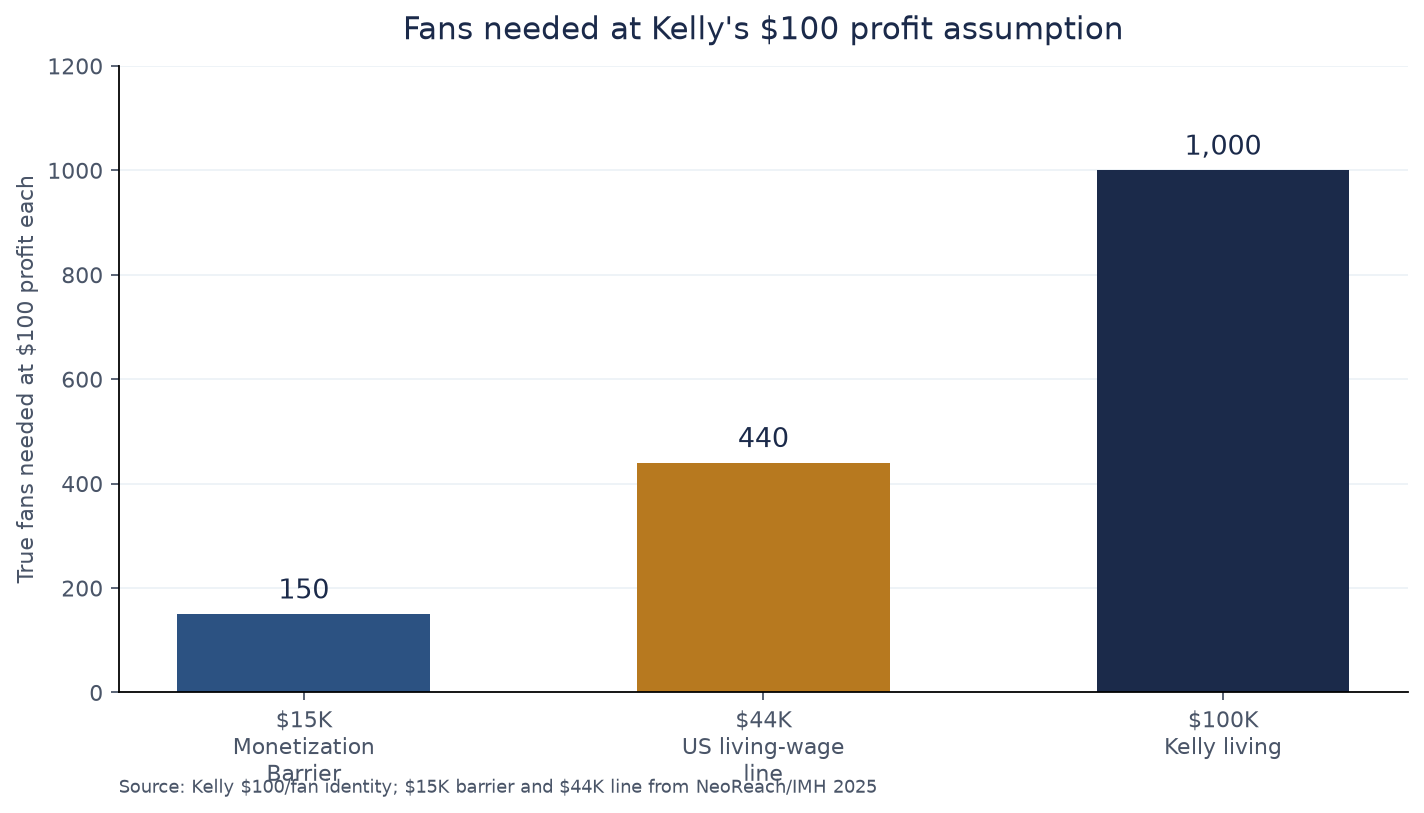
Source: feat. scenario math using Kevin Kelly’s $100-per-fan identity (https://kk.org/thetechnium/1000-true-fans/) against NeoReach/IMH $15K barrier and $44K living-wage reference.
At Kelly’s $100 assumption, clearing the Monetization Barrier needs on the order of 150 true fans, not 1,000. Clearing a $44K living-wage line needs about 440. The full $100K living still needs the classic thousand. Most creators fail earlier than the romantic slogan suggests: they never assemble even the smaller payer base, or they never keep the margin after fees, refunds, and fulfillment.
NeoReach’s 2025 survey (3,000+ creators, 1.1B+ combined followers), published with Influencer Marketing Hub:
| Signal | Figure | Source |
|---|---|---|
| Share under $15K / year | 50.71% (was 48.1% in 2023) | NeoReach / IMH |
| Monetization Barrier | ~$15,000 / year (~$1,250 / month) | NeoReach / IMH |
| Full-time creators under $44K living wage | nearly 57% (56.55% in NeoReach press) | NeoReach / IMH |
| Own a business / brand | nearly 45% (44.8% in NeoReach highlights) | NeoReach / IMH |
| Own-a-brand earners | close to $100K / year | NeoReach / IMH |
| “Making money from my content” as primary value | avg over $132K (IMH notes skew from high earners) | IMH |
Influencer Marketing Factory’s separate 2026 US sample (n=1,000, January 2026):
| Annual earnings band | Share of creators |
|---|---|
| Under $10K | 48.7% |
| $10K-$100K (“middle class” band in their framing) | 45.6% |
| $100K+ | 5.7% |
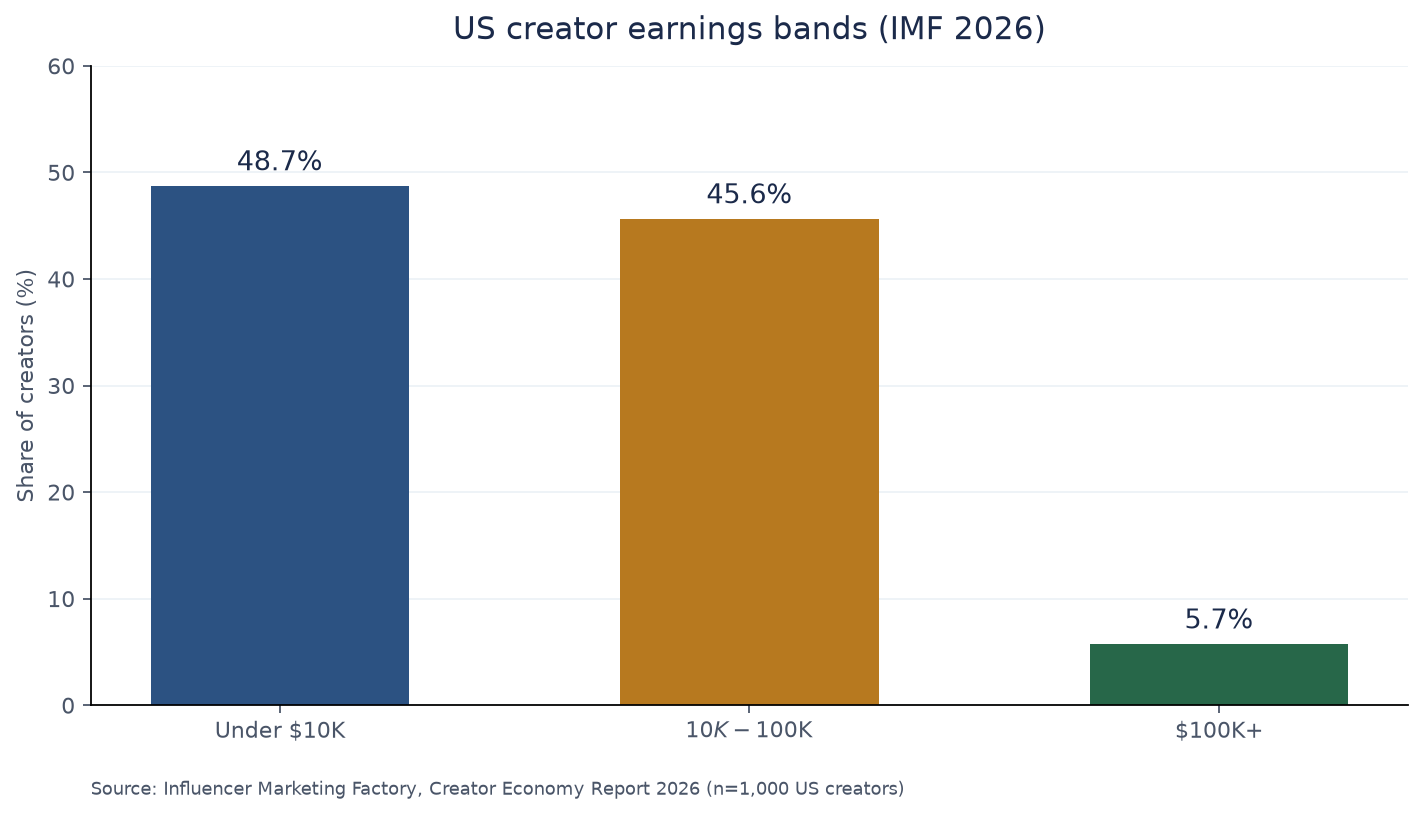
Source: Influencer Marketing Factory, Creator Economy Report 2026 (n=1,000 US creators). https://theinfluencermarketingfactory.com/creator-economy/.
Read the two surveys as compatible stress tests, not one merged census. NeoReach stresses the under-$15K mass and the barrier. IMF stresses that Kelly’s $100K living sits in a thin top band (5.7%). Tubefilter’s summary of NeoReach puts the over-$200K cohort near 5% of that survey (Tubefilter). Different cutoffs, same shape: the living Kelly sketched is uncommon.
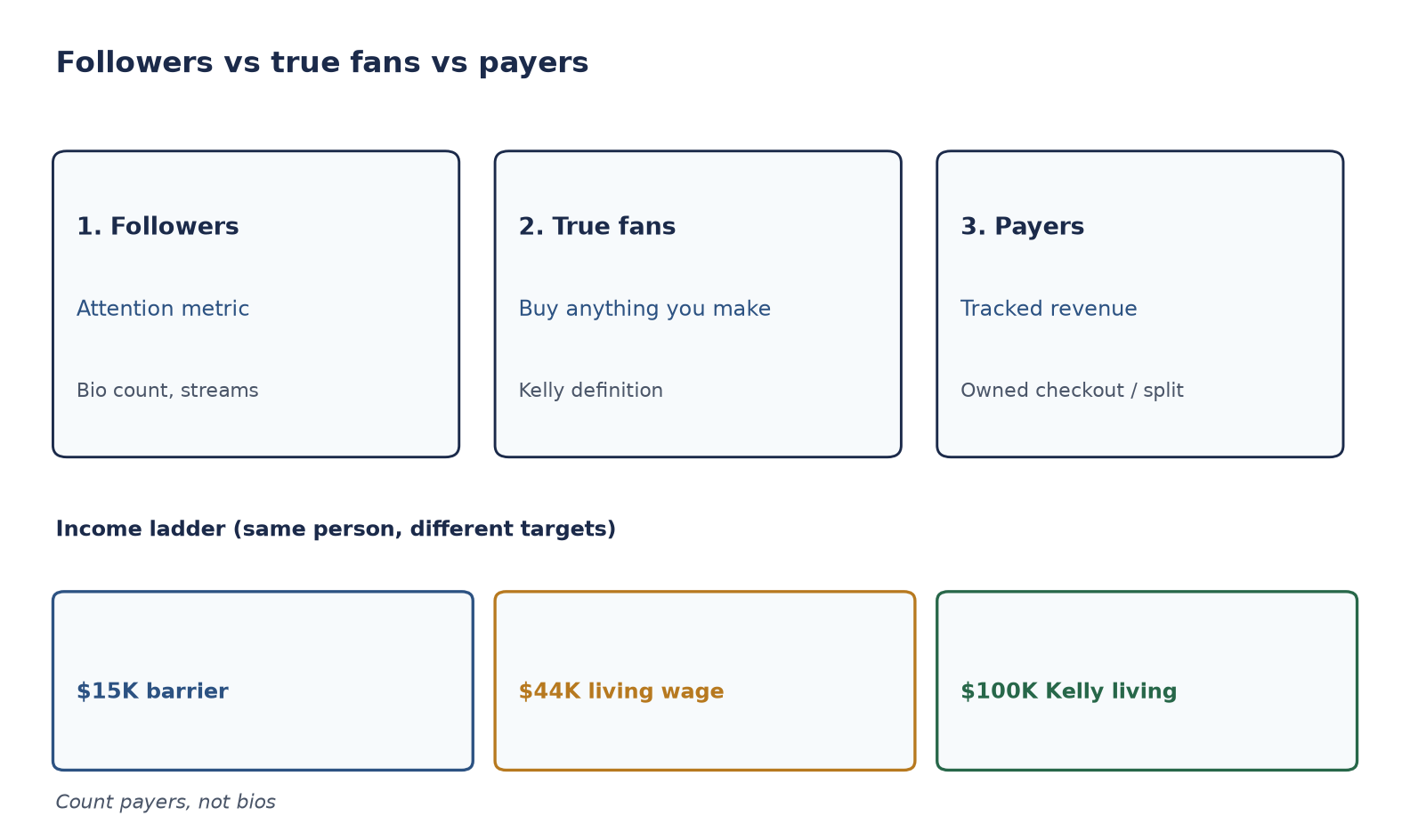
Source: feat. framework. Definitions from Kevin Kelly; barrier and earnings bands from NeoReach/IMH 2025 and Influencer Marketing Factory 2026.
Keep the parts that survive contact with data:
Q: Does the 1,000 true fans model still work? A: As a direct-relationship planning model, yes. As a promise that 1,000 followers equal a living, no. Kelly’s identity still holds if you keep roughly $100 profit per true fan. Survey data shows most creators never clear $15K, and only a small share reach $100K+.
Q: How much does each true fan need to spend? A: Kelly’s worked example is about $100 profit per true fan per year for a $100K living with 1,000 fans. If your profit per fan is $50, you need about 2,000. Always use profit, not gross sales.
Q: How many creators actually make $100,000 a year? A: In Influencer Marketing Factory’s 2026 survey of 1,000 US creators, 5.7% reported $100K or more. NeoReach/IMH’s broader 2025 work finds more than half under $15K. Samples differ; both show Kelly’s living is uncommon.
Q: What is the difference between true fans and followers? A: Followers are an attention metric. True fans, in Kelly’s definition, buy anything you produce and maintain a direct supportive relationship. A large follower count with no owned checkout path is not the model.
Q: What should I optimize if I am under the $15K Monetization Barrier? A: Optimize for owned conversion: an offer with clear profit per buyer, a direct payment path, and a small set of repeat purchasers. NeoReach frames ~$1,250 per month as the barrier’s monthly expression. Stack products, affiliates, and memberships instead of waiting for a single viral sponsorship.
The 1,000 true fans model against real data is not a funeral for Kevin Kelly. It is a refusal to confuse a planning identity with a follower fantasy. The math still says $100 profit × 1,000 payers can fund a living. NeoReach’s Monetization Barrier and IMF’s 5.7% at $100K+ say most creators never get there. Build for payers you can name, price for profit you can keep, and treat findability as the real constraint.
If you want a co-branded path to sell products with a tracked split, browse the feat. marketplace.
Turn your audience into a distribution channel with a five-rung ladder—attention, trust, offer, sales surface, and economics—not follower vanity.
Affiliate marketing for small creators works on trust density: one problem, one offer class, one surface, EPC math (median ~$0.14), FTC disclosure—not a follower floor.
How to create a storefront as a creator: name the job (route, sell-own, sell-others), pick Linktree, Stan, Beacons, or a co-branded page, then ship one hero offer.