How to Turn Your Audience Into a Distribution Channel
Turn your audience into a distribution channel with a five-rung ladder—attention, trust, offer, sales surface, and economics—not follower vanity.
Creator newsletter vs brand newsletter monetization: value ladder vs sponsor volume, Romaine planning bands, Circle and IMH samples, and platform fit.

TL;DR: Creator newsletter vs brand newsletter monetization is an operating-model choice. Creators optimize a value ladder (products and services) with sponsorships as a side stream. Media brands optimize sponsor volume with more sends. Hybrid sits between. There is no official public median income mix for every niche.
Copying Morning Brew’s send calendar when you sell a $297 course is how you train readers to ignore you. Copying a weekly solopreneur cadence when ads are the business is how you starve inventory. The model is the job, not the template.
Creator newsletter vs brand newsletter monetization decides what you optimize: expertise sold through a value ladder, or attention sold through sponsor volume. This is not the same job as digital product vs sponsorship revenue, which compares SKU ownership across creator samples. Pair this page with newsletter sponsorship rates by subscriber count, how to build a newsletter media kit, how creators monetize a small audience under 10K, and creator platform fee comparison.
Creator newsletter vs brand newsletter monetization is the comparison between running email as a relationship engine that sells owned offers (the creator value-ladder model) and running email as a media product that sells sponsor inventory at scale (the media-brand volume model). Hybrid mixes both with a middle sponsorship share.
Mike Romaine names the poles clearly: Creator Model = value ladder (digital products and services); Media-Brand Model = sponsor volume (ad sales), often daily or high-frequency curated sends in broader niches (Romaine). The Blog Herald frames the same split as platform philosophy: a media company monetizes attention; a creator business monetizes expertise (Blog Herald).
This page is about operating model. The digital product vs sponsorship article is about which SKU sample looks normal in Circle versus IMH surveys. You need both answers. Confusing them produces the wrong send calendar and the wrong media kit.
The model choice matters because send frequency, niche width, sales process, and platform tooling all follow from it. Pick wrong and you either underprice inventory or over-ad a list that was built to buy your course next quarter instead.
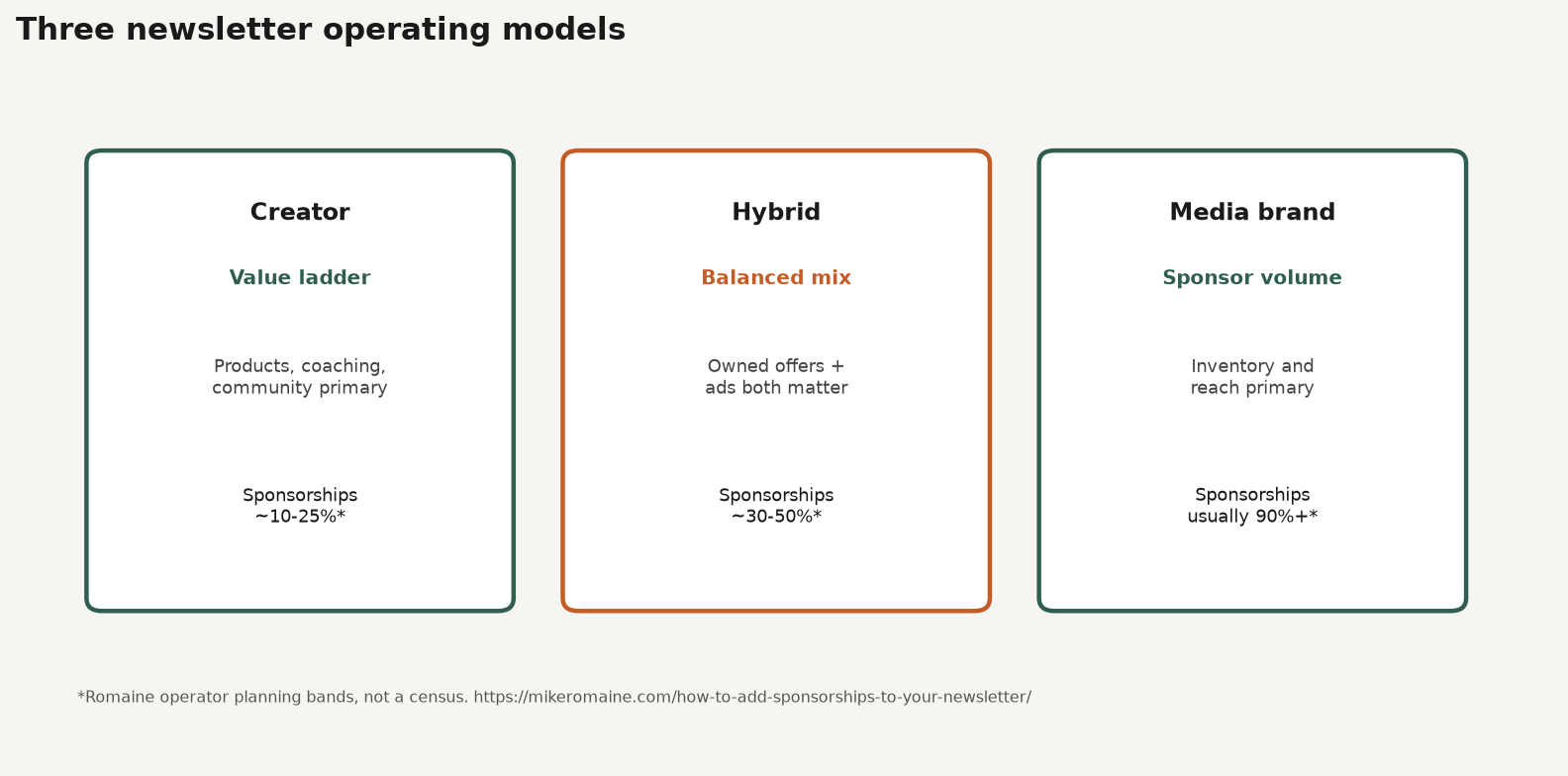
Source: Editorial framework from Mike Romaine newsletter business model guides. https://mikeromaine.com/solo-writer-creator-vs-media-brand-newsletters/ and https://mikeromaine.com/how-to-add-sponsorships-to-your-newsletter/
The models work as different optimization loops. Creators deepen trust and sell owned offers, with sponsorships diversifying cash. Media brands grow reach and fill dated inventory, with rates tied to opens and niche. Hybrid operators run both loops without letting either starve the other.
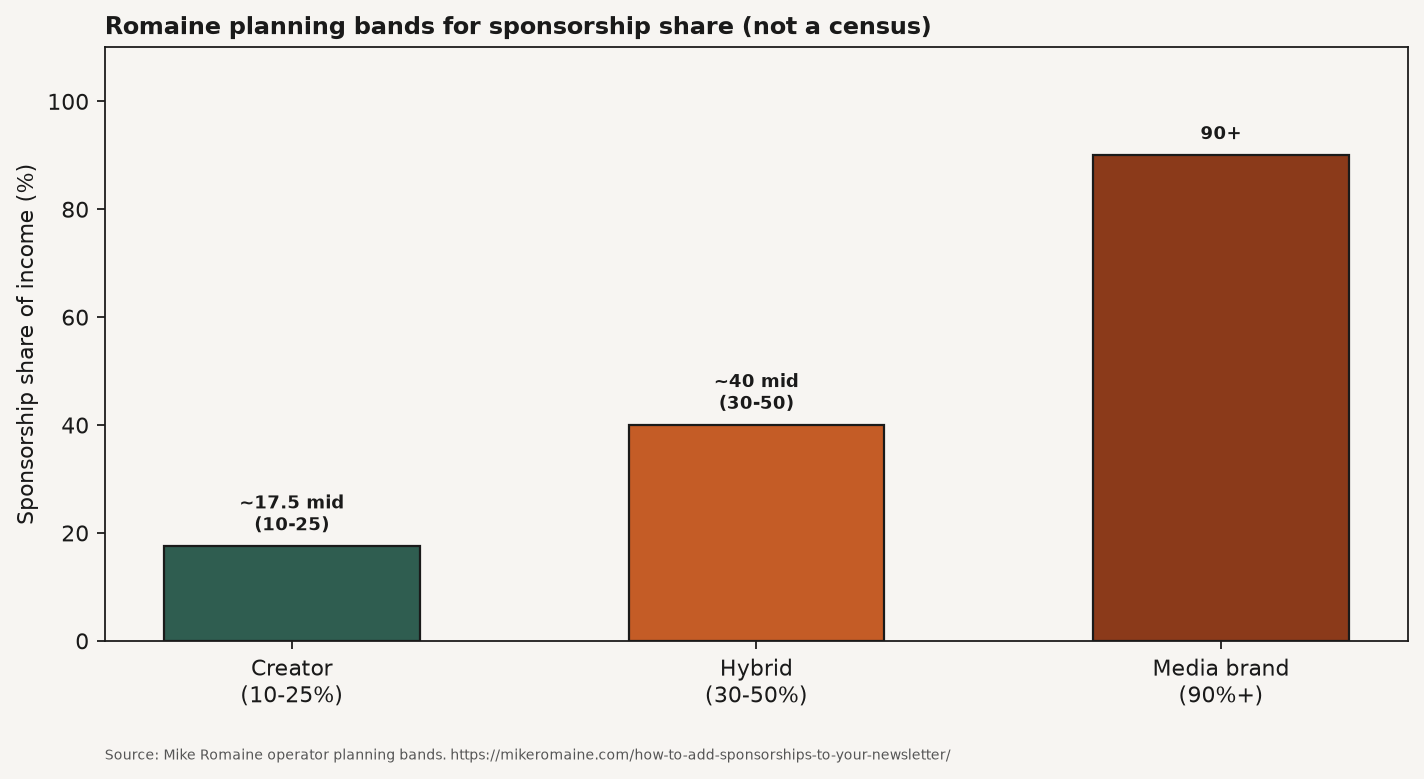
Source: Mike Romaine, How To Add Sponsorships To Your Newsletter (operator planning bands, not a census). https://mikeromaine.com/how-to-add-sponsorships-to-your-newsletter/
| Dimension | Creator (value ladder) | Hybrid | Media brand (sponsor volume) |
|---|---|---|---|
| Primary job | Sell products, coaching, community | Balance owned offers and ads | Sell sponsor access at scale |
| Sponsorship share (Romaine planning bands) | About 10-25% of income | About 30-50% | Usually 90%+ |
| Typical send pattern (Romaine) | Often about 1x/week | Mid frequency | Often higher / daily curated |
| Niche shape | Narrow specificity | Broader or mixed | Broad enough for inventory demand |
| Primary CTA | Owned offer / waitlist | Alternates | Sponsor placement + growth |
| Ops stack to study | Product funnel, storefront | Both | Media kit, rates, IO, kill fees |
| Platform fit heuristic (Blog Herald) | Kit-style when ~70% product revenue | Mixed | beehiiv-style when ~70% ads/paid subs |
Sources: Romaine models; Romaine sponsorships; Blog Herald.
Romaine republishes disclosed 2022 Justin Welsh streams: Courses $1.3M, Coaching $144,000, Sponsorships $120,000, Subscriptions $103,000, Affiliates $25,000, at 75,000+ subscribers. In that stack, sponsorships sit under 10% (Romaine). He labels Welsh as Creator-model.
For 2023 Katelyn Bourgoin / Why We Buy, Romaine cites Cohort $170,000, Sponsorships $135,000, Other digital products $43,000, Workshops $28,000, at 60,000+ subscribers, with sponsorships over 35% of that projected stack, labeled Hybrid (Romaine).
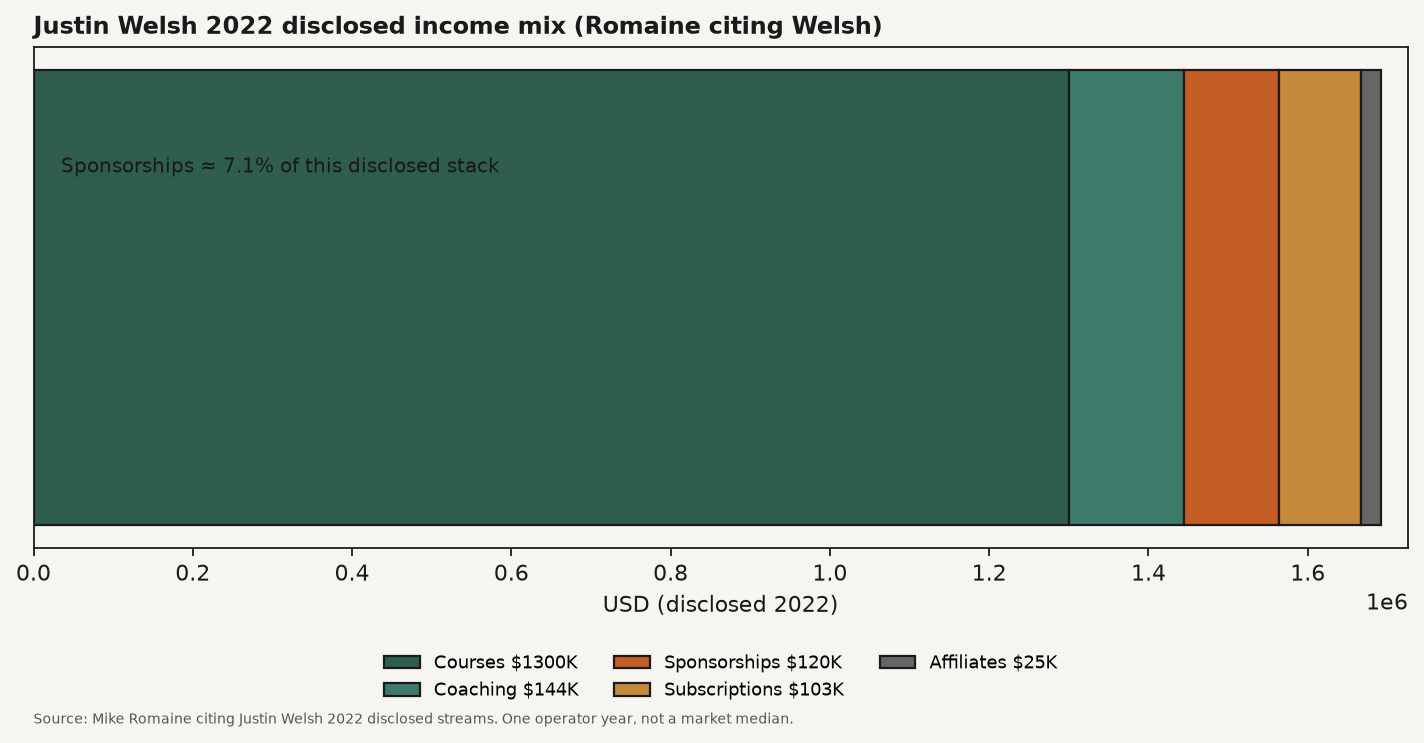
Source: Mike Romaine citing Justin Welsh 2022 disclosed income streams. https://mikeromaine.com/how-to-add-sponsorships-to-your-newsletter/ These are one operator’s published figures, not a market median.
Treat these as case evidence. There is no public dataset that turns them into an official average for every niche.
| Signal | Circle 2026 community builders | IMH / NeoReach 2025 creators |
|---|---|---|
| Sample | 750+ community builders | 3,000+ creators |
| Digital products | 37% sell digital products | Ownership shift noted; not the same % question |
| Sponsorships / brand deals | 18% earn from sponsorships | Over 49% earn most revenue from brand deals (−10 pts YoY) |
| Memberships | 88% monetize with paid memberships | Different cut |
| How to read it | Community-led operators already sell owned access; sponsorship is supplemental | Influencer-shaped sample still centers brand deals as majority share and aspiration (over 64% prefer) |
Sources: Circle; IMH. Full SKU comparison lives on digital product vs sponsorship revenue.
Blog Herald (Mar 12, 2026) argues beehiiv treats the newsletter as the product (ads, Boosts, growth), while Kit (formerly ConvertKit) treats email as a channel for product funnels. At 100,000 subscribers it cites about $262/month (beehiiv annual) versus about $566/month (Kit comparable). Free tiers: Kit up to 10,000 subscribers (with a recommend-other-newsletters trade-off) versus beehiiv 2,500 (Blog Herald).
That is platform pricing context for model fit, not a claim that one ESP makes you profitable. For ad-network fee rails specifically, see Paved vs beehiiv ad network. For product checkout fees across tools, see creator platform fee comparison.
Romaine’s Creator-model advice: under about 10,000 to 15-20,000 subscribers, prioritize selling your own products, learning from the audience, and training readers on a sponsorship section before you fill it with brands (Romaine). Small-audience playbooks also live on how creators monetize under 10K.
Media-brand operators still need proof and ops before the first agency IO: rates, media kit, insertion order, kill fees.
Choosing a newsletter model is a constraint exercise, not a vibes rebrand. Name the primary revenue job, set a sponsorship-share target, pick a send cadence you can keep for a year, and only then buy tooling that matches the mix.
These answers cover the model questions operators ask first: what the creator versus brand split means, how sponsorship share differs, how this differs from product-versus-sponsorship SKU choice, when to start selling ads, and whether one income mix is official.
Q: What is the difference between a creator newsletter and a brand newsletter? A: A creator newsletter uses email mainly to sell owned products and services (a value ladder). A media-brand newsletter uses email mainly to sell sponsor placements at volume. Hybrid mixes both. The split is about the primary job, not about whether you ever run a single ad.
Q: How much of income usually comes from sponsorships in each model? A: Mike Romaine’s operator planning bands put Creator newsletters around 10-25%, Hybrid around 30-50%, and Media Brand usually 90%+. Those are planning bands from his framework, not an official public median across all newsletters.
Q: How is this different from digital product vs sponsorship revenue? A: Digital product vs sponsorship compares SKU ownership and survey samples (Circle vs IMH). Creator vs brand newsletter monetization compares operating models: send cadence, inventory volume, and revenue-mix targets for the newsletter business itself. Read both when you are choosing a path.
Q: When should a creator newsletter start selling sponsorships? A: Romaine’s Creator-model guidance prioritizes owned products under about 10,000 to 15-20,000 subscribers, while still training readers on a sponsorship section. Exact timing depends on niche CPM, open rate, and whether one product sale already beats a weekly ad slot.
Q: Does beehiiv mean media brand and Kit mean creator? A: Not as destiny. Blog Herald argues beehiiv is built around the newsletter as product and Kit around email as a product-sales channel, with an about-70% revenue-mix heuristic for fit. Many operators run hybrid stacks. Exportability of your list still matters more than the logo on the ESP.
Creator newsletter vs brand newsletter monetization is a choice about what you optimize: a value ladder that sells expertise, or sponsor volume that sells attention. Set a sponsorship-share target, match cadence and tooling to that job, and treat planning bands as labeled evidence. If you want creators to sell a product you built, list it on feat..
Turn your audience into a distribution channel with a five-rung ladder—attention, trust, offer, sales surface, and economics—not follower vanity.
Affiliate marketing for small creators works on trust density: one problem, one offer class, one surface, EPC math (median ~$0.14), FTC disclosure—not a follower floor.
How to create a storefront as a creator: name the job (route, sell-own, sell-others), pick Linktree, Stan, Beacons, or a co-branded page, then ship one hero offer.