How Much Stock Loss Is Normal on a Creator Campaign
Most marketers see under half of gifted creators post. Plan stock loss as majority silent inventory, then cut ghosts with opt-in and prune rules.
Ambassador programs vs one-off posts: Roster finds top-quartile DTC programs refer 5.58% of revenue vs 0.88% baseline. Use one-offs for launches.

TL;DR: Long-term ambassador programs vs one-off posts is a job choice between compounding attributed sales and buying a dated reach spike. Roster’s 2026 live benchmarks put top-quartile $5M-$25M DTC programs at 5.58% of brand revenue referred by ambassadors versus 0.88% at baseline. Use one-offs when you need certainty by a launch date.
Most brands do not fail at influencer marketing because they picked the wrong hashtag. They fail because they rent a post, celebrate a spike, then wonder why the channel resets to zero next month.
Long-term ambassador programs vs one-off posts is the comparison that decides whether creator spend is a campaign line item or a growth system. One pays for a deliverable on a calendar. The other recruits people who already buy, keeps them posting, and measures referred revenue as a share of what the brand sells.
Key takeaways:
Long-term ambassador programs vs one-off posts is the choice between an ongoing creator relationship that compounds content and attributed sales, and a campaign booking that buys a fixed set of deliverables inside a window.
Roster’s useful definition: a brand ambassador has an ongoing relationship and is usually paid on performance (commission, product, or tiers). An influencer in the campaign sense is engaged for a specific push and paid a flat fee for agreed deliverables (Roster). The same person can wear both hats over a year. The contract shape is what changes.
One-off posts are not “bad.” They are a procurement format. You buy certainty: a Reel on Tuesday, a story package, usage rights for thirty days. Ambassador programs trade that invoice certainty for a channel: recurring posts, referral links or codes, and a roster you can manage. Risk moves. With a flat-fee post, you pay before you know if it worked. With a commission-heavy ambassador, you mostly pay after a tracked sale clears.
This is adjacent to, not identical with, affiliate vs influencer marketing. Affiliates can be open enrollment with pure CPS and no content obligation. Ambassadors are usually curated, often already customers, and expected to create. Customer referral programs sit closer still when the advocate is a buyer inviting friends, not a creator whose job is distribution.
Wrong format burns cash twice: once on the fee, again on the month you have to rebuy the same attention.
Why the split matters:
If your dashboard only shows impressions from last week’s Reel, you are scoring a rental. Score referred share of brand revenue if you claim you run a program.
One-offs buy a window of certainty. Ambassadors buy a measured channel. Run the comparison on risk, time horizon, who you recruit, and how you attribute. Then read Roster’s live gaps as an operating target, not as a promise that every brand will hit 5.58%.
| Dimension | Long-term ambassador program | One-off influencer post / campaign |
|---|---|---|
| Relationship | Ongoing (months to years) | Campaign window |
| Typical pay | Commission, product, tiers, hybrids | Flat fee per deliverable |
| Who holds performance risk | Mostly the partner (if CPS-heavy) | Mostly the brand (fee is sunk) |
| Best outcome | Compounding referred revenue + UGC library | Reach and awareness by a date |
| Weakness | Needs ops, attribution, activation discipline | Resets when the post dies; expensive to repeat |
| Recruiting pool | Often existing customers and micro advocates | Marketplace outreach across tiers |
| When it wins | Always-on social proof and tracked sales | Launches, tests, seasonal spikes |
Source framing: Roster definition guide. Hybrids exist: pay a small retainer plus CPS, or convert a high-performing one-off creator into an ambassador after the campaign.
Roster published Ambassador Marketing Benchmarks 2026 from live programs on its platform between February and July 2026. Only established programs count: at least 90 days of tenure and 25+ active members. An active member completed at least one tracked activity in the last 30 days. Stats are calculated per program, then summarized inside a revenue tier so a $6M brand is not compared to a $60M brand as if they were the same animal (Roster).
That is a strong sample for operators on similar tooling. It is not a census of every Shopify store, every TikTok Shop, or every agency retainer. Label it when you quote it.
For DTC and ecommerce brands doing $5M to $25M annually:
| Metric | Baseline program | Top quartile | Approx. gap |
|---|---|---|---|
| Referred revenue / brand revenue | 0.88% | 5.58% | ~6.3x |
| Referred revenue per active member / month | $20 | $63 | ~3.2x |
| Member activation rate | 80% | 92% | +12 pts |
| Referral clicks per active member / month | 1.5 | 3.3 | ~2.2x |
| Instagram posts per 100 active members / month | ~10 | ~38 | ~3.8x |
Source: Roster Ambassador Marketing Benchmarks 2026. Content figures are directional (social listening). Emerging brands under $5M show a different percentage band: baseline 2.5% vs top quartile 8.4% of brand revenue referred.
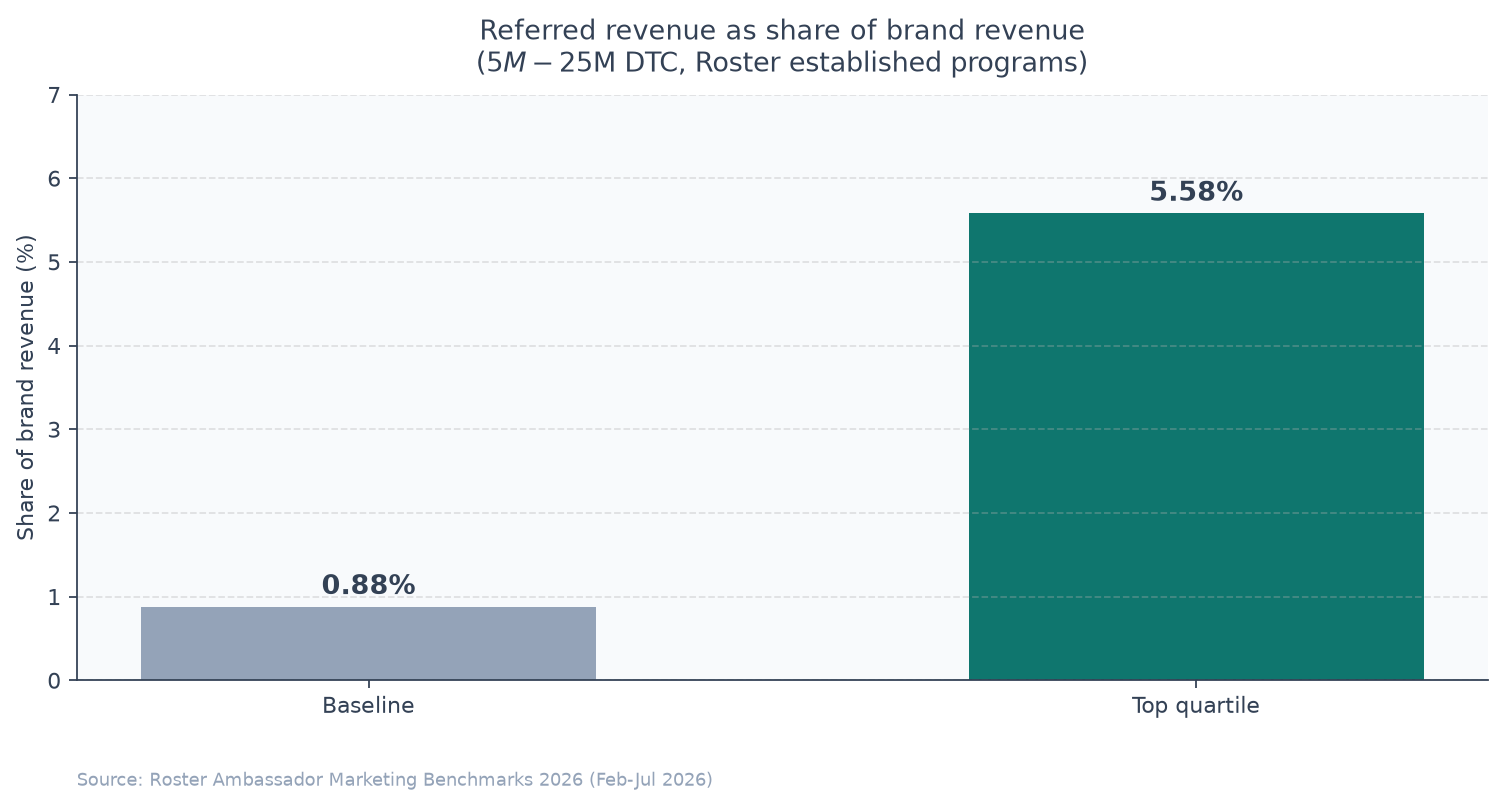
Source: Roster, Ambassador Marketing Benchmarks 2026. https://www.getroster.com/ambassador-marketing-benchmarks/. Live Roster programs, Feb-Jul 2026; established programs only.
Roster’s illustrative arithmetic at the top of the band: on a $25M brand, 5.58% is about $1.395M referred per year versus about $220K at 0.88%. Treat those dollars as scale math, not a forecast for your SKU mix (Roster).
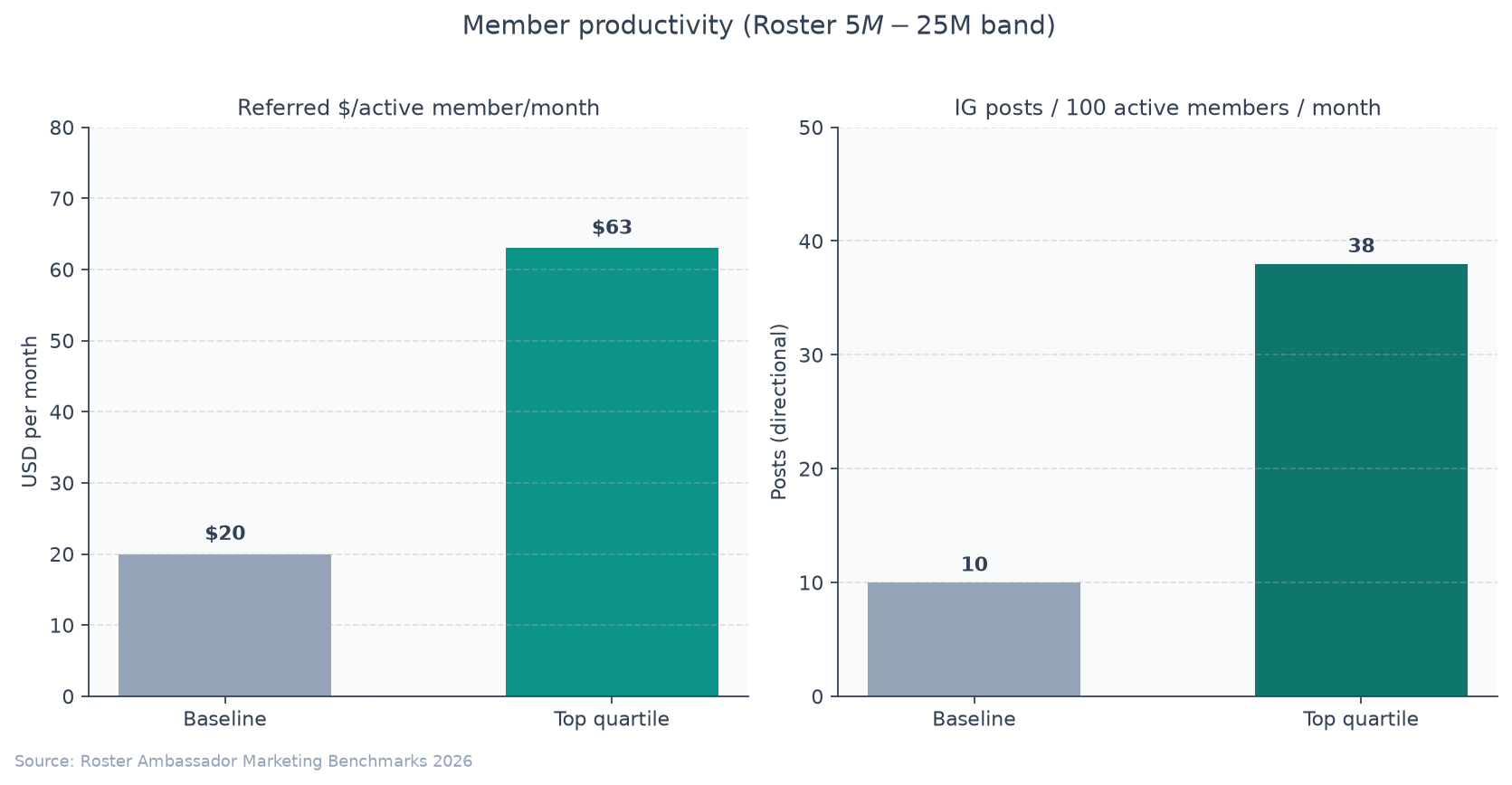
Source: Roster, Ambassador Marketing Benchmarks 2026. https://www.getroster.com/ambassador-marketing-benchmarks/. Instagram post counts are directional.
Do not let a benchmark talk you out of a launch you cannot miss.
Use one-off (or short campaign) bookings when:
Then convert winners. Roster’s own playbook is blunt: after a paid campaign, offer top attributed performers a permanent code and an ongoing commission seat (Roster). That is how one-offs stop being a treadmill.
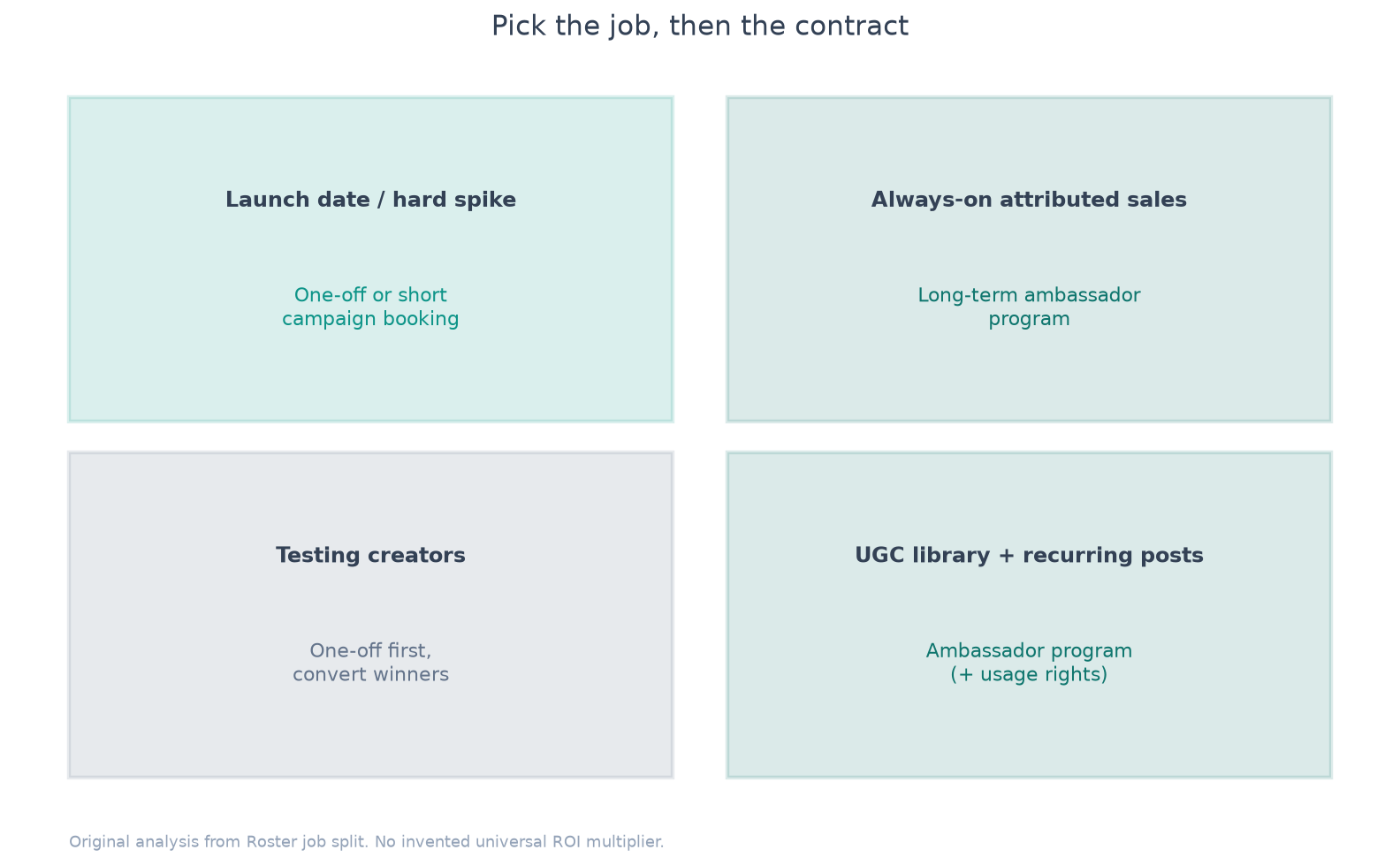
Source: Original analysis synthesizing Roster’s job split (ongoing/performance vs campaign/flat fee). Does not invent a universal ROI multiplier.
You will still see headlines that “Shopify confirms ambassadors deliver 11x ROI versus one-off influencer campaigns.” Trace that number. Shopify’s influencer statistics page attributes an 11x figure to Influencer Marketing Hub in the context of influencer marketing versus other forms of digital media, not a controlled ambassador-versus-one-off ledger (Shopify). Older ambassador blog URLs still wear “11x” in the slug even when the body has moved on. Do not put that multiplier in a board deck as proof that retainers beat Reels. Use Roster’s referred-share gaps when you are talking ambassador program quality. Use influencer vs paid ads when you are talking channel ROI against media.
If the job is “creators sell our catalog for a tracked cut,” you may need affiliate infrastructure more than a customer-ambassador club. Ambassadors often start as buyers. Affiliates often start as publishers. Some partners are both. Keep the contracts separate so commission, content obligations, and disclosure rules stay clear. For performance-priced distribution through co-branded sell pages, that is the feat. lane: merchants list, affiliates promote, buyers purchase with a split on the sale.
Q: What is the difference between a long-term ambassador program and a one-off influencer post? A: An ambassador program is an ongoing relationship, usually with performance-tied pay and recurring content. A one-off post is a campaign booking with a flat fee for specific deliverables in a window. Same creator can do both under different contracts.
Q: How much revenue should an ambassador program drive? A: There is no universal target. On Roster’s 2026 sample of established $5M-$25M DTC programs, baseline referred revenue was 0.88% of brand revenue and the top quartile hit 5.58%. Treat that as an operating benchmark on that platform sample, not a guarantee for every brand.
Q: When should brands still buy one-off influencer posts? A: When you need guaranteed reach by a launch date, when you are testing creators before offering an ongoing seat, or when you need a tier or niche your customer-ambassador pool does not cover. Convert the attributed winners into ambassadors afterward.
Q: Are ambassador programs always cheaper than one-off posts? A: Not in month one. Flat-fee posts can look cheaper per asset early while ambassadors carry product seeding, discount margin, and coordination cost. Over a year, programs that hit top-quartile referred share and content volume usually win on cost per asset. Run the annual math.
Q: Do brand ambassadors need to disclose if they only get free product? A: Yes. Free product is a material connection under the FTC Endorsement Guides, and brands share responsibility for clear, conspicuous disclosure. Build disclosure into terms and creative kits, not into hope.
Long-term ambassador programs vs one-off posts stops being a vibe war when you name the job. One-offs buy a date. Ambassadors buy a channel. Roster’s live mid-market gap (0.88% vs 5.58% referred share) shows how wide “having a program” can still be from running one. Use paid posts to launch and to test. Use ambassadors to compound. Measure referred revenue, activation, and content supply, not only last week’s views.
If you want creators selling your products through tracked co-branded storefronts with a revenue split on every sale, start at feat..
Most marketers see under half of gifted creators post. Plan stock loss as majority silent inventory, then cut ghosts with opt-in and prune rules.
UGC vs influencer marketing is assets vs distribution. Collabstr UGC ~$154 paid; Agentio shows Partnership Ads beat licensed UGC on CTR, CVR, and CPA.
Influencer contract terms explained: usage, exclusivity, whitelisting, kill fees, payment, and FTC disclosure, plus a brand vs creator negotiation matrix.