How Much Stock Loss Is Normal on a Creator Campaign
Most marketers see under half of gifted creators post. Plan stock loss as majority silent inventory, then cut ghosts with opt-in and prune rules.
How brands calculate influencer marketing ROI: cost stack, ROI vs ROAS vs ROIS vs EMV, attribution layers, and why Tomoson's $6.50 is not your target.

TL;DR: Brands calculate influencer marketing ROI as (return - fully loaded investment) / investment x 100. Load every fee, gift, shipping, tool, and ops hour into the denominator. Use ROAS for spend multiples, ROIS for creator efficiency, and a separate awareness scorecard for attention. Do not paste Tomoson’s $6.50 into your board deck as a 2026 target.
Most influencer ROI debates fail before the math starts. Teams argue about a creator’s vibe while the spreadsheet undercounts cost and overcounts vanity. How brands calculate influencer marketing ROI is a discipline problem: pick a goal, load the true spend, attribute revenue with stacked tracking, then read the right scorecard.
If you are a merchant or growth lead trying to defend creator spend, you need a formula finance will accept, an attribution stack that admits dark social exists, and a clean split between sales math and awareness math.
Key takeaways:
Influencer marketing ROI is the return a brand earns from creator partnerships relative to the fully loaded cost of those partnerships, usually expressed as a percentage.
In plain language: after you pay for the post (and everything around it), how much measurable value did you get back?
Shopify’s framing still holds: compare what you put in (payments, freebies, affiliate commissions, tools) with what you get out (sales, signups, traffic, or longer-term brand lift) (Shopify). The hard version of ROI uses attributed revenue. Soft metrics (reach, saves, brand lift) belong on an awareness scorecard unless you have a valuation method your finance team already accepts.
Related vocabulary you will hit in the same meeting:
| Metric | Formula shape | Best use |
|---|---|---|
| ROI % | (Return - Cost) / Cost x 100 | Finance-facing campaign outcome |
| ROAS | Revenue / Cost | Spend multiple (e.g., 3.6x) |
| ROIS | Attributed revenue relative to influencer spend | Creator efficiency comparisons (JM 2024) |
| EMV | Impressions or engagements x paid benchmarks | Directional media-value estimate, not cash |
This page sits next to affiliate vs influencer marketing. Seat choice (flat fee vs commission vs hybrid) changes what lands in the cost column. ROI math comes after the contract.
Wrong ROI math looks like a creator problem. It is usually an accounting problem.
Why the calculation earns its own page:
Brands calculate influencer marketing ROI by fixing the goal, summing fully loaded cost, attributing return with stacked tracking, then reading the scorecard that matches the job. Sales campaigns get ROI/ROAS. Creator efficiency gets ROIS. Awareness campaigns get attention metrics that never pretend to be cash.
Shopify’s monetary formula (Shopify):
ROI (%) = (Return - Investment) / Investment x 100
Worked Shopify illustration: $65,000 return on $10,000 investment → ($65,000 - $10,000) / $10,000 x 100 = 550% ROI.
ROAS is the sibling multiple: Revenue / Cost. The same example is 6.5x ROAS. Use one primary number in a meeting. Quote both only when you label them.
For gifted collaborations, Shopify’s investment base is the retail value of products sent plus shipping (Shopify). Do not treat “free product” as zero cost.
If a line item was required to ship the campaign, it belongs in Investment:
Nearly half of creators sit in Sprout’s roughly $250 to $1,000 per-post band for fee planning, before gifts and ops (Sprout Social). Negotiate hybrids with the same proof pack you would use for commission rate negotiation.
Assumptions for one Instagram seeding post: $2,000 creator fee; $150 product COGS + $30 shipping; $320 tooling and ops allocation; $9,000 tracked revenue from unique code + UTM within a 14-day window. No EMV. No survey lift.
| Line | Amount |
|---|---|
| Creator fee | $2,000 |
| Gift COGS + shipping | $180 |
| Tooling / ops allocation | $320 |
| Total investment | $2,500 |
| Tracked revenue (return) | $9,000 |
| ROI | ($9,000 - $2,500) / $2,500 x 100 = 260% |
| ROAS | $9,000 / $2,500 = 3.6x |
This is an original analysis for teaching the arithmetic, not a survey of live programs. Change the assumptions and the percentage moves with them.
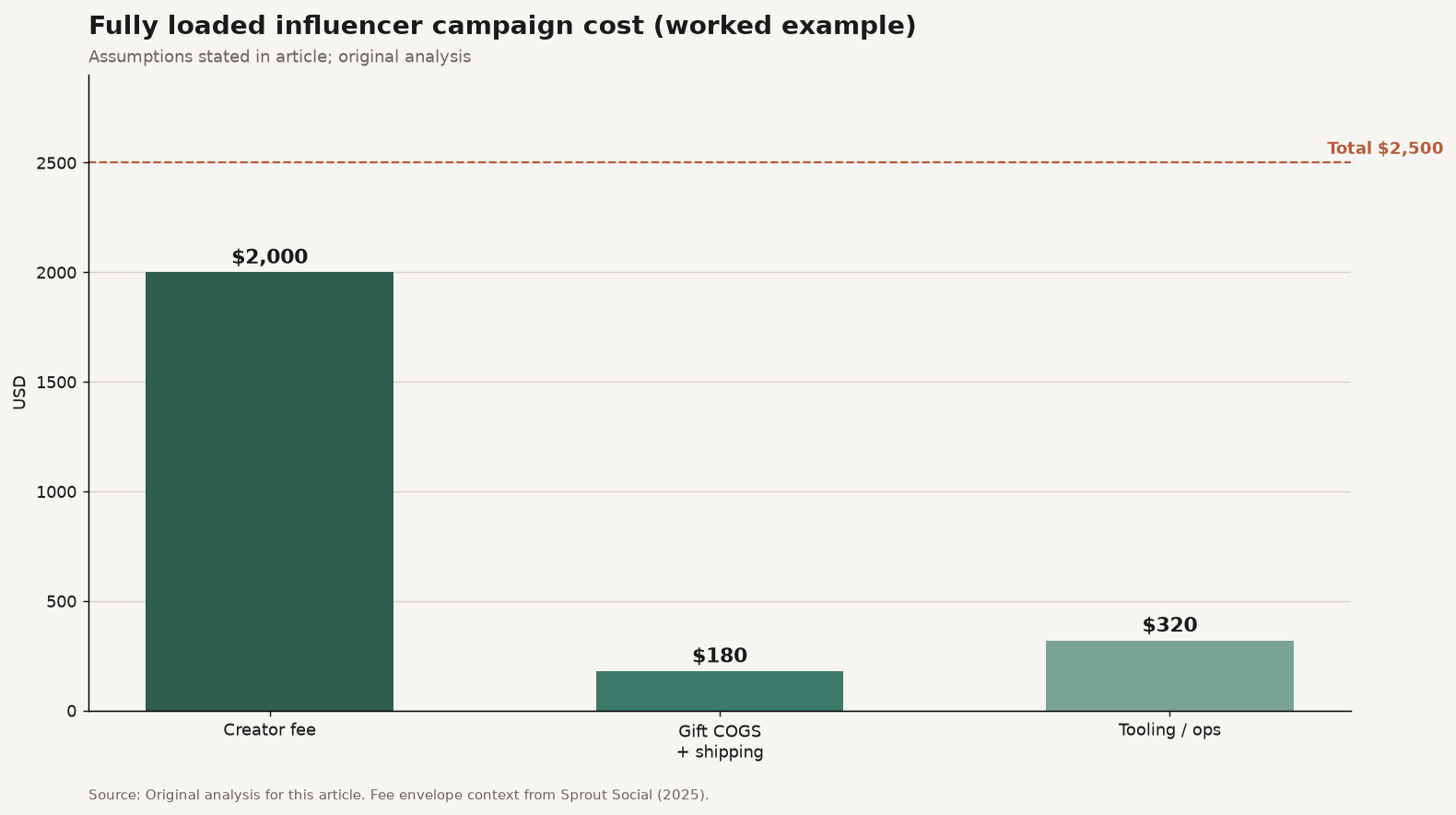
Source: Original analysis for this article (assumptions stated above). Fee envelope context from Sprout Social (2025).
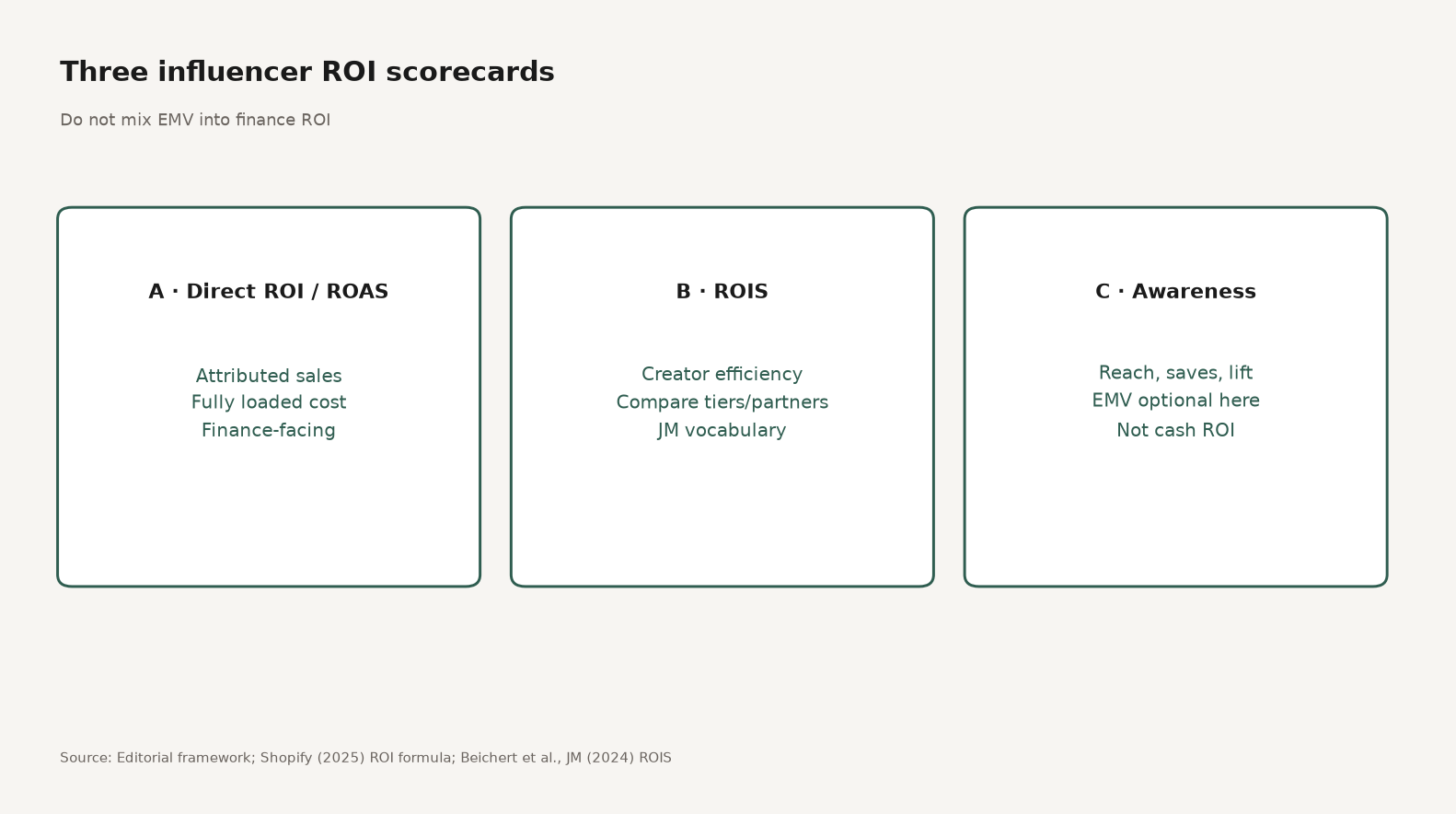
Source: Editorial scorecard framework; direct ROI formula aligned with Shopify (2025); ROIS vocabulary from Beichert et al., Journal of Marketing (2024).
Scorecard A: Direct sales ROI / ROAS. Use when the job is attributed revenue. Fully load cost. Attribute with codes, UTMs, and affiliate links. Fail the campaign on this card only if sales was the brief.
Scorecard B: Creator efficiency (ROIS). Use when comparing creators or tiers on revenue relative to what you paid them. Journal of Marketing’s Instagram DTC study is the clearest primary ladder for that conversation (JM 2024; tier guide).
Scorecard C: Awareness. Use reach, saves, branded search lift, content rights, and assisted paths. EMV can sit here as a directional media-value estimate. Community operators still call EMV a weak finance KPI (“vanity CAC for influencer”) for a reason (r/influencermarketing, accessed 2026-09-27). Never add EMV dollars into Scorecard A’s return unless finance already accepted that valuation method in writing.
| If the brief was… | Primary scorecard | Secondary | Failure mode |
|---|---|---|---|
| Attributed sales / CAC | Direct ROI / ROAS | ROIS by creator | Judging macros only on last-click |
| Compare nano vs macro efficiency | ROIS | Direct ROI | Ignoring ops cost of many nanos |
| Launch awareness / prestige | Awareness | Optional assisted revenue | Firing the campaign for weak ROAS |
| Hybrid fee + commission | Direct ROI + partner EPC | Content quality | Paying twice with no brief or clawback |
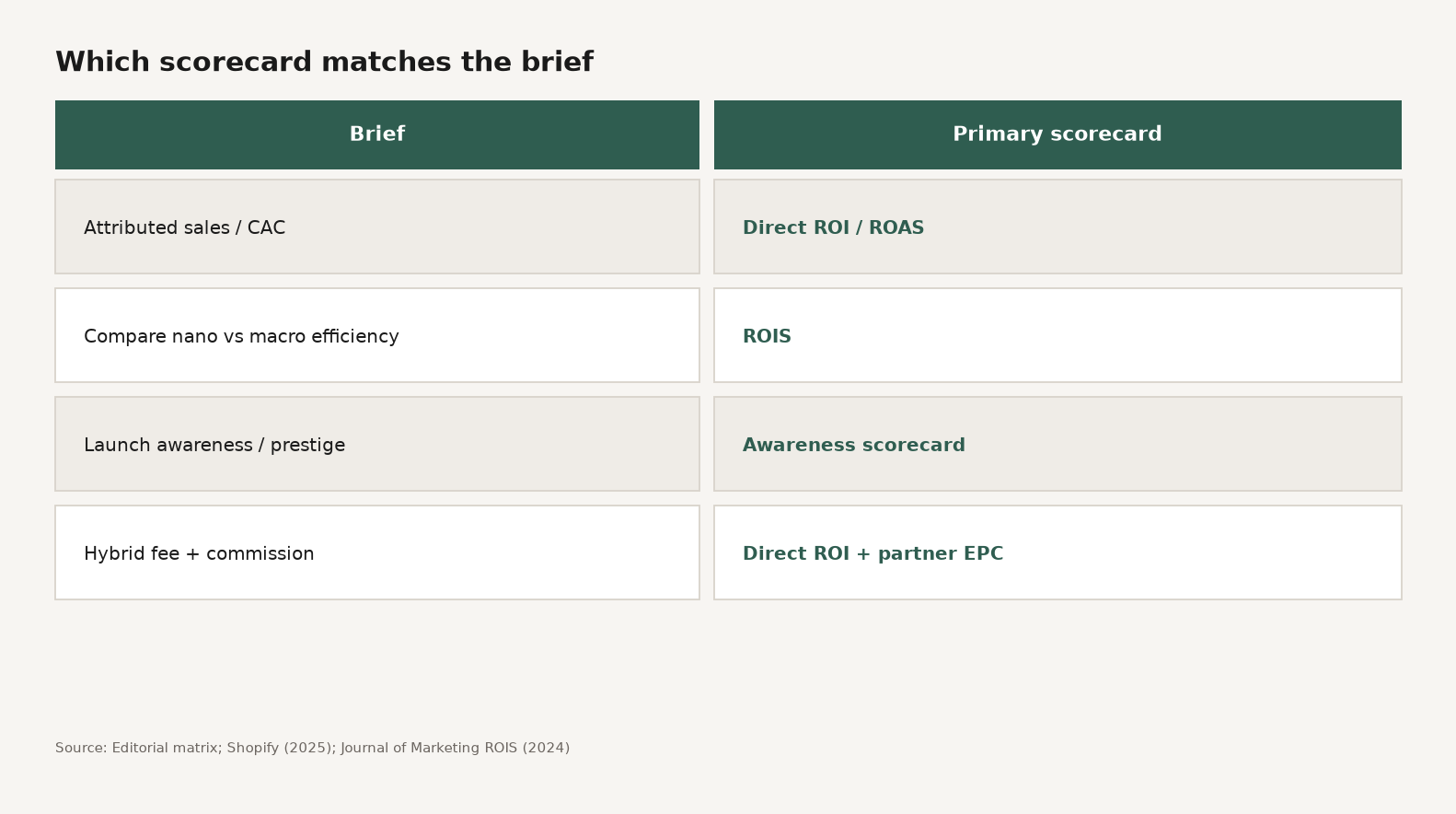
Source: Editorial decision matrix; metric definitions aligned with Shopify (2025) and Journal of Marketing ROIS usage (2024).
Last-click alone will lie. Stack methods:
There is no public dataset that publishes one universal “good influencer ROI” threshold across every category and attribution model. Set your bar from contribution margin and payback, not from a 2015 survey average.
Q: What is the formula for influencer marketing ROI? A: ROI (%) = (Return - Investment) / Investment x 100. Shopify’s illustration of a $65,000 return on a $10,000 investment equals 550% ROI. Investment should include fees, gifts, tools, and related campaign costs, not only the creator invoice.
Q: What is the difference between influencer ROI and ROAS? A: ROI expresses net return as a percentage of cost. ROAS expresses revenue as a multiple of cost. A campaign that spends $2,500 and tracks $9,000 in revenue is 260% ROI and 3.6x ROAS under those assumptions.
Q: Should brands use earned media value (EMV) in influencer ROI? A: Use EMV only on an awareness scorecard as a directional media-value estimate. Do not add EMV dollars into finance ROI unless your finance team has already accepted that valuation method. Operators often treat EMV as a weak cash KPI.
Q: Is $6.50 back per $1 a good influencer ROI benchmark? A: That figure comes from a Tomoson marketer survey popularized by Adweek and is widely treated as mid-2010s self-reported data. It is not a controlled 2026 benchmark for your niche. Set targets from your margins and payback math instead.
Q: How do you calculate ROI for gifted influencer campaigns? A: Treat the retail value of products sent plus shipping as the investment, then apply the same ROI formula to attributed return (Shopify). Gifted is not free. Disclose the free product as a material connection.
How brands calculate influencer marketing ROI comes down to honesty in the denominator and discipline in the scorecard. Fully load cost. Stack attribution. Run sales math, efficiency math, and awareness math on separate cards. Retire Tomoson’s $6.50 as your default target. The brands that keep creator budgets are the ones that can show the arithmetic without vanity padding.
If you are a merchant who wants tracked partners selling through co-branded storefronts instead of a link graveyard, start at https://www.feat.press.
Most marketers see under half of gifted creators post. Plan stock loss as majority silent inventory, then cut ghosts with opt-in and prune rules.
UGC vs influencer marketing is assets vs distribution. Collabstr UGC ~$154 paid; Agentio shows Partnership Ads beat licensed UGC on CTR, CVR, and CPA.
Influencer contract terms explained: usage, exclusivity, whitelisting, kill fees, payment, and FTC disclosure, plus a brand vs creator negotiation matrix.