Affiliate Marketing for Startups: Complete Guide
Affiliate marketing for startups is an operating system—locks, cost, recruit, rates, tracking, first 100 sales, then diagnose a flat roster.
Brand ambassador vs affiliate is a job fork: Roster's litmus and 0.88%-5.58% referred-revenue bands vs Rewardful's 1.28% affiliate sale activation.

TL;DR: Brand ambassador vs affiliate is a job fork, not a job title. Affiliates are paid to reach audiences that do not know you yet. Ambassadors are usually customers you reinforce so they keep advocating. Score ambassadors with Roster’s 0.88% to 5.58% referred-revenue bands. Score affiliates with activation math like Rewardful’s 1.28% sale rate. Do not average them.
Founders launch one “partner program,” paste affiliate terms onto fans, and call quiet customers “inactive affiliates.” Then they blame the channel. The channel was never one thing. Brand ambassador vs affiliate is the choice between paying for reach into stranger audiences and reinforcing people who would mention you anyway.
It sits next to affiliate vs referral marketing, affiliate vs influencer marketing, long-term ambassador programs vs one-off posts, how affiliate marketing works, and Shopify affiliate apps compared.
Brand ambassador vs affiliate means comparing two partner relationships by who the promoter is, why they promote, and what cost shape you accept. Same trackable link sometimes. Different recruiting pool, reward mix, and failure mode. Get the job wrong and every later metric is noise.
Roster’s clean split: an affiliate promotes to an audience they already built, for a commission, and will shift attention when another program pays better. A brand ambassador is usually already your customer. They post because they like the product. The incentive is a reason to keep going, not the only reason they started (Roster).
Do not mash this with affiliate vs referral. Referral programs pay customers to bring friends, often with double-sided rewards, and may never ask for content. Ambassadors are curated advocates expected to create, seed, and stay active. Affiliate vs influencer is a different fork again: flat-fee distribution versus pay-for-performance. An ambassador can earn commission and still not be a classic open-enrollment affiliate.
The distinction matters because the wrong program burns money in opposite ways. Affiliate programs die from coupon leakage, lazy recruiting, and partners who never activate. Ambassador programs die from silence: you ship product, nobody engages, and the roster goes quiet while software keeps billing.
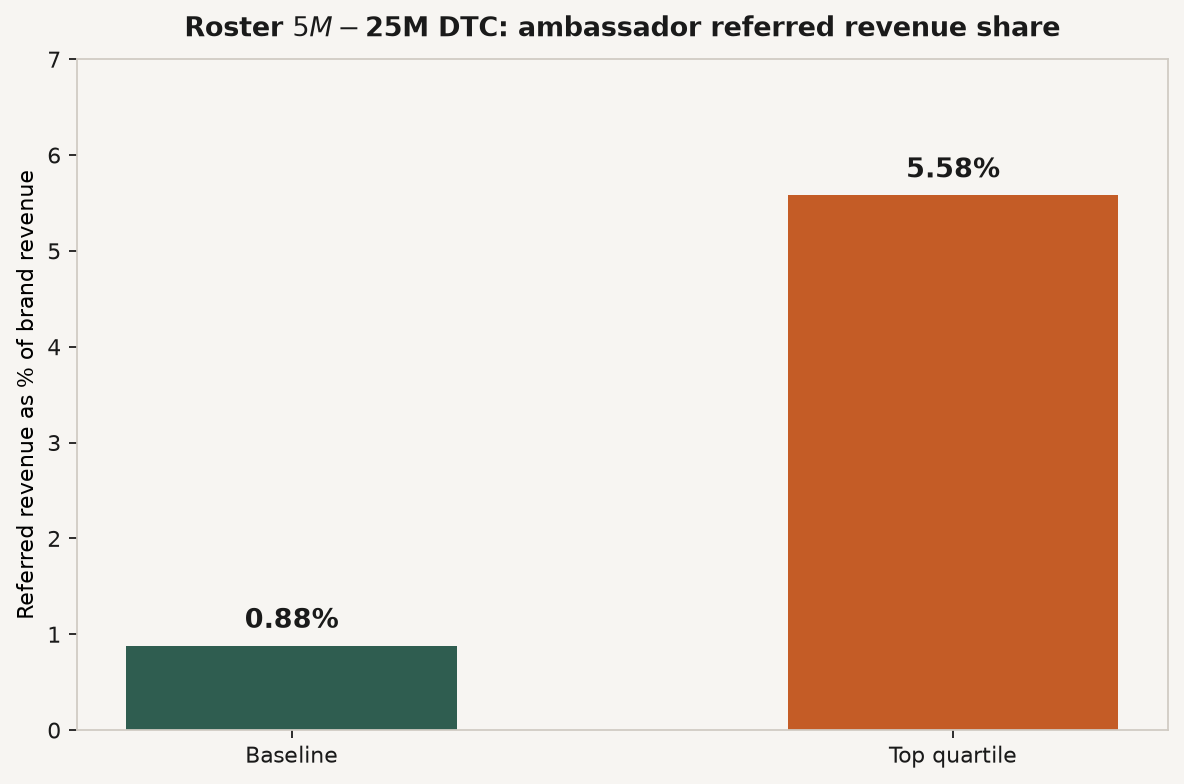
Source: Roster, Ambassador Marketing Benchmarks 2026 (established programs, Feb-Jul 2026). https://www.getroster.com/ambassador-marketing-benchmarks/
Brand ambassador vs affiliate differs in practice across recruiting, rewards, content rights, cost timing, and the scorecard you should trust. Start with the audience you need. Then pick the relationship that matches that audience. Only then buy software or write a brief.
| Dimension | Affiliate | Brand ambassador |
|---|---|---|
| Who they usually are | Publishers, creators, deal sites, agencies with an audience | Existing customers, often small to mid followings |
| Why they promote | Commission and competitive payouts | Preference, reinforced by rewards |
| Audience relationship | Mostly strangers to your brand | Friends, family, followers who know them |
| Typical reward | % of sale (sometimes tiers) | Mix: commission, product, credit, status, access |
| Content rights | Often theirs unless licensed | Reusable UGC if the program captures rights |
| Cost shape | Variable with sales | Fixed/front-loaded ops + product |
| Main risk | Non-activation, leakage, brand safety | Program decay from silence |
| Volume pattern | Higher revenue per partner, fewer partners | Lower per person, many more people |
Source framework: Roster.
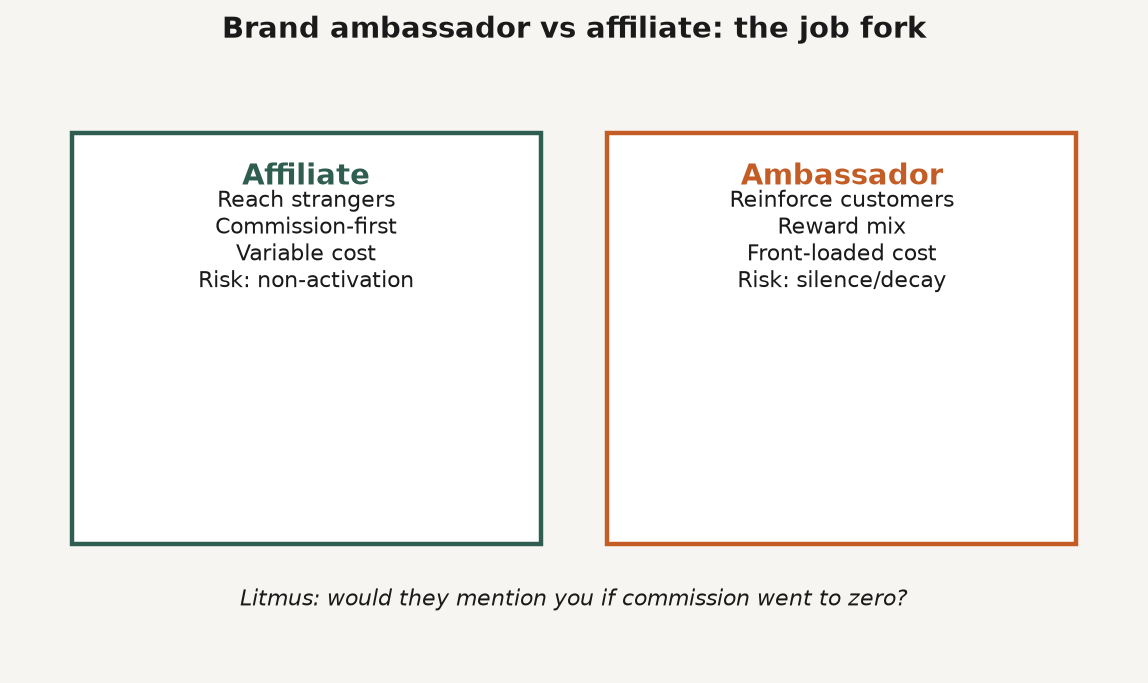
Source: Editorial framework synthesizing Roster’s affiliate vs ambassador definitions. https://www.getroster.com/blog/brand-ambassadors-vs-affiliates-what-is-best/
| Scorecard | Sample | What it measures | Labeled figures |
|---|---|---|---|
| Ambassador referred revenue | Roster live DTC programs, $5M-$25M, established (90+ days, 25+ actives) | Share of brand revenue attributed to ambassadors | 0.88% baseline / 5.58% top quartile |
| Ambassador monetization | Same | $/active member/month; activation | $20 vs $63; 80% vs 92% |
| Affiliate sale activation | Rewardful, 2,847 SaaS programs | Share of affiliates with ≥1 sale | 1.28% (≥1 referral: 7.6%) |
Sources: Roster benchmarks; Rewardful.
Roster’s mid-market gap is an operating target inside ambassador programs, not proof that every brand should skip affiliates. Rewardful’s 1.28% is a warning about affiliate roster quality, not a claim that ambassadors “activate better” by the same definition. Different jobs. Different denominators.
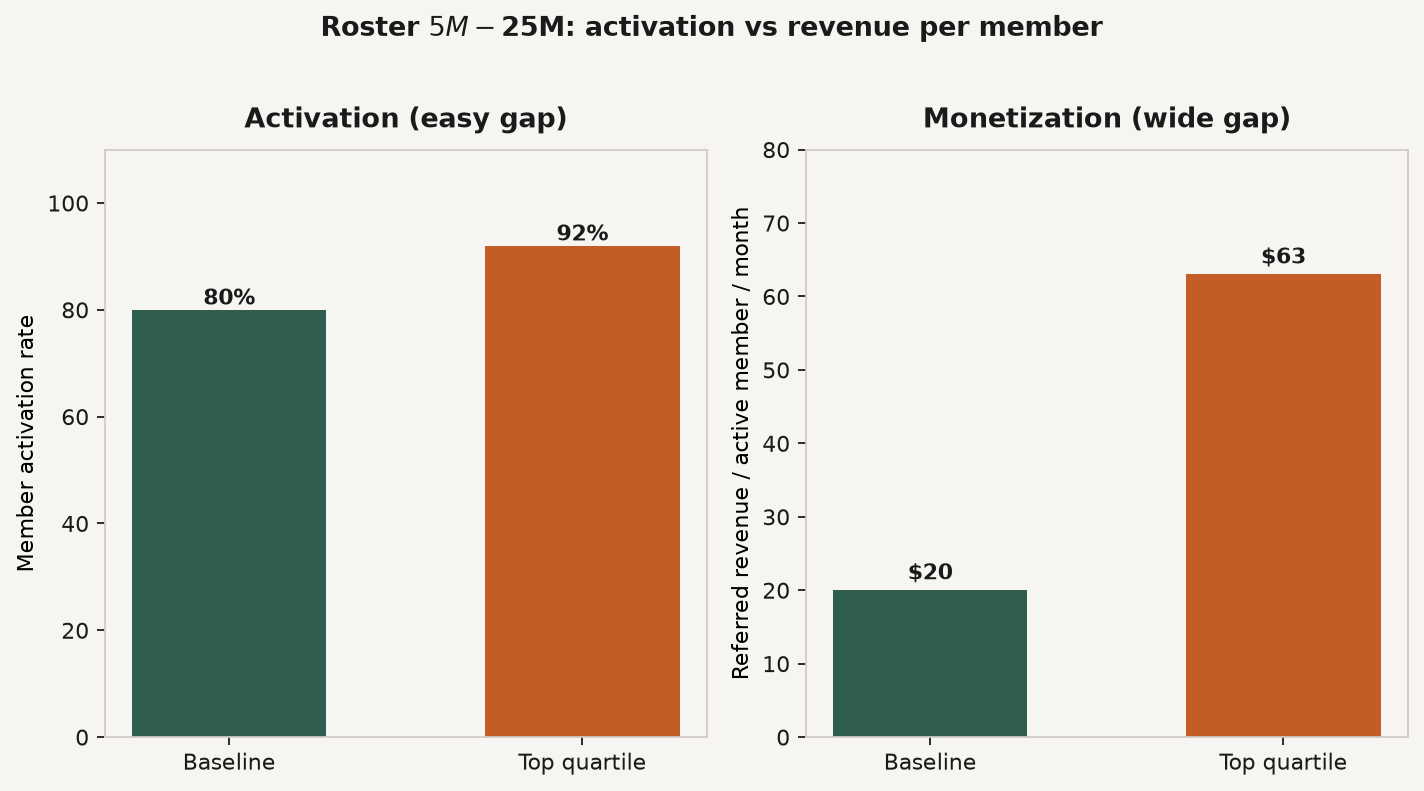
Source: Roster, Ambassador Marketing Benchmarks 2026. https://www.getroster.com/ambassador-marketing-benchmarks/
Roster’s practical sequence is blunt. Start with ambassadors when you have repeat purchase behavior and customers who already tag you. Start with affiliates when publishers and comparison sites already cover your category and you need audiences that have never heard of you. Run both when you are past roughly $5M and one motion already works: affiliates for strangers, ambassadors for people who have heard of you but have not bought (Roster).
If you run both, keep one attribution record. Splitting tools hides first-click versus closer interactions. Shopify-native fee shapes for affiliate/referral apps live in Shopify affiliate apps compared. Tenure versus one-off creator bookings lives in long-term ambassador programs vs one-off posts.
Choose between ambassadors and affiliates by naming the audience gap, matching the cost shape you can fund, and keeping separate scorecards from day one. Five steps follow below. Software and creative assets come last, after the relationship design is clear.
Q: What is the difference between a brand ambassador and an affiliate? A: An affiliate promotes for commission to an audience they built, and the relationship is transactional. A brand ambassador is usually an existing customer who advocates over time, with rewards that often mix commission, product, and status. Roster’s litmus is whether they would still mention you if commission went to zero.
Q: Can brand ambassadors earn commission? A: Yes. Most ambassador programs include performance pay. The difference is that commission is one part of a broader reward mix, not the entire relationship design.
Q: Which drives more revenue, ambassadors or affiliates? A: There is no public dataset that crowns a universal winner. Roster finds affiliates often drive more revenue per partner, while ambassador programs can drive more in aggregate at scale because you can run hundreds of customer advocates and collect content. Measure each on its own scorecard.
Q: Should a brand run both an ambassador and an affiliate program? A: Often, once you are past early scale. Roster’s guidance is to run both past roughly $5M when one motion already works: affiliates for unknown audiences, ambassadors for warmer trust. Keep attribution unified so paths do not hide in separate tools.
Q: How is an ambassador different from a customer referral program? A: Referral programs pay customers to bring friends and may never require content. Ambassador programs curate advocates, expect ongoing creation and participation, and usually manage rights, seeding, and activation. See affiliate vs referral marketing for the identity fork.
Brand ambassador vs affiliate is a relationship choice before it is a software choice. Affiliates buy reach into stranger audiences on variable cost. Ambassadors reinforce customers who already care, on a longer horizon and a different scorecard. If you want creators selling through co-branded storefronts with a clear revenue split, list your product on feat.
Affiliate marketing for startups is an operating system—locks, cost, recruit, rates, tracking, first 100 sales, then diagnose a flat roster.
How to track affiliate sales: pick link cookie, coupon, pixel, S2S postback, or storefront checkout—then match Rewardful, Tapfiliate, or Impact.
Best affiliate programs for SaaS companies pass the Recurring Cap Test: labeled duration, cookie, seat type, payout rails—plus Rewardful’s ~24% planning band.