Discount Code vs Cashback Promotions Explained
Discount code vs cashback promotions: who funds the shopper benefit, Impact voucher vs loyalty mix, and a $100 true-cost stack for merchants.
Referral program benchmarks: ReferralCandy 2.35% global rate, software at 4.75%, industry ladder, double-sided incentives, and referral vs affiliate.

TL;DR: Referral program benchmarks and structures start with a definition: referral rate is referred purchases divided by total purchases. ReferralCandy’s stable average after about six months is roughly 2.35% globally, with software and digital goods near 4.75%. Treat 20%+ rates as outliers. Pick a double-sided structure that fits margin and AOV, and do not confuse customer referral with affiliate commissions.
Founders ask for “a good referral rate” the same way boards ask for “3:1.” They want a single number that blesses the deck. The internet answers with Dropbox lore, 20% screenshots, and tip lists that never say what was measured.
Referral program benchmarks and structures only help when you lock the metric, the sample, and the incentive design. ReferralCandy defines referral rate as the volume of referred purchases as a percentage of total purchases. On that definition, a successful retailer after about six months sits near 2.35% globally, not at viral fairy-tale levels (ReferralCandy).
Key takeaways:
A referral program benchmark is a published performance range for a defined referral metric, usually referral rate or referral conversion, measured on a stated sample of merchants or customers.
Referral rate, per ReferralCandy, is referred purchases as a percentage of total purchases. A 1% rate means 1 in 100 purchases came through the program. Their industry figures use merchants tagged into major categories with at least about six months of data, because rates tend to stabilize after that window (ReferralCandy).
Structures are the other half of the phrase. Structure means who gets paid (advocate only, friend only, or both), what they get (cash, store credit, percent off, free product, subscription time), when it unlocks (signup vs purchase vs retention), and how fraud is constrained. A benchmark without a structure note is a number without a recipe.
This page is adjacent to CAC vs LTV benchmarks by industry: referral lowers effective CAC when rewards are smaller than paid media, and referred cohorts can lift LTV. It is also adjacent to affiliate commission structures: both pay for tracked acquisition, but the actor and the contract differ.
Wrong benchmarks create expensive theater. You either kill a healthy 2% program because a case study claimed 22%, or you overspend on rewards chasing a viral coefficient your category cannot support.
Why the numbers fight back:
Read three layers: the stable rate baseline, the industry ladder (absolute and relative), then the structure choices that move you inside your category. Never reverse that order.
ReferralCandy’s published baseline for merchants with enough history is a global average referral rate of about 2.35%. They describe that as roughly 1 in every 50 sales for a successful retailer that has used the program for six months or more. They also warn that low sales volume or weak product-market fit will not magically print the average (ReferralCandy).
Outliers exist. The same page cites Atmoph near 24%, Branch Basics near 9.57%, iWader Fishing near 23%, and Farm Hounds near 22.25%. Those are proof that high rates are possible, not that your forecast should open at 20% (ReferralCandy). A high rate can also mean other acquisition channels are immature. Diversify anyway.
Keep two other metrics separate:
| Metric | What it measures | Common failure |
|---|---|---|
| Referral rate | Referred purchases ÷ total purchases | Treating viral K-factor anecdotes as this rate |
| Share / participation rate | Customers who share or join | Celebrating shares that never buy |
| Referral conversion rate | Referred visitors (or leads) who purchase | Mixing with overall store conversion |
There is no public cross-platform census that fixes one median referral conversion rate for all ecommerce. Vendor blogs publish 3%-5% median and 8%+ top-quartile bands with uneven attribution. Use them as directional, not as law. Always label which metric you are quoting.
ReferralCandy studied thousands of data points across 11 industry tags. The HTML page states the global 2.35% and software/digital 4.75% figures in text. Exploding Topics republishes additional ladder rows from that ReferralCandy analysis (Exploding Topics):
| Industry (RC / ET framing) | Avg referral rate | Notes |
|---|---|---|
| Software and digital goods | 4.75% | Highest; RC primary text |
| Books and education | 3.27% | ET transcription of RC |
| Food, beverage, and groceries | 2.98% | ET transcription of RC |
| Global average (all industries) | 2.35% | RC primary; ~1 in 50 sales |
| Health foods and supplements | 1.92% | ET transcription of RC |
| Apparel and fashion | 1.77% | ET transcription of RC |
| Beauty and grooming | 1.66% | Lowest in the published cut |
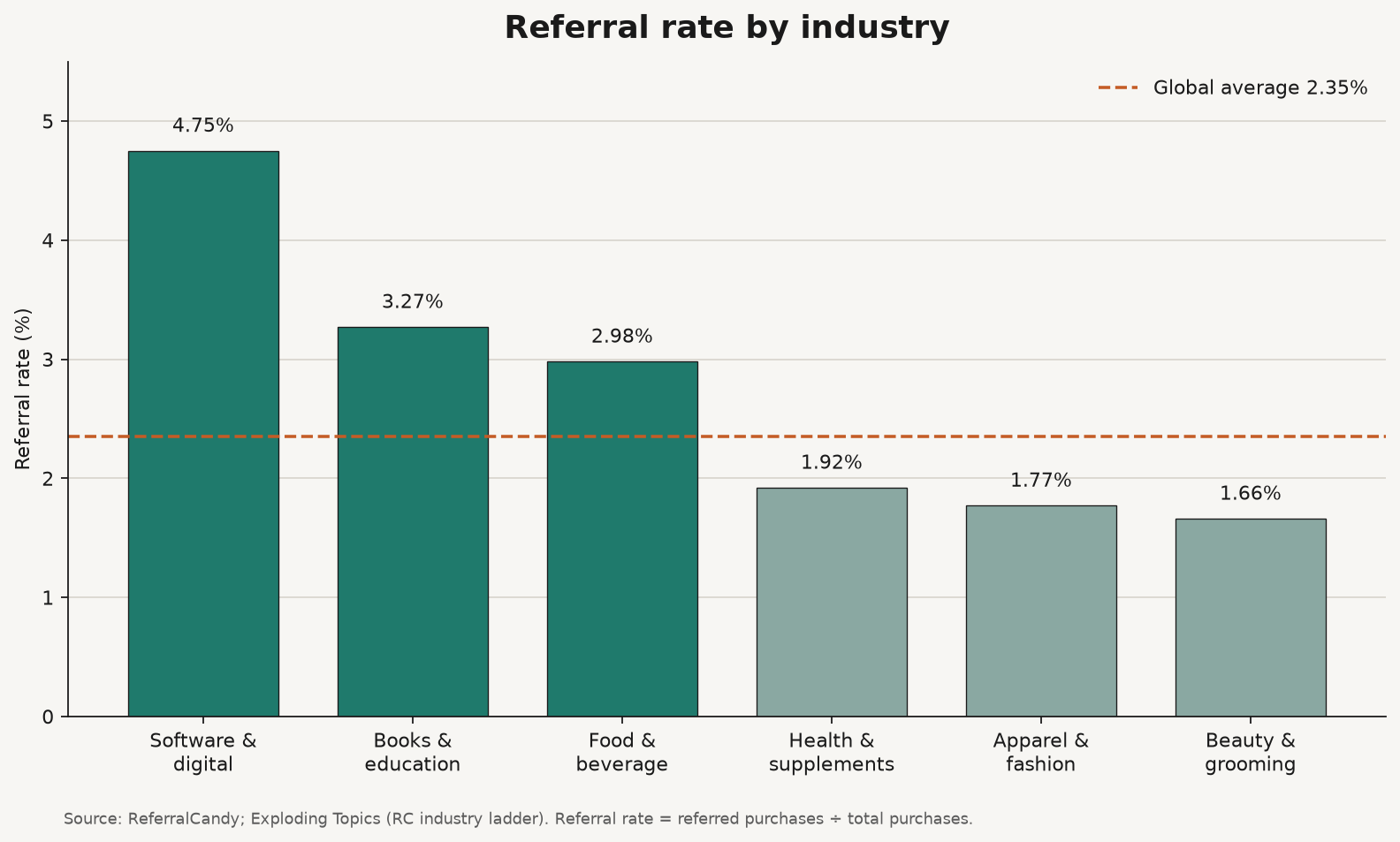
Source: ReferralCandy (global 2.35%, software 4.75%); Exploding Topics republishing ReferralCandy industry ladder rows. https://www.referralcandy.com/blog/referral-rates/ · https://explodingtopics.com/blog/referral-marketing-stats
Software’s lead fits how digital products travel in communities: low shipping friction, easy demo, early-adopter networks. Beauty and apparel sit lower on this rate definition even when social chatter is loud. Recommendation noise is not the same as tracked referred purchases.
Absolute rate is one lens. ReferralCandy’s August 2026 study asks a different question: among more than 600 active Shopify referral programs from July 2025 through June 2026, which industries saw referrals contribute the largest share of new customers (median, non-disqualified referral events, normalized for store size)? Home is the reference point (ReferralCandy):
| Industry | Referral contribution vs Home (median) |
|---|---|
| Sport | 2.2× |
| Health | 1.9× |
| Food | 1.7× |
| Gadget | 1.6× |
| Home | 1.0× (reference) |
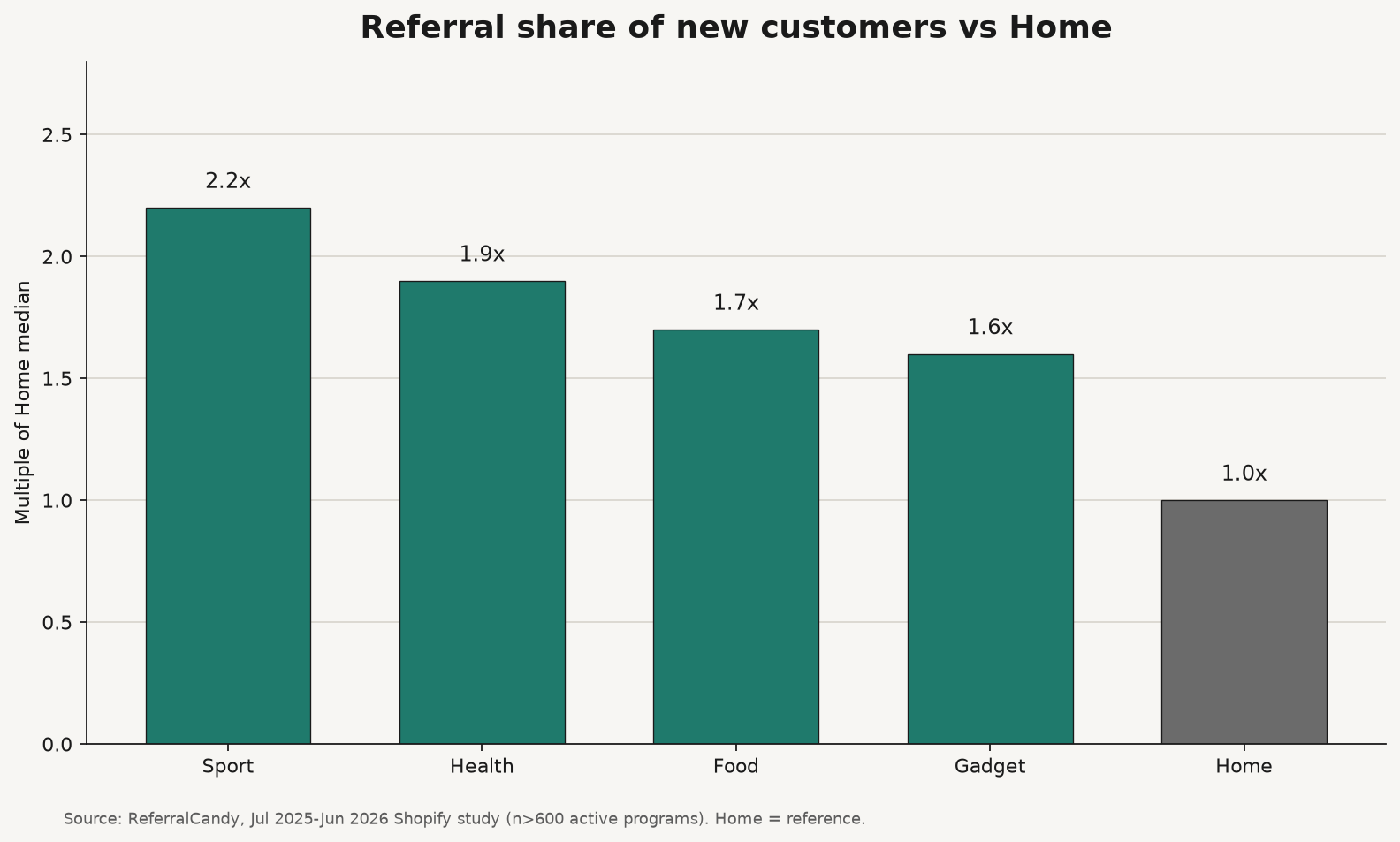
Source: ReferralCandy, Study: The five ecommerce industries where referral pulls the most weight (Jul 2025-Jun 2026, n>600 Shopify programs). https://www.referralcandy.com/blog/top-ecommerce-industries-for-referral-programs
Apparel and Beauty did not make that top five; their medians sat below Home in the window. Execution still dominates: inside Home, top-quarter programs contributed about 2.8× the referral-customer share of the median Home program, a within-category gap larger than Sport’s 2.2× edge over Home (ReferralCandy). Industry changes the slope. Operators decide the climb.
Most formal programs reward both sides. Exploding Topics cites SaaSquatch that more than 9 in 10 referral programs are double-sided, and that 72% offer the same reward to promoter and friend (Exploding Topics). Double-sided is the default because sharing needs a reason and acting needs a reason.
ReferralCandy’s customer-success guidance for offer design (ReferralCandy):
Structure decision matrix:
| Constraint | Prefer | Avoid |
|---|---|---|
| Low margin / high refund risk (apparel, gadgets) | Modest credit, delayed unlock after return window | Huge friend discounts that invite abuse |
| High AOV, considered purchase | Fixed dollar both sides; clear product demo share | Tiny percent that feels insulting |
| Consumables / subscriptions | Recurring credit or free unit after N orders | One-time coupon with no reorder trigger |
| Digital / SaaS | Account credit or subscription time; double-sided | Cash that trains partners instead of users |
| You need creator distribution, not friend WOM | Affiliate / co-selling program | Stretching customer referral into a pseudo-affiliate |
Customer referral pays people who already bought. Affiliate and co-selling pay people whose job is distribution. If your growth problem is “happy buyers do not invite friends,” fix referral structure. If your problem is “nobody with an audience will sell this,” you need affiliate marketing or a co-branded storefront path, not a larger friend coupon. For payout duration on partner deals, see recurring vs one-time affiliate commissions.
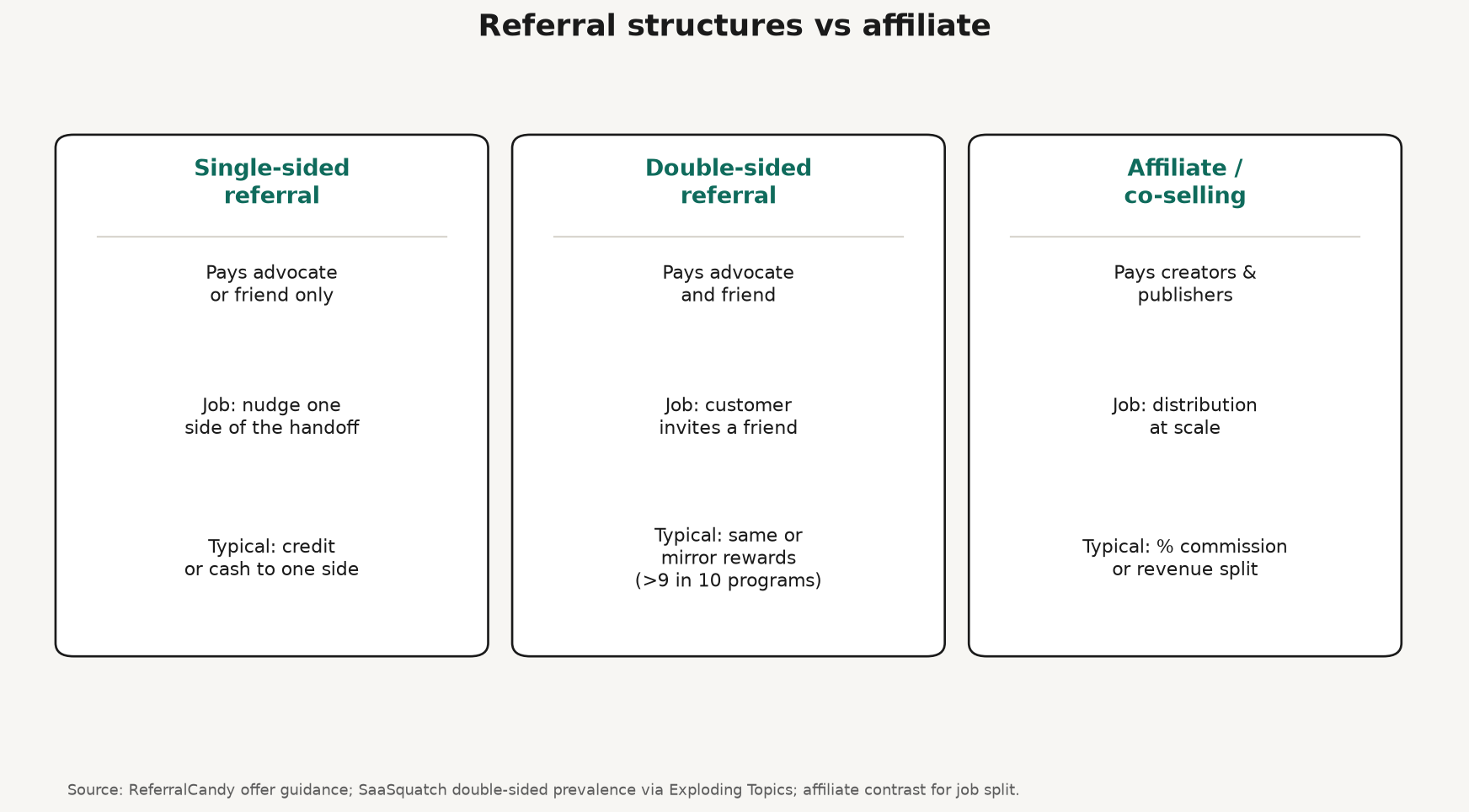
Source: Structure definitions synthesized from ReferralCandy offer guidance and SaaSquatch double-sided prevalence via Exploding Topics; affiliate column contrasts with feat. blog affiliate explainers. https://www.referralcandy.com/blog/referral-rates/ · https://explodingtopics.com/blog/referral-marketing-stats
Use this sequence when you launch or reset a program. Each step is at most two sentences.
Q: What is a good referral rate for a referral program?
A: On ReferralCandy’s definition and sample, a useful baseline after about six months is roughly 2.35% of purchases referred, or about 1 in 50 sales. Software and digital goods average closer to 4.75%. Rates above 20% appear in case studies but are not the planning default.
Q: What are referral program benchmarks by industry?
A: Exploding Topics republishes ReferralCandy’s ladder with software at 4.75%, books at 3.27%, food at 2.98%, health at 1.92%, apparel at 1.77%, and beauty at 1.66%, against a 2.35% global average. A separate 2025-2026 Shopify study ranks Sport, Health, Food, and Gadget above Home on referral’s share of new customers.
Q: Should referral programs be double-sided?
A: Usually yes. Exploding Topics cites SaaSquatch that more than 9 in 10 programs reward both sides, and 72% give the same reward to both. Single-sided can work under tight margins, but you must decide whether you are buying shares or purchases.
Q: How is referral marketing different from affiliate marketing?
A: Referral programs incentivize existing customers to invite friends, usually with store credit or discounts. Affiliate marketing pays publishers or creators a commission for tracked sales as a distribution job. Same tracking idea, different actor and contract.
Q: Do referred customers have higher lifetime value?
A: In the Journal of Marketing study of a German bank (~10,000 customers, nearly three years of tracking), referred customers were at least 16% more valuable on a six-year CLV horizon than comparable non-referred customers. That is one industry sample, not a universal ecommerce law, but it is stronger than volume-only storytelling.
Referral program benchmarks and structures are a definition problem before they are a growth story. Lock referral rate as referred purchases over total purchases, plan around ReferralCandy’s ~2.35% stable average and the industry ladder (software near 4.75%, beauty near 1.66%), and use the 2025-2026 relative contribution study to set category expectations without surrendering to them. Prefer double-sided rewards sized to AOV, wait six months before you panic, and send partner distribution to an affiliate or co-selling motion when the job is audience, not friendship.
If you are a merchant who wants creators to sell what you built through co-branded storefronts with a revenue split on every sale, start at feat..
Discount code vs cashback promotions: who funds the shopper benefit, Impact voucher vs loyalty mix, and a $100 true-cost stack for merchants.
Loyalty program ROI vs acquisition spend: Antavo reports ROI climbing 4.8x to 5.3x. Rebalance with retention math, not vanity.
Affiliate marketing for startups is an operating system—locks, cost, recruit, rates, tracking, first 100 sales, then diagnose a flat roster.