Affiliate Marketing for Startups: Complete Guide
Affiliate marketing for startups is an operating system—locks, cost, recruit, rates, tracking, first 100 sales, then diagnose a flat roster.
Start an affiliate program for your business: five locks before go-live, Rewardful 15.6% survival / 1.28% sale activation, LinkJolt 83% manual review.

TL;DR: How to start an affiliate program for your business means locking economics, tracking surface, contract, soft-launch partners, and activation meters before you open signup. Rewardful’s sample of 2,847 SaaS programs finds only 15.6% continue long-term and only 1.28% of affiliates generate a sale. Software without those locks builds a waiting room.
Most founders treat “start an affiliate program” as a weekend software install. They paste a script, publish a footer signup, and wait. The dashboard fills with dormant accounts. Revenue does not. That is not a launch. That is hope with a tracker.
How to start an affiliate program for your business is a merchant job: decide what you can pay, pick the surface that attributes and pays cleanly, write rules partners will actually read, invite a small soft-launch roster, and measure activation before you chase headcount. Mechanics live in how affiliate marketing works. Rate depth lives in SaaS affiliate commission rates and affiliate commission structures. Recruitment depth lives in how to recruit affiliates for SaaS. This page owns go-live. Startup constraints (runway, unknown LTV, tracker not network) live on how to create an affiliate program for a startup.
Starting an affiliate program for your business means publishing a performance contract where named partners promote your offer through tracked links or storefronts, earn a commission on a qualifying event, and get paid under written terms, instead of paying upfront for untracked attention.
It is not the same as a customer referral program. Referral rewards friends of buyers. Affiliate programs recruit third-party promoters who already reach your buyers. Shopify draws that fork plainly: referral often needs no audience platform; affiliate usually does (Shopify how-to). For the identity matrix, use affiliate vs referral marketing.
It is also not “add creators until the roster looks impressive.” Rewardful finds 56% of programs run with fewer than 50 affiliates, and only about 1 in 10 ever pass 1,000 (Rewardful). Small and deliberate beats large and dormant. If you already have a fat roster and flat sales, read why affiliate programs go flat after adding creators after you finish this launch stack.
Starting correctly matters because most programs do not fail on the logo of the tracker. They fail on economics nobody can fund, contracts nobody published, and activation nobody measured. Durability and activation are the harsh public meters.
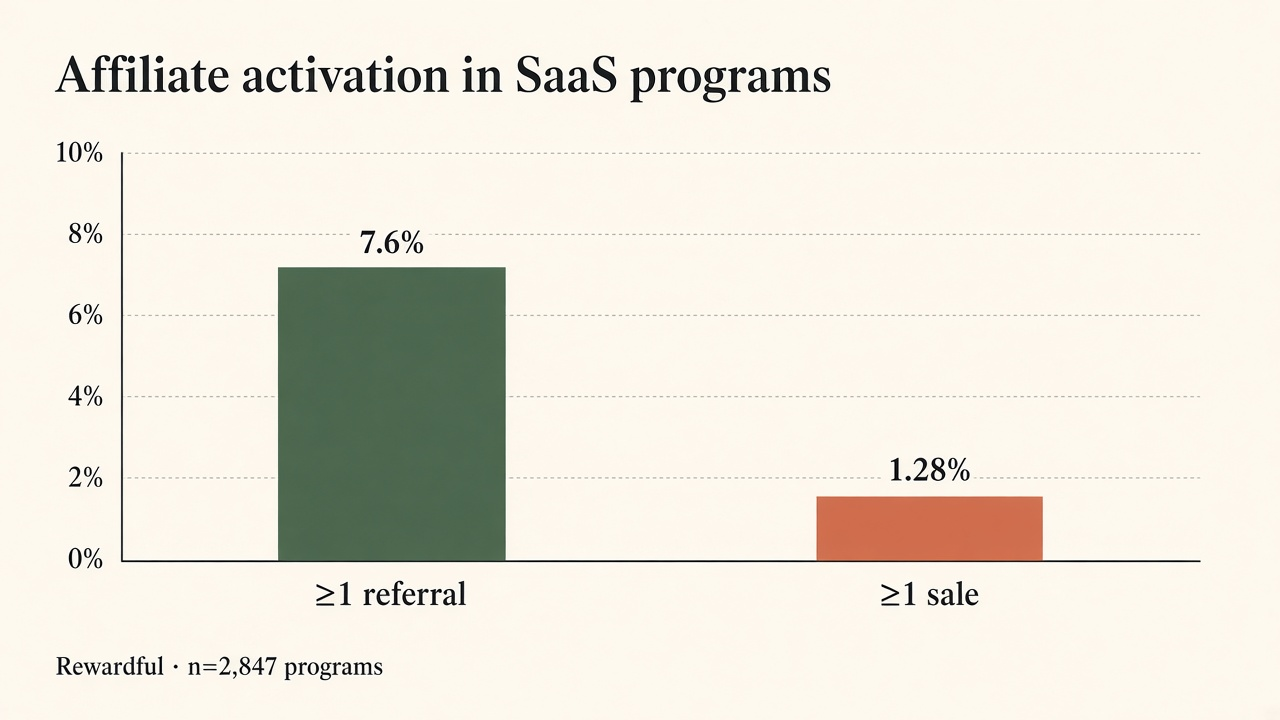
Source: Rewardful State of SaaS Affiliate Programs Report (updated July 21, 2026), analysis of 2,847 SaaS affiliate programs. https://www.rewardful.com/articles/state-of-saas-affiliate-programs-report
How to start an affiliate program for your business works as five locks before go-live. Lock what you can pay. Lock where tracking and selling happen. Lock the written rules. Soft-launch with a handful of fit partners. Instrument activation meters. Only then open a wider signup. Skip a lock and you will debug trust after partners already feel burned.
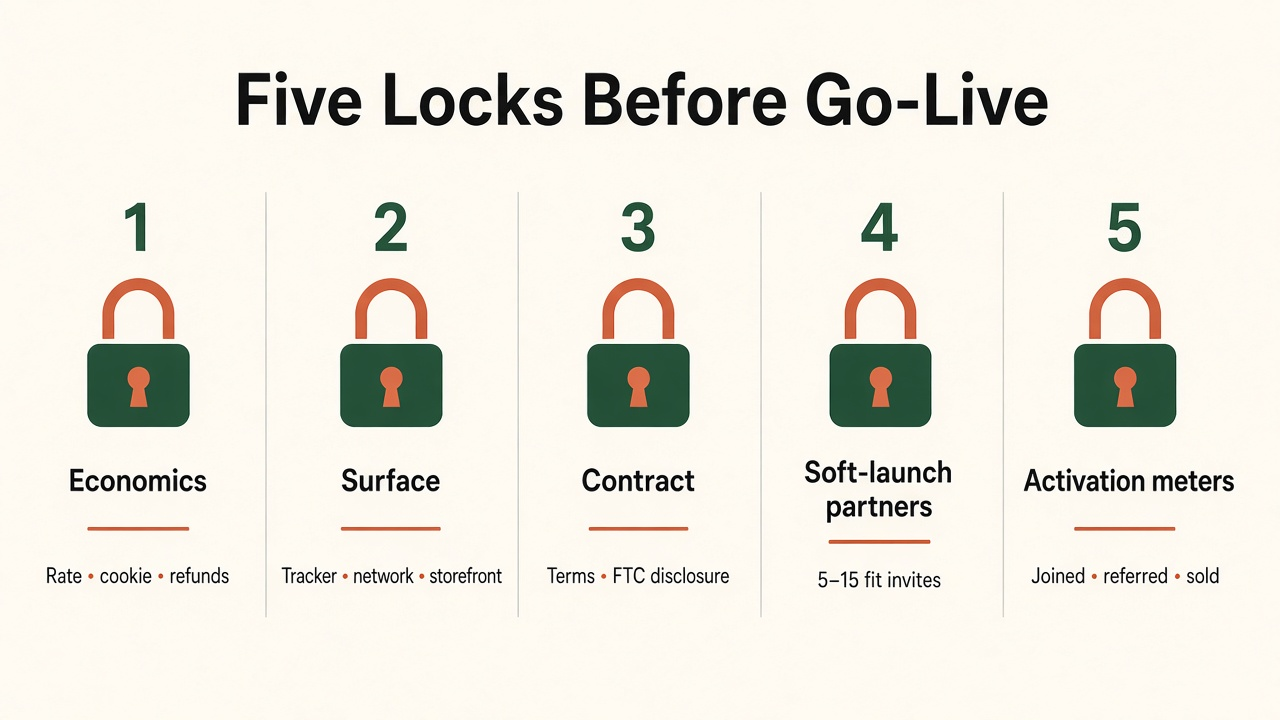
Source: Editorial Five Locks Before Go-Live framework for merchant affiliate program launch; durability and activation benchmarks from Rewardful (n=2,847, updated July 21, 2026). https://www.rewardful.com/articles/state-of-saas-affiliate-programs-report
Write the payable event (sale, first invoice, booked call), the rate or bounty, the cookie or attribution window, the payout hold, and the refund clawback. Shopify’s how-to still frames common cookie windows as 30, 60, or 90 days and points merchants to match the sales cycle (Shopify how-to).
Use published bands as envelopes, not vibes:
| Offer type | Planning band | Source |
|---|---|---|
| Physical goods (DTC-style) | 5%-15% per sale | Shopify |
| Digital products / courses | 20%-50% per sale | Shopify |
| Subscriptions (recurring) | 15%-30% recurring | Shopify |
| SaaS sample average | 24.16% average (Rewardful n=2,847) | Rewardful |
| SaaS sample median | 20% median (LinkJolt n=98 %-based) | LinkJolt |
If you cannot fund the midpoint of your band after a bad refund month, do not launch at the top of the band to “look competitive.” For duration math (one-time vs recurring), use recurring vs one-time affiliate commissions.
Pick the layer that matches your distribution job. Tools are not interchangeable logos. A tracker is not a network. A network is not a co-branded storefront. For the broader stack, see best affiliate marketing tools and best affiliate marketing platforms.
| Surface | Best when | Public cost signal | Tradeoff |
|---|---|---|---|
| Standalone tracker (e.g. Rewardful) | You already recruit; Stripe-style billing | Rewardful from $49/month, 0% of affiliate-attributed revenue on the subscription (Rewardful pricing) | You own recruiting and enablement |
| Partnership network / cloud | You need publisher discovery and B2B workflows | Demo or network fees vary; pricing often sales-led | Higher ceiling, more ops weight |
| Shopify Collabs / store apps | Catalog lives on Shopify | Native Collabs path in Shopify’s guide (Shopify how-to) | Strong for Shopify; weaker off-platform |
| Co-branded seller storefront (e.g. feat.) | You want named promoters selling your existing offer on a storefront with an automatic split | Do not invent feat. fees; see product for current terms | Marketplace + storefront job, not a raw cookie tracker |
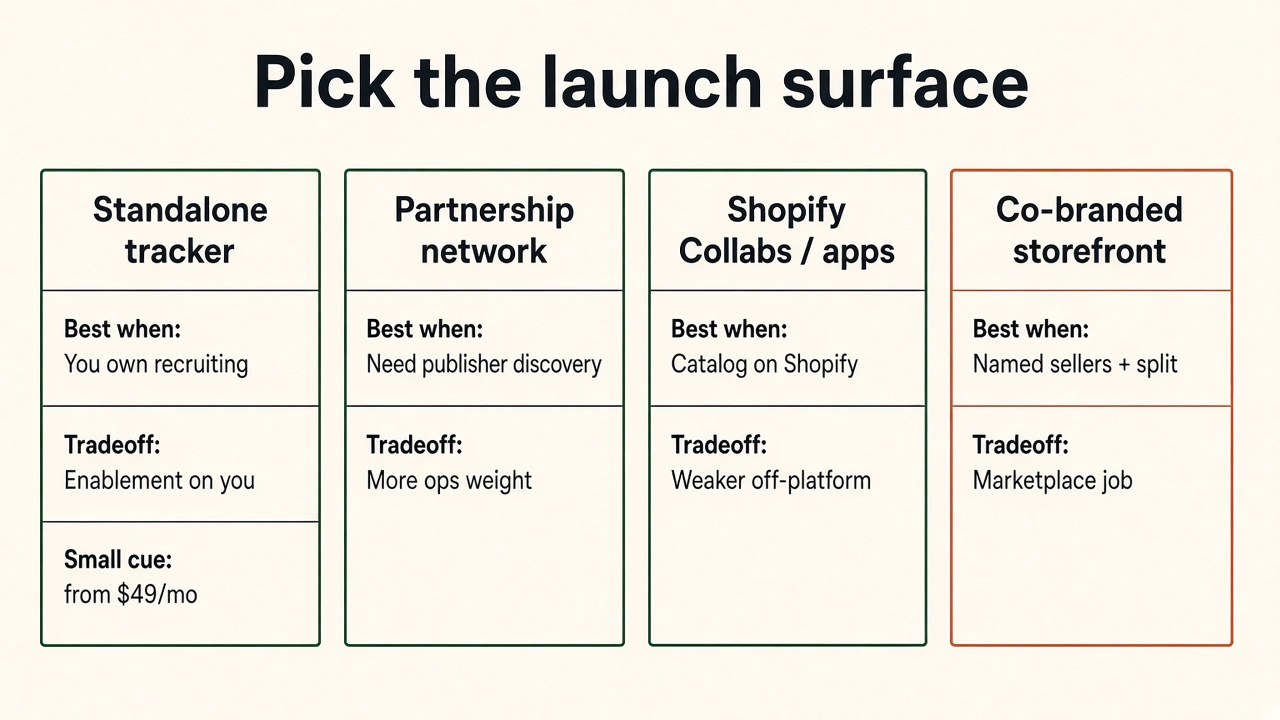
Source: Surface comparison synthesized from Rewardful pricing (accessed 2026-10-05), Shopify Collabs guidance in Shopify’s affiliate program how-to (accessed 2026-10-05), and feat. storefront positioning. https://www.rewardful.com/pricing · https://www.shopify.com/blog/53669701-how-to-set-up-an-affiliate-program-for-your-shopify-store · https://www.feat.press
Test a full click → purchase → commission → refund path with a fake partner before anyone real joins. Operators on Reddit still repeat the same failure: launch before the test purchase clears (r/HowEarnMoneyOnline Rewardful thread).
Publish terms before the first approval. Cover commission events, cookie window, prohibited promo (brand bidding, spam, misleading claims), payment schedule, refunds, termination, and the affiliate’s duty to disclose material connections. Clause depth lives on affiliate program terms of service. Disclosure language for partners lives on affiliate marketing disclosure rules. The FTC’s endorsement guidance is the public floor for clear, conspicuous disclosure of commissions (FTC).
Invite a handful of fit partners before public signup. Happy customers, niche creators already covering your category, and consultants who implement adjacent tools beat a directory blast. B2B operators on r/Affiliatemarketing say activation and co-planned content beat “resource folder and hope” (thread). Early-stage founders on r/growthmarketing describe treating affiliates as 10-15 key partners with a one-pager that shows “if a user stays 12 months, you make $X” (thread).
Keep approval intentional. LinkJolt’s 83% manual-review norm exists for a reason (LinkJolt). When you are ready to scale outreach, use the five-bucket map in how to recruit affiliates for SaaS. If your product is already listed and you want named sellers with storefronts, how to turn anyone into a seller is the adjacent feat. motion.
Instrument three meters before you celebrate roster size:
Rewardful’s funnel says most partners never clear even the middle rung (Rewardful). Add a weekly enablement ask: one asset, one first-promotion deadline, one payout FAQ. Do not raise rates for people who never promote.
Q: How long does it take to start an affiliate program for a small business? A: The software path can take hours once billing is connected. The real path is economics, terms, a test purchase, and a soft-launch roster, which usually takes days to a few weeks if you already have happy customers to invite. Do not open public signup until the test commission clears.
Q: What commission should I offer when I launch? A: Start inside a published band you can fund after refunds: Shopify’s physical 5%-15%, digital 20%-50%, or subscription 15%-30% recurring envelopes, triangulated with Rewardful’s 24.16% SaaS average and LinkJolt’s 20% median. Publish examples in dollars, not only percentages.
Q: Do I need an affiliate network on day one? A: No. Many early programs start on a standalone tracker and own recruiting. Move to a network when you need publisher discovery or B2B partner workflows you cannot staff yourself. Pick the surface for the job, not the logo count.
Q: How is starting an affiliate program different from a referral program? A: Referral programs usually reward customers for inviting friends. Affiliate programs recruit third-party promoters who already reach buyers and accept tracked performance terms. You can run both, but do not reuse the same page copy for both seats.
Q: Is an open affiliate signup enough to launch? A: Rarely. Only 1.28% of affiliates generate a sale in Rewardful’s sample, and 83% of LinkJolt campaigns review applications manually. Open signup without soft-launch enablement usually creates roster inflation, not revenue.
Starting an affiliate program is five locks before go-live: economics, surface, contract, soft-launch partners, and activation meters. Rewardful’s public sample says most programs do not survive long-term and most affiliates never sell, so treat launch as an operating system, not a plugin. When you want named promoters selling your existing offer through co-branded storefronts with a revenue split on every sale, list on feat..
Affiliate marketing for startups is an operating system—locks, cost, recruit, rates, tracking, first 100 sales, then diagnose a flat roster.
How to track affiliate sales: pick link cookie, coupon, pixel, S2S postback, or storefront checkout—then match Rewardful, Tapfiliate, or Impact.
Best affiliate programs for SaaS companies pass the Recurring Cap Test: labeled duration, cookie, seat type, payout rails—plus Rewardful’s ~24% planning band.