Affiliate Marketing for Startups: Complete Guide
Affiliate marketing for startups is an operating system—locks, cost, recruit, rates, tracking, first 100 sales, then diagnose a flat roster.
How affiliate marketing works: merchant, affiliate, buyer, tracking link, attribution window, commission, and FTC disclosure. PMA scale stats plus a founder decision stack.

TL;DR: How affiliate marketing works is simple in motion and strict in rules. A merchant pays an affiliate only when a tracked visitor completes a defined action inside an attribution window. The money moves after approval and disclosure is required when the commission is a material connection. Set the event, window, surface, and payout before you recruit anyone.
Most explanations of how affiliate marketing works stop at “share a link and earn a cut.” That sentence is true and incomplete. The channel only works when three parties share one tracked contract: merchant, affiliate, and buyer.
If you are designing a program for a digital product, SaaS plan, or creator storefront, you need the mechanics and the decisions. The seven steps below are the loop. The decision stack after them is what separates a clean program from a dispute queue.
Key takeaways:
Affiliate marketing is a performance arrangement where a merchant pays an independent partner a commission when a tracked referral completes a qualifying action.
In plain language: someone else recommends your product with a unique link or code, tracking records the referral, and you pay only when the agreed event happens. That event is usually a purchase. It can also be a lead, install, trial, or another defined acquisition.
Three roles sit inside every program:
A fourth actor often appears as infrastructure: an affiliate network or tracking platform that issues IDs, stores cookies or click IDs, calculates payouts, and runs holds. Merchants can also run programs in-house. The commercial logic does not change either way.
Affiliate marketing is not the same as paying for a sponsored post. Sponsorship buys reach on a schedule. Affiliation buys a defined outcome. The line blurs when creators run hybrids (fee plus commission), which is common and still requires disclosure. For the comparison to sponsorship and co-selling, see sponsorships vs affiliates vs co-selling.
Affiliate marketing matters because it turns distribution into a measurable cost of sale instead of a fixed media buy.
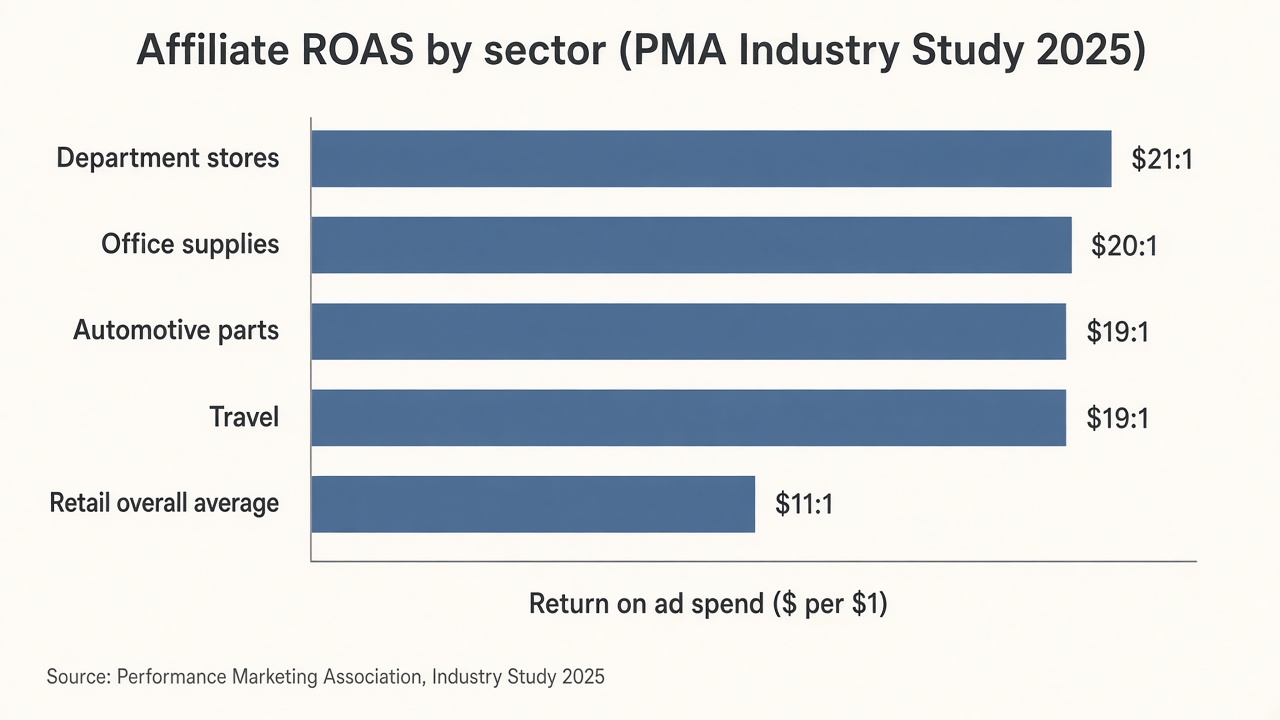
Source: Performance Marketing Association, Industry Study 2025. https://thepma.org/pma-study-affiliate-marketing-industry-grows-49-8-to-13-63-b-outpacing-e-commerce-growth-by-2x/
How affiliate marketing works is a closed loop: program terms create a tracked ID, a click starts an attribution window, a qualifying action inside that window earns commission after approval.
Shopify’s 2026 explainer maps the consumer path the same way most platforms implement it (Shopify):
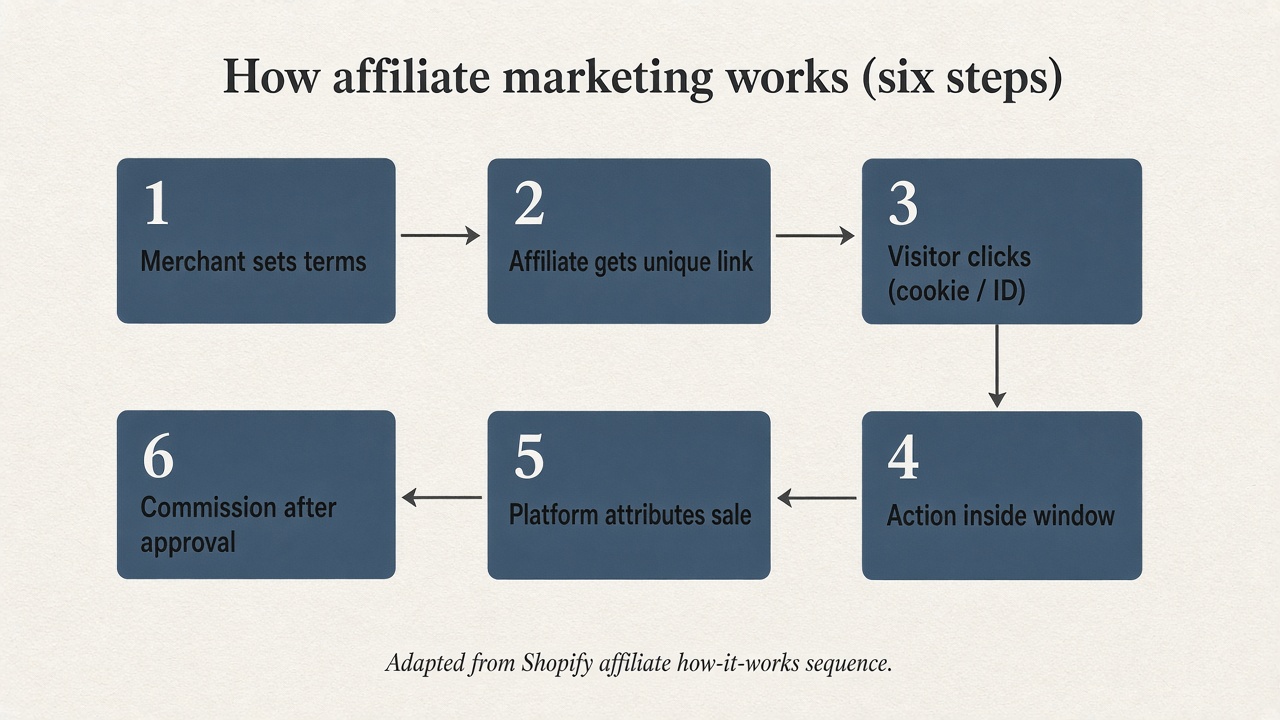
Source: Process model adapted from Shopify, Affiliate Marketing: How It Works in 2026. https://www.shopify.com/blog/affiliate-marketing
The attribution window (often called cookie duration) is the rule that decides how long a referral remains eligible for credit. Shopify notes typical program windows of 30, 60, and 90 days when merchants set up programs (Shopify program guide). Ahrefs describes 30 days as the usual framing for many programs (Ahrefs). Across listed programs, Shopify also notes cookie durations ranging from one day to 400 days (Shopify best programs).
Credit can still fail when a buyer deletes cookies, switches devices, buys after the window, or clicks a later affiliate link. Safari’s Intelligent Tracking Prevention can cap some decorated-link cookies at 24 hours, which shortens effective windows for affiliates who rely on browser cookies alone (Shopify). That is why promo codes and server-to-server tracking show up in serious programs: they reduce dependence on a single browser file.
The payout formula is not the first decision. The qualifying event is. Pay-per-sale (CPS), CPA, CPL, pay-per-click, and recurring revenue share reward different behaviors and put cash-flow risk on different balance sheets. Shopify’s published industry bands put physical goods near 5%–15%, digital products near 20%–50%, and subscriptions near 15%–30% recurring (Shopify). For the full risk-allocation matrix, use the spoke article on affiliate commission structures.
| Piece | What it answers | Common choices |
|---|---|---|
| Qualifying event | What earns money? | Sale, lead, install, activated subscription |
| Rate / formula | How much? | % of order, fixed $, recurring % |
| Attribution window | For how long after click? | 24h, 30 / 60 / 90 days, custom |
| Attribution rule | Who gets credit if multiple partners touch? | Last click (default on many networks), first click, multi-touch |
| Approval / hold | When is cash real? | Instant vs 30–60 day hold |
| Partner surface | Where does the buyer convert? | Link in content, discount code, co-branded storefront |
A raw affiliate link is the classic surface. A discount code helps when buyers land from social and check out later on another device. A co-branded storefront goes further: the creator gets a branded selling surface, not only a redirect into a generic PDP. That is still affiliate marketing in the commercial sense (tracked, performance-paid distribution). It changes the conversion surface. For why that matters on digital products, see why co-selling beats affiliate links.
Affiliate pay is a material connection under the FTC’s Endorsement Guides. Example 11 in 16 CFR 255.5 covers a blogger who earns a portion of sales through affiliate links and must disclose that compensation clearly and conspicuously (eCFR). The FTC’s FAQ suggests plain language such as “I get commissions for purchases made through links in this post,” placed close enough that the reader sees the disclosure with the recommendation (FTC FAQ). Disclosure is not optional branding. It is how the channel stays legal.
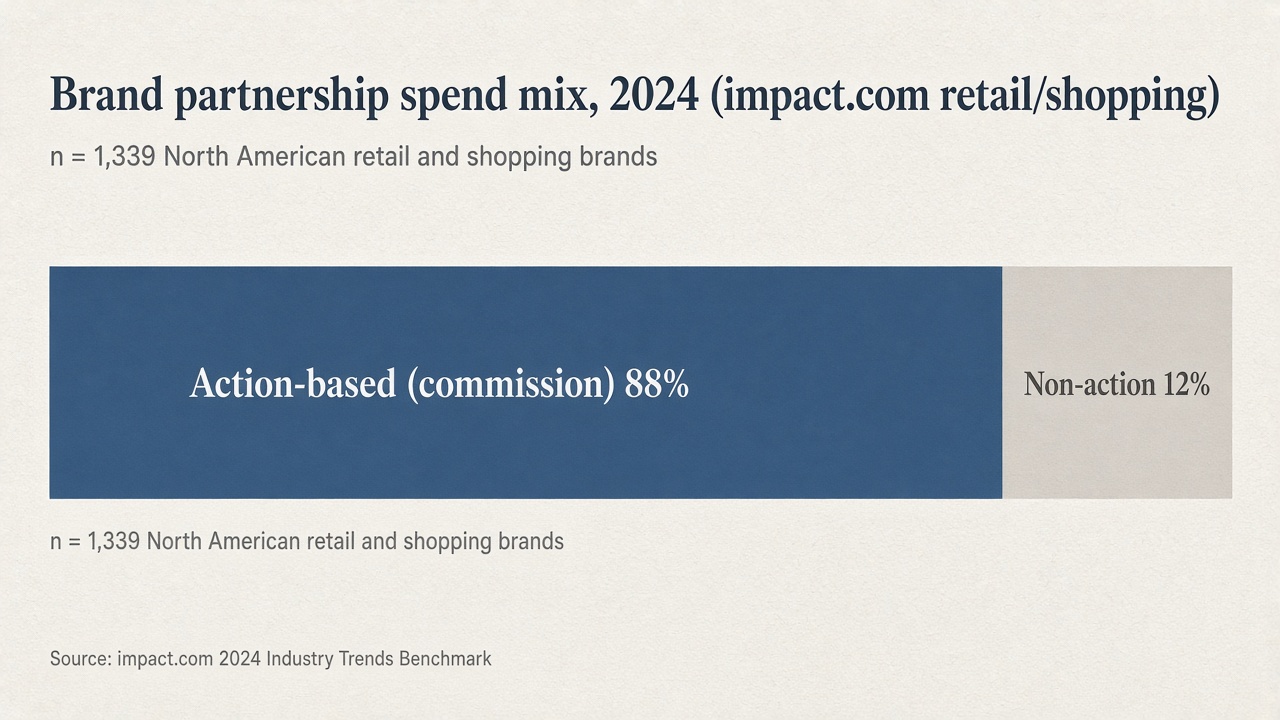
Source: impact.com, 2024 Industry Trends Benchmark (1,339 NA retail/shopping brands). https://impact.com/affiliate/research-driven-shopping-leads/
Set up affiliate marketing by writing the rules before you recruit partners, then instrument tracking, then publish offers with disclosure baked in.
If you are the affiliate, reverse the checklist: choose niches you can explain honestly, join programs whose windows and holds you can live with, and disclose every material connection near the recommendation.
Q: How does affiliate marketing work step by step? A: The merchant sets commission rules and issues a tracked link or code. The affiliate shares it. A visitor clicks, the tracker starts an attribution window, and a qualifying purchase (or other event) inside that window earns the affiliate a commission after approval.
Q: What is an affiliate attribution window? A: It is the time after a tracked click during which a conversion can still be credited to that affiliate. Typical merchant setups use 30, 60, or 90 days, though some programs use 24 hours or much longer windows (Shopify).
Q: How do affiliates get paid? A: After the platform attributes an approved conversion, the commission enters the affiliate’s balance. Many programs hold payouts 30–60 days to cover returns and chargebacks, then pay via the network’s method (bank, PayPal, or similar) (Shopify).
Q: Is affiliate marketing the same as influencer marketing? A: No. Affiliate marketing pays for a tracked outcome. Influencer marketing usually pays upfront for reach and content. The same creator can do both, often as a hybrid fee-plus-commission deal, and still must disclose material connections.
Q: Do affiliates have to disclose commissions? A: Yes when the payment is a material connection audiences would not reasonably expect. U.S. FTC guidance requires clear, conspicuous disclosure; “I get commissions for purchases made through links in this post” is an example of plain-language wording (FTC FAQ).
How affiliate marketing works is not a mystery. It is a tracked contract: unique ID, attribution window, qualifying event, approval, payout, disclosure. The channel is large enough that PMA’s 2025 study tied $13.62B in 2024 U.S. spend to $113B in e-commerce sales. Your program still lives or dies on the decisions you write before the first click.
If you built a product and want creators selling it through co-branded storefronts with a revenue split on every sale, start at feat..
Affiliate marketing for startups is an operating system—locks, cost, recruit, rates, tracking, first 100 sales, then diagnose a flat roster.
How to track affiliate sales: pick link cookie, coupon, pixel, S2S postback, or storefront checkout—then match Rewardful, Tapfiliate, or Impact.
Best affiliate programs for SaaS companies pass the Recurring Cap Test: labeled duration, cookie, seat type, payout rails—plus Rewardful’s ~24% planning band.