Affiliate Marketing for Startups: Complete Guide
Affiliate marketing for startups is an operating system—locks, cost, recruit, rates, tracking, first 100 sales, then diagnose a flat roster.
Affiliate program terms of service for merchants: clauses for commissions, cookies, prohibited promo, FTC disclosure duty, chargebacks, and exit.

TL;DR: Affiliate program terms of service are the merchant’s operating agreement with promoters. They define commissions, attribution, prohibited methods, FTC disclosure duties, chargebacks, fraud, and termination. A Notion FAQ is not enough. This is compliance education, not legal advice.
Most “affiliate programs” launch with a rate and a tracking link. Then a coupon site bids on your brand, a chargeback reverses a paid commission, and nobody can point to a signed rule. The argument is not about loyalty. It is about missing definitions.
Affiliate program terms of service are how merchants make the program operable before the first payout. Pair this hub with affiliate marketing disclosure rules, affiliate commission structures, how to negotiate affiliate commission rates, affiliate fraud and how to detect it, affiliate link cloaking and tracking explained, and sub-affiliate and multi-tier programs explained.
Affiliate program terms of service are the binding rules between a merchant (advertiser) and each affiliate that govern enrollment, how commissions are earned and paid, which promotions are allowed, how tracking works, compliance duties including disclosure, and how either side exits. They are often published as a clickwrap page and accepted at signup.
iRev distinguishes the commercial agreement from the public disclosure statement affiliates show audiences, and from influencer or customer-referral contracts that solve different jobs (iRev). Newsletter insertion orders bind a publisher and a sponsor for a dated placement. Affiliate TOS bind a merchant and many promoters for ongoing tracked sales.
If you only publish rates without definitions for net revenue, refunds, and brand bidding, you will renegotiate every dispute from scratch. Counsel should review any production document before you rely on it.
Terms matter because affiliate economics are definition-heavy from day one. Words like “sale,” “new customer,” and “net revenue” decide who gets paid after a refund hits finance. Without written rules on paper, chargebacks and coupon hijacks become relationship fights instead of contract operations.
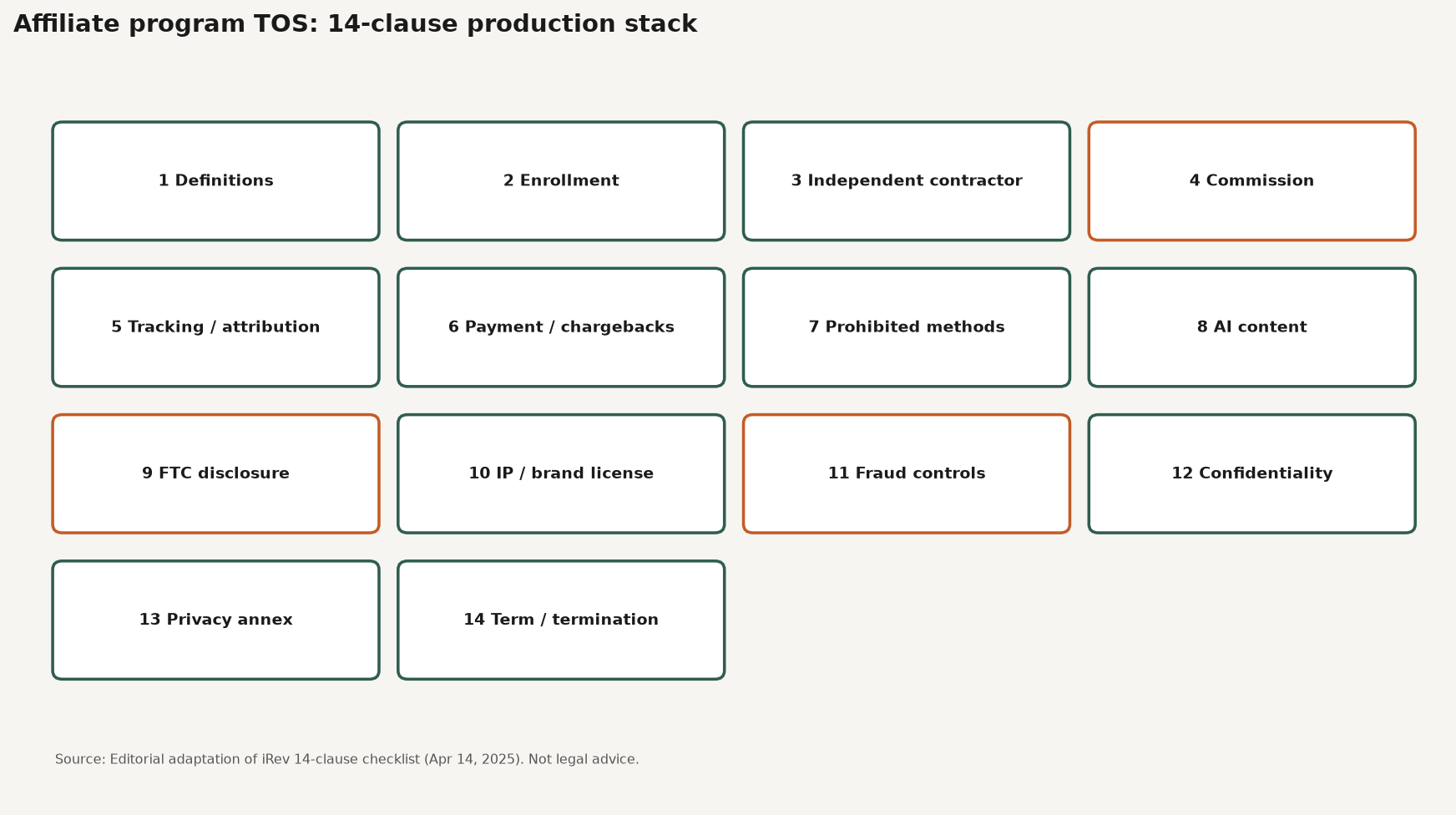
Source: Editorial framework adapted from iRev’s 14-clause affiliate agreement checklist (Apr 14, 2025). https://irev.com/blog/creating-terms-and-conditions-for-affiliate-program-agreement/ Not legal advice.
Affiliate program terms work as a clause stack you accept at enrollment, then apply at payout and termination. Definitions do the heavy lifting. Commercial clauses reference those definitions. Compliance clauses make disclosure and brand safety enforceable. Exit clauses end the relationship without a forum fight.
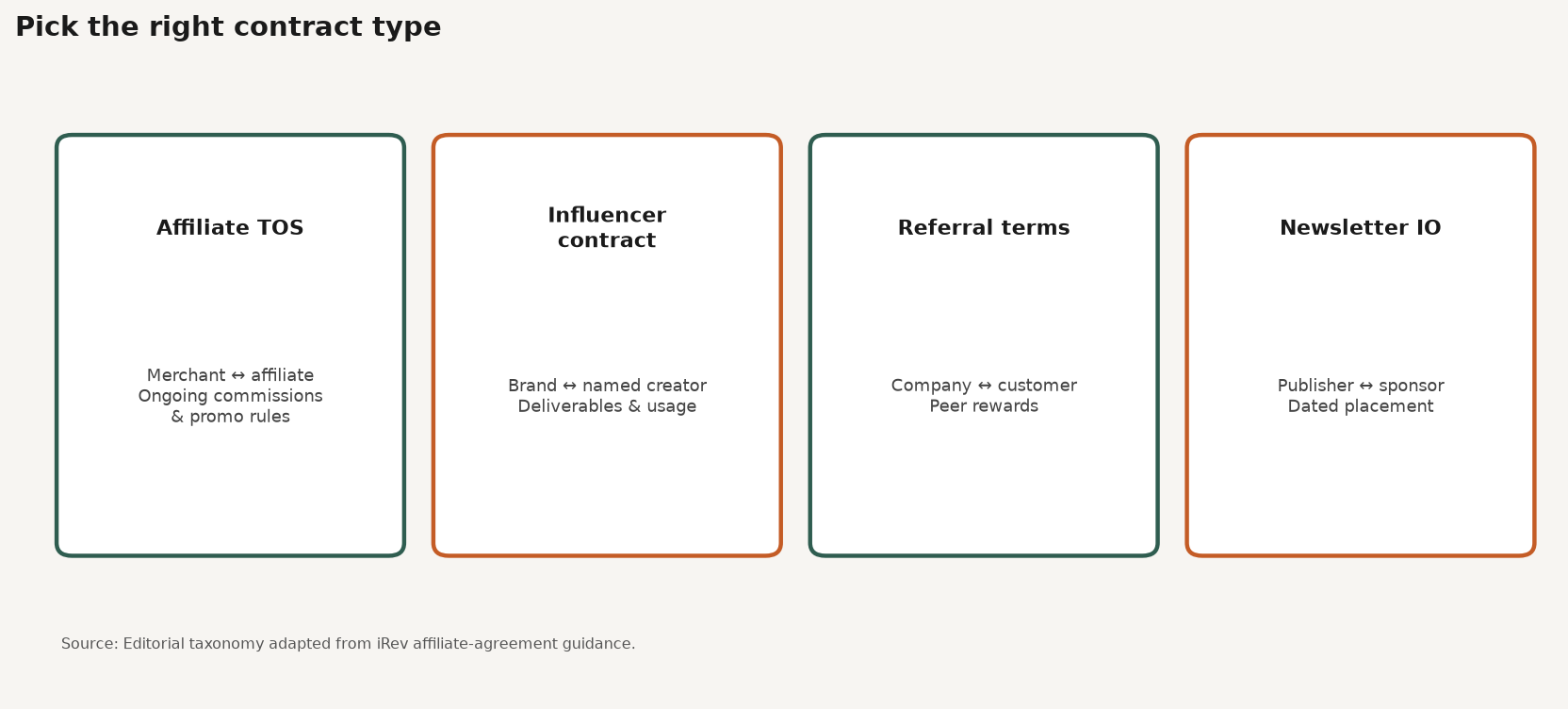
Source: Editorial comparison adapted from iRev document-taxonomy guidance. https://irev.com/blog/creating-terms-and-conditions-for-affiliate-program-agreement/
| Document | Parties | Primary job |
|---|---|---|
| Affiliate program TOS / agreement | Merchant ↔ affiliate | Ongoing commissions, tracking, promo rules, compliance |
| Influencer / creator contract | Brand ↔ named creator | Deliverables, usage, exclusivity, fees for content |
| Referral / customer advocacy terms | Company ↔ customer | Rewards for referring peers; usually not media buying |
| Newsletter sponsorship IO | Publisher ↔ sponsor | Dated placement, price, kill fee (IO guide) |
Borrowing a referral template for media buyers, or an influencer exclusivity pack for open affiliates, is how programs stall at signup (iRev).
iRev’s Apr 14, 2025 guide lists 14 must-have clauses for a production affiliate agreement. Treat the list as an editorial checklist for counsel, not as statute (iRev).
| # | Clause group | What it must settle |
|---|---|---|
| 1 | Definitions | Qualified sale, net revenue, customer vs new customer, affiliate link, territory |
| 2 | Enrollment / eligibility | Approval rights, geo limits, prohibited verticals |
| 3 | Independent contractor | Affiliates are not employees or agents |
| 4 | Commission structure | Rate, tiers, what “net” excludes; notice for rate changes (structures) |
| 5 | Tracking / attribution | Last-click or other model, cookie or S2S window, platform data as settlement source |
| 6 | Payment, holds, chargebacks | Validation hold, minimum payout, schedule, post-pay reversals |
| 7 | Prohibited methods | Brand bidding, coupon hijacking, toolbars, incentivized spam, stuffing |
| 8 | AI / synthetic content | Whether AI-assisted promo is allowed and under what review |
| 9 | FTC disclosure and compliance | Clear disclosure duty; merchant monitoring rights (disclosure) |
| 10 | IP / brand license | Limited logo use; takedown window after termination |
| 11 | Fraud controls | Definitions matching your detection stack; withhold pending investigation (fraud) |
| 12 | Confidentiality | Rates, conversion data, customer data ownership; survival |
| 13 | Data / privacy annex (when needed) | Cookie consent, GDPR/CCPA handling where applicable |
| 14 | Term, termination, liability, law | Notice period, pending commissions, governing law |
iRev also describes a short-form one-pager (parties, commission, tracking, prohibited methods, termination) for a scramble launch, then the full 14-clause document for production (iRev). Placeholders they show for planning, such as a hold around 30 days, a $100 minimum payout example, or 7 days’ termination notice, are samples to replace with your real numbers. They are not official industry medians. There is no public dataset that certifies one correct cookie length for every niche.
The FTC FAQ states advertisers need reasonable programs to train and monitor network members. Scope depends on risk (for example health claims need more supervision than fashion). Elements every program should include: explain what affiliates can and cannot say; tell them how to disclose; monitor; and follow up when they fail (FTC FAQ).
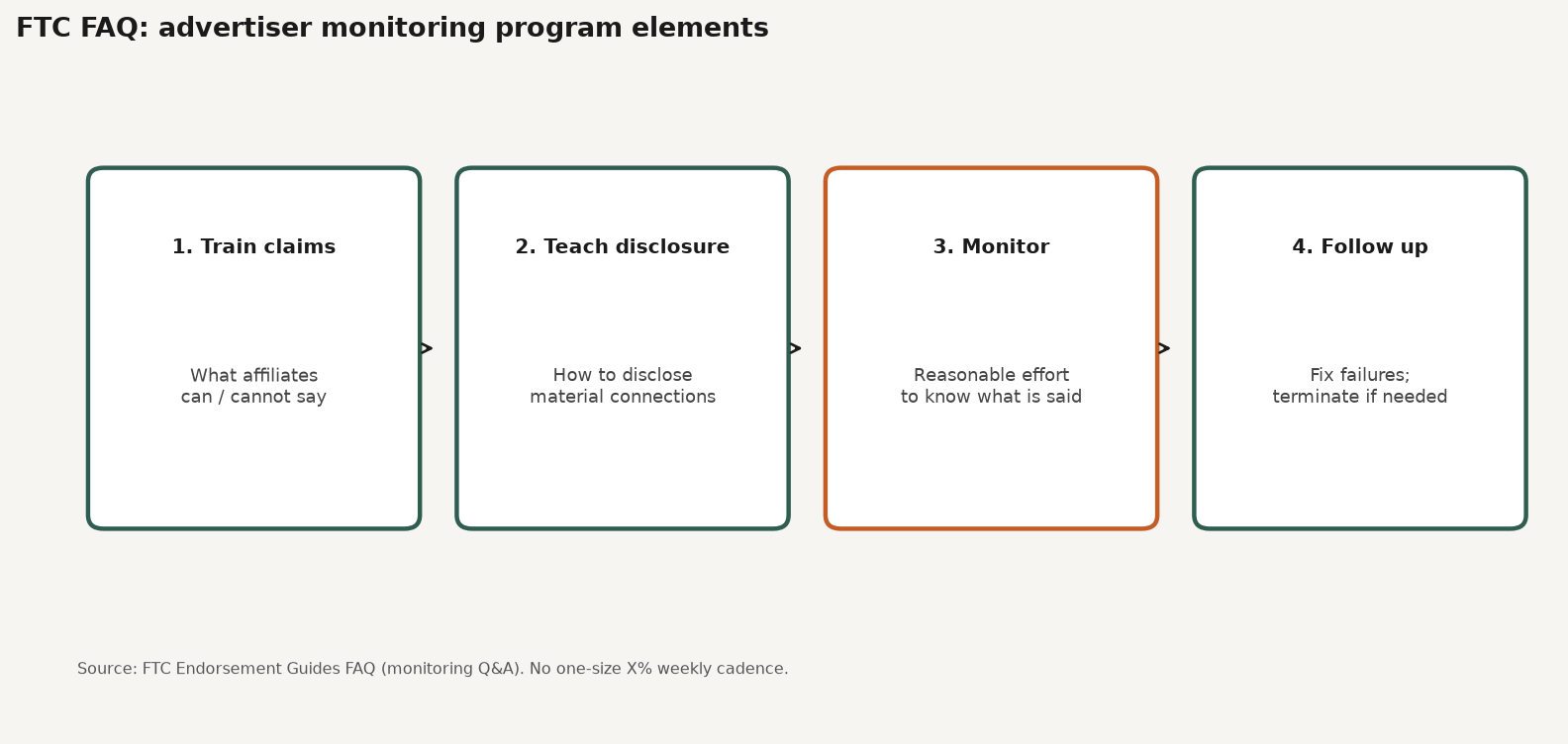
Source: FTC, Endorsement Guides: What People Are Asking (advertiser monitoring Q&A). https://www.ftc.gov/business-guidance/resources/ftcs-endorsement-guides-what-people-are-asking
Staff also say there is no one-size-fits-all cadence like “monitor X% every week.” If regular monitoring is impossible, consider pre-approval. Ephemeral Stories-style posts may require pre-approval because real-time monitoring is impractical (FTC FAQ). Put those rights and duties in the TOS, then actually run the program. An unenforced disclosure clause is a paper shield.
Point the commission clause at your published structure: percentage of net, flat CPA, recurring, or hybrid (commission structures; recurring vs one-time). Define net revenue exclusions (taxes, shipping, refunds, discounts, processor fees) so “X%” is not a surprise.
For attribution, name the model and the window your stack can prove. Browser cookie limits make over-promised windows a breach waiting to happen (cloaking and tracking). If you negotiate custom rates for top partners, keep the public TOS as the default and put overrides in a signed schedule (negotiate rates).
Shipping affiliate program terms is an ops launch job, not a blog post. Draft the clause stack, align numbers with your tracking stack, add FTC monitoring rights, have counsel review, then require clickwrap acceptance before any affiliate links go live.
These answers cover the merchant questions that show up first: what affiliate program terms of service are, which clauses matter, how TOS differs from a disclosure statement, how FTC monitoring fits, and whether a one-page email is enough. This is not legal advice.
Q: What are affiliate program terms of service? A: They are the binding rules between a merchant and each affiliate covering enrollment, commissions, tracking, allowed promotions, compliance (including disclosure), fraud, and termination. Affiliates usually accept them as clickwrap when they join the program.
Q: What clauses belong in affiliate program terms? A: A production checklist often includes definitions, enrollment, independent-contractor status, commission, tracking, payment and chargebacks, prohibited methods, AI content rules, FTC disclosure, IP license, fraud, confidentiality, privacy annexes when needed, and termination. iRev publishes a 14-clause version of that stack as an editorial guide for counsel.
Q: How is the TOS different from an affiliate disclosure? A: The TOS is the contract between merchant and affiliate. The disclosure is what the affiliate shows the audience about the paid relationship. The TOS should require that disclosure. Audience-facing wording guidance lives on affiliate marketing disclosure rules.
Q: Do merchants have to monitor affiliates under the FTC Guides? A: The FTC FAQ says advertisers need reasonable programs to train and monitor their networks, with scope based on risk. There is no single required percentage cadence. Put monitoring and remedy rights in the TOS, then actually use them.
Q: Can I launch with a one-page affiliate agreement? A: iRev describes a short-form one-pager (parties, commission, tracking, prohibited methods, termination) for a fast launch, then a full clause stack for production. Either way, undefined net revenue and silent chargeback rules create payout fights. Have counsel review before you scale payouts.
Affiliate program terms of service are the operating agreement that turns rates, cookies, and disclosure duties into enforceable onboarding. Draft the clause stack, match attribution promises to your stack, reserve monitoring rights, and require acceptance before links ship. If you want creators to sell a product you built under clear program rules, list it on feat..
Affiliate marketing for startups is an operating system—locks, cost, recruit, rates, tracking, first 100 sales, then diagnose a flat roster.
How to track affiliate sales: pick link cookie, coupon, pixel, S2S postback, or storefront checkout—then match Rewardful, Tapfiliate, or Impact.
Best affiliate programs for SaaS companies pass the Recurring Cap Test: labeled duration, cookie, seat type, payout rails—plus Rewardful’s ~24% planning band.