Affiliate Marketing for Startups: Complete Guide
Affiliate marketing for startups is an operating system—locks, cost, recruit, rates, tracking, first 100 sales, then diagnose a flat roster.
How to recruit affiliates for SaaS: five partner buckets, PartnerStack 43% vs 3% earners, Rewardful 1.28% sale activation, Hunter.io outbound case.

TL;DR: How to recruit affiliates for SaaS means intentional outreach into fit partner buckets, not a footer signup page. Rewardful finds only 1.28% of affiliates generate a sale. PartnerStack Network partners earn commissions at 43% vs 3% outside the Network. Pair buckets with outbound and manual vetting.
A live application form is not a recruitment system. Most SaaS programs launch tracking, paste a footer link, and wait. Then they wonder why the roster grows while attributed MRR stays flat. Waiting is not a channel. It is a hope with a dashboard.
How to recruit affiliates for SaaS is the motion that fills a program with partners who already reach your buyers, then gets them to a first tracked promotion. Rate bands live on SaaS affiliate commission rates. Event types live in affiliate commission structures. Duration lives in recurring vs one-time. Identity forks live in affiliate vs referral. This page owns SaaS partner buckets and how you ask. General-product recruit order lives on how to recruit affiliates for your product. Program go-live locks live on how to start an affiliate program for your business.
Recruiting affiliates for SaaS means identifying partner types that already reach your buyers, inviting them with clear economics, approving the fit ones, and enabling a first promotion, instead of waiting for strangers to discover a signup page and never promote.
It is sales for partnerships. Passive discovery (footer, directories, product mentions) still matters. It is incomplete. Founders on r/SaaS already name the fork in plain language: passive versus active (thread). Active means you choose who hears about the program first.
Recruitment is also not the same job as setting the percentage. If you have not triangulated Rewardful’s 24.16% average, LinkJolt’s 20% median, and PartnerStack’s 20 / 25 / 30 top offers, fix that on the rates article before you cold-email creators with a made-up number.
SaaS affiliate recruitment matters because enrollment without fit produces dormant accounts, and fit without outreach leaves your best partners on competing programs. The activation math is brutal enough that roster vanity becomes an expensive hobby for any merchant who confuses signups with sales.
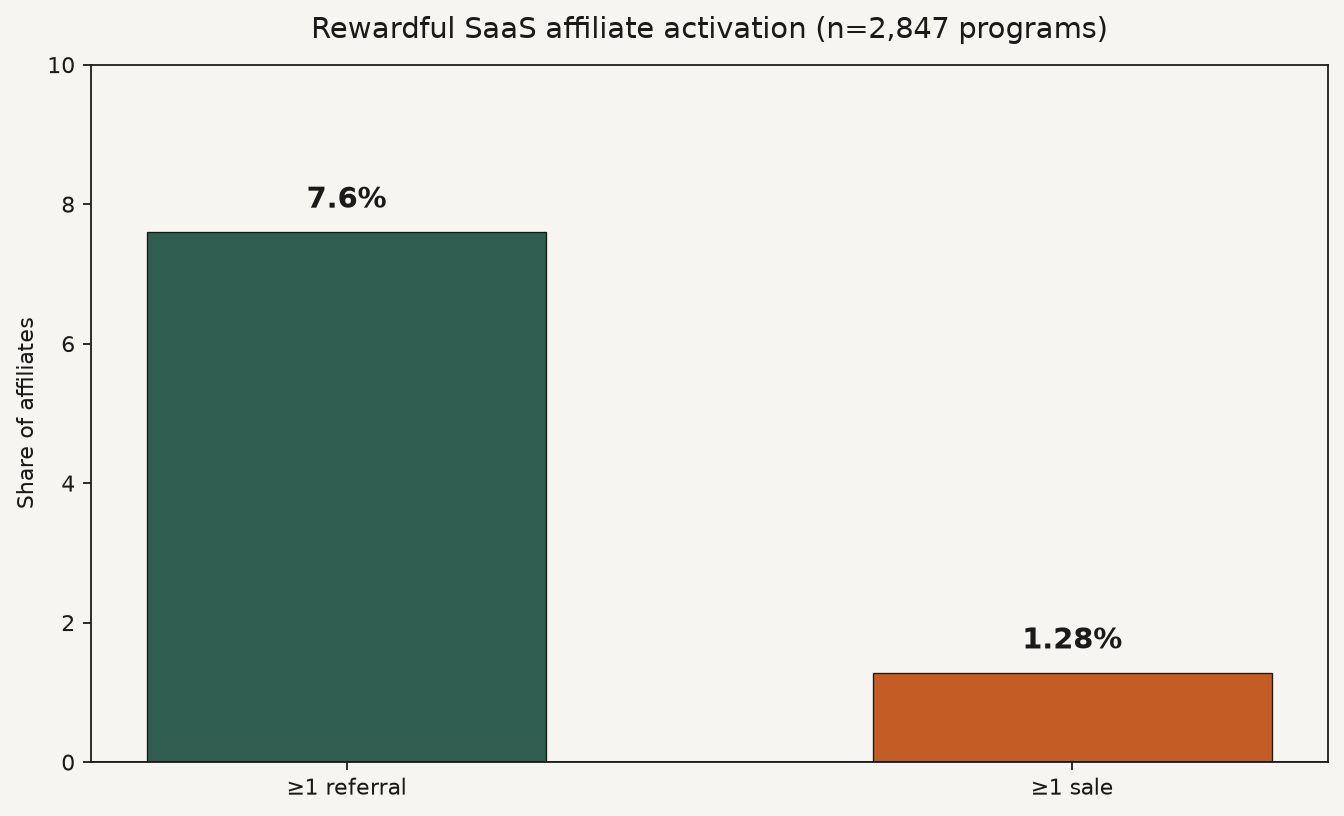
Source: Rewardful State of SaaS Affiliate Programs Report (updated July 21, 2026), analysis of 2,847 SaaS affiliate programs. https://www.rewardful.com/articles/state-of-saas-affiliate-programs-report
How to recruit affiliates for SaaS works as a five-bucket target map, then a repeatable invite and enable loop. Name who already reaches your ICP. Pitch economics in one screen. Approve for fit. Ship assets and a first-promotion ask. Measure active partners, not total signups.
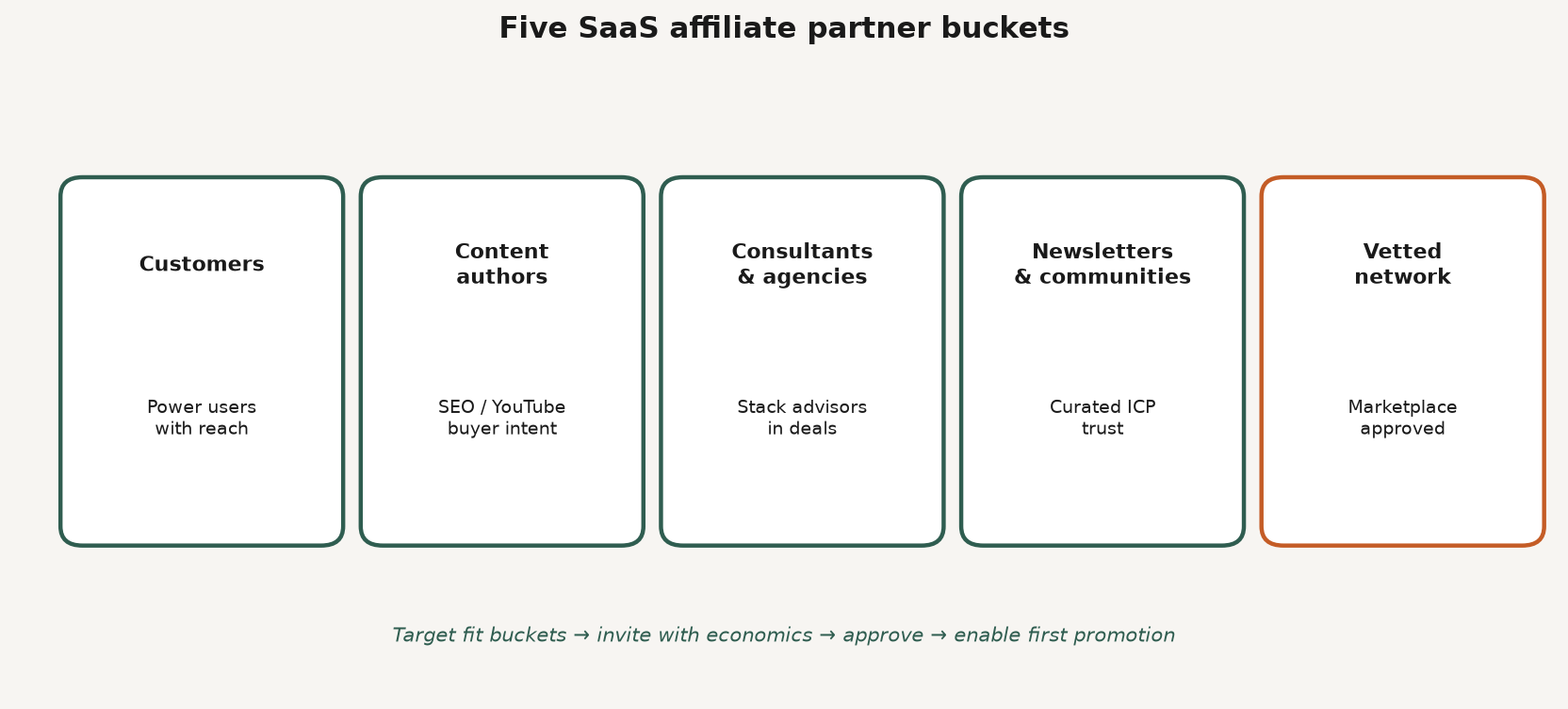
Source: Editorial five-bucket recruitment framework synthesized from SaaS operator vernacular (r/SaaS) and partner-type mixes discussed in PartnerStack Network commentary. Taxonomy diagram; no invented bucket conversion rates. https://www.reddit.com/r/SaaS/comments/1n77rpy/how_to_find_affiliates_that_actually_work_for/
| Bucket | Who | Why they convert | How you find them | Risk if unmanaged |
|---|---|---|---|---|
| Happy customers | Power users with a list, podcast, or community | They already trust the product | In-app invite, onboarding P.S., support tickets from advocates | Coupon-first asks without brand rules |
| SEO / content authors | Bloggers and YouTubers ranking for buyer queries | They own commercial intent traffic | “[Competitor] alternatives,” “best [category]” SERPs, competitor backlinks | Thin listicles that chase every tool |
| Consultants / agencies | Implementers who recommend stacks to clients | They influence purchase in sales cycles | LinkedIn, agency directories, integration partner lists | Slow cycles; needs co-sell assets |
| Newsletters / communities | Curators with concentrated ICP trust | High trust, lower volume, often high intent | Newsletter indexes, Slack/Discord admins, niche forums | Flat-fee sponsorship asks instead of CPS |
| Vetted network partners | Marketplace or Network-approved publishers | Pre-filtered for activity on the platform | PartnerStack Network, similar marketplaces | Volume without brand fit if auto-join is open |
PartnerStack’s public Network chart is the quality evidence for the last row: 43% of Network-approved partners earn a commission versus 3% of non-Network partners (PartnerStack).
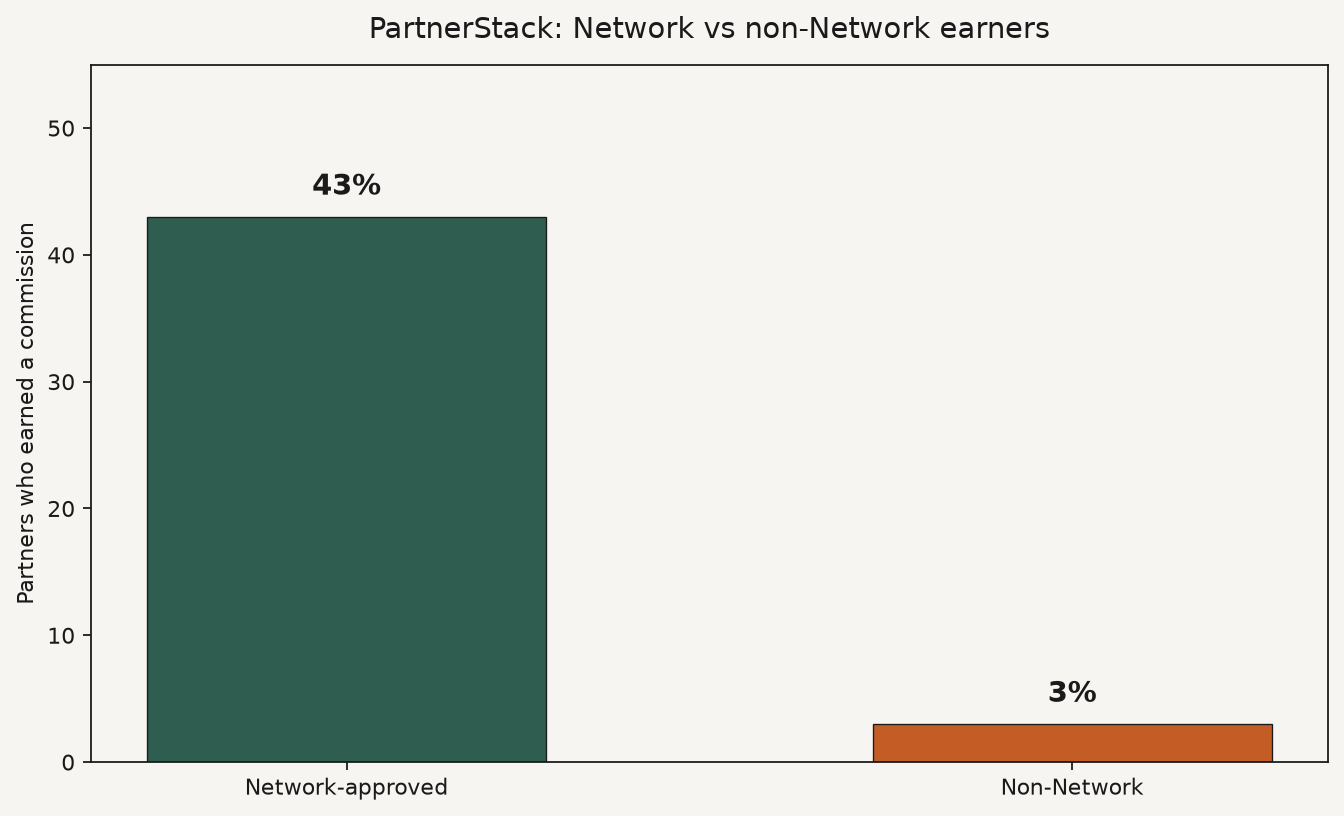
Source: PartnerStack Research Lab, May 2024. https://partnerstack.com/resources/research-lab/charts/partnerstack-network-approved-partners-are-far-more-likely-to-earn-a-commission-compared-to-non-network-partners
A PartnerStack operator commentary also describes Network mix near 43.4% channel, 33.9% referral, and 22.7% performance marketing (LinkedIn). Use that as vernacular for partner variety, not as a chart you invent for your own niche.
Passive is the always-on layer: affiliate page in nav or footer, product dashboard link, onboarding P.S., and listings in “best affiliate programs for [niche]” pages. Reddit operators keep rediscovering this because it is cheap and real (r/SaaS). It will not replace outbound to creators who already monetize competitors.
Hunter.io’s playbook (hosted on Rewardful) is the clearest public operator case for SaaS outbound recruit. They define an ideal affiliate profile from existing converters, enrich contacts, build lookalike lists, and run personalized sequences. Reported results: affiliate revenue 10x, outbound >50% of affiliate revenue, average response rates around 15% combining email and LinkedIn, and an early test campaign at 7.8% reply built in about thirty minutes (Rewardful / Hunter).
Treat those figures as one company’s labeled experiment. Do not invent a universal cold-email reply median for SaaS affiliates. Steal the process shape: profile from winners, list from competitor promoters and ranking authors, pitch with economics and audience fit, follow up once, then enable.
Lead with why their audience matches, then put commission, cookie or attribution window, and payout shape in one screen. Hunter’s own affiliate templates push the same honesty: rate, average order context, and cookie window up front (Hunter templates). Vague “join our partner program” emails train busy creators to ignore you.
Point to your published band. Shopify still frames subscription services near 15%-30% recurring as a planning envelope (Shopify). Your exact offer should sit inside the samples on SaaS commission rates, not above every dataset with a hope.
Manual review matches the LinkJolt sample (83%). Check audience overlap, brand risk, and whether they already promote a competitor you can displace with a clearer offer. Then remove friction: deep link ready, two swipe drafts, one comparison angle, product access, and a direct contact for the first post. Activation fails when onboarding is a login URL and silence.
| Metric | Why it matters | What “good” looks like in public samples |
|---|---|---|
| Active partners (≥1 referral) | Separates roster vanity from traffic | Rewardful baseline: 7.6% of affiliates |
| Partners with ≥1 sale | Revenue reality | Rewardful baseline: 1.28% |
| Referral-to-sale CVR | Traffic quality | Rewardful: 0.8% |
| Share of revenue from outbound recruits | Proves the motion | Hunter labeled case: outbound >50% |
| Manual approve rate / reject reasons | Protects brand | LinkJolt: 83% review manually |
There is no public dataset that publishes official first-sale rates by the five buckets above for every SaaS category. Until you have your own cohort math, use Rewardful and PartnerStack as constraints, not as promises.
Refuse TrackRev (or similar) activation quartile tables as your primary census when methodology is a mashup of secondary reports. Refuse invented reply rates by niche. Refuse feat. proprietary recruit conversion claims that were not supplied as a dataset in this project.
A thirty-day sprint turns recruitment into a calendar, not a mood. Build the offer and buckets first. Invite customers and ranking authors next. Approve fast. Enable first promotions in the same week. Measure active partners before you scale cold-email volume.
These answers cover the long-tail questions SaaS founders ask after they stop waiting for empty footer signups: where to find partners, whether to auto-approve applications, how long revenue takes, and why raising commission is not the same job as recruiting.
Q: How do I recruit affiliates for a SaaS product with no audience of my own? A: Start with SEO authors already ranking for your category and consultants who implement adjacent tools. Your brand audience is nice. Their audience is the channel. Pair competitor-promoter lists with a clear CPS offer and fast enablement.
Q: What is the best way to find affiliates for SaaS? A: Map five buckets (customers, content authors, consultants, communities, vetted network partners), then run outbound to the first four and marketplace discovery for the fifth. Footer links help. They do not replace intentional invites.
Q: Should I auto-approve every SaaS affiliate application? A: Usually no. LinkJolt’s September 2026 sample shows 83% of campaigns review applications manually. Open signup inflates dormancy when only 1.28% of affiliates generate a sale in Rewardful’s data.
Q: How long does SaaS affiliate recruitment take before revenue shows? A: Expect weeks for first promotions and longer for stable MRR. Hunter.io’s labeled case shows outbound can become the majority of affiliate revenue after a deliberate shift, not after a weekend blast. Measure active partners monthly.
Q: Is recruiting affiliates the same as raising the commission rate? A: No. Rate is a recruiting headline inside published bands. Recruitment is who you invite and how you activate them. Fix fit and enablement before you pay more to a dormant roster.
How to recruit affiliates for SaaS is a bucket map plus an invite loop, judged by partners who promote, not by signup counts. Use PartnerStack’s 43% vs 3% contrast and Rewardful’s 1.28% sale rate as constraints; treat Hunter’s 10x outbound story as a labeled playbook. List on feat. if builders should recruit creators through co-branded storefronts.
Affiliate marketing for startups is an operating system—locks, cost, recruit, rates, tracking, first 100 sales, then diagnose a flat roster.
How to track affiliate sales: pick link cookie, coupon, pixel, S2S postback, or storefront checkout—then match Rewardful, Tapfiliate, or Impact.
Best affiliate programs for SaaS companies pass the Recurring Cap Test: labeled duration, cookie, seat type, payout rails—plus Rewardful’s ~24% planning band.