Affiliate Marketing for Startups: Complete Guide
Affiliate marketing for startups is an operating system—locks, cost, recruit, rates, tracking, first 100 sales, then diagnose a flat roster.
SaaS affiliate commission rates: Rewardful 24.16% average, LinkJolt 20% median, PartnerStack top offers 20-30%, and why activation beats rate alone.

TL;DR: SaaS affiliate commission rates cluster near 20-30%. Plan with three labeled samples: Rewardful average 24.16% (n=2,847), LinkJolt median 20% (n=121, Sep 2026), and PartnerStack top offers 20% / 25% / 30%. Rate alone rarely wins when only 1.28% of affiliates generate a sale.
Copying a competitor’s footer percentage is not a commission strategy. Underpaying starves recruitment. Overpaying turns every sticky customer into a permanent tax. The useful question is which public samples you trust, and what else has to work after the rate is set.
SaaS affiliate commission rates are the percentage (or bounty) a software merchant pays partners for tracked paid conversions. This page owns the rate-setting samples. Event types live in affiliate commission structures. Duration (one-time vs capped vs lifetime) lives in recurring vs one-time. Split math and activation funnels also show up in revenue split models and affiliate vs referral. Pair cookie windows with attribution windows.
SaaS affiliate commission rates are the payout terms a software company publishes for partners who drive tracked paying customers: usually a percentage of subscription revenue, sometimes a flat bounty per qualified sale, and often a recurring share for a defined term.
They are not Amazon category percentages, and they are not TikTok Shop seller-set catalog rates. Those surfaces have their own articles (Amazon Associates rates; TikTok Shop affiliate). SaaS rates sit closer to digital and subscription bands in Shopify’s taxonomy, and closer to partner-network offers on stacks like PartnerStack and Stripe-connected tools like Rewardful.
Founders on r/SaaS often talk as if 30% recurring is “the” indie standard and 20% is ignored (thread). That is useful vernacular. It is not a census. The platform samples below are what you put in a board memo.
SaaS affiliate commission rates matter because the percentage is the recruiting headline, the payout shape is the cash liability, and neither fixes a program where almost nobody promotes. Get the sample wrong and you negotiate from vibes. Ignore activation and you raise rates forever without revenue.
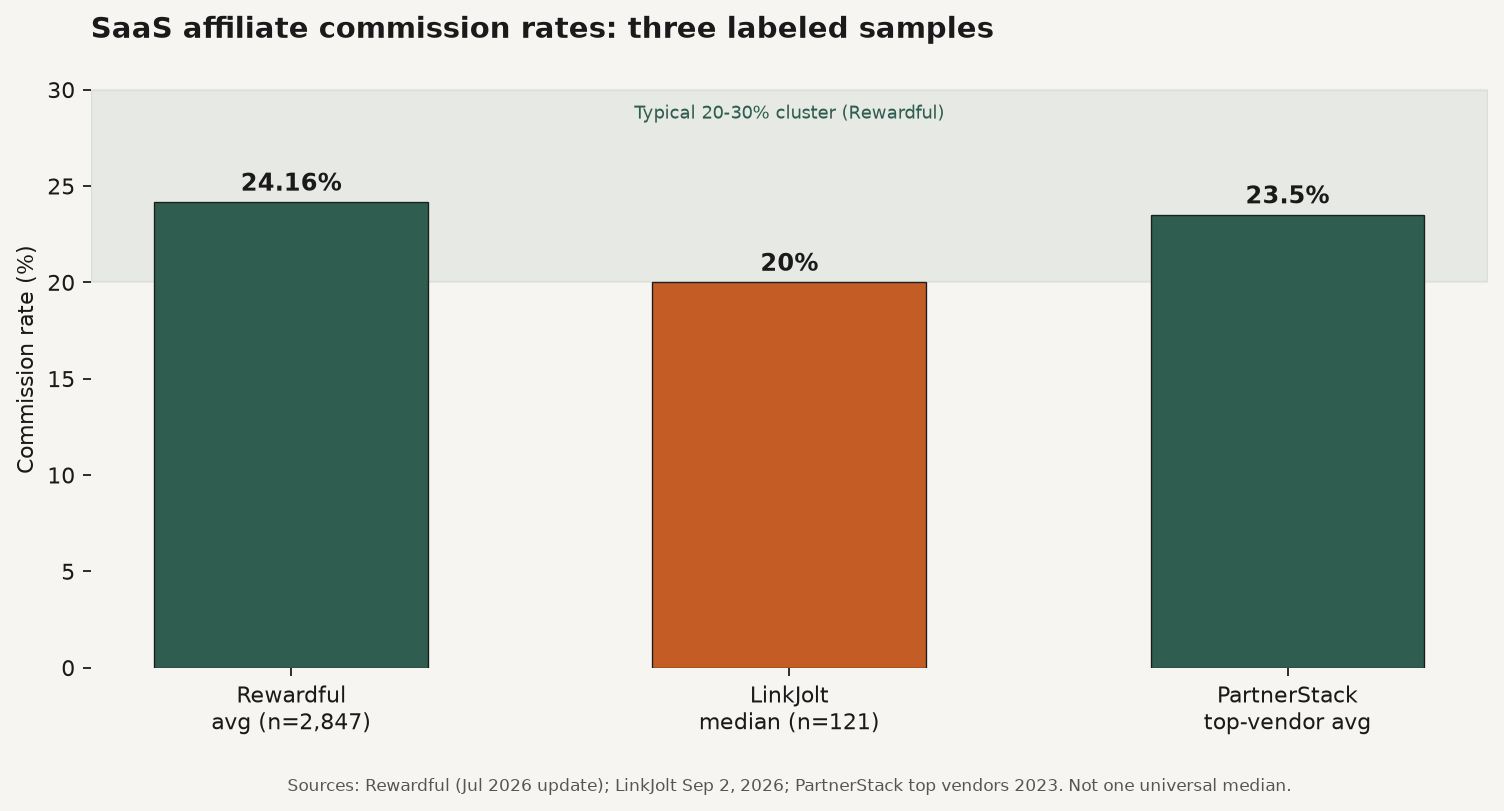
Source: Rewardful State of SaaS Affiliate Programs (updated July 21, 2026), https://www.rewardful.com/articles/state-of-saas-affiliate-programs-report; LinkJolt SaaS Affiliate Benchmarks (Sep 2, 2026 snapshot), https://www.linkjolt.io/saas-affiliate-benchmarks; PartnerStack Research Lab (top vendors, 2023; chart March 2024), https://partnerstack.com/resources/research-lab/charts/high-performing-vendors-tend-to-offer-20-25-for-commissions. Labeled samples, not one universal median.
SaaS affiliate commission rates work as a published percentage or bounty on a qualifying paid event, optionally repeating on renewals, inside a cookie window and refund hold. You pick a competitive band from labeled samples, choose percentage versus bounty, decide recurrence, then measure activation before you blame the rate.
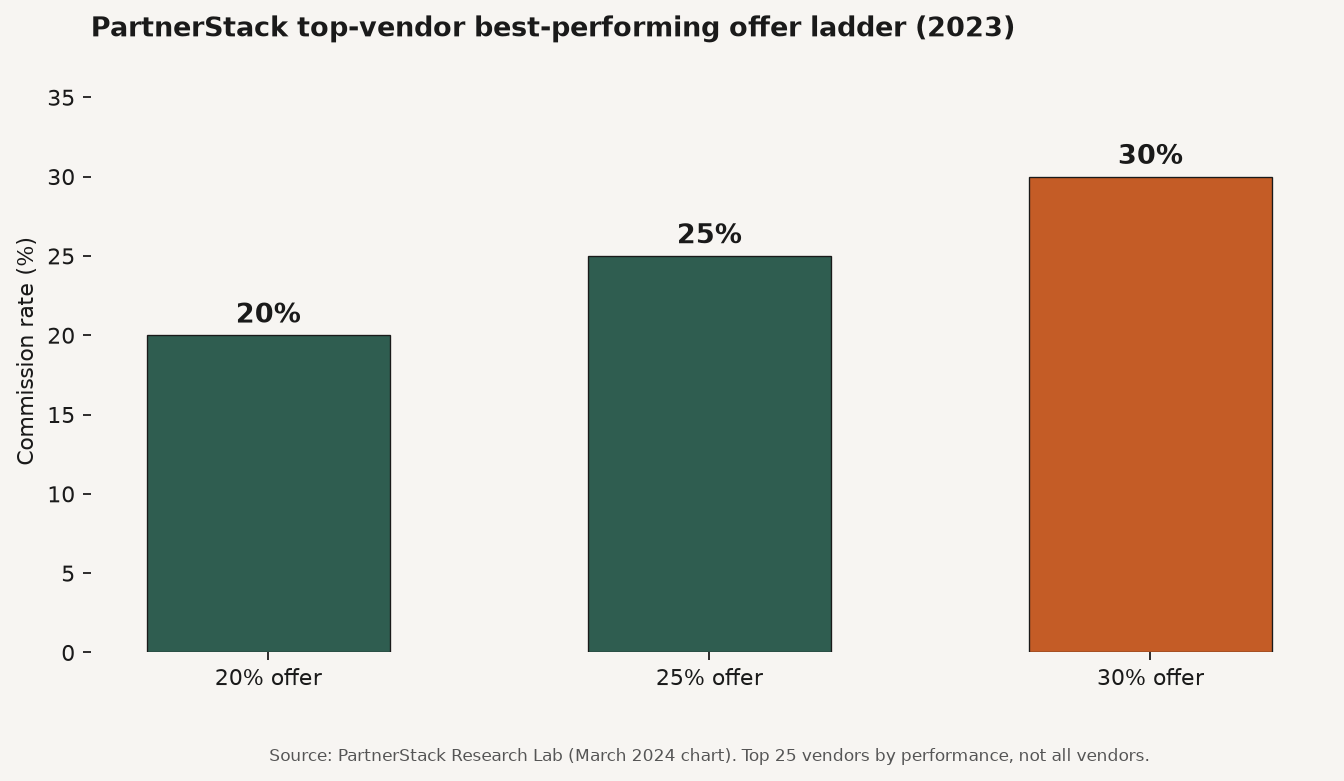
Source: PartnerStack Research Lab, top 25 highest performing vendors (2023 data; chart published March 2024). https://partnerstack.com/resources/research-lab/charts/high-performing-vendors-tend-to-offer-20-25-for-commissions
| Sample | What it measures | Headline rate | Structure notes | Limits |
|---|---|---|---|---|
| Rewardful State of SaaS | Manager-selected rates across 2,847 programs | Average 24.16%; typical band 20-30% | 96.4% percentage; 3.6% flat | Stripe-oriented SaaS tooling cohort |
| LinkJolt Sep 2026 | Live campaigns on one platform (121 total; 98 percentage) | Median 20%; average 22.9% | 81% percentage; 19% fixed (median bounty $30); 26% recurring | Early-stage SaaS skew; one platform |
| PartnerStack top vendors (2023) | Best-performing offers among top 25 vendors | Ladder 20% / 25% / 30%; avg payout among top vendors 23.5% | Network partner programs; ERP noted up to 30-35% | Top-performer cut, not all vendors |
Sources: Rewardful; LinkJolt; PartnerStack.
Use the samples as triangulation. A new self-serve tool can justify starting near LinkJolt’s 20-25% competitive guidance. A PartnerStack-style B2B motion can justify the 20 / 25 / 30 ladder. An aggressive indie recruit pitch at 30% recurring matches community vernacular and sits at the top of PartnerStack’s published offer set, not above every dataset.
Rewardful finds 96.4% of commissions are percentage-based (Rewardful). LinkJolt finds 81% percentage and 19% fixed, with a $30 median bounty among fixed campaigns (LinkJolt). Percentages scale with upgrades and annual plans. Flat bounties fit single price points or trial-to-paid events where first revenue is predictable.
If you pay a bounty, write the qualifying event in plain language: first paid invoice, not free trial signup. Affiliates already distrust vague “lifetime” language in public threads (r/HighCPAaffiliations).
LinkJolt’s September snapshot shows 26% of campaigns offering recurring commissions, and inside those programs 28% of verified commission events were renewal payments rather than new sales (LinkJolt). That is a platform sample, not a claim that three-quarters of all SaaS programs refuse recurring. Shopify still frames subscription services near 15%-30% recurring as the category planning band (Shopify). For capped vs lifetime math, use recurring vs one-time.
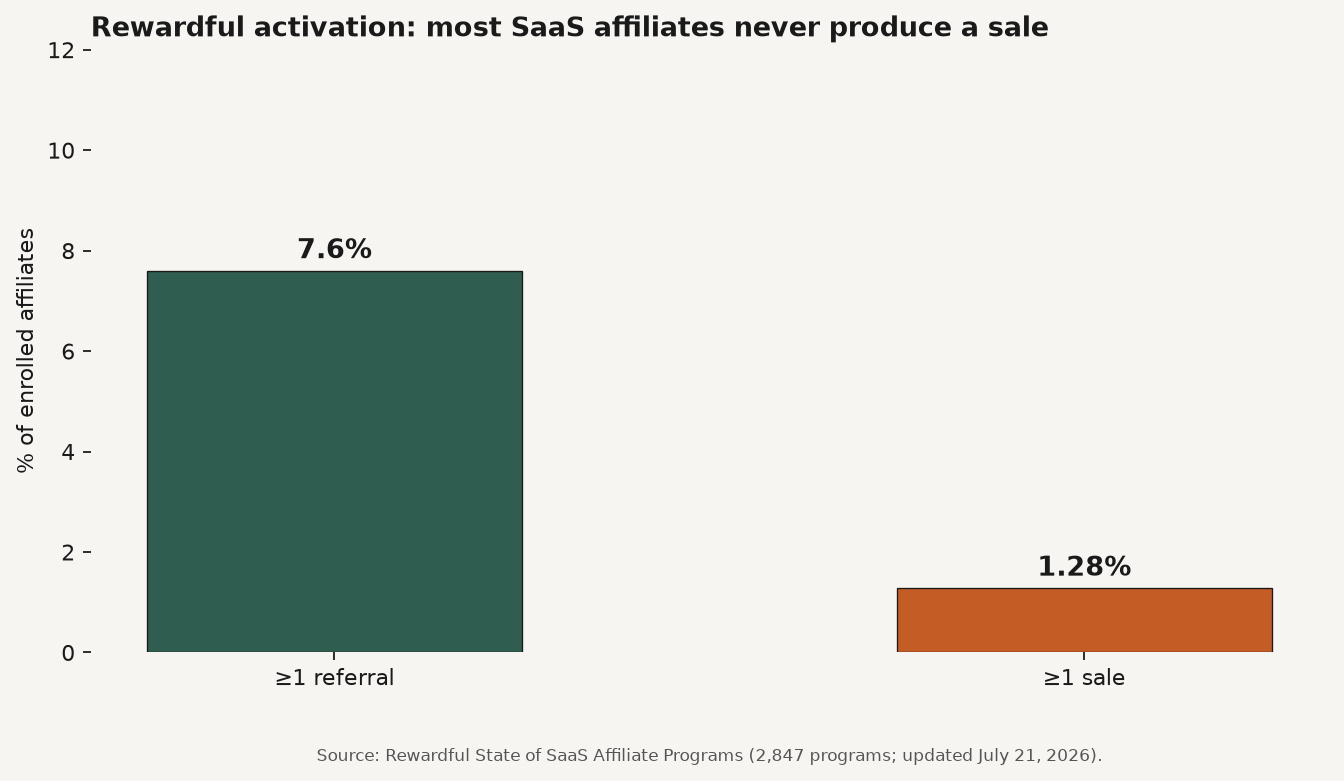
Source: Rewardful State of SaaS Affiliate Programs Report (updated July 21, 2026), analysis of 2,847 SaaS affiliate programs. https://www.rewardful.com/articles/state-of-saas-affiliate-programs-report
| Activation signal (Rewardful) | Figure | Read |
|---|---|---|
| Affiliates with ≥1 referral | 7.6% | Most enrollments never send traffic |
| Affiliates with ≥1 sale | 1.28% | Fewer than 2 in 100 produce revenue |
| Referrers who convert a sale | 16.8% | Traffic quality among the active minority |
| Referral-to-sale CVR | 0.8% | About 8 paying customers per 1,000 referred visitors |
| Programs with <50 affiliates | 56% | Small rosters are normal |
| Programs at 1,000+ affiliates | ~10% | Scale is rare |
| Programs that continue long-term | 15.6% | Most experiments do not become channels |
Source: Rewardful.
If you only raise the percentage, you improve the headline for people who never promote. Fix onboarding, assets, cookie honesty, and partner fit first. LinkJolt also notes 83% of campaigns review applications manually rather than auto-approving (LinkJolt). Quality over roster size is the sample pattern, not a vibes slogan.
On a $100/month plan at Rewardful’s 24.16% average, monthly commission is about $24.16 while the customer stays and the term allows it. At LinkJolt’s 20% median, it is $20/month. At PartnerStack’s 30% top-offer rung, it is $30/month. None of those figures include refund holds, churn, or a twelve-month cap. Model LTV and payback the way you would for any CAC channel (CAC vs LTV).
There is no public dataset that publishes one official SaaS commission median across Impact, Awin, CJ, PartnerStack, Rewardful, and every direct program at once. Aggregator tables that invent per-vertical medians without a reproducible methodology stay out of the charts. feat. does not publish a proprietary SaaS commission census here.
Setting SaaS affiliate commission rates means picking a labeled band, choosing percentage versus bounty, deciding recurrence, publishing the cookie and clawback rules, then measuring activation for 90 days before you renegotiate the percentage. Each step is at most two sentences.
Q: What is the average SaaS affiliate commission rate? A: Rewardful reports an average selected rate of 24.16% across 2,847 SaaS programs, with most programs between 20% and 30%. LinkJolt’s September 2026 campaign sample shows a 20% median. Treat both as labeled samples, not one official industry law.
Q: Is 20% or 30% better for a new SaaS affiliate program? A: 20-25% matches LinkJolt’s competitive guidance and the bottom of PartnerStack’s top-offer ladder. 30% matches PartnerStack’s top rung and common indie vernacular for recruiting power. Choose from margin and LTV, then measure activation before you raise again.
Q: Should SaaS affiliate commissions be recurring? A: Often yes for subscriptions, because partner incentives then match retention. LinkJolt finds 26% of its campaigns pay recurring, and Shopify frames subscription services near 15%-30% recurring. Cap the term when open-ended liability is the risk.
Q: Do higher SaaS commission rates fix a quiet affiliate program? A: Usually not by themselves. Rewardful finds only 1.28% of affiliates generate a sale and says commission structure alone rarely distinguishes high performers. Fix partner fit, onboarding, and assets before you treat rate as the only lever.
Q: How do SaaS rates compare to physical-goods affiliate commissions? A: SaaS samples cluster near 20-30%. Physical retail programs often sit much lower (Shopify’s physical band is commonly cited near 5%-15%). Compare jobs and margins, not vanity percentages across categories (digital vs physical affiliate).
SaaS affiliate commission rates live in a tight 20-30% cluster across Rewardful, LinkJolt, and PartnerStack samples. Pick a labeled band, write recurrence and clawbacks clearly, and fix activation before you treat another percentage point as strategy. For co-branded partners selling an owned product on a marketplace surface, start at the feat. marketplace.
Affiliate marketing for startups is an operating system—locks, cost, recruit, rates, tracking, first 100 sales, then diagnose a flat roster.
How to track affiliate sales: pick link cookie, coupon, pixel, S2S postback, or storefront checkout—then match Rewardful, Tapfiliate, or Impact.
Best affiliate programs for SaaS companies pass the Recurring Cap Test: labeled duration, cookie, seat type, payout rails—plus Rewardful’s ~24% planning band.