Affiliate Marketing for Startups: Complete Guide
Affiliate marketing for startups is an operating system—locks, cost, recruit, rates, tracking, first 100 sales, then diagnose a flat roster.
Best affiliate marketing platforms compared by job: Amazon, Awin, CJ, Impact, PartnerStack, and direct storefronts, plus the ShareASale-to-Awin shift.

TL;DR: There is no single best affiliate marketing platform. Match the job: Amazon for catalog coverage, Awin or CJ for classic network reach, Impact for unified partnership ops, PartnerStack for B2B SaaS recurring, or a direct co-branded storefront when you own the offer. ShareASale is no longer a live parallel network after Awin’s 2025 upgrade. Stack two seats. Ignore lists that invent average commissions.
Most “best affiliate marketing platforms” posts are logo rankings with invented average commissions. That helps nobody ship. Affiliates need merchant fit and tracking they can trust. Merchants need a seat that matches program complexity and margin, not a trophy name.
This comparison of the best affiliate marketing platforms is the network-type map. For a buying stack that separates Amazon, SaaS trackers, networks, and co-branded storefronts (including feat.), use best affiliate marketing tools compared.
If you are choosing among the best affiliate marketing platforms in 2026, start with the job, then the platform type. Treat brand names as instances of those types. Any roundup that still lists ShareASale as a separate live network is already stale.
Key takeaways:
The best affiliate marketing platforms are the tools and networks that connect merchants (or marketplaces) with publishers and creators, track a qualifying event, and pay a commission when that event clears.
“Platform” here covers more than one product shape:
That taxonomy matters more than a ranked top-ten. Ranking logos collapses different jobs into one fake ladder. For the contract mechanics underneath every seat, see how affiliate marketing works and affiliate commission structures.
Wrong platform choice looks like a traffic problem. It is usually a match problem.
Why the comparison earns its own page:
Compare platform types by the job you are hiring them for, then pick one primary seat and one backup. Score candidates on merchant fit, cookie and payout rules, approval friction, and ops load. Do not score them on recycled “average commission” integers that no network publishes as a single global rate.
| Platform type | Examples | Best job | Main tradeoff | Who feels the pain first |
|---|---|---|---|---|
| Catalog marketplace | Amazon Associates | Broad product coverage for review and roundup content | Lower category rates in many verticals; short cart window | Affiliates monetizing general commerce content |
| Classic network | Awin (incl. former ShareASale merchants), CJ | Discover many advertisers; international or retail depth | Program-by-program approval; uneven merchant quality | Affiliates and brands scaling mid-market programs |
| Partnership cloud | Impact | One ops layer for affiliates, creators, referrals | Complexity and cost can exceed simple program needs | Merchants with multi-channel partnership programs |
| SaaS partner platform | PartnerStack | Recurring B2B SaaS commissions and partner ecosystem | Wrong seat for physical retail catalogs | SaaS vendors and software affiliates |
| Direct / co-branded storefront | Merchant-owned or marketplace storefronts (including feat.) | Own the offer surface and tracked revenue split | You must recruit and brief partners yourself | Merchants who already have product-market fit |
There is no public dataset that proves one row always earns more. Treat “Impact always beats Amazon” as ideology.
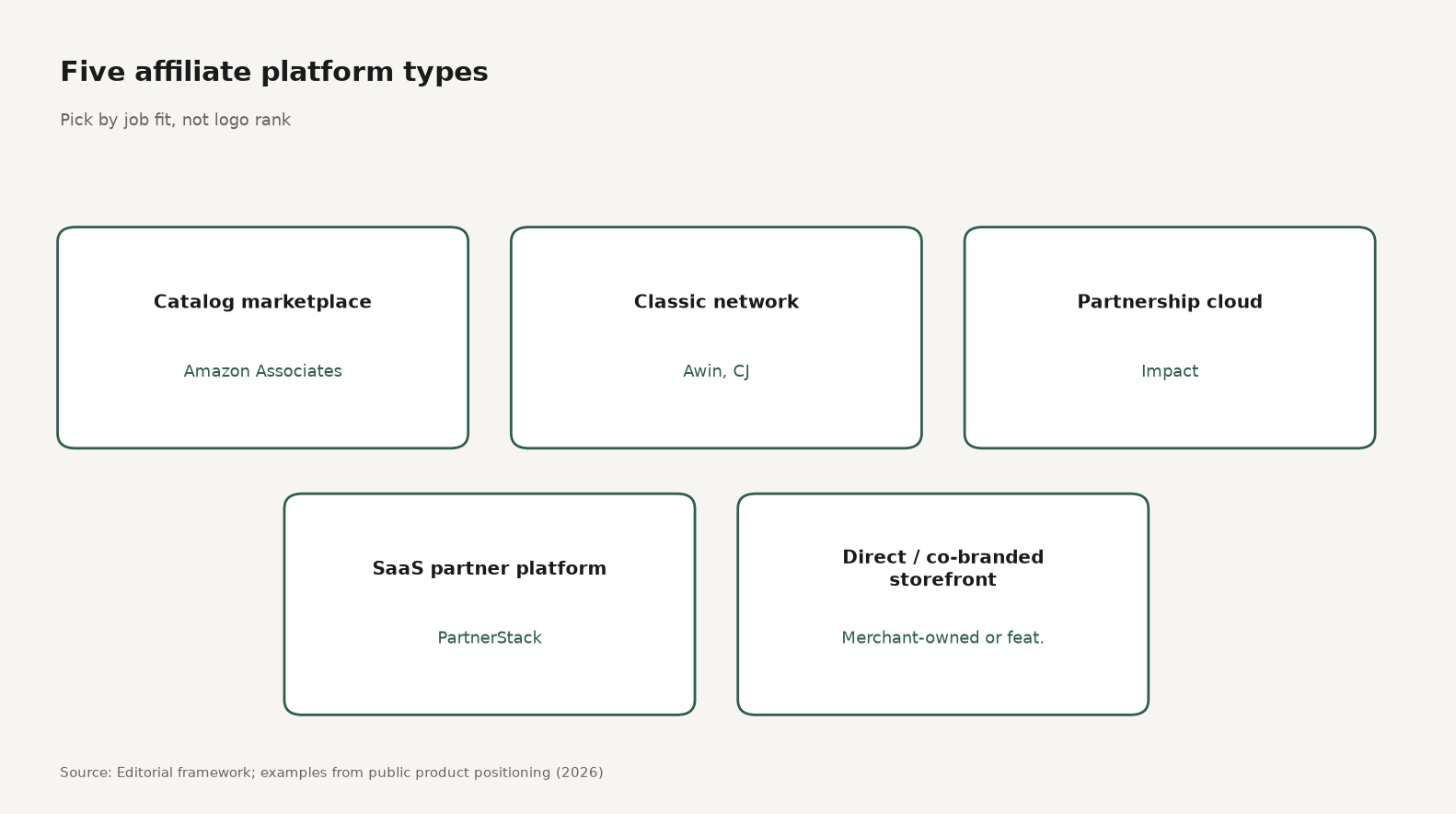
Source: Editorial platform-type framework for this article; examples drawn from Amazon Associates, Awin, CJ, impact.com, and PartnerStack public positioning (accessed 2026-09-27).
Amazon Associates. Best starting catalog for many content sites. Cite the official US table when you talk rates: Luxury Beauty and Amazon Explore at 10%; Books, Kitchen, and Automotive at 4.5%; Apparel and many devices at 4%; Toys, Home, Beauty, and Sports at 3%; Grocery and Health & Personal Care at 1% (Amazon). Payments land about 60 days after month-end once you clear Amazon’s minimum for your payout method (Amazon’s gift-certificate example uses a $10 threshold) (Amazon payment help).
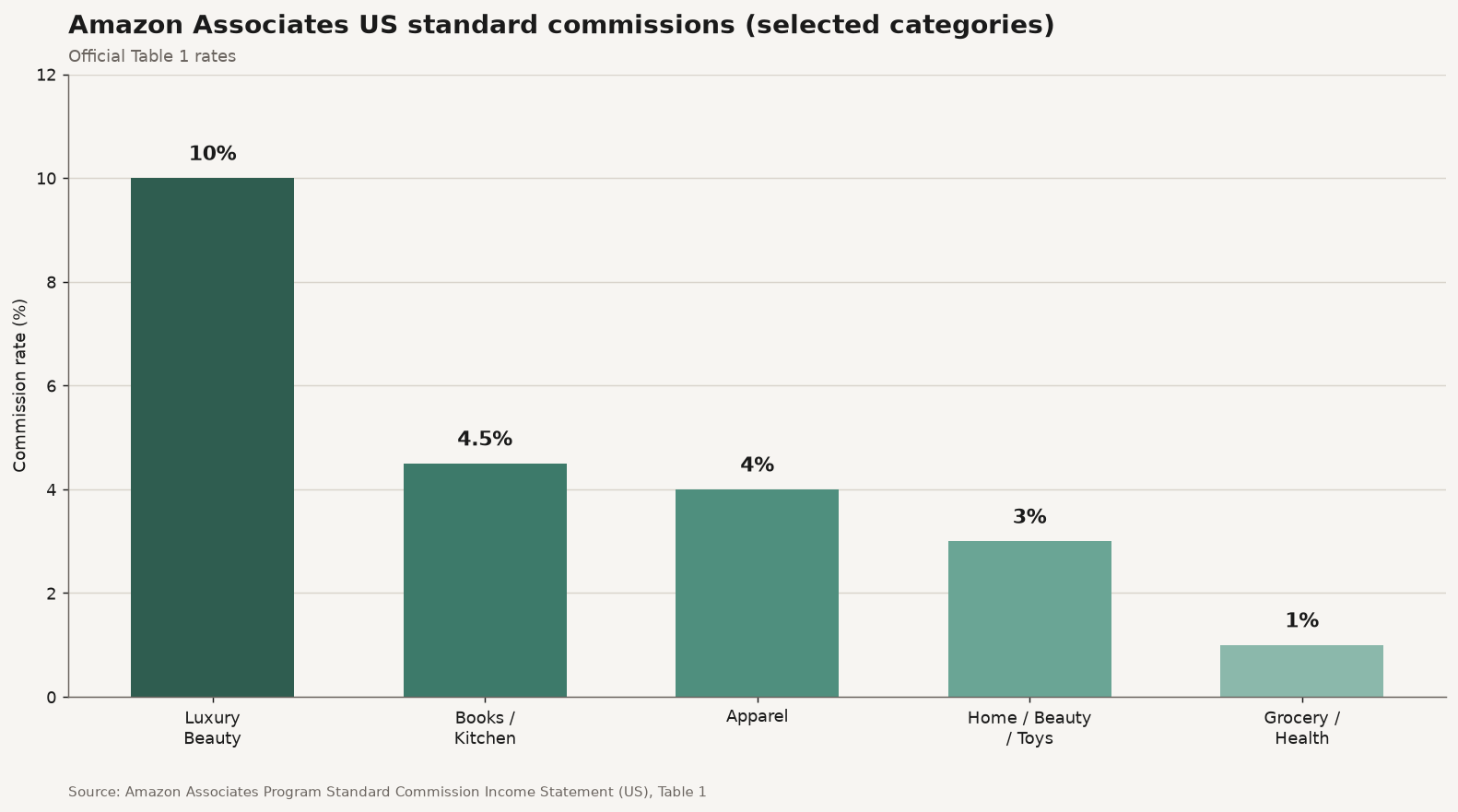
Source: Amazon Associates Program Standard Commission Income Statement (US), Table 1. https://affiliate-program.amazon.com/help/node/topic/GRXPHT8U84RAYDXZ
Awin (post-ShareASale). For US mid-market merchants that used to live on ShareASale, Awin is now the live network, not a “versus ShareASale” option. Awin’s own upgrade post is the source of record for the consolidation numbers and the October 6, 2025 ShareASale close (Awin). Use Awin when you need classic network discovery with global coverage, especially if your traffic or advertisers are international.
CJ Affiliate. CJ positions itself as a large, established partnership performance ecosystem for brands, publishers, and creators (CJ). It remains a common seat for larger retail and editorial programs. Expect advertiser-level approvals and more operator overhead than a beginner Amazon-only stack. Do not invent a network-wide average commission; read each program’s terms.
Impact. Impact sells unified partnership management across affiliates, creators, and referrals. Its homepage claims brands using affiliates plus influencers drive up to 46% more sales than single-channel strategies (impact.com, accessed 2026-09-27). Treat that as a vendor claim, not an independent meta-study. Choose Impact when you need that unified ops layer and can staff it. Skip it when a lean tracking tool plus three partners would do. For the seat difference between flat-fee creators and commission affiliates, see affiliate vs influencer marketing.
PartnerStack. Built for B2B SaaS partner and affiliate motions, with recurring and expansion-friendly commissioning. PartnerStack’s homepage claims a marketplace of 115,000+ active partners (PartnerStack). Its own guidance notes that many strong programs pay partners on a recurring basis, often in a 20% to 40% band of transaction value (PartnerStack support). Wrong tool if your offer is a physical SKU catalog.
Direct / co-branded storefront. When you are the merchant (or you recruit affiliates onto your own offer), you may not need a third-party merchant directory at all. You still need tracking, approval, payout, and disclosure. feat. is one marketplace shaped for merchants listing products and affiliates selling through co-branded storefronts with a revenue split. We do not invent listing fees or platform cut figures here. If you only need updates while you evaluate, use the waitlist. If you want to browse offers as an affiliate, use the marketplace.
| Your job | Prefer first | Add second | Avoid as primary |
|---|---|---|---|
| Monetize broad product reviews | Amazon Associates | Awin or CJ for higher-fit brands | PartnerStack |
| Promote SaaS / B2B tools | PartnerStack or Impact brand programs | Direct vendor programs | Amazon category rates alone |
| Run a DTC creator + affiliate program | Impact (if complexity warrants) or lean Shopify-native tracking | Hybrid fee + commission deals | Catalog-only Amazon for your own SKU |
| International retail audience | Awin | CJ or Impact | US-only assumptions |
| Own the offer and recruit affiliates | Direct / co-branded storefront | One classic network for overflow discovery | Joining five networks before one tracked path works |
| Beginner testing commercial content | Amazon Associates | One network after 10+ commercial URLs exist | Paying enterprise partnership software on day one |
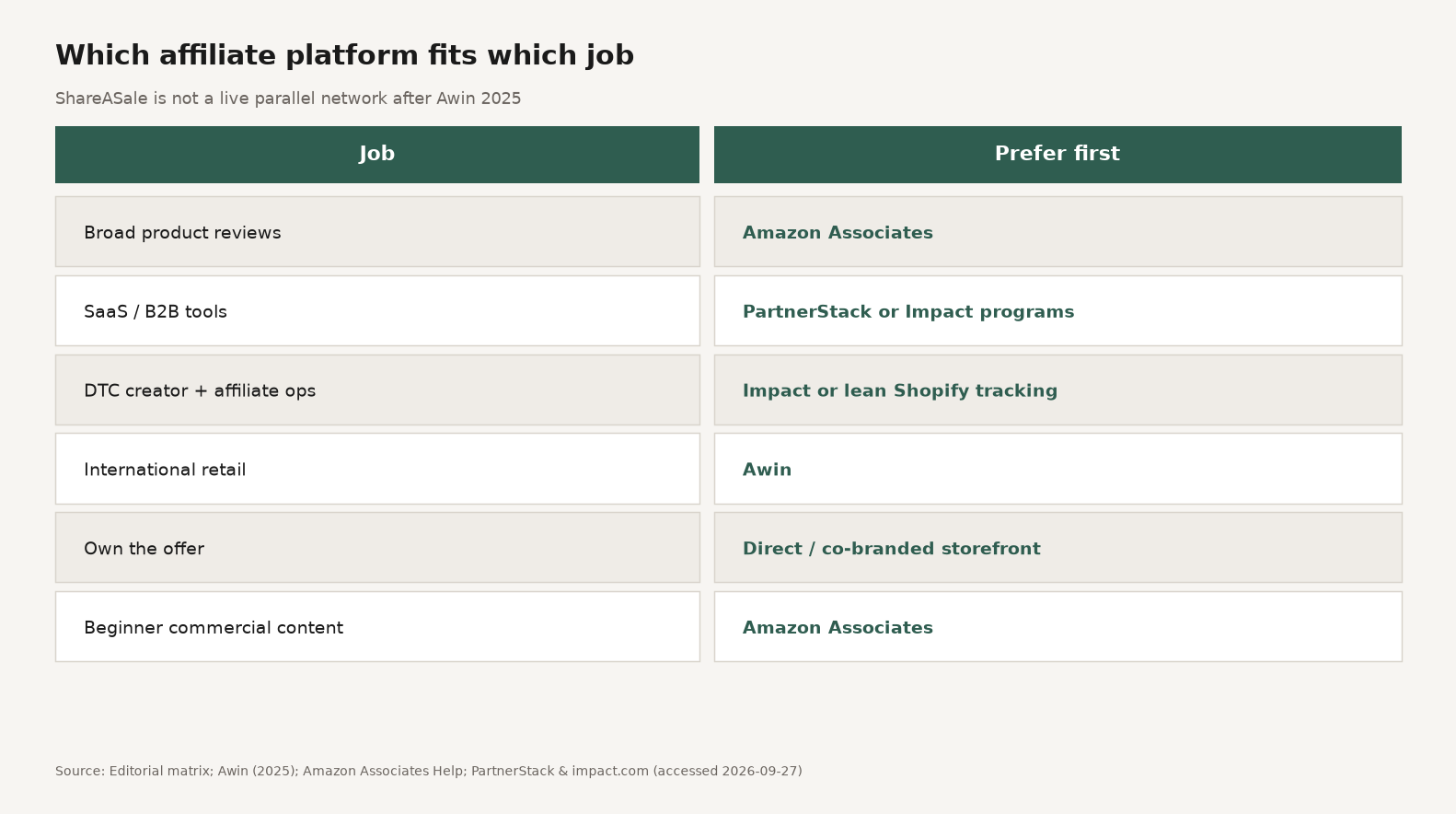
Source: Editorial decision matrix; Awin consolidation facts from Awin (Aug 2025); Amazon rate and cookie facts from Amazon Associates Help; PartnerStack and Impact positioning from their public sites (accessed 2026-09-27).
Common mistakes: treating ShareASale as still separate from Awin; optimizing for the highest advertised CPA instead of EPC after reversals; putting informational traffic on hard-sell offers; buying Impact because a list said “enterprise”; ignoring Amazon’s 24-hour cart rule; inventing feat. or network “average” fees that no primary page publishes.
Q: What are the best affiliate marketing platforms for beginners? A: For most beginners monetizing product content, Amazon Associates is the fastest catalog seat because setup is straightforward and coverage is wide. Add Awin or CJ once you have commercial pages worth matching to specific brands. There is no public dataset that makes one beginner stack universal.
Q: Is ShareASale still a separate affiliate network? A: No. Awin completed the ShareASale upgrade in August 2025 and closed the ShareASale platform on October 6, 2025. Active programs moved onto Awin. Compare Awin as the live network, not ShareASale as a parallel option.
Q: Amazon Associates vs Impact: which should I choose? A: Different jobs. Amazon is a catalog marketplace with published category rates and a short cart window. Impact is a partnership-cloud ops platform for managing affiliates, creators, and referrals. Many serious publishers use Amazon for coverage and a network or partnership platform for higher-fit brand deals.
Q: Which affiliate platform is best for SaaS? A: Start with SaaS-native partner platforms such as PartnerStack, or direct vendor programs you can join through Impact or the vendor’s own portal. Amazon’s retail category table is the wrong primary seat for subscription software.
Q: Can I use multiple affiliate marketing platforms at once? A: Yes, and most operators should. Use multiple seats to match pages to merchants. Cap the stack so you can actually maintain links, disclosures, and reporting. Two focused seats beat seven neglected logins.
The best affiliate marketing platforms are the ones that match the job you are hiring them for. Amazon wins on catalog coverage with published, uneven category rates. Awin now carries the old ShareASale mid-market seat. CJ remains a classic network for established programs. Impact consolidates partnership ops when you need that complexity. PartnerStack fits B2B SaaS recurring. Direct storefronts fit merchants who want affiliates on their own offer. Skip fake average-commission crowns. Ship a primary seat, measure EPC, and disclose the relationship.
If you are a merchant who wants tracked partners selling through co-branded storefronts instead of a link graveyard, start at https://www.feat.press.
Affiliate marketing for startups is an operating system—locks, cost, recruit, rates, tracking, first 100 sales, then diagnose a flat roster.
How to track affiliate sales: pick link cookie, coupon, pixel, S2S postback, or storefront checkout—then match Rewardful, Tapfiliate, or Impact.
Best affiliate programs for SaaS companies pass the Recurring Cap Test: labeled duration, cookie, seat type, payout rails—plus Rewardful’s ~24% planning band.