How to Create a Partner Program for a Startup
Create a startup partner program by picking one seat—affiliate, agency, reseller, or tech—then PartnerStack, a $49 tracker, or feat.
Build a product distribution network on four rails—DTC, wholesale, commission sellers, co-branded storefronts. Densify before you scale; Lowe’s pays up to 20% on storefronts.

TL;DR: How to build a product distribution network is a Maker Distribution Ladder: owned DTC, wholesale where title moves, a single-tier commission seller graph, then co-branded storefront forks. Build rails in that control order. Densify the commission rail with Rewardful’s 7.6% refer / 1.28% sell meters before you chase retail creator programs that accept 50 of 14,000+ applicants.
Most founders who ask how to build a product distribution network are really asking which affiliate marketplace to join. That is the wrong verb. Joining puts your SKU on someone else’s rails. Building means you own the product and assemble the paths buyers use to reach it—direct, wholesale, commission sellers, and storefronts—without confusing those jobs.
The Performance Marketing Association’s 2025 study still credits affiliates with $113B in 2024 U.S. e-commerce sales (9.4% of the market) (PMA). That is one rail. Retailer creator programs publish another: Lowe’s up to 20% with a 30-day window, Sephora 15%, Walmart 1%–4% by category (Sprout Social, Dec 5, 2025). None of those numbers tell you which rail to pour capital into first. The ladder does.
Key takeaways:
A product distribution network is the set of owned and partnered paths that move a product you make—or fully control—from inventory to a paying buyer, with clear title, attribution, and settlement rules on each path.
That is not the same as “an affiliate network.” An affiliate network is a marketplace of publishers you join or a cloud that hosts your program (best affiliate marketing network). A product distribution network can include that shape as one rail. It also includes your DTC site, wholesale accounts that take title, and co-branded storefronts that keep checkout under your brand kit. Metacake’s blog asserts a neat 40% / 20% / 20% / 10% / 10% ecommerce-marketplace-wholesale-affiliate-offline mix. That is a vendor recommendation, not a public census—do not chart it as a benchmark.
If you do not own the offer, you are not building this network. You are selling someone else’s product on an ownership ladder. This page is for the maker.
feat. sits on the storefront rail: one merchant listing, many approved creator pages, automatic split on attributed checkout. Marketplace listing is optional. feat. does not stock warehouses or negotiate Faire accounts for you.
Building matters when channel risk concentrates on one login. Amazon changes Table 1 rates. A wholesale buyer ghosts. A coupon affiliate poisons brand terms. Diversified rails are the hedge—if you actually operate them.
Why the ladder beats “join three networks and hope”:
There is no public dataset for the “ideal” revenue mix across DTC, wholesale, and affiliate for every niche. Measure your own contribution margin by rail.
The Maker Distribution Ladder is four rails you assemble for a product you own. Climb by control and capital intensity: master DTC before you discount for wholesale; name commission sellers before you open a public affiliate form; fork storefronts when sellers need a page, not a parameter.
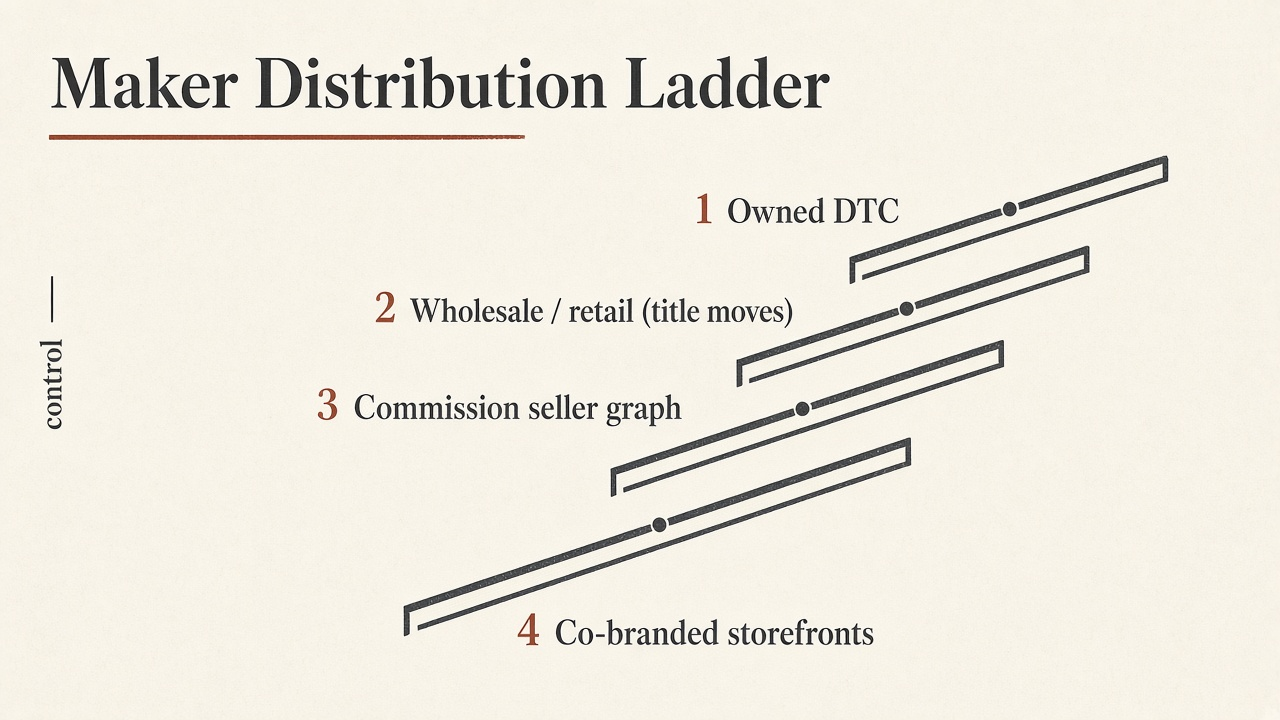
Source: Editorial framework synthesized for this article from Shopify, Rewardful, Sprout Social, PartnerStack, and feat. product mechanics. Taxonomy diagram, no invented channel-mix percentages.
Your site, your checkout, your customer file. Highest control. You fund ads, content, and email. Every other rail should protect this rail’s price integrity, not cannibalize it with uncontrolled coupons. If DTC does not convert, a distribution network only amplifies a broken offer.
Independent retailers, specialty shops, and later larger accounts. Title and often risk move with the goods. Start with independents and sell-through proof before chasing chains—the sequence manufacturer checklists and D2C wholesale guides repeat for a reason. MAP, territories, and dealer communication are the product. This rail is not an affiliate cookie.
Independent sellers promote; you keep title and fulfillment; they earn CPS or rev-share on attributed sales. Shopify’s bands still bound the edge: physical 5%–15%, digital 20%–50%, subscriptions 15%–30% recurring (Shopify). Rewardful’s SaaS average sits at 24.16% (Rewardful). Build this rail with the Single-Tier Seller Graph—named nodes, density meters, no multi-tier downline.
| Meter | Published figure | Source |
|---|---|---|
| Affiliates who refer | 7.6% | Rewardful, n=2,847 |
| Affiliates who sell | 1.28% | Rewardful |
| Referral → sale | 0.8% | Rewardful |
| Network-approved earners vs outside | 43% vs 3% | PartnerStack |
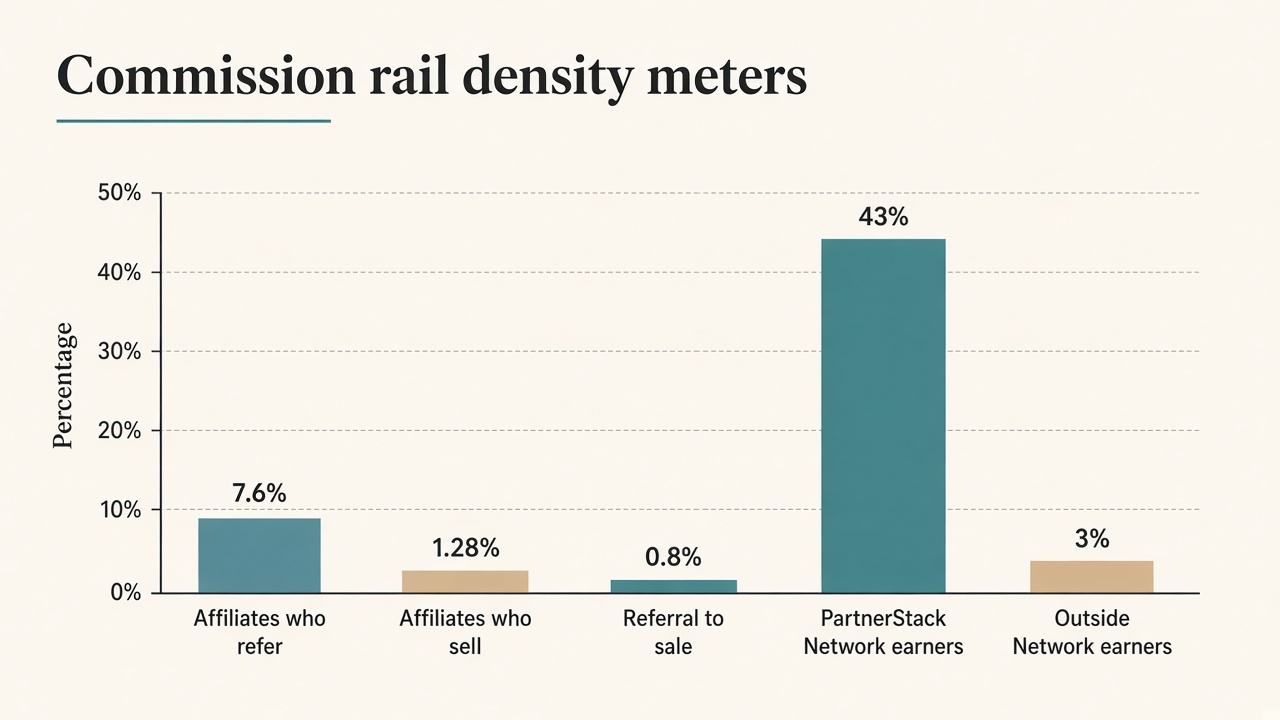
Source: Rewardful State of SaaS Affiliate Programs (n=2,847). https://www.rewardful.com/articles/state-of-saas-affiliate-programs-report · PartnerStack Research Lab Network chart. https://partnerstack.com/resources/research-lab/charts/partnerstack-network-approved-partners-are-far-more-likely-to-earn-a-commission-compared-to-non-network-partners
When a seller needs a page—not a ?via= parameter—you fork a storefront with their handle and your locked offer. Retailer programs publish the competitive set: Lowe’s up to 20% / 30 days, Sephora 15%, Walmart 1%–4%, ShopMy/LTK often framed 10%–30% (Sprout). Those are retailer-hosted pages. An independent merchant who is not Sephora still needs a rail. That is the feat. job: co-branded storefronts for a product you already sell, with an automatic split. See what is a creator storefront and how to turn your audience into a distribution channel for the creator-side ladder.
| Program / hub | Published commission signal | Notes |
|---|---|---|
| Lowe’s Creator | Up to 20% | 30-day attribution (Sprout) |
| Sephora storefront | 15% | Capacity gated (50 of 14,000+ apps in a recent year per Sprout) |
| Walmart Creator | 1%–4% by category | No minimum follower count (Sprout) |
| ShopMy / LTK (Sprout framing) | 10%–30% | Third-party hubs |
| Merchant co-branded storefront (feat.) | Revenue split in-product | You list; approved sellers get pages |
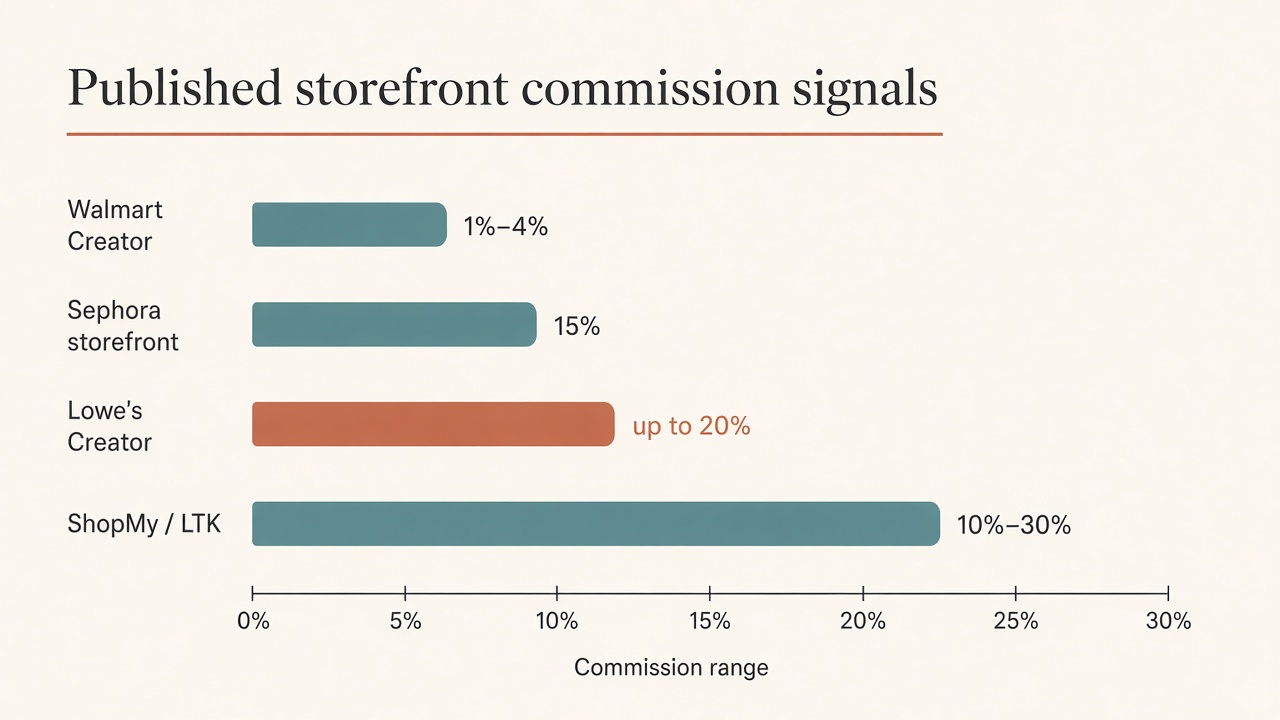
Source: Sprout Social, Creator Storefronts and the Future of Influencer ROI (Dec 5, 2025). https://sproutsocial.com/insights/creator-storefronts/
Do not treat “join Impact” or “join Amazon Associates” as rail four. Those are catalog or partnership-cloud choices covered in Amazon Associates vs feat and Impact vs feat. Building means the surface sells your product under rules you write.
Assemble the Maker Distribution Ladder in this order. Each step is at most two sentences.
Q: How do you build a product distribution network if you are a small brand? A: Master DTC first, then add one rail at a time—usually named commission sellers before heavy wholesale. Retailer creator programs with 50-of-14,000 acceptance rates are a bonus rail, not the plan.
Q: Is a product distribution network the same as an affiliate network? A: No. An affiliate network is one possible rail (or a place you join). A product distribution network also includes owned DTC, wholesale where title moves, and co-branded storefronts you control.
Q: Should I start with wholesale or affiliates? A: Start with whichever rail your ops can settle cleanly. Wholesale needs inventory and retailer service. Affiliates need attribution and payouts. Most digital-first makers stand up a small commission graph before full wholesale.
Q: How much commission should distributors or affiliates earn? A: For performance affiliates, stay inside Shopify’s published bands you can fund—physical 5%–15%, digital 20%–50%, subscriptions 15%–30% recurring (Shopify). Wholesale discounts are a different math (title and margin transfer), not a CPS percentage pasted onto a purchase order.
Q: Where does feat. fit in a product distribution network? A: On the storefront rail: you list a product you own; approved sellers get co-branded pages with an automatic split. feat. does not replace DTC, wholesale logistics, or recruiting. Live fees stay in-product.
A product distribution network is not a directory login. It is a Maker Distribution Ladder: DTC you control, wholesale that takes title, a single-tier commission graph you densify, and storefronts sellers can actually share. Sprout’s retail rates and Rewardful’s activation meters are planning constraints—not slogans. Build the rails in control order, measure contribution margin by rail, and refuse any “network” that is only a spreadsheet of ghost signups.
If the missing rail is a co-branded page for sellers of a product you already make, list it on feat. and open storefronts for the partners you trust.
Create a startup partner program by picking one seat—affiliate, agency, reseller, or tech—then PartnerStack, a $49 tracker, or feat.
Turn anyone into a seller of your existing offer: give them a co-branded storefront, lock the SKU, attribute checkout, and split revenue automatically.
Marketplace take rates compared: take rate is revenue divided by GMS, not the seller sticker. Etsy, Fiverr, eBay, Apple 30/15, Amazon referrals.