How to Build a Product Distribution Network
Build a product distribution network on four rails—DTC, wholesale, commission sellers, co-branded storefronts. Densify before you scale; Lowe’s pays up to 20% on storefronts.
Marketplace take rates compared: take rate is revenue divided by GMS, not the seller sticker. Etsy, Fiverr, eBay, Apple 30/15, Amazon referrals.

TL;DR: Marketplace take rates compared correctly start with definition. Company-reported take rate is marketplace revenue divided by GMS or GMV. Seller sticker fees are a separate stack. In FY2025, Etsy consolidated take was 24.2% and Fiverr marketplace take was 27.7%. eBay reported 13.9% in Q1 2026. Amazon publishes referral schedules, not one take rate.
Founders quote “take rate” from earnings slides. Sellers quote “take rate” from the fee line on one order. Those are not the same number. Mix them and you will underprice a SKU or overread a platform’s power. Start with the definition before you compare platforms.
Marketplace take rates compared only works when you name the metric first. This page sits next to creator platform fee comparison, revenue split models for collaborative selling, Stripe Connect explained for creators, Amazon Associates commission rates by category, and best affiliate marketing platforms.
Marketplace take rate means marketplace revenue for a period divided by the gross merchandise value that flowed through the marketplace in that period. Etsy calls it revenue take rate and defines it as revenue divided by GMS. Fiverr defines marketplace take rate as marketplace revenue divided by GMV. Same idea: how much of transaction volume the company kept as revenue.
That number is an investor and operator metric. It includes more than one seller line item. Ads, payments, listing fees, buyer fees, and shipping programs can all sit inside revenue while GMS/GMV stays the denominator. A high take rate can mean denser monetization, not a single “commission” sticker.
Seller sticker fees are the price list the seller sees on an order: listing, transaction %, processing, optional ads. Those lines can sum toward the company’s take, but they are not interchangeable with the IR percentage. Creator platform fee comparison owns storefront fee shapes (Gumroad, Stan, Whop, Beacons, Linktree). This article owns marketplace IR take rates versus marketplace seller schedules.
Take rates matter because they set contribution margin for sellers and monetization power for platforms. Compare the wrong object and you make the wrong decision. Founders diligencing a marketplace need the IR definition. Sellers pricing a $28 print need the sticker stack.
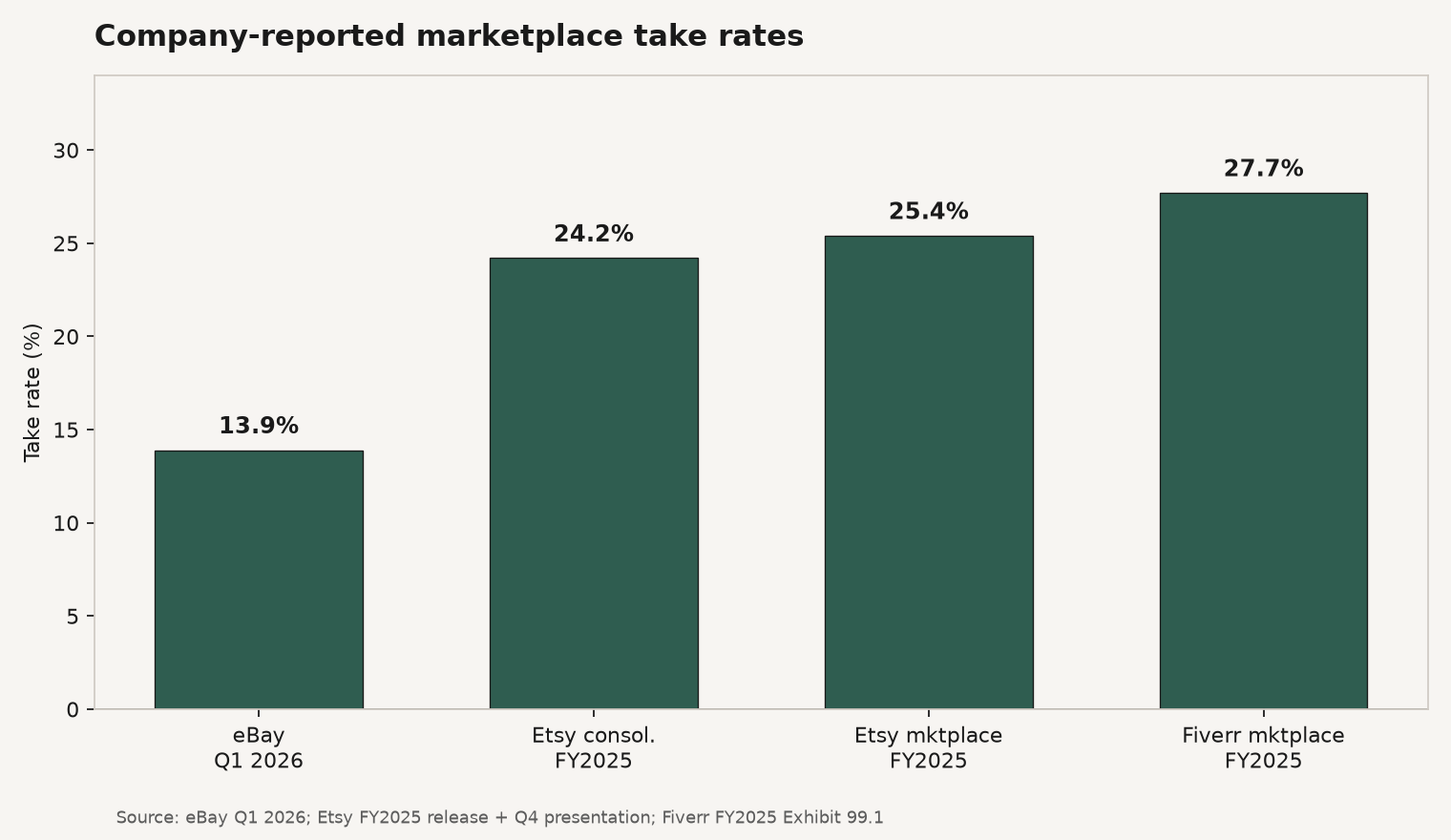
Source: eBay Q1 2026 earnings materials (13.9%); Etsy FY2025 earnings release and Q4 2025 presentation (24.2% consolidated, 25.4% marketplace); Fiverr FY2025 Exhibit 99.1 (27.7%).
Marketplace take rates work as a company ratio: keep revenue in the numerator and GMS or GMV in the denominator, then read seller schedules and app-store commissions as separate objects. Do not average unlike metrics into one fake league table. The useful comparison is definition-first, then platform-by-platform.
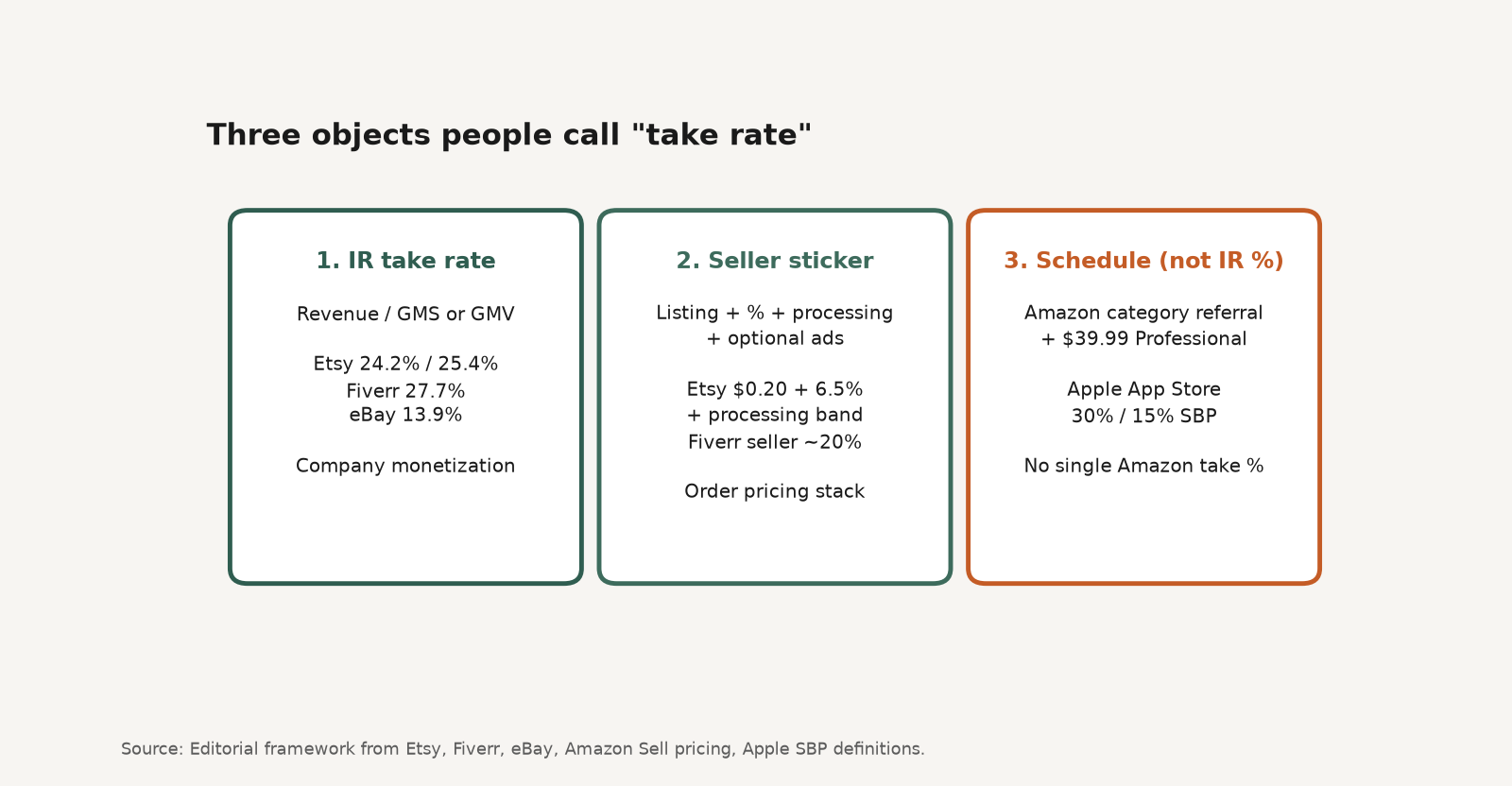
Source: Definitions from Etsy (revenue ÷ GMS), Fiverr (marketplace revenue ÷ GMV), Amazon Sell pricing, Apple App Store Small Business Program. Editorial framework.
| Platform | Metric named | Period | Reported take rate | Denominator / notes |
|---|---|---|---|---|
| eBay | Take rate (revenue as % of GMV) | Q1 2026 | 13.9% | GMV $22.2B; revenue about $3.1B |
| Etsy (consolidated) | Revenue take rate | FY 2025 | 24.2% | Revenue ÷ GMS; Q4 2025 was 24.5% |
| Etsy (marketplace) | Take rate | FY 2025 | 25.4% | Core Etsy marketplace GMS about $10.5B |
| Fiverr (marketplace) | Marketplace take rate | FY 2025 | 27.7% | Marketplace revenue $297.5M ÷ GMV |
Sources: eBay, Etsy, Etsy presentation, Fiverr.
Etsy marketplace (from the FY2025 10-K). Sellers pay a fixed listing fee of $0.20 per item listed. They pay a 6.5% transaction fee on each completed transaction, inclusive of shipping fees charged. Offsite Ads add a transaction fee of 12% or 15% of the value of a sale based on the seller’s volume of annual sales when that program applies. Etsy Payments processing fees typically vary between 3.0% and 6.5% of an item’s total sale price, including shipping, plus a flat fee per order that depends on the country in which the seller’s bank account is located (Etsy 10-K).
Labeled planning example on a $100 item with $0 shipping and no Offsite Ads: listing $0.20 + transaction $6.50 = $6.70 before processing. Processing then adds another 3.0% to 6.5% plus a flat fee. That sticker path can land near low-double-digits on the item before ads. It is still not the 25.4% marketplace take rate, which also includes ads, payments mix, and other revenue over all GMS.
Fiverr. Fiverr’s own comparison guides state a flat 20% commission on freelancer earnings, including tips. Buyer-side help pages state a standard service fee of 5.5% of the purchase amount, with an additional small-order fee on lower-ticket checkouts (Fiverr guide; Fiverr Help). Marketplace take of 27.7% is revenue over GMV. Seller 20% alone cannot equal that ratio. Buyer fees and other marketplace revenue close the gap. That is the definition fork in one platform.
Apple’s App Store standard commission is 30% on paid apps and in-app purchases for developers above the Small Business threshold. The App Store Small Business Program reduces the commission to 15% for developers who earned up to $1 million in proceeds in the prior calendar year (Apple Newsroom; Apple Developer). Treat this as a published commission schedule for digital goods on iOS, not as “Apple’s marketplace take rate” in the Etsy/Fiverr sense unless Apple reports that ratio the same way.
Amazon does not give you one IR take-rate percentage in the sources used for this article. It gives you a selling plan and a category referral table. Professional is $39.99 per month. Individual is $0.99 per item sold. Referral fees vary by category. Selected US examples from Amazon’s pricing page: Consumer Electronics 8%, Computers 8%, Home and Kitchen 15%, Everything Else 15%, Clothing and Accessories 5% / 10% / 17% by price band, Amazon Device Accessories 45%, Media (Books, DVD, Music, Software, Video) 15% plus a $1.80 closing fee (sell.amazon.com/pricing).
There is no public dataset here for a single Amazon company-level marketplace take rate comparable to Etsy’s revenue/GMS. Secondary blogs that say “Amazon take rate 30%-40%” usually fold Fulfillment by Amazon pick-pack and storage into the story. FBA is a fulfillment cost. It is not the same object as eBay’s or Etsy’s reported take rate. Do not chart it as one.
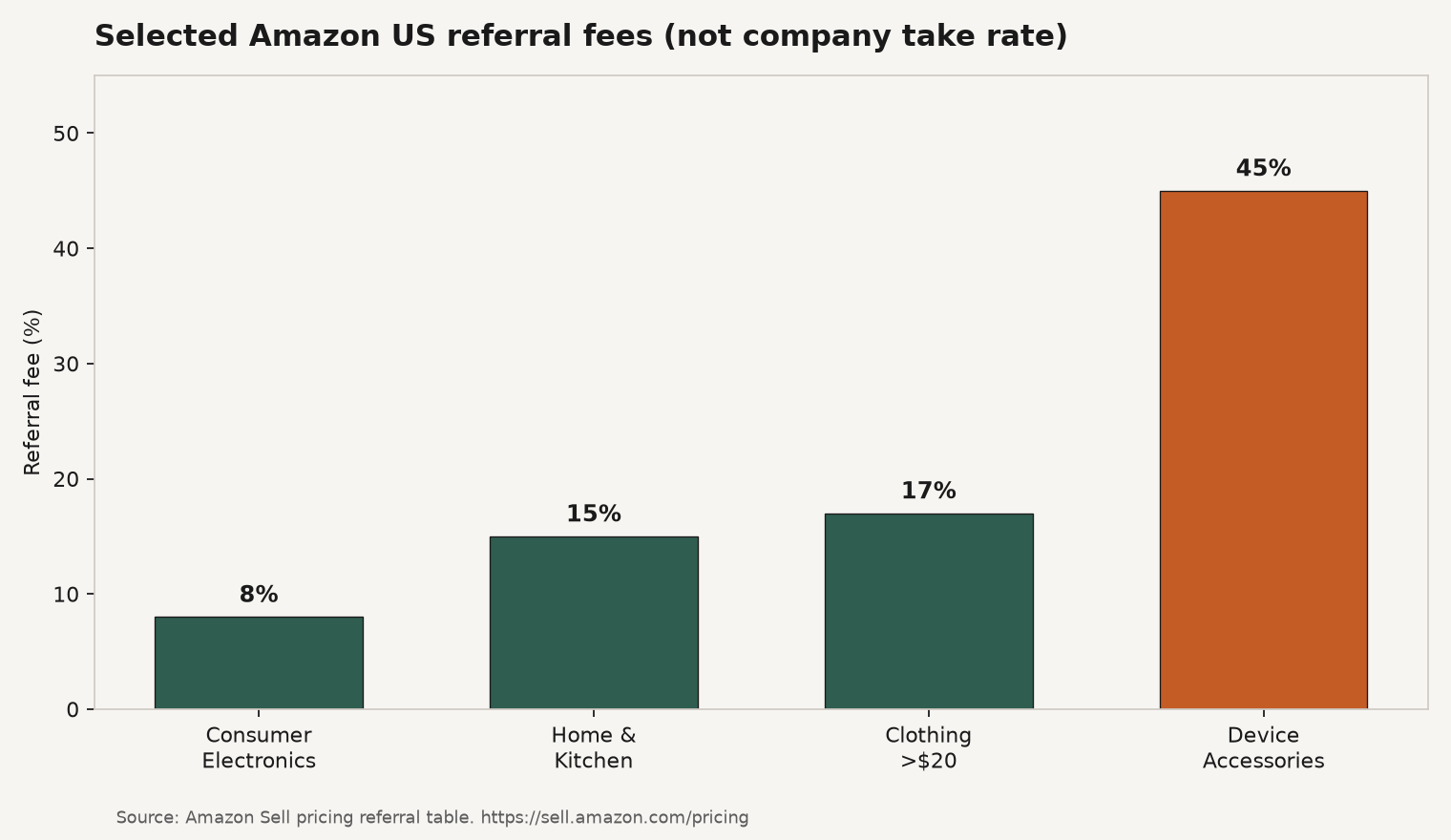
Source: Amazon Sell pricing, referral fee table. https://sell.amazon.com/pricing
Affiliate commissions on Amazon’s Associates program are a different schedule again. Use Amazon Associates commission rates by category when you are the promoter, not the seller.
| Job | Use this number | Do not use |
|---|---|---|
| Diligence a public marketplace’s monetization | Company-reported take rate (revenue ÷ GMS/GMV) | One seller’s checkout fee % |
| Price a physical SKU on Etsy or Amazon | Seller sticker stack (listing + % + processing + ads + fulfillment if any) | Consolidated IR take alone |
| Ship a digital app on iOS | App Store 30% / 15% commission schedule | eBay or Etsy take rate |
| Compare co-sell or affiliate payout room | Margin after sticker + COGS, then commission band | Blended “industry take rate” lists |
| Read Amazon unit economics | Category referral + selling plan + optional FBA line items | Invented single Amazon take % |
Payment routing and application fees can sit under the marketplace layer. When you are building the rails yourself, start with Stripe Connect for creators.
Reading marketplace fees before you commit is a five-step checklist: name the metric, pull the IR take if it exists, open the seller schedule, separate fulfillment, then leave margin for partners. Skip a step and you will compare Apple’s 30% to Etsy’s 24.2% as if they answered the same question.
Q: What does marketplace take rate mean? A: Marketplace take rate means marketplace revenue for a period divided by GMS or GMV for that period. Etsy states revenue take rate is revenue divided by GMS. Fiverr states marketplace take rate is marketplace revenue divided by GMV. It is a company monetization ratio, not one seller fee line.
Q: What is Etsy’s take rate versus what sellers pay? A: Etsy’s consolidated FY2025 revenue take rate was 24.2%, and the Etsy marketplace take rate was 25.4%. Sellers separately pay a $0.20 listing fee, a 6.5% transaction fee, possible Offsite Ads of 12% or 15%, and Payments processing typically 3.0% to 6.5% plus a flat fee. Those sticker lines feed revenue. They are not identical to the IR percentage on every order.
Q: What is Fiverr’s take rate if sellers pay 20%? A: Fiverr reported a marketplace take rate of 27.7% for FY2025. Its guides also describe a flat 20% seller commission. Buyer service fees (standard 5.5% of purchase, plus small-order fees on lower tickets) and other marketplace revenue sit in the numerator of take rate. Seller 20% and marketplace take 27.7% are related, not equal.
Q: Does Amazon have a marketplace take rate like Etsy? A: Not in the public sources used here. Amazon publishes Professional $39.99/month (or Individual $0.99/item) and category referral fees such as Electronics 8%, Home and Kitchen 15%, and Clothing up to 17%. There is no public dataset in this article for one Amazon company-level take rate equal to revenue ÷ GMS. Do not treat FBA all-in cost bands as that metric.
Q: Is the App Store 30% commission a marketplace take rate? A: It is a published commission schedule on digital goods and in-app purchases, with 15% under Apple’s Small Business Program for qualifying developers up to $1 million in prior-year proceeds. Unless you are citing an Apple IR ratio defined like Etsy’s, call it commission, not take rate. Compare it to other commission schedules, not to eBay’s 13.9% take.
Marketplace take rates compared without a definition are just rival percentages competing for a screenshot. Company-reported take rate is revenue over GMS or GMV. Seller stickers and app-store commissions are schedules. Use Etsy’s 24.2% / 25.4%, Fiverr’s 27.7%, and eBay’s 13.9% when you are diligencing platforms. Use Etsy’s 10-K lines, Fiverr’s 20% seller fee, Amazon’s referral table, and Apple’s 30% / 15% when you are pricing a product. If you build something people should sell for you, list it on feat. and let affiliates move it through co-branded storefronts.
Build a product distribution network on four rails—DTC, wholesale, commission sellers, co-branded storefronts. Densify before you scale; Lowe’s pays up to 20% on storefronts.
Create a startup partner program by picking one seat—affiliate, agency, reseller, or tech—then PartnerStack, a $49 tracker, or feat.
Turn anyone into a seller of your existing offer: give them a co-branded storefront, lock the SKU, attribute checkout, and split revenue automatically.