How to Turn Your Audience Into a Distribution Channel
Turn your audience into a distribution channel with a five-rung ladder—attention, trust, offer, sales surface, and economics—not follower vanity.
How much creators earn by platform and follower tier, with NeoReach averages, the $15K barrier, and why salary tables fail.

TL;DR: How much creators earn by platform and follower tier depends more on monetization systems than vanity counts. NeoReach’s 2025 survey puts Instagram average annual income near $81.7K, YouTube $62.4K, TikTok $44.25K, and Twitch $25.6K, while 50.71% of creators still earn under $15K. Follower-tier salary charts are mostly fiction.
Creators ask for a paycheck chart by platform and follower tier. Platforms sell average success stories. Brands still buy follower bands as if they were salary grades. The useful answer separates survey means from medians, names the Monetization Barrier, and refuses invented nano-to-mega annual tables that no public census supports.
How much creators earn by platform and follower tier is the wrong question if you want a neat ladder from 1K to 1M followers. The better question is which survey means are skewed, which barriers still trap most creators, and what follower count actually predicts (post rates) versus what it does not (annual living). Pair this with the 1,000 true fans stress test, small-audience monetization paths, and influencer rate bands by tier.
Creator earnings by platform and follower tier means estimated annual or campaign income conditioned on a creator’s primary social platform and audience size band, usually from surveys or paid-campaign databases, not from a single official wage table. That definition already warns you: the object is an estimate with a method, not a salary grade carved into stone.
Two measurement traps show up immediately. First, averages are not typical. NeoReach and Influencer Marketing Hub note that Instagram’s high average is “bolstered by a handful of top-earning creators,” while TikTok’s respondent base concentrates in lower income brackets (IMH report; NetInfluencer summary of NeoReach). Second, follower tier is a pricing input for a post, not a guaranteed annual salary. Cheerful-style ask and offer bands belong in rate cards. Annual living belongs in earnings surveys and bank deposits.
Treat every viral “creator salary by followers” graphic the same way you treat a fake CAC: ask for the sample, the year, and whether the number is a mean, a median, or a made-up midpoint. If the deck cannot answer those three, it is not a planning input.
These numbers mislead when decks treat a platform mean as a median paycheck or invent tier salaries the surveys never published. Founders and creators both need the barrier share, the campaign median, and an explicit refusal of fake ladders before they treat any average as a forecast.
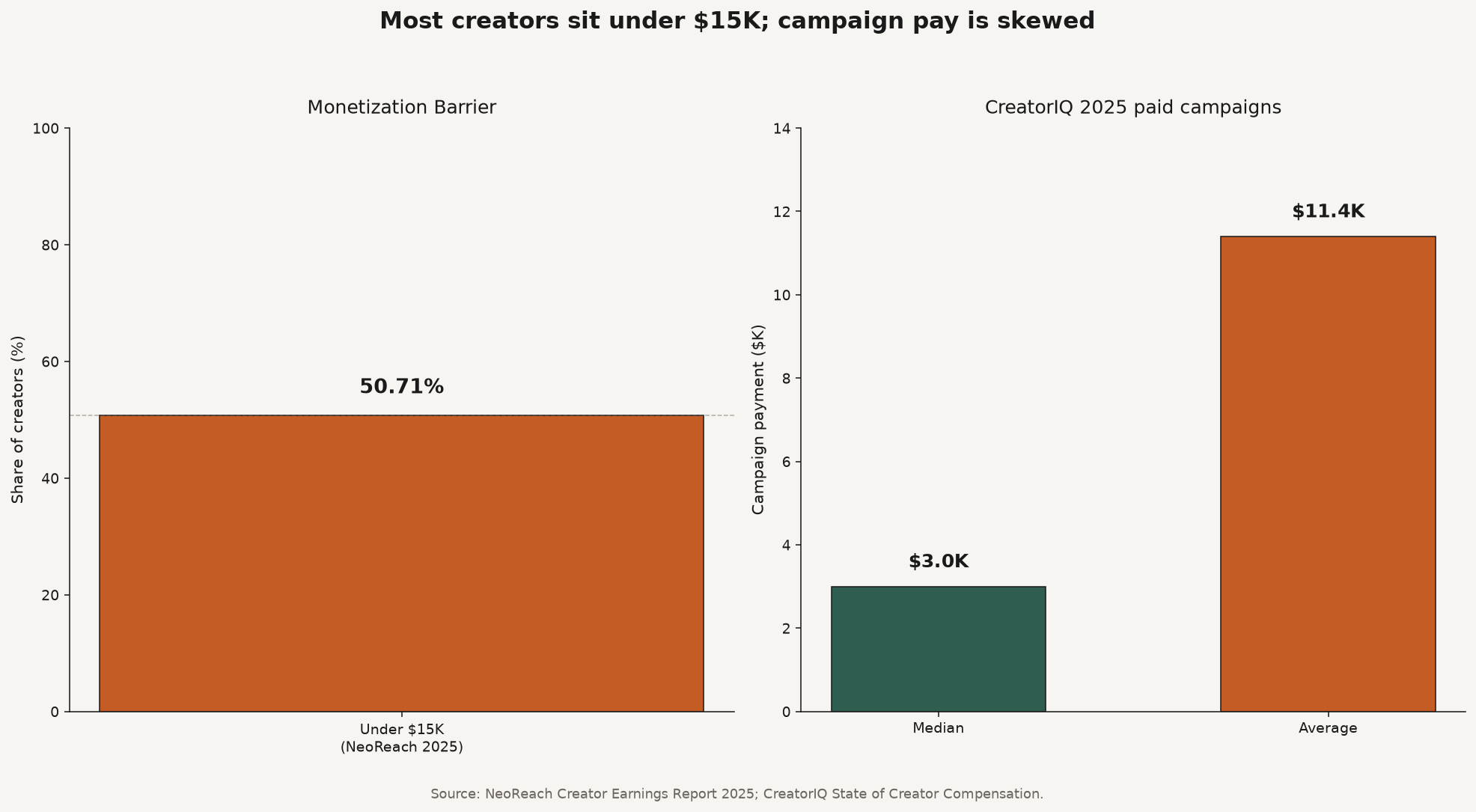
Source: NeoReach Creator Earnings Report 2025; CreatorIQ State of Creator Compensation. https://neoreach.com/reports/creator-earnings-report-2025/ ; https://www.creatoriq.com/press/releases/state-of-creator-compensation-.
If your planning model needs a single “average creator salary,” you are already lying to yourself. Build a stack that can clear ~$1,250/month before you worship a platform mean.
Primary platform choice correlates with different average annual incomes in NeoReach’s sample, but popularity and pay do not move together. TikTok led as the primary platform for surveyed creators while sitting below Instagram and YouTube on average annual income. Follower tier still matters for negotiating a sponsored deliverable. It does not publish your yearly W-2.
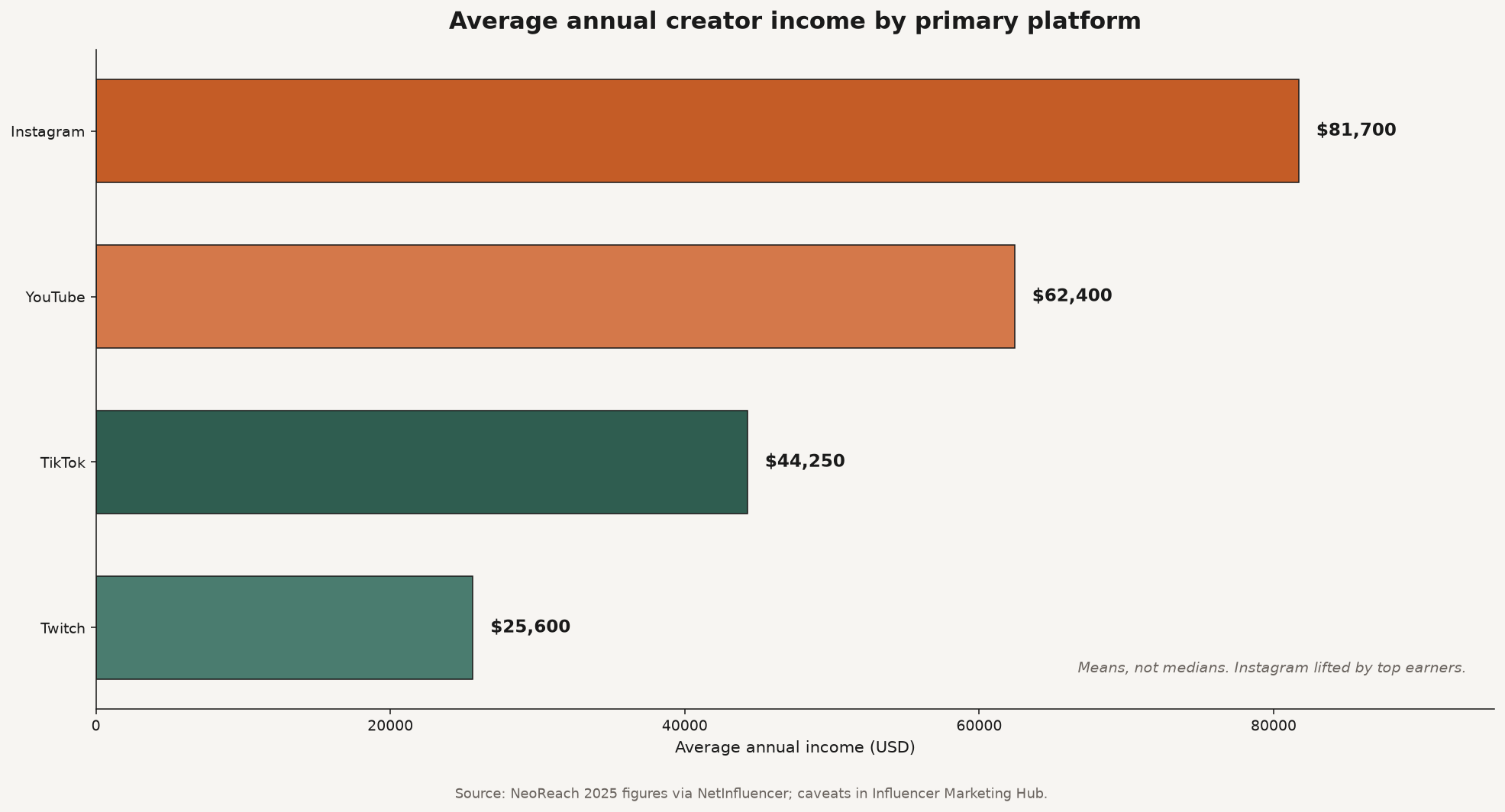
Source: NeoReach Creator Earnings Report 2025 figures as reported by NetInfluencer; qualitative caveats in Influencer Marketing Hub. https://www.netinfluencer.com/over-half-of-full-time-creators-earn-below-us-living-wage-despite-250b-industry-neoreach-finds/ ; https://influencermarketinghub.com/creator-earnings-report-2025/.
| Primary platform (NeoReach sample) | Reported average annual income | Caveat from the same research |
|---|---|---|
| $81,700 | Mean lifted by a small set of top earners | |
| YouTube | $62,400 | Higher-earning creators more prominent in responses |
| TikTok | $44,250 | Heaviest concentration of lower income brackets |
| Twitch | $25,600 | Lowest of the four reported averages |
Primary-platform mix in the 2025 sample shifted hard toward TikTok: 45.5% named TikTok primary, 30% YouTube, 21.03% Instagram, versus Instagram at 62.68% in 2023 (NetInfluencer / NeoReach). Accessibility is not the same as average pay. A merchant reading only TikTok share will overfund discovery. A creator reading only Instagram’s mean will overpromise rent.
Follower tier predicts the asking range for a post more than it predicts annual revenue. Brands still sort rosters by nano/micro/macro. Cheerful-style ask versus offer bands are the honest public object for that job (rates by follower count and platform). Annual income also depends on deal volume, niche CPM, owned products, affiliates, and whether you work full-time.
| Signal | What public data supports | What to refuse |
|---|---|---|
| Primary platform averages | NeoReach platform means above | Treating $81.7K Instagram as “typical Instagram creator pay” |
| Monetization Barrier ~$15K | NeoReach 50.71% under the line | Assuming time alone crosses the barrier |
| Campaign median vs average | CreatorIQ $3K median vs $11.4K average | Using only the average in a pitch deck |
| Follower tier | Useful for post-rate negotiation | Invented “10K followers = $X/year” salary tables |
| Business ownership | ~44.8% own a brand; those earners near $100K in NeoReach highlights | Assuming every merch drop hits that mean |
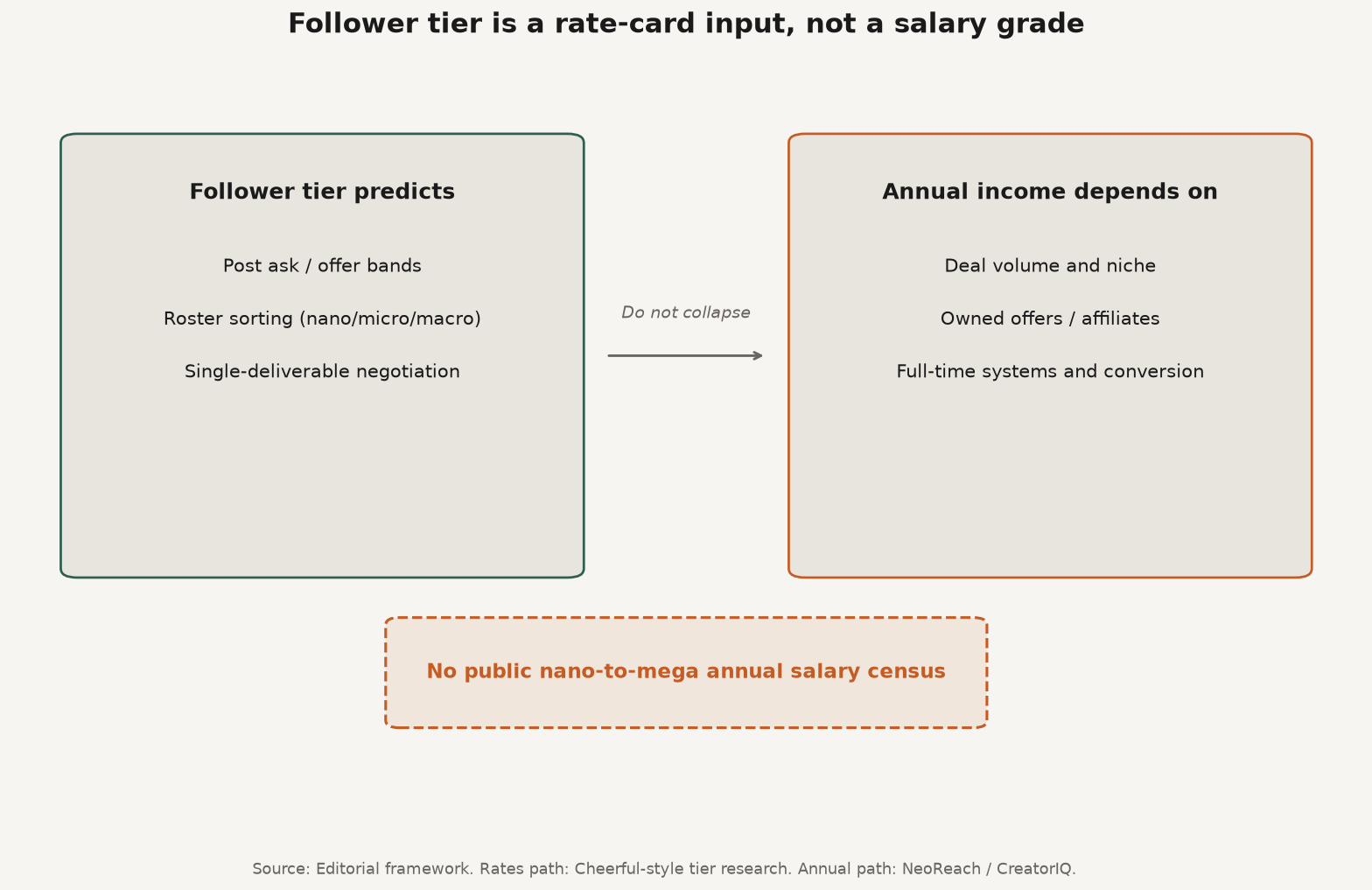
Source: Editorial framework. Post-rate path links to Cheerful-style tier research; annual path uses NeoReach barrier and CreatorIQ concentration. https://neoreach.com/reports/creator-earnings-report-2025/.
Over 49% of NeoReach respondents still earn most revenue from brand deals, down about ten points from the prior year, with shifts toward ad revenue (21%, up from 13%) and self-owned businesses (18%, up from 15%) in NetInfluencer’s summary (IMH; NetInfluencer). Creators who said their primary focus was making money reported average annual income over $132K, a figure the report itself flags as skewed by high earners (IMH).
That is why digital product versus sponsorship and creator platform fees belong in the same planning conversation as follower count. A smaller audience with an owned offer can beat a larger audience that only waits for brand briefs. Affiliates and co-selling are another path when you recommend well but do not want to manufacture SKUs (how affiliate marketing works).
These answers restate the NeoReach platform means, the ~$15K Monetization Barrier, CreatorIQ’s median-versus-average campaign gap, and the hard line that follower tier prices a post, not a verified annual salary. Use them as lift-ready quotes, then read the tables above for caveats.
Q: How much do creators earn by platform and follower tier? A: NeoReach’s 2025 averages put Instagram near $81,700, YouTube $62,400, TikTok $44,250, and Twitch $25,600 in annual income for primary-platform respondents, while 50.71% of creators still earn under $15K. There is no public census that maps each follower tier to a verified annual salary.
Q: Which platform pays creators the most? A: In NeoReach’s reported averages, Instagram leads, then YouTube, TikTok, and Twitch. Those are means, not medians, and Instagram’s figure is pulled up by top earners. Your niche, deal mix, and owned offers can beat the platform ranking.
Q: Does having more followers guarantee higher income? A: No. NeoReach’s Monetization Barrier sits near $15K regardless of the talent and reach story people tell themselves. Follower tier helps price a post. It does not guarantee annual revenue.
Q: What is a typical creator campaign payment? A: CreatorIQ’s 2025 campaign data shows a $3,000 median and an $11,400 average, with the top 10% of creators taking 62% of payment volume. Plan with the median unless you have evidence you are in the top of the distribution.
Q: How should a creator under 100K followers think about earnings? A: Expect to compete inside the large under-100K share of survey respondents and prioritize conversion systems (offers, email, affiliates) over waiting for a macro label. Use public post-rate bands when you negotiate, and ignore invented yearly salary ladders.
How much creators earn by platform and follower tier is a survey-and-systems problem, not a follower multiplication table. Platform averages differ, outliers distort them, and more than half of NeoReach’s creators still sit under $15K. Follower tiers belong on rate cards. Annual income belongs to the creators who convert attention into owned or partnered cash flow.
If you want products to sell without inventing a six-figure follower fantasy first, browse offers on the feat. marketplace.
Turn your audience into a distribution channel with a five-rung ladder—attention, trust, offer, sales surface, and economics—not follower vanity.
Affiliate marketing for small creators works on trust density: one problem, one offer class, one surface, EPC math (median ~$0.14), FTC disclosure—not a follower floor.
How to create a storefront as a creator: name the job (route, sell-own, sell-others), pick Linktree, Stan, Beacons, or a co-branded page, then ship one hero offer.