How to Turn Your Audience Into a Distribution Channel
Turn your audience into a distribution channel with a five-rung ladder—attention, trust, offer, sales surface, and economics—not follower vanity.
Creator platform fee comparison across Gumroad, Stan, Whop, Beacons, and Linktree: fee shapes, published rates, and take-home at fixed monthly GMV.

TL;DR: Creator platform fee comparison starts with fee shape, not logo. Gumroad takes a percentage (and is Merchant of Record). Stan sells a flat subscription with 0% platform cut. Whop prices like a payments stack (2.7% + $0.30 on domestic cards). Beacons and Linktree mix free percentages with paid 0% tiers. Compare at a fixed monthly GMV before you migrate.
Creators argue about Gumroad, Stan, Whop, Beacons, and Linktree as if one sticker price settles the fight. It does not. A “free” plan that takes 12% of every sale can cost more than a $29 flat fee once you actually sell. A “cheap” card rate can grow when optional tax and billing add-ons switch on.
If you need a creator platform fee comparison that is safe to quote, you need three things: the published fee shape for each tool, a worked example at fixed GMV, and honesty about what is not comparable (Merchant of Record vs Stripe pass-through vs sell-your-own vs sell-others).
Key takeaways:
Creator platform fee comparison is the side-by-side reading of published subscription fees, platform transaction cuts, and payment-processing layers across tools creators use to sell digital products, memberships, and bio commerce.
It is not the same job as picking a link hub versus a storefront. That page answers what the bio link is for. This page answers what you pay after the sale clears.
Four fee shapes show up again and again:
If you mix those shapes without labeling them, your spreadsheet lies.
Fee mistakes show up as “I am not making money,” not as a pricing FAQ. Low-ticket SKUs feel the $0.50 and the fixed card cents hardest. High-ticket courses feel percentage cuts hardest. Memberships feel both, every renewal.
Why the ledger matters:
There is no public dataset that ranks one platform as cheapest for every creator niche. Anyone who crowns a universal winner without your price point and volume is selling certainty they do not have.
Read each vendor’s help center, classify the fee shape, then run the same monthly GMV through every row. Keep processor fees visible. Keep marketplace discovery fees visible. Keep feat. in a separate column when the job is selling someone else’s product.
| Platform | Fee shape | Published platform price | Processor / extras (typical US) | Source |
|---|---|---|---|---|
| Gumroad | % + MoR | 10% + $0.50 direct; 30% Discover | MoR tax handling included in model | Gumroad pricing |
| Stan Store | Flat + 0% | $29 Creator / $99 Creator Pro | Stripe ~2.9% + $0.30 (US); PayPal separate | Stan fees |
| Whop | Processor-as-platform | No monthly on standard pricing; 2.7% + $0.30 domestic cards | +1.5% intl; optional stacks | Whop fees |
| Beacons | % then flat 0% | 9% on Free/$10 Creator; 0% on $30 Plus / $90 Max | Stripe 2.9% + $0.30 | Beacons fees |
| Linktree | % then 0% tier | 12% Free; 9% Starter/Pro; 0% Premium on digital products | Stripe 2.9% + $0.30 | Linktree fees |
| feat. | Marketplace (list + split) | Live fees at signup / checkout / in-product | Stripe-powered splits; not a public fixed menu here | Product docs; do not invent |
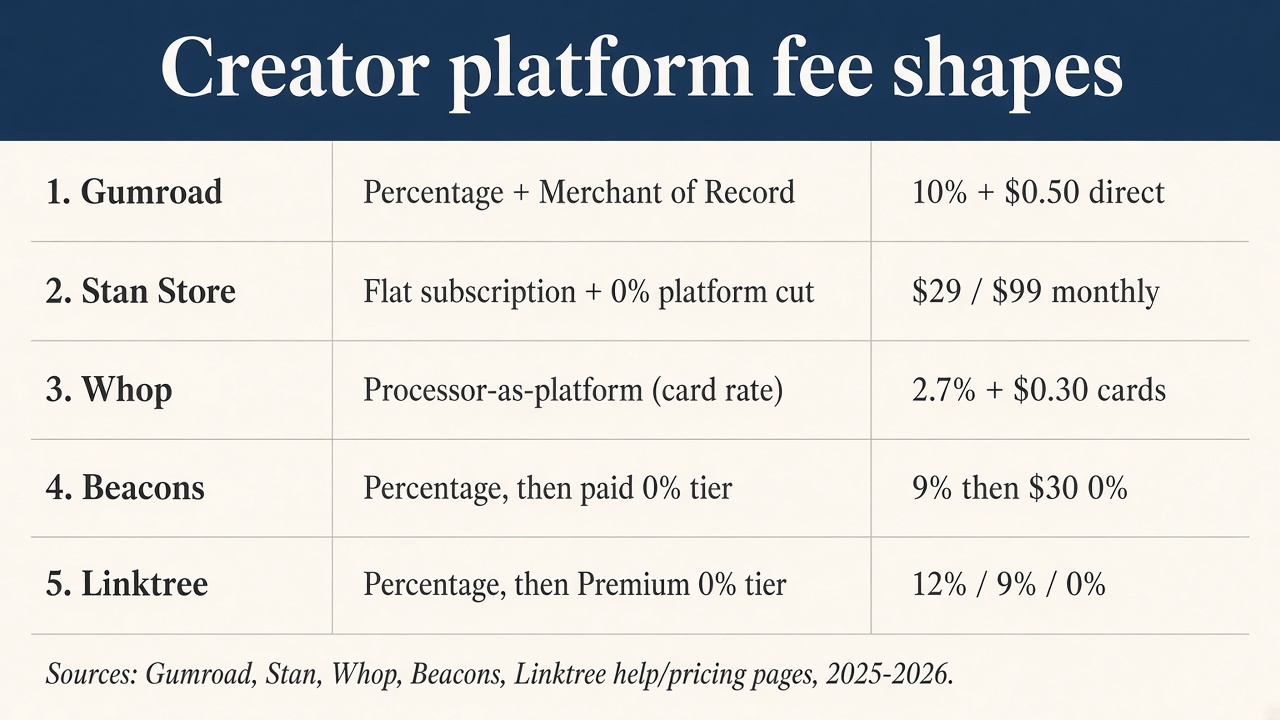
Source: Platform help centers and pricing pages cited in the table (accessed 2026-09-27).
Assumptions for an original analysis (not a survey of live accounts):
| Setup | Platform-layer cost at $2,000 GMV | Notes |
|---|---|---|
| Linktree Free (12%) | $240 | Plus Stripe on each sale |
| Gumroad direct (10% + $0.50 × 20) | $210 | MoR bundle; Discover would be far higher |
| Beacons Free / Creator (9%) | $180 | Plus Stripe |
| Whop base cards (2.7% + $0.30 × 20) | $60 | All-in card fee on this path |
| Beacons Creator Plus ($30, 0%) | $30 | Plus Stripe |
| Stan Creator ($29, 0%) | $29 | Plus Stripe ~$64 on this mix ($3.20 × 20) |
Reading the table honestly:
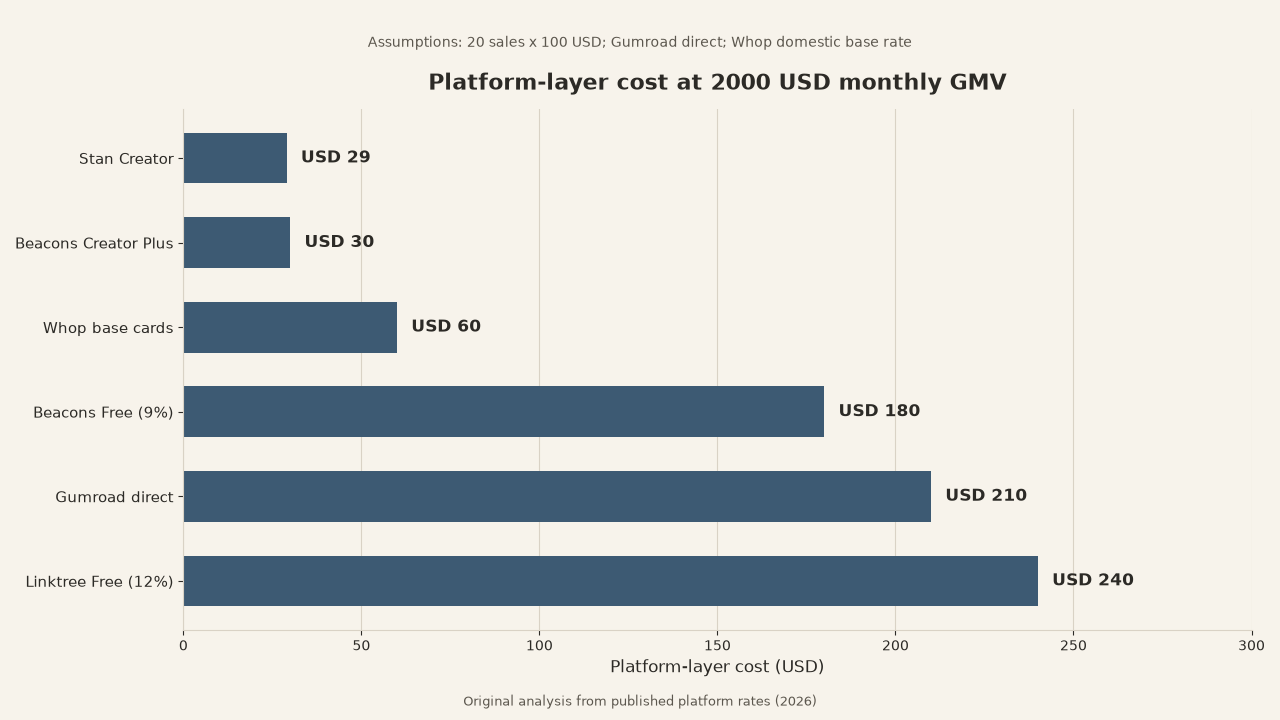
Source: Original analysis from published rates (Gumroad, Stan, Whop, Beacons, Linktree). Assumptions: 20 x $100 sales; Gumroad direct; Whop base domestic cards.
Platform fees only (ignore Stripe for a moment so the shape is clear):
Below those lines, percentage “free” plans often win. Above them, flat 0% tiers usually win if you are bringing your own traffic.
Two traps show up in community threads:
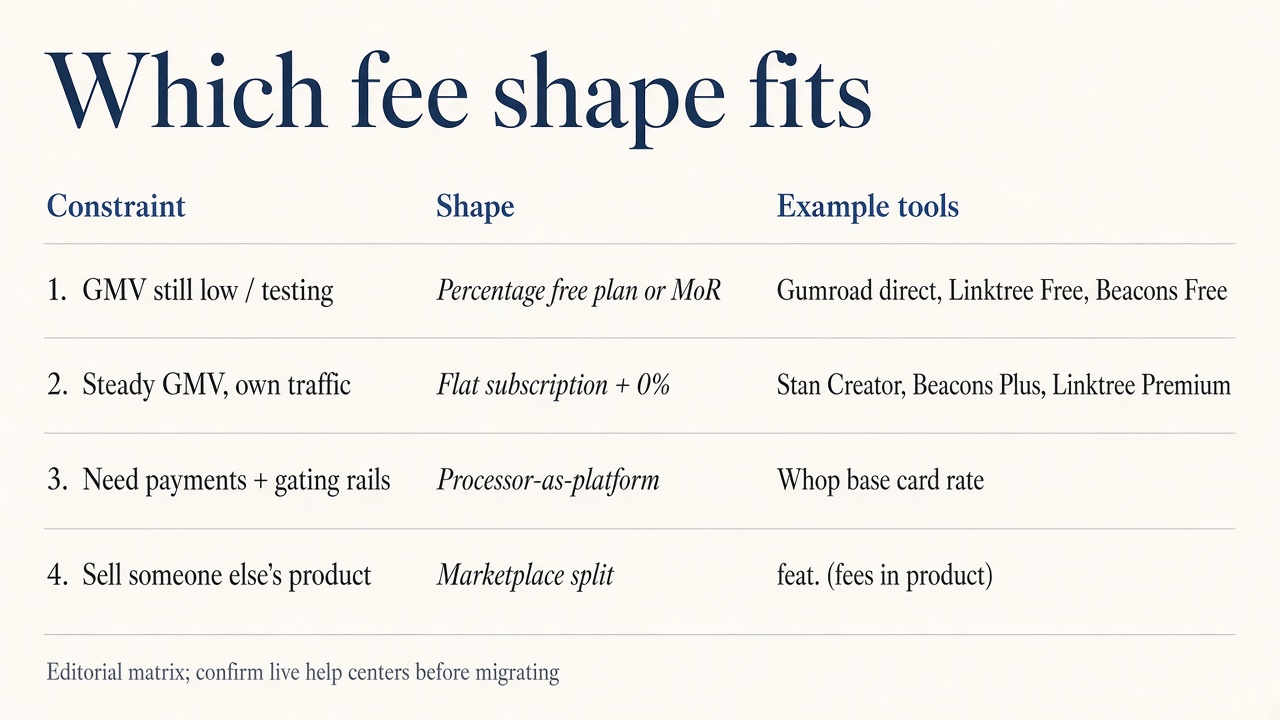
Source: Editorial matrix; rates from platform help centers cited above.
feat. is built so merchants list products and affiliates sell through co-branded storefronts with a revenue split on tracked sales. That is closer to how affiliate marketing works than to “host my course PDF.”
Public product context: feat. monetizes through listing fees and a cut of marketplace-driven sales, with live amounts shown at signup, checkout, or in-product. Deck model assumptions are not current public pricing. If a comparison table needs a feat. cell, the honest cell is confirm in product, not a blogger-invented percentage.
Use this page for sell-your-own fee shapes. Use feat. when the job is sell-others with tracking and a split.
Common failure modes: comparing Gumroad 10% to Stan 0% without MoR or Stripe; pricing Whop from a 2025 blog that still lists a removed gating fee; staying on Linktree Free at $5k GMV because the plan says free; inventing a feat. cut from a pitch deck.
Q: Which creator platform has the lowest fees? A: It depends on your GMV and fee shape. At roughly $2,000/mo with twenty $100 sales, Stan Creator ($29) and Beacons Plus ($30) beat Linktree Free and Gumroad direct on platform-layer cost, while Whop’s base card rate can undercut percentage MoR pricing. There is no universal winner dataset.
Q: Is Gumroad more expensive than Stan Store? A: On platform dollars at meaningful GMV, usually yes, because Gumroad’s direct rate is 10% + $0.50 with no monthly floor (Gumroad) while Stan is $29 or $99 with 0% platform cut (Stan Help). Gumroad also acts as Merchant of Record for tax, which Stan’s Stripe pass-through does not replace.
Q: What are Whop’s fees in 2026? A: Whop’s published domestic card rate is 2.7% + $0.30 with no monthly setup fee on standard pricing (Whop docs). International cards, currency conversion, and optional orchestration, billing, or tax features add more. Confirm the live docs; secondary blogs lag.
Q: When should I leave a free plan with a percentage fee? A: When monthly GMV times the percentage exceeds the flat 0% plan. Examples: Linktree Free 12% vs Stan $29 near $242 GMV/mo; Beacons Free 9% vs Creator Plus $30 near $333 GMV/mo (platform fees only).
Q: Does this creator platform fee comparison include feat. pricing? A: It includes feat.'s role (merchant lists, affiliate sells, tracked split) and states that live fees appear at signup, checkout, or in-product. It does not invent a public feat. percentage or monthly sticker.
Creator platform fee comparison is fee-shape literacy. Percentage plans finance your upside. Flat plans finance your software. Processor-as-platform plans finance the rails. Merchant of Record plans finance tax ops inside the cut. Run one GMV number through every row, keep Discover and add-ons honest, and separate sell-your-own tools from sell-others marketplaces. Logos are branding. The ledger is the decision.
If you need affiliates selling merchant products through co-branded storefronts rather than another PDF host, start at https://www.feat.press.
Turn your audience into a distribution channel with a five-rung ladder—attention, trust, offer, sales surface, and economics—not follower vanity.
Affiliate marketing for small creators works on trust density: one problem, one offer class, one surface, EPC math (median ~$0.14), FTC disclosure—not a follower floor.
How to create a storefront as a creator: name the job (route, sell-own, sell-others), pick Linktree, Stan, Beacons, or a co-branded page, then ship one hero offer.