How to Turn Your Audience Into a Distribution Channel
Turn your audience into a distribution channel with a five-rung ladder—attention, trust, offer, sales surface, and economics—not follower vanity.
Creator economy market size depends on definition. Goldman's $480B-by-2027 is a 2023 TAM; 2025 note puts ~67M creators at ~10% CAGR. Read the ladder.

TL;DR: Creator economy market size and growth is a definition problem before it is a spreadsheet problem. Goldman Sachs’s famous $480B-by-2027 figure is an April 2023 TAM projection from a ~$250B base. Goldman’s March 2025 note re-baselines headcount at ~67M creators in 2025, growing ~10% CAGR toward ~107M by 2030. Size the rung you mean, then face concentration.
People ask for one number. The internet gives them “$480 billion” and pretends the year does not matter.
Creator economy market size and growth only makes sense when you name what is inside the dollar: brand creator spend, creator take-home, platform payouts, tooling, or a total addressable market (TAM) built for investors. Mix those layers and you get a slide that impresses a room and misleads every budget decision after.
Key takeaways:
Creator economy market size and growth is the attempt to measure how large the ecosystem of individual content creators is in dollars and people, and how fast those measures are changing.
Goldman Sachs defines the creator economy as an ecosystem where individuals create content for digital consumption with the goal of building an audience and monetizing their brand (GS 2025 PDF). That definition is useful and still incomplete for sizing. Do you count only money that lands in creator bank accounts? Brand budgets for influencer campaigns? Platform ad-revenue share? Creator-run commerce? The agencies and SaaS tools around them?
Growth has the same fork. Headcount can explode while professional share shrinks. Aggregate payments can rise while the median campaign fee stalls. A CAGR attached to a 2023 TAM is not the same object as a CAGR attached to creator counts in a 2025 note.
If someone quotes a single size without naming the rung, treat it as marketing copy until you can restate the methodology in one sentence.
Wrong size numbers create wrong strategies. Merchants overbuild affiliate capacity for a fantasy TAM. Creators quit day jobs because a deck said “half a trillion.” Affiliates chase platforms that look huge in a roundup and tiny in attributable sales.
Why the ladder matters:
Reddit threads keep restating the same tension: the economy looks huge in headlines, while most creators describe under-$15K years and unstable months. That language is demand evidence. It is not a substitute for primary methodology.
Market size works by stacking definitions. Growth works by picking one stack and tracking it over time. The honest page shows both Goldmans, a brand-spend rung, headcount, and concentration, then refuses to invent a single 2026 GMV everyone secretly agrees on.
| Rung | What it roughly counts | Anchored figure | Source and date | Use it for |
|---|---|---|---|---|
| Narrow brand spend | Marketer investment in creator / influencer campaigns | ~$32.6B global in 2025 | CreatorIQ, Jan 21, 2026 | Brand media budgets, agency scopes |
| Mid TAM (dated) | Goldman’s creator-economy total addressable market | ~$250B (then-current) | Goldman Sachs GIR, Apr 5, 2023 | Investor framing of 2023 base |
| Mid TAM projection | Same Goldman construction, forward | ~$480B by 2027 (~14% '22-'27E CAGR) | Goldman Sachs GIR, Apr 5, 2023 | Historical forecast, not a 2026 census |
| Headcount base | People who consider themselves creators | ~66.6M in 2025; ~107.2M by 2030 (~10% CAGR) | Goldman Sachs GIR, Mar 26, 2025 | Supply of creators, talent markets |
| Platform payout pool | Money one platform says it paid out | $100B+ over four years (YouTube) | YouTube CEO letter, Jan 21, 2026 | Platform economics, not whole-economy GMV |
These rows are not a time series of one metric. Mixing them into one line chart is how roundups manufacture false precision.
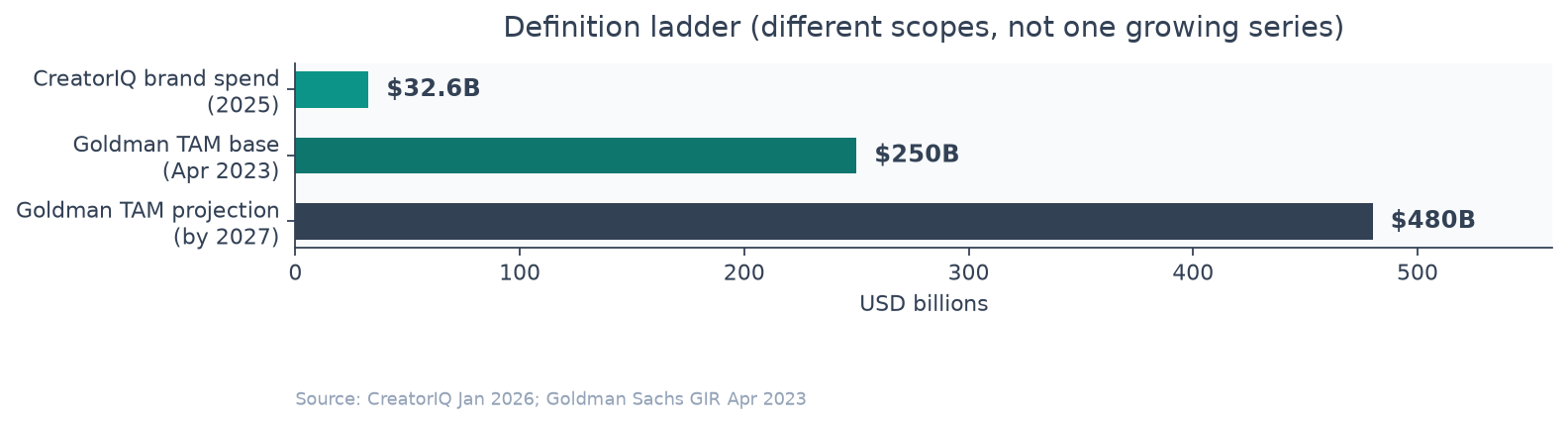
Source: CreatorIQ State of Creator Compensation press release, January 21, 2026 (https://www.creatoriq.com/press/releases/state-of-creator-compensation-); Goldman Sachs Global Investment Research Creator Economy Primer, April 5, 2023 (PDF). Different definitions, not one growing series.
The April 2023 primer is the origin of the half-trillion meme. Analysts estimated a ~$250B TAM that could grow to ~$480B by 2027, largely tracking digital advertising and the rise of short-form monetization (Goldman primer). Quote it with the date or do not quote it.
The March 2025 note does not quietly replace that dollar series with a newer single GMV everyone can copy. It re-emphasizes creator counts and the widening amateur base. Exhibit 3 in that report:
| Year | Total creators (M) | Amateur (M) | Professional (M) | Professional % of total |
|---|---|---|---|---|
| 2022 | 50.0 | 48.0 | 2.0 | 4.0% |
| 2025 | 66.6 | 64.6 | 2.0 | 3.0% |
| 2027 | 80.5 | 78.3 | 2.2 | 2.8% |
| 2030 | 107.2 | 104.5 | 2.7 | 2.5% |
Source: Goldman Sachs GIR, Mar 26, 2025, Exhibit 3 (Zippia / Influencer Marketing Hub / GS estimates). Self-definitions of amateur vs professional (part-time vs full-time).
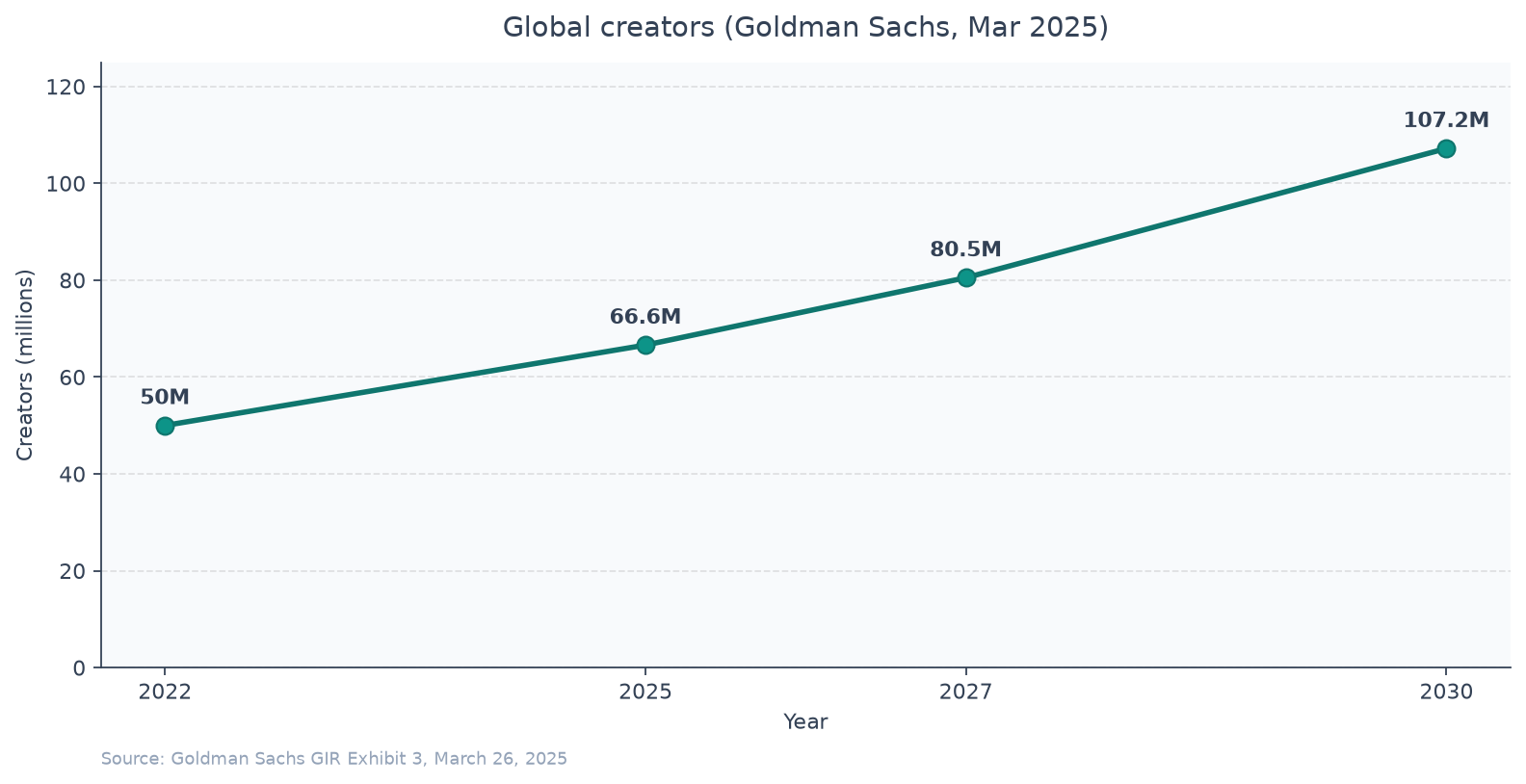
Source: Goldman Sachs Global Investment Research, Creator Economy: Framing Market Opportunity, March 26, 2025, Exhibit 3. https://creatorswithinfluence.com/wp-content/uploads/2025/04/Goldman-Sachs-Global-Investment-Research-Creator-Economy-Framing-Market-Opportunity-Download-Report-March-26-2025.pdf
That table is the growth story most decks skip. The pie gets more creators. The professional slice does not grow as a share of the pie.
Aggregate growth and typical outcomes diverge.
CreatorIQ’s State of Creator Compensation (Jan 21, 2026) reports:
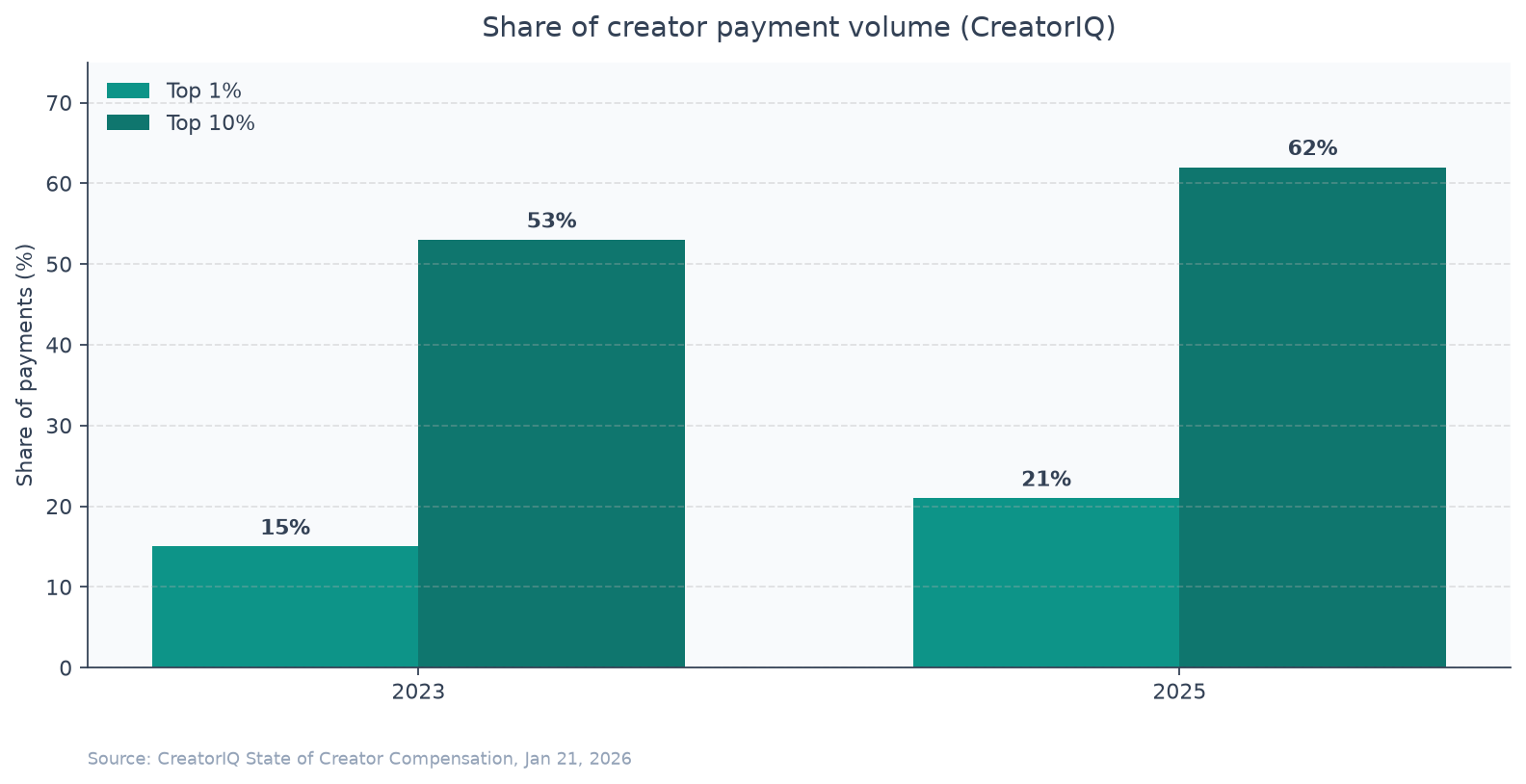
Source: CreatorIQ, State of Creator Compensation press release, January 21, 2026. https://www.creatoriq.com/press/releases/state-of-creator-compensation-. Platform/sample-labeled payment volume, not a census of every creator worldwide.
On the platform-payout side, Goldman’s 2025 note cites Zippia’s finding that 3% of YouTubers capture 90% of net creator earnings on YouTube (GS 2025 PDF). Pair that with YouTube’s own disclosure of $100B+ paid over four years, plus $55B US GDP contribution and 490,000+ full-time-equivalent jobs in 2024 (YouTube). Huge pool. Barbell distribution.
For brand buyers choosing tiers, micro vs macro vs nano influencer ROI and influencer marketing vs paid ads own the efficiency and channel jobs. This page owns the sizing frame those decisions sit inside.
Goldman notes private funding around creator-economy startups reaccelerated in 2024 to about $1.5B in the US, outpacing overall US startup funding growth (reported +29% YoY for all US startups in that comparison) (GS 2025 PDF). That is capital into tools and platforms. It is not creator take-home. Do not add it to CreatorIQ’s $32.6B and call the sum “the market.”
If you sell through creators, you are buying into a growing supply of part-time promoters and a concentrated set of professionals who already capture most paid volume. That favors clear offers, tracked links, and co-selling surfaces over hoping “the $480B market” spills onto your SKU. Published platform fee shapes still matter when creators sell owned products (creator platform fee comparison). Performance affiliate rails still matter when the job is a tracked sale (how affiliate marketing works).
Q: How big is the creator economy in 2026? A: There is no single agreed 2026 total. Use a definition ladder: CreatorIQ estimates ~$32.6B of global creator-marketing brand investment in 2025, while Goldman’s April 2023 primer projected a ~$480B TAM by 2027 from a ~$250B base. Headcount from Goldman’s March 2025 note is ~67M creators in 2025 growing toward ~107M by 2030.
Q: Is the $480 billion creator economy figure still accurate? A: It is a Goldman Sachs April 2023 TAM projection, not a 2026 census. Cite it with that date and methodology. Goldman’s fresher March 2025 research emphasizes creator counts and monetization share shifts rather than quietly refreshing one universal GMV everyone can reuse without context.
Q: How many creators are there in the world? A: Goldman Sachs (March 26, 2025) estimates about 66.6 million global creators in 2025, up from 50.0 million in 2022, growing at roughly a 10% CAGR to about 107.2 million by 2030. Most of that base is amateur or part-time under Goldman’s framing.
Q: Why do creator economy market size estimates disagree? A: Firms count different things: brand influencer spend, creator take-home, platform payouts, commerce, and tooling. Narrow brand-spend figures near the low tens of billions can sit beside mid-hundreds-of-billions TAM projections without either being “wrong” if the definitions differ.
Q: Does a huge creator economy mean most creators earn a living wage? A: No. CreatorIQ finds payment volume concentrated (top 10% at 62% in 2025) with median campaign earnings far below the average. Goldman cites research that 3% of YouTubers capture 90% of net earnings on that platform. Market size and median livelihood are different questions.
Creator economy market size and growth is readable once you stop hunting for one magic integer. Date Goldman’s $250B-to-$480B TAM as a 2023 projection. Use the 2025 headcount path (~67M to ~107M) when you need supply growth. Put CreatorIQ’s brand-spend and concentration numbers next to YouTube’s disclosed payout pool when you need operating reality. Then build offers and partner programs for the distribution you actually face, not the slide.
If you want creators selling tracked products through co-branded storefronts rather than only quoting market-size slides, start at feat..
Turn your audience into a distribution channel with a five-rung ladder—attention, trust, offer, sales surface, and economics—not follower vanity.
Affiliate marketing for small creators works on trust density: one problem, one offer class, one surface, EPC math (median ~$0.14), FTC disclosure—not a follower floor.
How to create a storefront as a creator: name the job (route, sell-own, sell-others), pick Linktree, Stan, Beacons, or a co-branded page, then ship one hero offer.