Marketing Mix Modeling Basics
Marketing mix modeling basics: time-series channel impact with adstock and saturation. Use Meridian or Robyn, calibrate with lift tests, not last-click.
Attribution models compared: last-click, multi-touch (MTA), and MMM. EMARKETER reliability ranks, when each fits, and how incrementality calibrates.

TL;DR: Attribution models compared honestly are different tools for different decisions. Last-click names the closer. Multi-touch attribution (MTA) spreads credit across tracked journeys. Marketing mix modeling (MMM) allocates budget from aggregate spend. Incrementality tests whether ads caused the lift. EMARKETER × TransUnion (July 2025, n=196) found 27.6% of US marketers name MMM most reliable versus 19.4% for MTA.
Your ad platforms all claim the same sale. Shopify says one channel. Finance asks which number is real. Someone opens a slide titled “we need multi-touch” and hopes the argument ends.
Attribution models compared only help when you match the model to the decision. Last-click is a closer report. MTA is a journey map under privacy stress. MMM is a budget allocator that does not need cookies. Incrementality is the causal check when correlation is not enough.
Key takeaways:
Attribution models are rules or statistical methods that assign credit for conversions, revenue, or other outcomes to marketing touchpoints or channels.
Last-click (last-touch) gives 100% of credit to the final tracked interaction before conversion. First-click does the opposite. Multi-touch attribution (MTA) splits credit across multiple tracked touchpoints using a rule (linear, time-decay, position-based) or a data-driven model. Marketing mix modeling (MMM) is not a click path at all: it estimates how aggregate spend and other factors relate to outcomes over time, usually with econometric or Bayesian methods.
Incrementality testing sits beside these models. Google frames it as a randomized controlled experiment that estimates the revenue you would have missed without the campaign, then defines incremental ROAS as incremental revenue divided by media spend (Google Think). Measured’s common formula for incrementality percent is (test conversion rate − control conversion rate) ÷ test conversion rate (Measured).
This page compares the models operators actually argue about. It pairs with CAC vs LTV benchmarks by industry, because a pretty attributed CAC is useless if LTV and payback are wrong, and with how brands calculate influencer marketing ROI, where last-click often buries upper-funnel creator work.
Wrong attribution does not just mislabel a dashboard. It moves money. You cut the channel that built demand because it never “closed,” or you scale the closer that harvested branded intent your content already paid for.
Why the choice fights back:
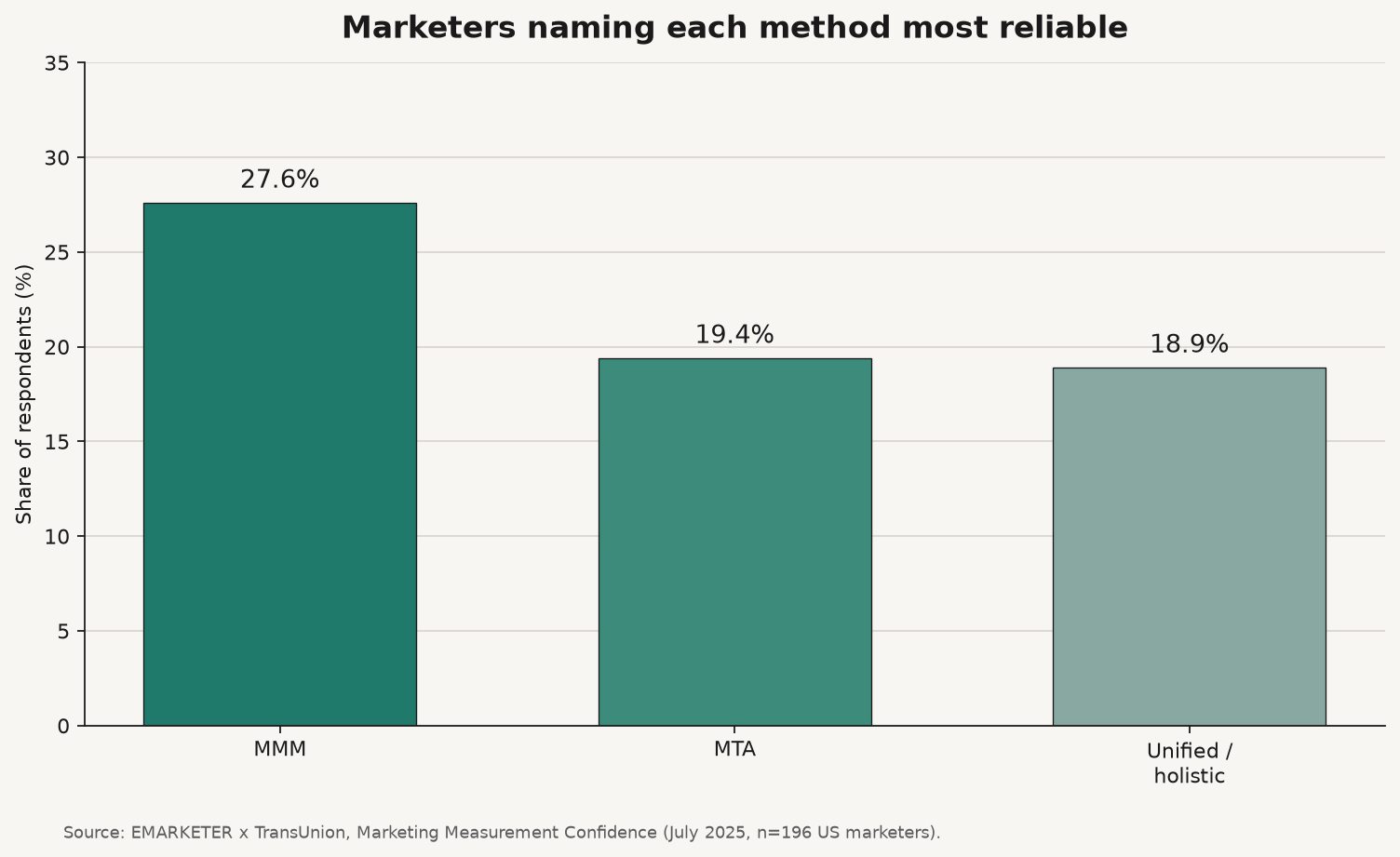
Source: EMARKETER × TransUnion, Marketing Measurement Confidence survey (July 2025, n=196 US marketers). https://www.emarketer.com/content/nearly-half-of-us-marketers-plan-invest-mmm-over-next-year
Start with the decision, then pick the model. Comparing last-click, MTA, and MMM as if one winner replaces the others is how teams buy software and keep fighting.
Last-click answers: which tracked touchpoint finished the sale?
It is simple, available in almost every ad platform and analytics tool, and useful for short paths: a same-session search, a retargeting click after strong intent, a coupon code at checkout. Use it for tactical optimization of bottom-funnel creatives and keywords when the journey is short and the path is mostly observed.
Do not use it as the only truth for channel budget when awareness, creators, email, or offline influence sit earlier in the path. Reddit threads calling last-click “flat earth” are loud for a reason: it is correlation with the end of the path, not proof of causation (r/analytics).
MTA answers: how should we split credit across the tracked touchpoints we can see?
Common rule sets:
| MTA rule | How credit is split | Fits when |
|---|---|---|
| Linear | Equal share to every touch | You want a simple multipoint view |
| Time-decay | More credit to recent touches | Late touches dominate your cycle |
| Position-based (U-shape) | Heavy first and last; light middle | You care about discovery and close |
| Data-driven / algorithmic | Model-estimated weights | You have volume and clean paths |
MTA is directionally better than last-click for journey storytelling. It still only credits what it observes. Dark social, walled-garden views without clicks, and consent gaps leave holes. Operators on r/GoogleAnalytics often land here: MTA for tactical digital directionality, not as sole strategic truth (r/GoogleAnalytics).
MMM answers: given spend, seasonality, price, and other aggregate inputs, how much outcome should we attribute to each channel over time?
MMM does not need user IDs. That is why privacy pressure revived it. EMARKETER’s July 2025 sample shows marketers naming MMM the top “most reliable” methodology more often than MTA, and nearly half planning fresh MMM investment (EMARKETER). Reliability in a survey is not the same as accuracy on your dataset. Treat MMM as a strategic quarterly tool, not a daily bid manager.
Open-source lowered the license tax. Google Meridian (Bayesian, Python) and Meta Robyn (frequentist, R) are free frameworks. Free code does not mean free expertise. Someone still has to specify the model, judge fit, and defend the output when a channel owner disagrees.
Incrementality answers: what changed because the campaign ran?
Google describes a randomized controlled experiment across exposed and unexposed groups, then defines incremental ROAS as incremental revenue divided by campaign media spend (Google Think). Use lift tests and geo holdouts to calibrate MMM and to stress-check MTA stories. Do not run overlapping tests that contaminate each other. Google’s own guidance calls for an annual testing plan so channel tests do not collide (Google Think).
Deep experiment design belongs in the queued spoke on incrementality testing. Here, treat it as the calibration layer in the stack.
| Decision you need | Prefer | Secondary | Avoid as sole source |
|---|---|---|---|
| Which keyword or creative closed today? | Last-click / platform reporting | Data-driven MTA | MMM (too slow) |
| How should credit split across a tracked journey? | MTA | First-party path analytics | Last-click alone on long paths |
| How should we reallocate next quarter’s budget? | MMM | Incrementality calibration | Platform-reported ROAS alone |
| Did this channel cause incremental sales? | Incrementality test | Calibrated MMM | Unvalidated MTA fractions |
| Short path, low spend, one channel? | Last-click | Simple before/after | Full MMM stack |
| Affiliate or creator introduced the buyer? | Partner tracking + contract rules | Surveys / branded search lift | Pure last-click that erases the introducer |
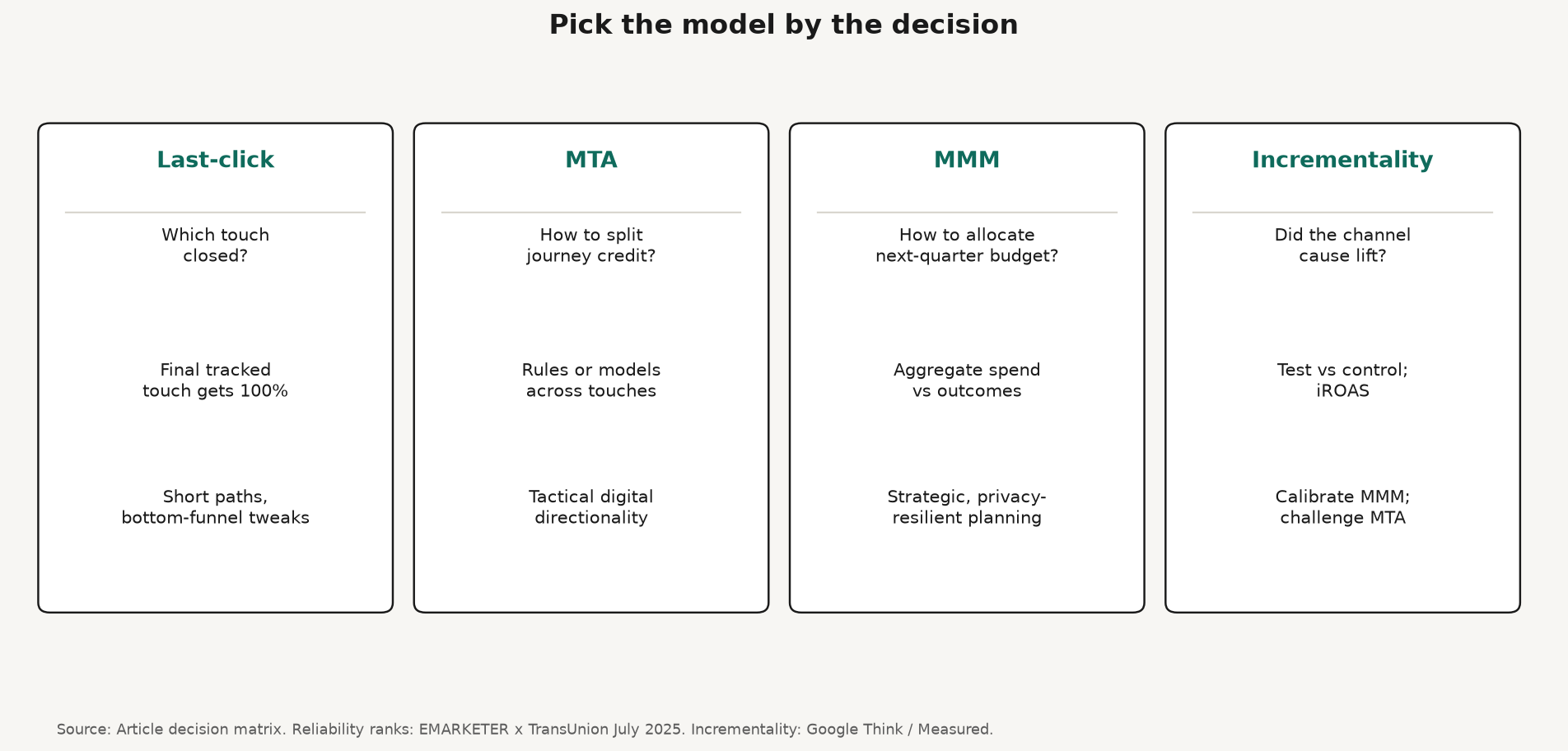
Source: Decision framing synthesized for this article; reliability ranks from EMARKETER × TransUnion July 2025; incrementality definitions from Google Think and Measured. https://www.emarketer.com/content/nearly-half-of-us-marketers-plan-invest-mmm-over-next-year · https://business.google.com/en-all/think/measurement/incrementality-testing/
| Dimension | Last-click | MTA | MMM | Incrementality |
|---|---|---|---|---|
| Unit of analysis | Final touch | User/path touches | Aggregate time series | Test vs control |
| Typical refresh | Hours | Hours to days | Weeks to months | Per experiment (weeks) |
| Privacy resilience | Medium (still needs IDs) | Lower (path dependent) | Higher (aggregates) | Higher (geo/user holdouts) |
| Best output | Closer channel | Journey credit mix | Budget response curves | Causal lift / iROAS |
| Common failure | Ignores upper funnel | Blind spots / overfit rules | Needs history and skill | Slow; one channel at a time |
There is no public peer-reviewed constant that “MTA always over-credits digital by 30%.” Vendor blogs publish directional warnings. Say what your holdout showed, not what a roundup claimed.
Partner channels need explicit rules too. Commission duration and cookie windows are attribution policy by another name (recurring vs one-time affiliate commissions).
Q: What is the difference between last-click and multi-touch attribution?
A: Last-click gives all credit to the final tracked touch before conversion. Multi-touch attribution splits credit across multiple tracked touches using a rule or model. Last-click is simpler and favors closers; MTA is fairer to journeys you can fully observe.
Q: How do attribution models compared include marketing mix modeling?
A: MMM is usually listed with attribution because teams use it to allocate budget, but it is not a click-path model. It estimates channel contribution from aggregate spend and outcomes over time, which makes it more privacy-resilient and slower than last-click or MTA.
Q: Is MTA or MMM more reliable?
A: In EMARKETER × TransUnion’s July 2025 survey of 196 US marketers, 27.6% named MMM the most reliable methodology versus 19.4% for MTA. That is stated confidence, not a universal accuracy ranking. Mature teams often run both: MTA for tactics, MMM for strategy.
Q: When is last-click attribution still useful?
A: Use last-click for short, mostly observed paths and for bottom-funnel creative or keyword tweaks. Do not use it alone to set quarterly budgets across brand, creators, and performance when journeys are long.
Q: How does incrementality testing relate to attribution models?
A: Attribution assigns credit; incrementality estimates causal lift with a test and control. Google defines incremental ROAS as incremental revenue divided by media spend. Use lift tests to calibrate MMM and to challenge MTA stories, not as a replacement for daily reporting.
Attribution models compared well are a stack, not a tournament. Last-click names the closer. MTA maps the tracked journey. MMM allocates budget without needing every cookie. Incrementality asks whether the spend caused the outcome. EMARKETER’s mid-2025 sample shows marketers leaning toward MMM on stated reliability, but your decision matrix still starts with the question on the table.
If you are a merchant who wants creators to sell what you built through co-branded storefronts with a revenue split on every sale, start at feat..
Marketing mix modeling basics: time-series channel impact with adstock and saturation. Use Meridian or Robyn, calibrate with lift tests, not last-click.
Incrementality testing explained: lift formulas, Google iROAS, geo vs user holdouts, and how to calibrate MMM.
Affiliate marketing for startups is an operating system—locks, cost, recruit, rates, tracking, first 100 sales, then diagnose a flat roster.