Incrementality Testing Explained
Incrementality testing explained: lift formulas, Google iROAS, geo vs user holdouts, and how to calibrate MMM.
Marketing mix modeling basics: time-series channel impact with adstock and saturation. Use Meridian or Robyn, calibrate with lift tests, not last-click.

TL;DR: Marketing mix modeling basics start with aggregate time-series data, not cookies. MMM estimates how channel spend (plus controls) drives outcomes with two core mechanisms: adstock (carryover that decays) and saturation (diminishing returns). Use it for budget allocation. Calibrate with lift tests. Do not treat MMM as a daily creative dashboard.
Your platforms all claim the same sale. Last-click says paid search won. Brand asks why you cut creators. Finance wants one budget story that survives privacy changes.
Marketing mix modeling basics exist for that fight. MMM estimates incremental impact from weekly (or similar) spend and outcome series. It does not need a user-level path. It does need honesty about lag, diminishing returns, and calibration.
Key takeaways:
Marketing mix modeling is a statistical approach that estimates how marketing activities and other factors contribute to business outcomes using aggregated historical time-series data.
It is not multi-touch attribution. MTA follows user paths when it can see them. MMM regresses outcomes on channel spend (and controls such as price, distribution, seasonality, or brand interest) over time. Google’s Meridian docs describe the job as estimating causal incremental outcome for treatment variables, then turning those estimates into ROI, response curves, and budget recommendations (Meridian).
If someone sells you “MMM” that only reshuffles last-click credits, that is not MMM.
Click paths are thinner every year. Walled gardens hide assists. Offline and upper-funnel spend look “inefficient” on last-click and then get cut until demand collapses.
Why the basics matter:
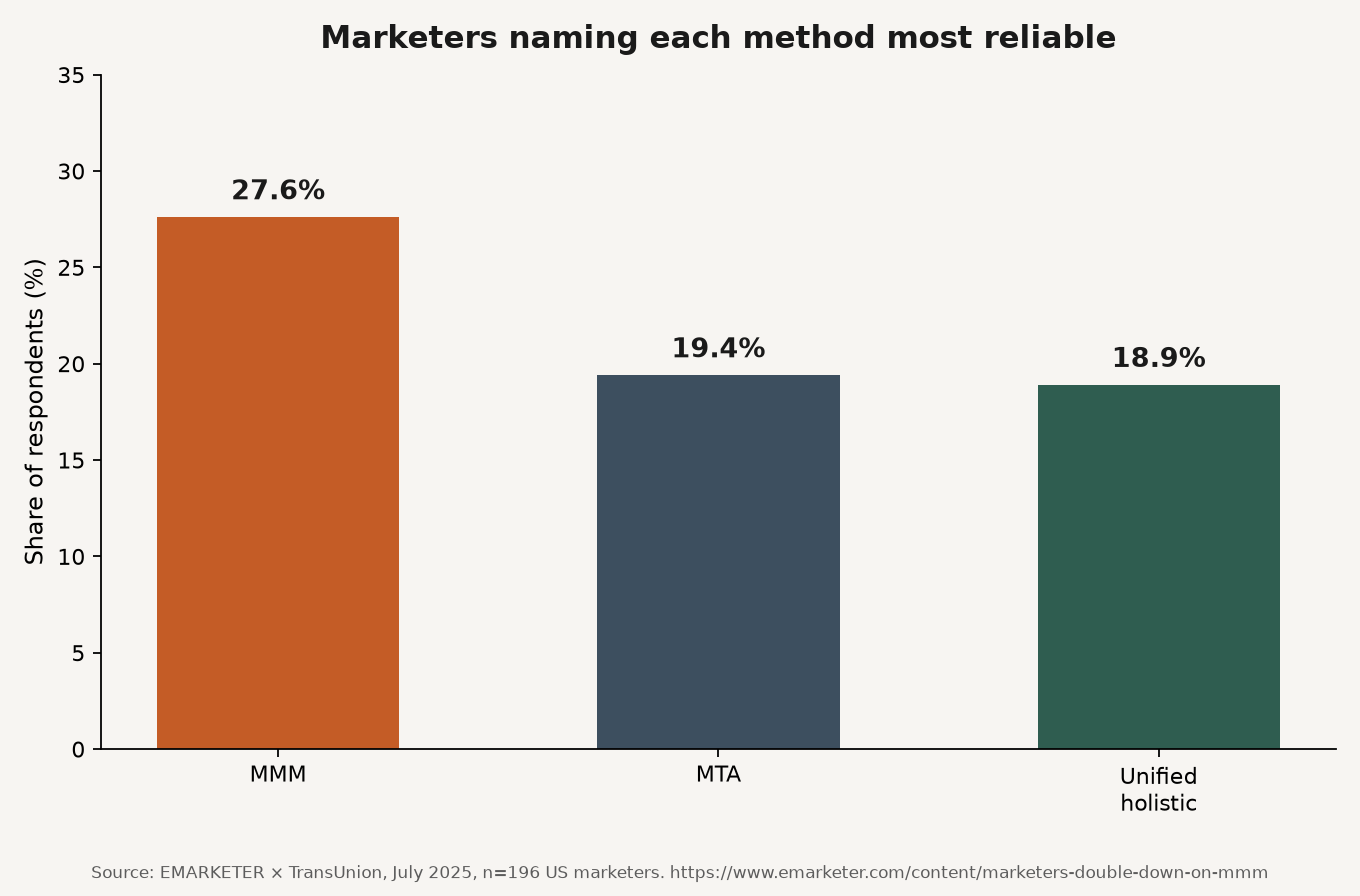
Source: EMARKETER × TransUnion, Marketing Measurement Confidence survey, July 2025 (n=196 US marketers). https://www.emarketer.com/content/marketers-double-down-on-mmm
MMM fits a model where outcomes vary with media execution and controls over time. The media terms are transformed so spend today can affect outcomes later (adstock) and so more spend eventually returns less (saturation). Posteriors or calibrated coefficients become contribution, ROI, response curves, and a budget recommendation. Calibrate those curves with incrementality tests before you move seven figures.
Meridian’s architecture is explicit: media effects on KPI are governed by a lagged effect and a saturation effect (Meridian).
| Mechanism | Plain-language job | Meridian implementation note |
|---|---|---|
| Adstock (lag / carryover) | Ads keep working after the spend week; effect tapers | Cumulative effect as a weighted average of current and past media with geometric or binomial weights; max lag caps how far back you look |
| Saturation (diminishing returns) | The next dollar eventually buys less than the first | Hill function with ec and slope parameters; can sit before or after Adstock (hill_before_adstock, default False) |
If your “MMM” is linear in raw spend with no carryover and no diminishing returns, it will over-trust last week’s blitz and under-warn you about saturation.
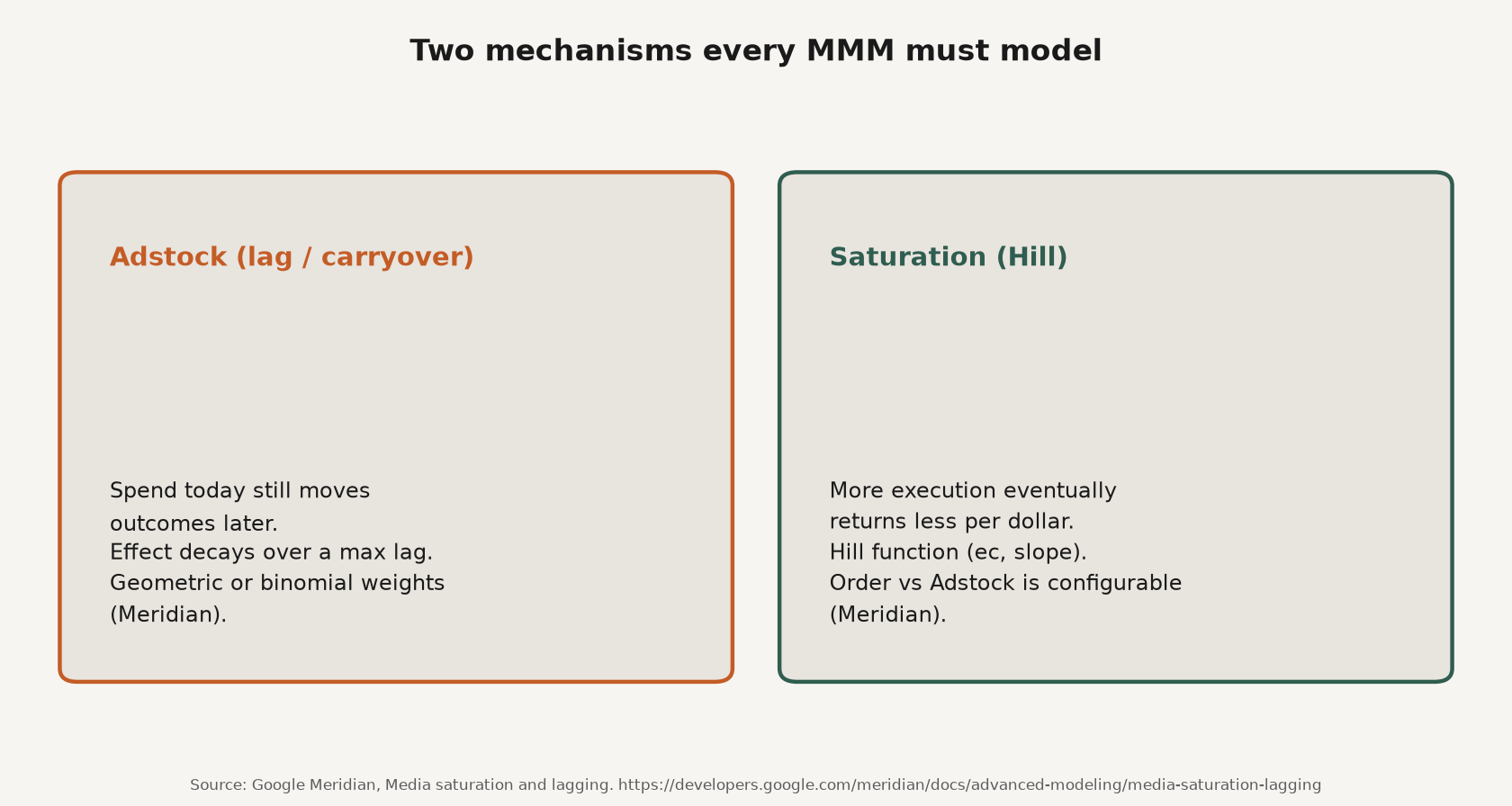
Source: Google Meridian documentation on media saturation and lagging. https://developers.google.com/meridian/docs/advanced-modeling/media-saturation-lagging
Meridian is Google’s open-source Bayesian MMM. The docs say it is free, inspectable, and built to answer three business questions (Meridian):
The journey is pre-modeling (KPI, media, controls), modeling (Bayesian core with lag and saturation; posterior distributions), and post-modeling (fit checks, contribution, ROI with credible intervals, budget optimization) (Meridian). Priors let you inject domain knowledge. Geo-level data and optional reach/frequency inputs are first-class options when you have them.
Robyn is Meta Marketing Science’s open-source MMM package. The project site stresses ridge regression to regularize multicollinearity, Nevergrad evolutionary search for hyperparameters, Prophet for trend/season/holiday decomposition, calibration against ground-truth methods (geo, Facebook lift, MTA, and similar), and a gradient-based budget allocator. It is privacy-by-design: no PII or cookie/pixel dependency required (Robyn; GitHub).
| Dimension | Google Meridian | Meta Robyn |
|---|---|---|
| Core style | Bayesian hierarchical MMM | Ridge + evolutionary HPO (Nevergrad) |
| Time structure | Explicit Adstock + Hill in model architecture | Adstock and saturation via hyperparameter search; Prophet for baseline patterns |
| Causal stance | Docs emphasize causal inference design and priors | Emphasizes calibration to experimental / ground-truth methods |
| Action layer | Built-in optimization and scenario planning | Budget allocator + model one-pagers |
| Typical staff fit | Teams comfortable with Bayesian workflows / Python | Teams comfortable with R (Python also available; check current maturity) |
Neither tool invents clean data for you. Neither replaces a lift test when you need a causal checkpoint.
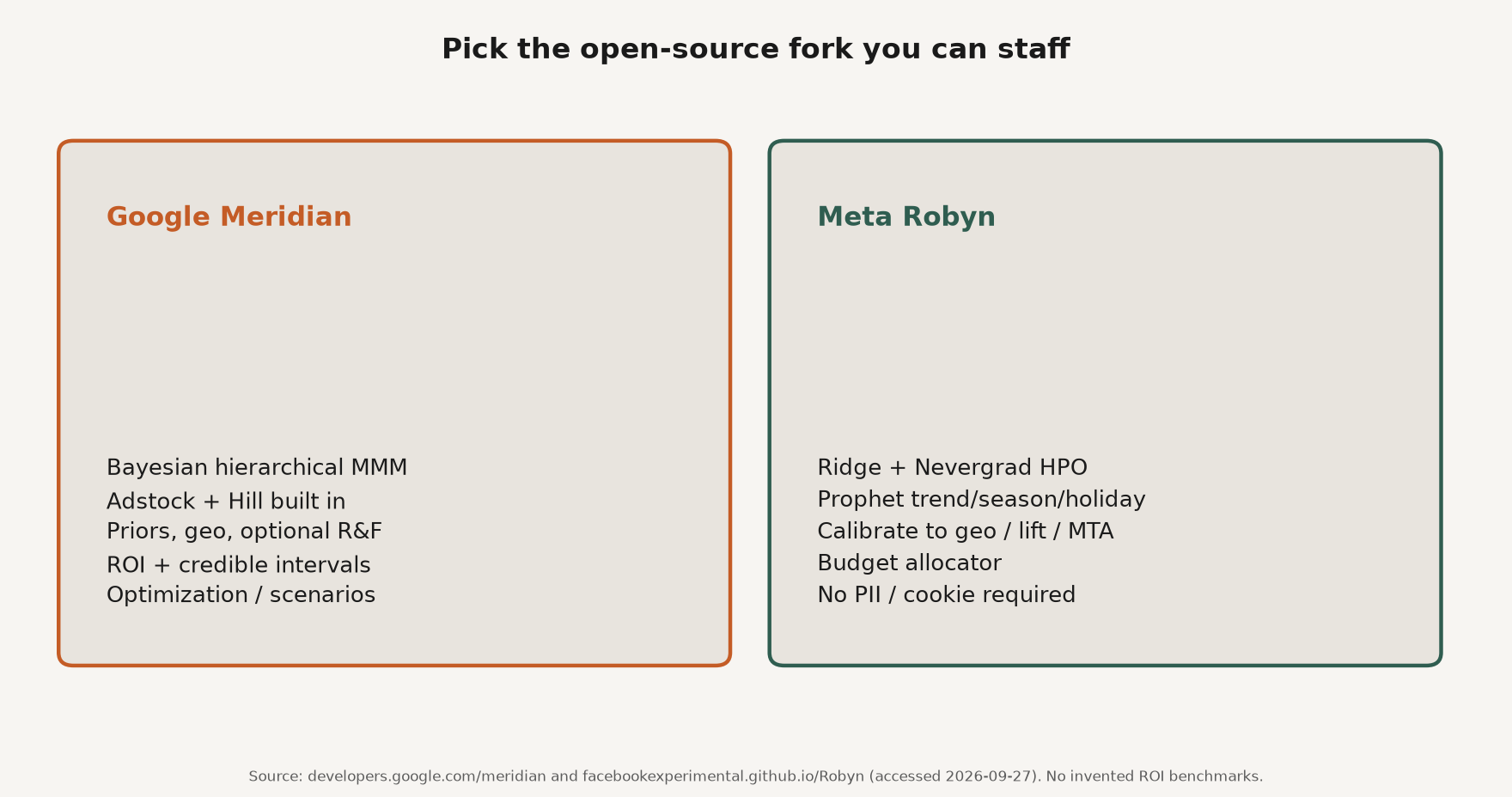
Source: Google Meridian introduction docs and Meta Robyn project documentation (accessed 2026-09-27).
| Question | Prefer | Why |
|---|---|---|
| Which touch closed this session? | Last-click / simple rules | Fast ops; short paths (attribution models) |
| How do tracked journeys share credit? | MTA | Journey map when first-party paths exist |
| How should next quarter’s media mix look? | MMM | Aggregates, offline, upper funnel, privacy-durable |
| Did this channel cause lift? | Incrementality / geo holdout | Causal check; use iROAS and lift % to calibrate MMM (incrementality testing) |
There is no public dataset that publishes one true median MMM ROI for every channel and industry. Anyone selling a universal “paid social should be 3.2x in MMM” table without your data is selling comfort.
MMM can include influencer and affiliate spend as media or treatment variables when you have clean weekly cost and a defined outcome. That does not replace creator-specific scorecards (how brands calculate influencer ROI). It stops you from cutting the line because last-click was quiet while long-horizon indexes still looked strong.
Start with the decision, not the package name. Gather weekly outcomes and media costs, pick Meridian or Robyn for the stack you can staff, fit with adstock and saturation, then calibrate with at least one lift test before you reallocate serious budget.
Q: What is marketing mix modeling in plain language? A: It is a statistical model that links aggregated marketing spend and other factors to business outcomes over time. It estimates channel contribution and response curves without requiring user-level click paths.
Q: What are adstock and saturation in MMM? A: Adstock models carryover: today’s media still affects later periods and then decays. Saturation models diminishing returns: more spend in a period eventually adds less incremental outcome. Meridian implements these with Adstock weight functions and a Hill function (Meridian).
Q: How is MMM different from multi-touch attribution? A: MTA assigns credit across tracked user journeys. MMM estimates effects from aggregate time series and controls. Use MTA for in-channel journey questions when paths exist; use MMM for cross-channel budget allocation. See attribution models compared.
Q: Should I use Google Meridian or Meta Robyn? A: Pick the fork your team can staff and audit. Meridian is Bayesian with strong docs on Adstock, Hill, priors, and geo/R&F. Robyn emphasizes ridge regression, Nevergrad search, Prophet baselines, calibration to experiments, and a budget allocator. Many teams evaluate both; neither removes the need for clean data.
Q: Can MMM replace incrementality testing? A: No. MMM gives a comprehensive, assumption-heavy view. Incrementality tests give sharper causal estimates for specific channels and windows. Use lift and iROAS to calibrate MMM, not as a substitute for every budget slide (incrementality testing).
Marketing mix modeling basics are not mysterious once you name the job. Estimate incremental channel impact from aggregates, with adstock for carryover and saturation for diminishing returns. Use Meridian or Robyn for the stack you can operate. Believe the curves only after you calibrate them with experiments. Keep last-click for closing reports and MMM for the mix.
If your growth stack includes creators selling through tracked storefronts, keep those partner economics visible beside media MMM. Start at the feat. marketplace.
Incrementality testing explained: lift formulas, Google iROAS, geo vs user holdouts, and how to calibrate MMM.
Attribution models compared: last-click, multi-touch (MTA), and MMM. EMARKETER reliability ranks, when each fits, and how incrementality calibrates.
Affiliate marketing for startups is an operating system—locks, cost, recruit, rates, tracking, first 100 sales, then diagnose a flat roster.