Kit Creator Network vs beehiiv Boosts Compared
Kit Creator Network vs beehiiv Boosts (paid recommendations): beehiiv's 20% fee-in-CPA vs Kit's 23.5%, buy vs earn, and verification.
Viral loop mechanics explained: native vs referral loops, K = invites x conversion, and why Skok's cycle time often beats chasing K > 1.

TL;DR: Viral loop mechanics explained simply: a viral loop is a product path where normal usage exposes non-users, who sign up and repeat the cycle. Measure two variables: K-factor (invites per user x invite conversion) and viral cycle time. David Skok’s model shows cutting cycle time can dominate raising K. Most referral programs sit near K ~ 0.05 (Extole, 400 customers). Chase a short loop and amplification, not permanent K > 1 theater.
Founders ask for viral loop mechanics explained, then ship a “Invite friends, get $10” banner and call it done. That is a referral program. It may be useful. It is not the same machine as a product that only works when someone else opens the link.
The confusion is expensive. Teams optimize reward copy while the real bottleneck is a fourteen-day delay before the first share, or a guest experience that never converts.
Two primary sources keep the math honest. David Skok’s For Entrepreneurs essay on viral marketing defines the viral coefficient K and viral cycle time ct, and shows why cycle time is often the higher-leverage variable (Skok). Extole’s study of 400 referral programs backs into a typical k ~ 0.0494, then shows why sub-1.0 coefficients still amplify every other acquisition channel (Extole). Waitlist-specific K bands live on our waitlist growth benchmarks. Purchase referral-rate benchmarks live on our referral program structures. This page owns the mechanics.
Key takeaways:
A viral loop is a closed product path in which an existing user, doing normal work, exposes the product to one or more non-users, who then activate and become users who can repeat the path.
It is not a hashtag campaign. It is not “go viral on TikTok.” It is a designed cycle with a trigger, an exposure surface, a conversion step, and a re-trigger.
Four ingredients define the job:
If any ingredient depends only on a marketing ask, you have bolted-on distribution. If the product fails without the other person, you have a native loop.
Mechanics matter because “virality” without variables becomes a religion. Boards ask for K > 1. Product ships a widget. Finance sees no compounding. Everyone blames the reward amount.
Why this page earns space:
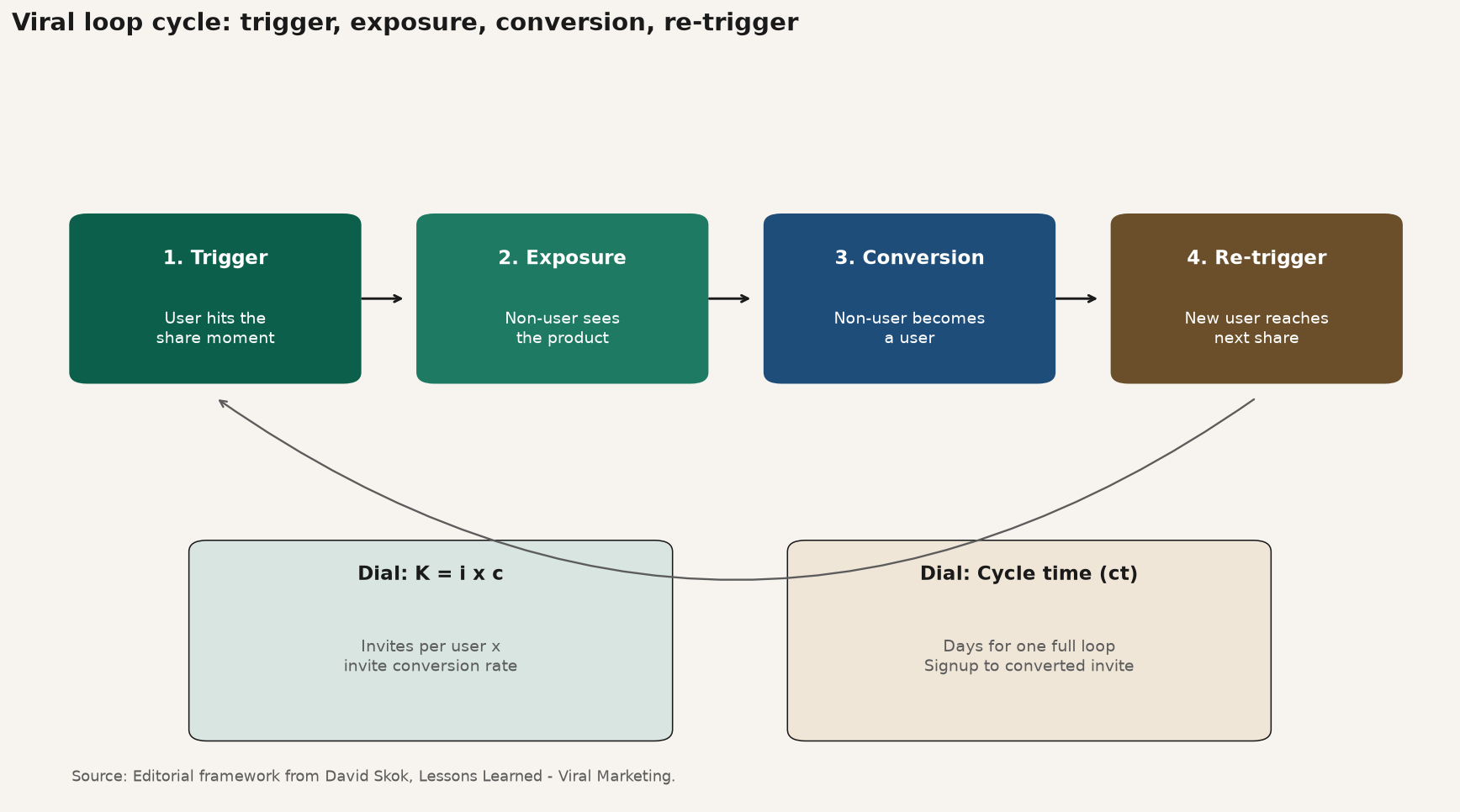
Source: Editorial framework from David Skok, Lessons Learned - Viral Marketing (For Entrepreneurs). https://www.forentrepreneurs.com/lessons-learnt-viral-marketing/
Viral loop mechanics work through loop type, K-factor, and cycle time. They create motion without compounding when the type is wrong, K is misread, or the cycle is slow.
| Loop type | Trigger | Why it spreads | Failure mode |
|---|---|---|---|
| Native / product-led | Core job needs another person | Exposure is unavoidable | Product can be used solo forever |
| Incentivized referral | Reward for invite | Raises i when rewards fit | Reward tourists; high CPA; still not native |
| Content / demo | Shared output (video, page, report) | Artifact carries the brand | Weak CTA; vanity traffic |
| Collaboration | Multiplayer workspace | Invite is the workflow | Slow activation of invited seats |
Native loops are usually more durable because they survive incentive budget cuts. Referral loops are still valuable, especially as amplifiers. Just label them correctly.
Skok’s definition:
K = i x c
Where i is invitations sent per new customer and c is the conversion rate of those invitations into customers (Skok).
In the pure model, K > 1 is required for self-sustaining viral growth. K < 1 grows for a while, then flattens unless other channels keep adding seed users. Skok also describes a hybrid: buy or earn seed users, then let a sub-1.0 K amplify them.
Extole’s 400-customer referral study puts a hard number under “typical bolted-on referral”:
| Funnel step (Extole) | Value |
|---|---|
| Potential advocates who become advocates | 19% |
| Shares per advocate (average) | 2 |
| Friend clicks per share (median) | 1 |
| Click-to-customer conversion | 13% |
| Implied i | 0.19 x 2 = 0.38 |
| Implied c | 0.13 |
| Implied k | 0.0494 (~0.05) |
Source: Extole, How to Model Non-Viral Referral (Jan 27, 2016).
That k ~ 0.05 is not failure. Extole shows the amplification factor for k < 1 is 1/(1-k). At k = 0.05, every cohort is multiplied by about 1.053. At k = 0.20, the factor is 1.25. In their illustration with ongoing search and paid acquisition, k = 0.05 produced nearly 2,500 more customers after one month versus no referral, and k = 0.20 produced over 10,000 more. Small K moves are hyperbolic for amplification, which is why funnel fixes beat slogan fixes.
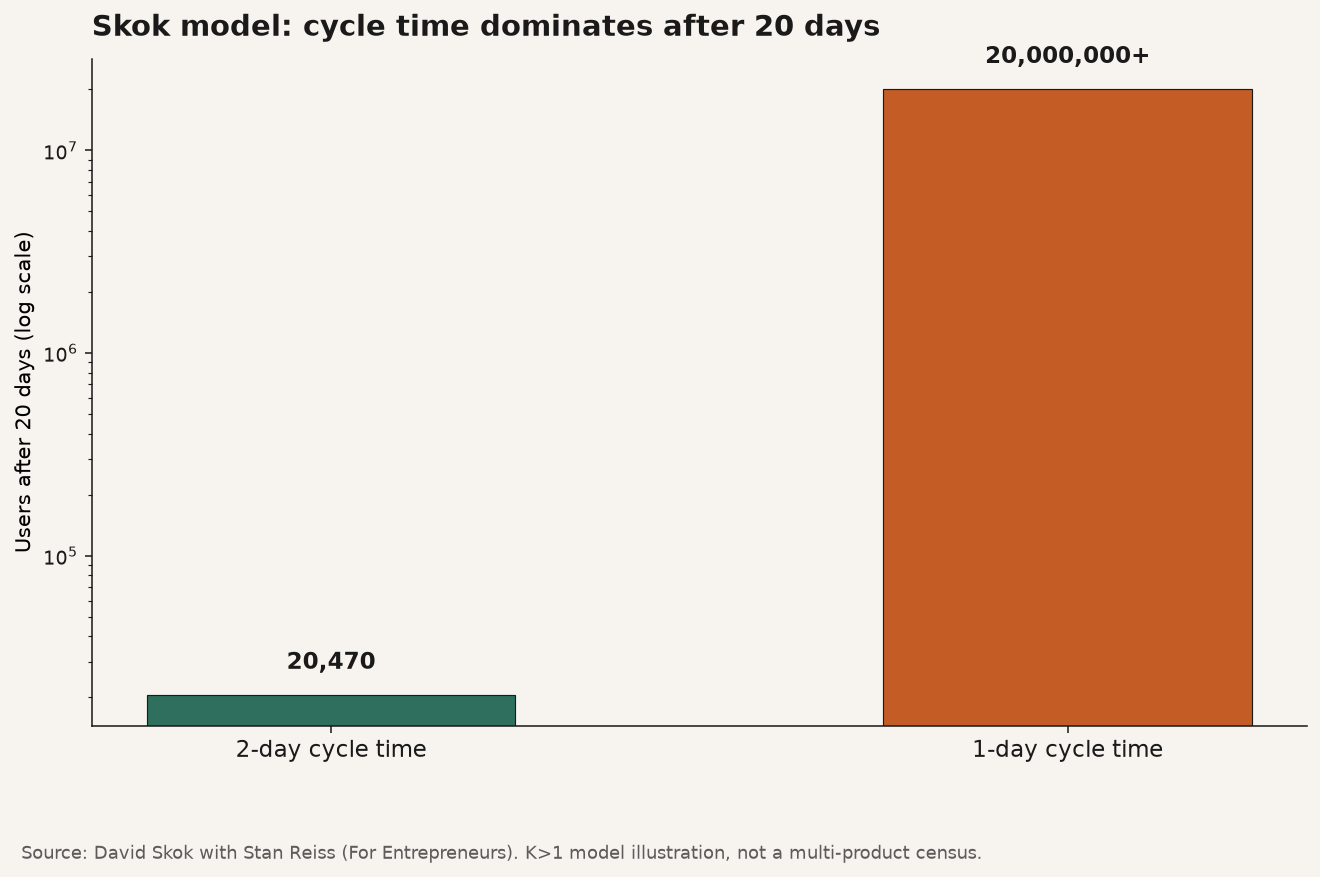
Source: David Skok with Stan Reiss, Lessons Learned - Viral Marketing (For Entrepreneurs). Model illustration for viral cycle time, not a multi-product census. https://www.forentrepreneurs.com/lessons-learnt-viral-marketing/
Viral cycle time ct is how long one full loop takes: user joins, reaches the trigger, exposes a non-user, and that non-user converts. Skok’s YouTube vs Tabblo contrast is the classic story. YouTube’s cycle was nearly immediate (watch, send link). Tabblo’s cycle waited until the next time someone wanted to share photos, which could be months.
His quantitative illustration is the chart founders should tattoo on the roadmap: after 20 days, a 2-day cycle produces 20,470 users while a 1-day cycle produces over 20 million in the same model family, because K is raised to t/ct. Halving cycle time is not a 2x improvement. It is an exponential change in the number of compounding turns.
Practical ways to cut ct:
| Dimension | Viral loop | Referral program | Waitlist K |
|---|---|---|---|
| Job | Product usage creates users | Customers invite for a reward | Pre-launch list compounds |
| Core metrics | K + cycle time | Referral rate, CPA | Capture CVR + K bands |
| Typical benchmark cited here | Extole k ~ 0.05 for referral-style funnels | ReferralCandy ~2.35% referral rate | LaunchList healthy K ~0.3-0.7 |
| Owned on feat. blog | This page | Referral benchmarks | Waitlist benchmarks |
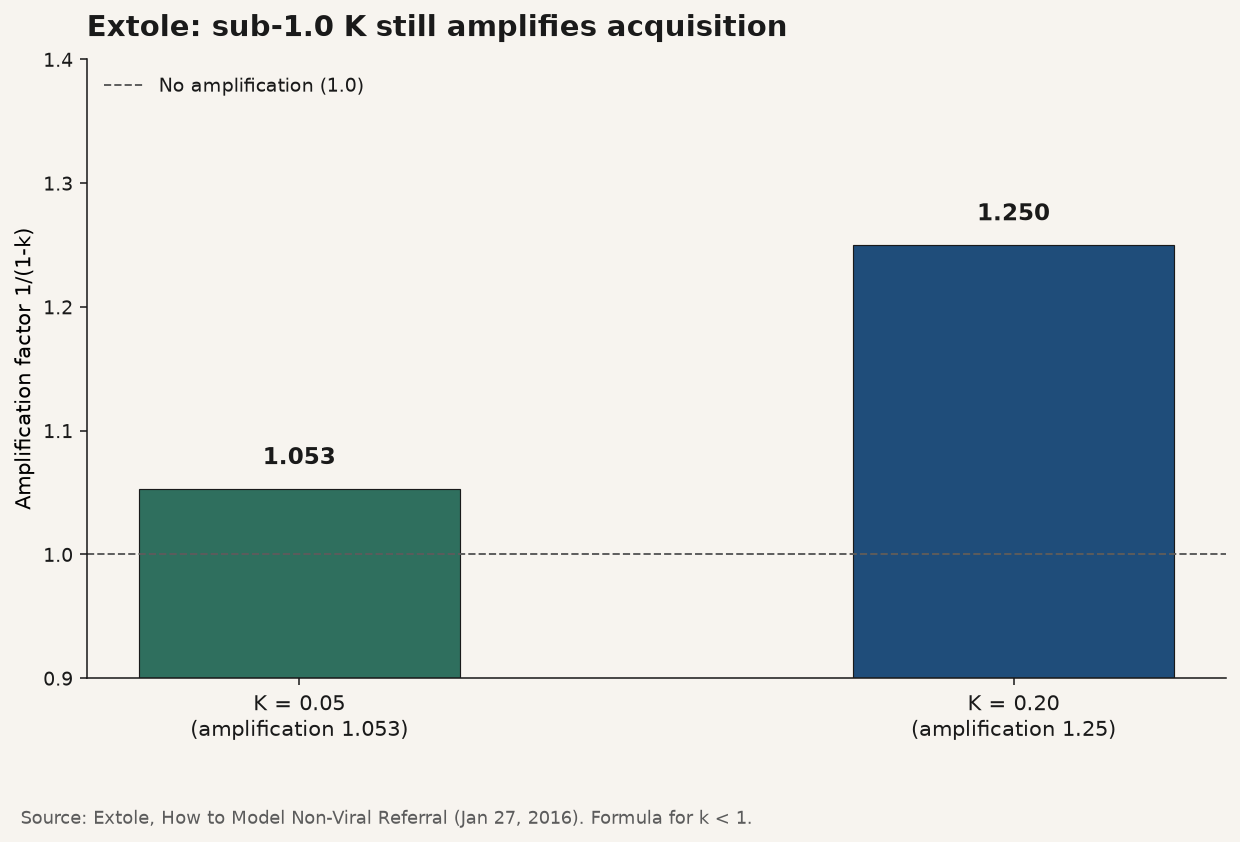
Source: Extole, How to Model Non-Viral Referral (Jan 27, 2016). Amplification factor = 1/(1-k) for k < 1. https://www.extole.com/blog/how-to-model-non-viral-referral/
Improving a viral loop means naming the loop type, measuring K and cycle time by cohort, shortening the cycle before you raise rewards, and seeding with other channels when K stays below 1.
Q: What are viral loop mechanics? A: Viral loop mechanics are the product and math rules that turn usage into new users: a trigger that exposes non-users, a conversion step, a re-trigger, plus K-factor (invites x conversion) and viral cycle time. Native loops bake exposure into the job. Referral widgets bolt an ask onto the side.
Q: What is the difference between a viral loop and a referral program? A: A viral loop spreads because using the product requires or naturally creates exposure. A referral program spreads because you pay or reward someone to invite. Referral programs can raise K, but they are a different machine with different KPIs (referral rate and CPA versus K and cycle time).
Q: What is a good K-factor for a viral loop? A: Sustained K > 1 is rare. Extole’s study of 400 referral programs implied about k = 0.05, which still amplifies other channels via 1/(1-k). For pre-launch waitlists, healthy K is often discussed in the 0.3-0.7 band on our waitlist page. Context beats a universal “good” number.
Q: Why does viral cycle time matter more than K-factor sometimes? A: Because compounding happens per cycle. David Skok’s model shows that after 20 days, cutting cycle time from 2 days to 1 day jumps users from about 20,470 to over 20 million in the same K>1 illustration, since K is raised to t/ct. Faster loops create more turns.
Q: Can K below 1 still help growth? A: Yes. Extole models sub-1.0 K as an amplification factor of 1/(1-k) on top of paid and organic acquisition. Their illustration at k = 0.05 added nearly 2,500 customers after a month versus no referral, and k = 0.20 added over 10,000 in the same setup. Hybrid seeding plus a modest K is the common path.
Viral loop mechanics explained without mythology: name the loop type, measure K and cycle time, and shorten the cycle before you decorate the rewards. Permanent K > 1 is rare. Sub-1.0 loops still cut acquisition cost when they amplify every seeded cohort. Build the exposure into the product, or admit you are running a referral program and manage it like one.
If you build products and want affiliates to sell them through co-branded storefronts with a revenue split on every sale, start at feat..
Kit Creator Network vs beehiiv Boosts (paid recommendations): beehiiv's 20% fee-in-CPA vs Kit's 23.5%, buy vs earn, and verification.
Launch promotion playbooks by product type: SaaS free-to-paid medians, DTC checkout tax, digital LP bands, affiliate activation.
How to run a limited-time promotion that converts: Cro Metrics lifts for real deadlines, where cart urgency fails, and FTC rules against baseless timers.