Kit Creator Network vs beehiiv Boosts Compared
Kit Creator Network vs beehiiv Boosts (paid recommendations): beehiiv's 20% fee-in-CPA vs Kit's 23.5%, buy vs earn, and verification.
Launch promotion playbooks by product type: SaaS free-to-paid medians, DTC checkout tax, digital LP bands, affiliate activation.

TL;DR: Launch promotion playbooks by product type share one spine (pre-launch, launch week, amplify, retain) but use different scorecards. SaaS tracks free-to-paid against ChartMogul’s 8% median. DTC fights Baymard’s ~70% cart abandonment. Digital products benchmark Unbounce landing-page medians. Affiliate co-sells win on partner activation, not blast size.
Founders steal the wrong launch playbook. A SaaS trial checklist lands on a Shopify PDP. A Product Hunt day plan becomes the strategy for a course with no waitlist. Then launch week looks busy and the numbers look random.
Launch promotion playbooks by product type fix that mismatch. Keep one operational spine. Swap the KPI and the primary lever by whether you sell self-serve software, physical goods, digital downloads, or co-sold offers through affiliates. Pair this with waitlist growth strategies with real benchmarks for capture math, how to run a limited-time promotion that converts for urgency rules, and go-to-market strategy frameworks compared for motion choice.
Key takeaways:
Launch promotion playbooks by product type are staged go-to-market checklists that keep the same phases but change the primary KPI, offer mechanic, and channel mix for each product shape.
In plain language: the calendar looks similar. The definition of “it worked” does not.
Four product types cover most indie and early-stage launches:
The shared spine has four phases:
| Phase | Job | Universal tools |
|---|---|---|
| Pre-launch | Capture demand and warm a list | Promise page, waitlist or early access, referral K |
| Launch week | Convert intent with a real offer window | One primary CTA, real deadline, support coverage |
| Amplify | Extend reach without resetting the story | Partners, retargeting, content derivatives |
| Retain | Turn buyers into repeat or expansion | Onboarding, email, loyalty or upgrade path |
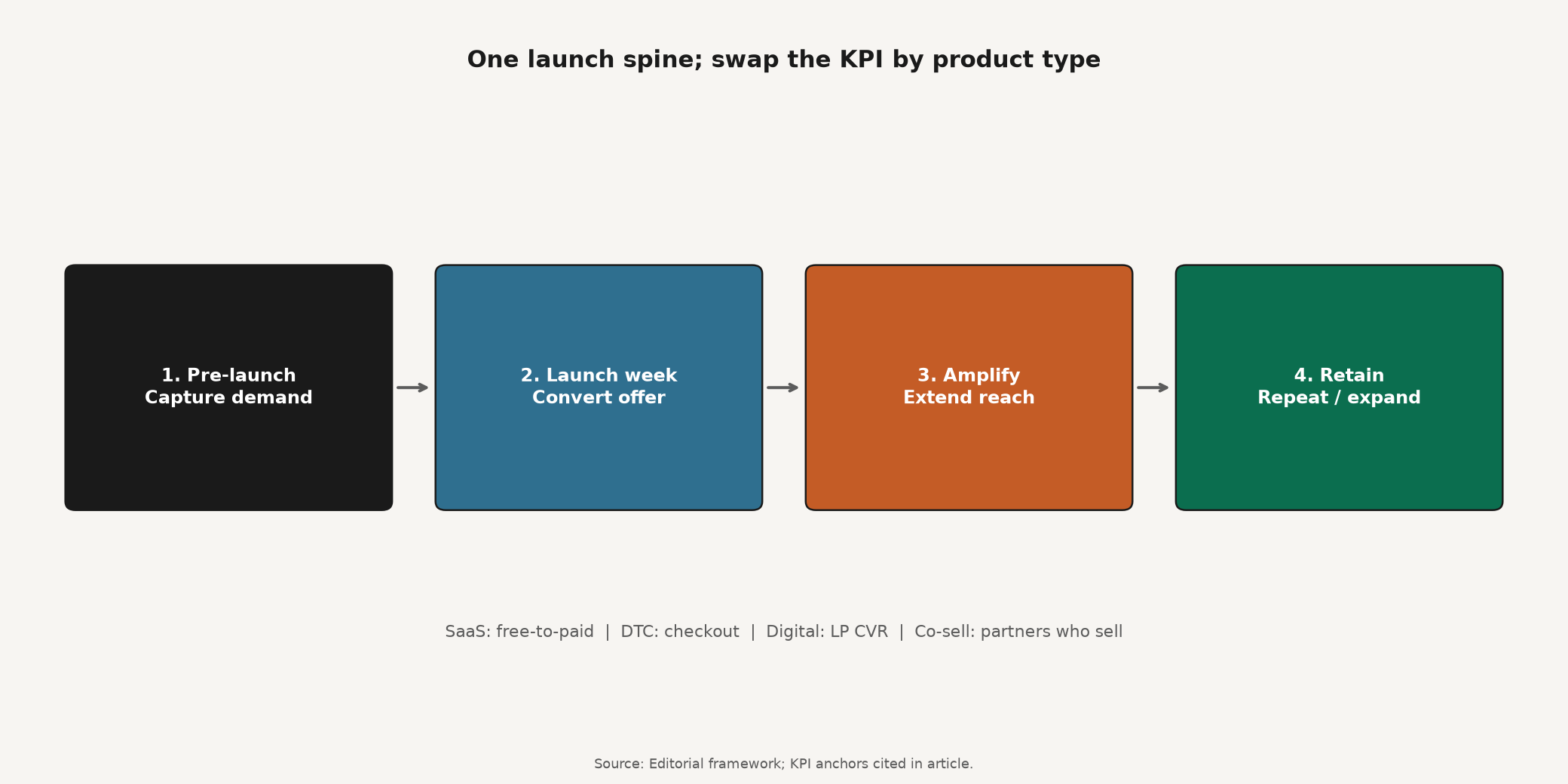
Source: Editorial launch spine for this article; product-type KPIs from ChartMogul, Baymard, Unbounce, and Rewardful cited in body.
A generic launch plan optimizes theater. Product-type playbooks optimize the bottleneck that actually kills that category.
Why the fork matters:
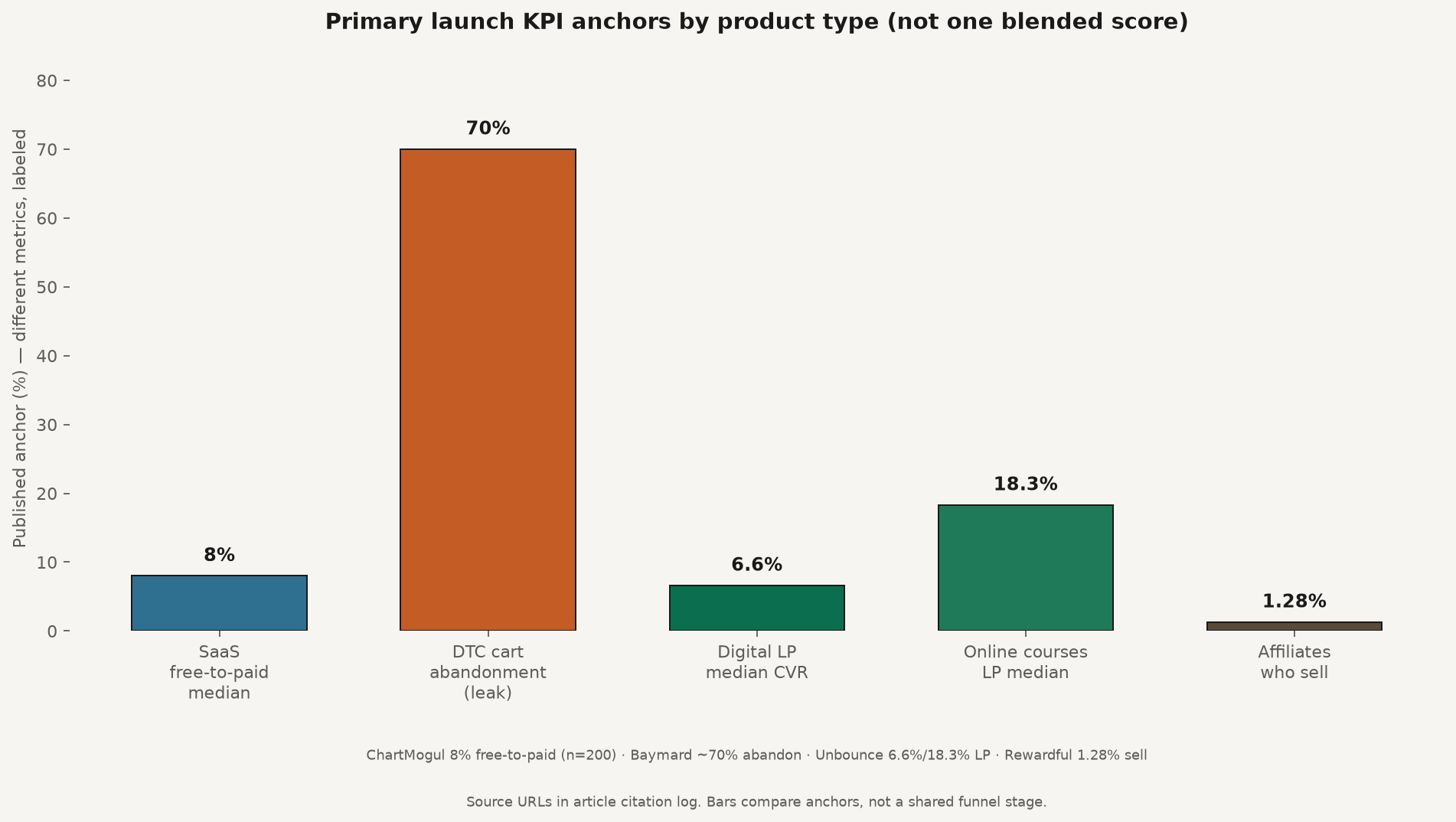
Source: ChartMogul Conversion Report (Feb 4, 2026); Baymard cart abandonment; Unbounce 2024 LP medians; Rewardful State of SaaS Affiliate Programs. See citation log for URLs.
Launch promotion playbooks work by running the same four phases while swapping the offer mechanic and the north-star metric for each product type. Pre-launch still captures demand. Launch week still converts it. The spreadsheet columns change.
Use LaunchList’s vendor-published capture bands as rails, not destiny: warm traffic about 15%-35%, medium-intent communities 8%-15%, cold paid 3%-8%, with a timing sweet spot near 8-16 weeks and healthy pre-launch K often discussed as 0.3-0.7 (LaunchList; K-factor guide). There is no public census for waitlist-to-paid conversion. Do not invent one. See our waitlist benchmarks.
North star: free-to-paid inside your window (ChartMogul’s survey definition is paying within six months).
Launch week levers:
Refuse: treating Product Hunt rank as revenue.
North star: checkout completion and contribution margin after shipping and returns.
Launch week levers:
Refuse: optimizing only ROAS on day one while checkout is broken.
North star: attention-page conversion into paid delivery, then refund rate.
Launch week levers:
Refuse: tripwire take-rate folklore without your own cart data.
North star: share of partners who publish and generate a sale.
Launch week levers:
Refuse: celebrating affiliate count as launch success.
| Product type | Primary KPI | Sourced anchor | Primary launch lever | Common false KPI |
|---|---|---|---|---|
| SaaS / self-serve | Free-to-paid (e.g. 6 months) | ChartMogul median 8%; card-required 30% | Activation + trial model choice | Signups without activation |
| DTC / physical | Checkout completion / margin | Baymard abandon ~70%; Cro Metrics real urgency lifts | Checkout + real promo window | Announcement reach |
| Digital product | Attention-page CVR → paid | Unbounce 6.6% / courses 18.3% | One-CTA sales page + delivery | Fake timer clicks |
| Affiliate co-sell | % partners who sell | Rewardful 1.28% sell | Enablement kit + recruiting | Affiliate headcount |
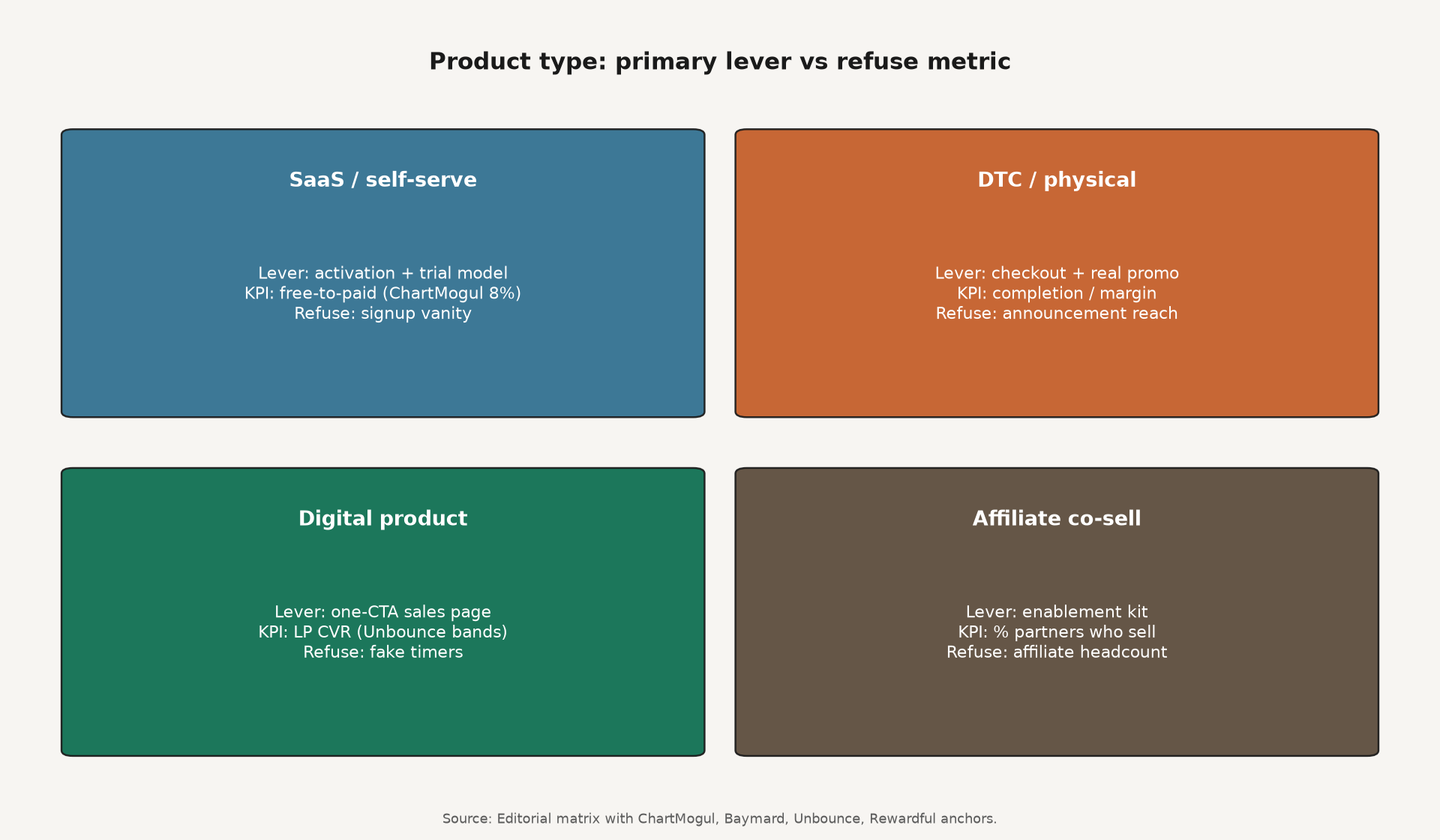
Source: Editorial matrix; anchors from ChartMogul, Baymard, Unbounce, Rewardful as cited above.
Choose the playbook from the product shape, then run the spine without mixing scorecards mid-week.
Q: What are launch promotion playbooks by product type? A: They are staged launch checklists that share pre-launch, launch week, amplify, and retain phases, but change the primary KPI and levers for SaaS, DTC, digital products, or affiliate co-sell. The calendar is shared. The scorecard is not.
Q: What is a good SaaS free-to-paid conversion rate for a launch? A: ChartMogul’s 2026 Conversion Report on 200 B2B software products puts the median free-to-paid rate at 8%, with wide dispersion and different GOOD/GREAT bands by freemium versus trial and by credit-card friction. Use the band that matches your entry model, not a single universal target.
Q: How should ecommerce launches differ from SaaS launches? A: Ecommerce launches should treat checkout completion and margin as the north star, because cart abandonment averages near 70% in Baymard’s documented studies. SaaS launches should optimize trial or freemium activation into paid. Announcement tactics can look similar. Measurement should not.
Q: Do I need a waitlist for every product type? A: No. Waitlists help when supply, cohort timing, or referral loops matter. Capture benchmarks vary by traffic warmth (LaunchList publishes rough bands), and there is no public waitlist-to-paid census. A simple early-access list still beats launching cold with zero warm contacts.
Q: What kills affiliate or co-sell launches? A: Enrollment without enablement. In Rewardful’s SaaS affiliate sample, only 1.28% of affiliates generate a sale. Launch week should prioritize partner kits, tracking, and recruiting quality over blasting a large inactive roster.
Launch promotion playbooks by product type keep one spine and four scorecards. SaaS lives on free-to-paid and activation. DTC lives on checkout. Digital products live on the attention page. Co-sell lives on partners who actually sell. Steal the calendar. Do not steal the wrong KPI.
If you want launch distribution through affiliates with co-branded storefronts and a clear revenue split, start at feat..
Kit Creator Network vs beehiiv Boosts (paid recommendations): beehiiv's 20% fee-in-CPA vs Kit's 23.5%, buy vs earn, and verification.
Viral loop mechanics explained: native vs referral loops, K = invites x conversion, and why Skok's cycle time often beats chasing K > 1.
How to run a limited-time promotion that converts: Cro Metrics lifts for real deadlines, where cart urgency fails, and FTC rules against baseless timers.