Kit Creator Network vs beehiiv Boosts Compared
Kit Creator Network vs beehiiv Boosts (paid recommendations): beehiiv's 20% fee-in-CPA vs Kit's 23.5%, buy vs earn, and verification.
How to run a limited-time promotion that converts: Cro Metrics lifts for real deadlines, where cart urgency fails, and FTC rules against baseless timers.

TL;DR: How to run a limited-time promotion that converts starts with a real constraint, not a blinking timer. Cro Metrics’ Ask Iris review of thousands of tests finds concrete promo deadlines lifting conversion (one sitewide promo countdown +8.3% CVR; checkout +4.3% completion) while cart urgency and mismatched timers often fail or cut revenue. The FTC’s 2022 dark patterns report flags baseless countdown timers and false low-stock claims. Make the deadline true, specific, and placed where intent already exists.
Founders ask how to run a limited-time promotion that converts, then ship a resetting countdown and a “Only 3 left” badge that is not tied to inventory. Traffic spikes. Revenue does not. Trust decays.
Scarcity is not a skin. It is a claim. Shoppers decide whether to believe it.
Cro Metrics’ Ask Iris brief, trained on thousands of A/B tests across e-commerce, subscription, SaaS, and lead-gen, finds that urgency works when users can understand and believe the constraint (Cro Metrics). Real promo deadlines with a legible end point are the most consistent winners. Cart FOMO and generic timers are the usual losers. The FTC’s September 2022 staff report, Bringing Dark Patterns to Light, names baseless countdown timers and false low-stock messages among practices that induce false beliefs (FTC report; FTC press).
Key takeaways:
A limited-time promotion that converts is a time-boxed or inventory-boxed offer whose constraint is real, disclosed with a specific end point, and placed so shoppers with intent can finish the purchase before the window closes.
It is not every red badge on a product page. It is not a timer that resets on refresh. It is not a flash sale with a 40% cut and no margin model.
Three ingredients define the job:
If any ingredient is fake, you are running dark-pattern theater, not growth.
Promotions matter because they compress decision time for people who were already close. They fail when they manufacture panic for people who were still researching, or when they teach the market that your timers lie.
Why this page earns space:
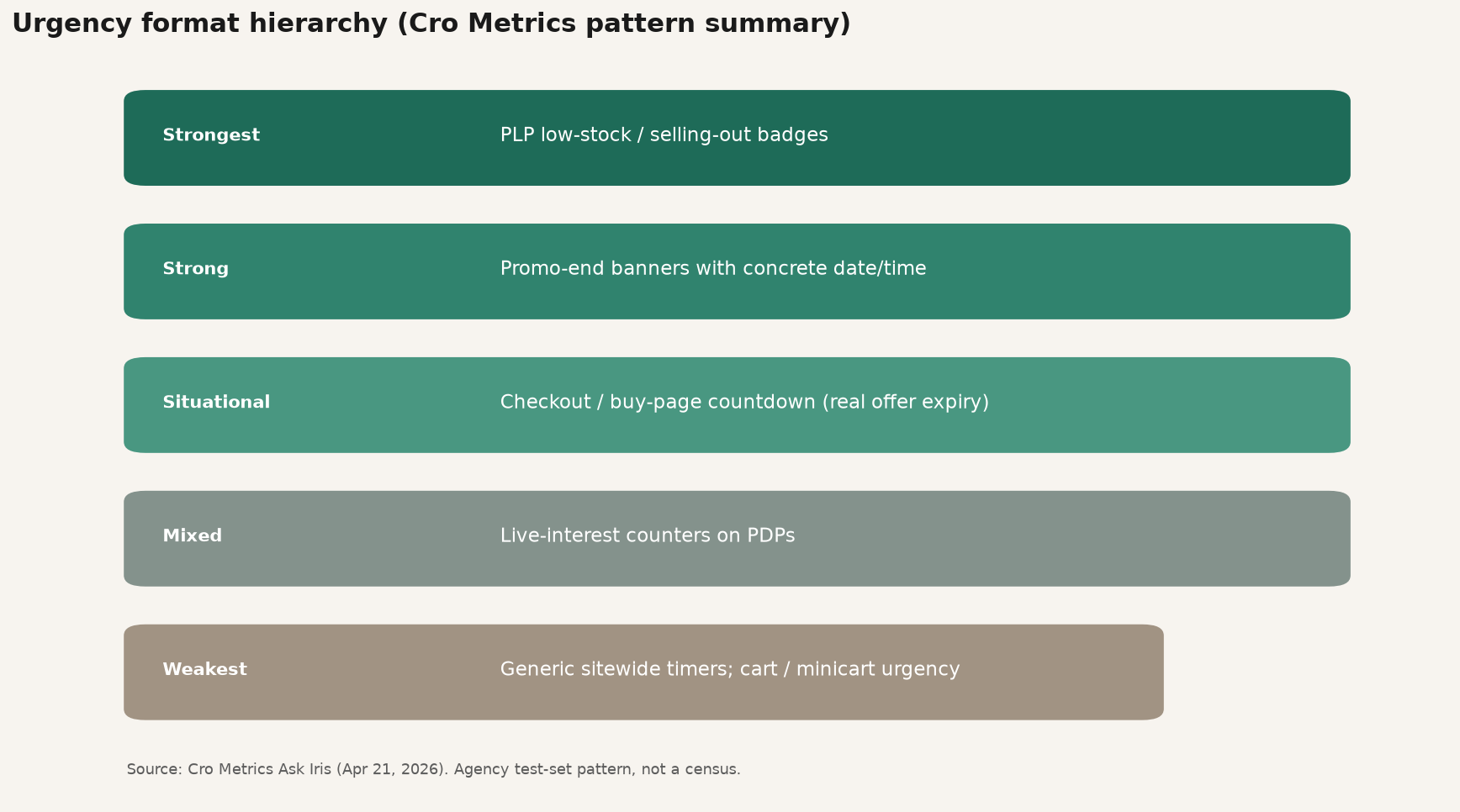
Source: Cro Metrics, Go Ask Iris: Why Your Countdown Timer Might Be Costing You Sales (Apr 21, 2026). Hierarchy summarized from their format section. https://crometrics.com/blog/urgency-that-actually-works/
Limited-time promotions work when the shopper believes the constraint and the offer matches the timer. They create motion without conversion when the signal is loud and the promise is soft. Use three scorecards: authenticity, placement, and economics.
| Signal | Believable version | Dark-pattern version (FTC taxonomy) |
|---|---|---|
| Countdown | Offer truly ends at the shown time | Timer resets or disappears; offer continues |
| Stock | Live inventory (“3 left”) | Always “2 left” or formulaic scarcity |
| Social proof | Real concurrent viewers if you measure them | Invented “12 people viewing” |
| Strike-through price | Prior bona fide price for a reasonable period | Inflated fake “was” price |
Source for dark-pattern labels: FTC, Bringing Dark Patterns to Light (Sept 2022). Source for test pattern that concrete beats vague: Cro Metrics.
Cro Metrics’ directional hierarchy from their test set:
| Rank | Format | Why it tends to work |
|---|---|---|
| Strongest | Real low-stock / “selling out” badges on PLP product cards | Helps browse-stage triage, especially on mobile |
| Strong | Promo-end banners with concrete date/time | Anchors a real promotional window |
| Situational | Checkout or buy-page countdown tied to a real offer expiry | Reinforces commitment for high-intent users |
| Mixed | Live-interest counters on PDPs | One +3.1% orders test; others flat or negative |
| Weakest | Generic sitewide timers not tied to offer mechanics; cart/minicart urgency | Creates noise; cart tests flat at best |
This is an agency pattern summary, not a universal law. Still, it beats “add a timer everywhere.”
A converting promo can still be a bad business. Stack discount, commission, and contribution margin before you turn the clock on (discount code vs cashback). Then measure incremental orders, not clicks (incrementality testing).
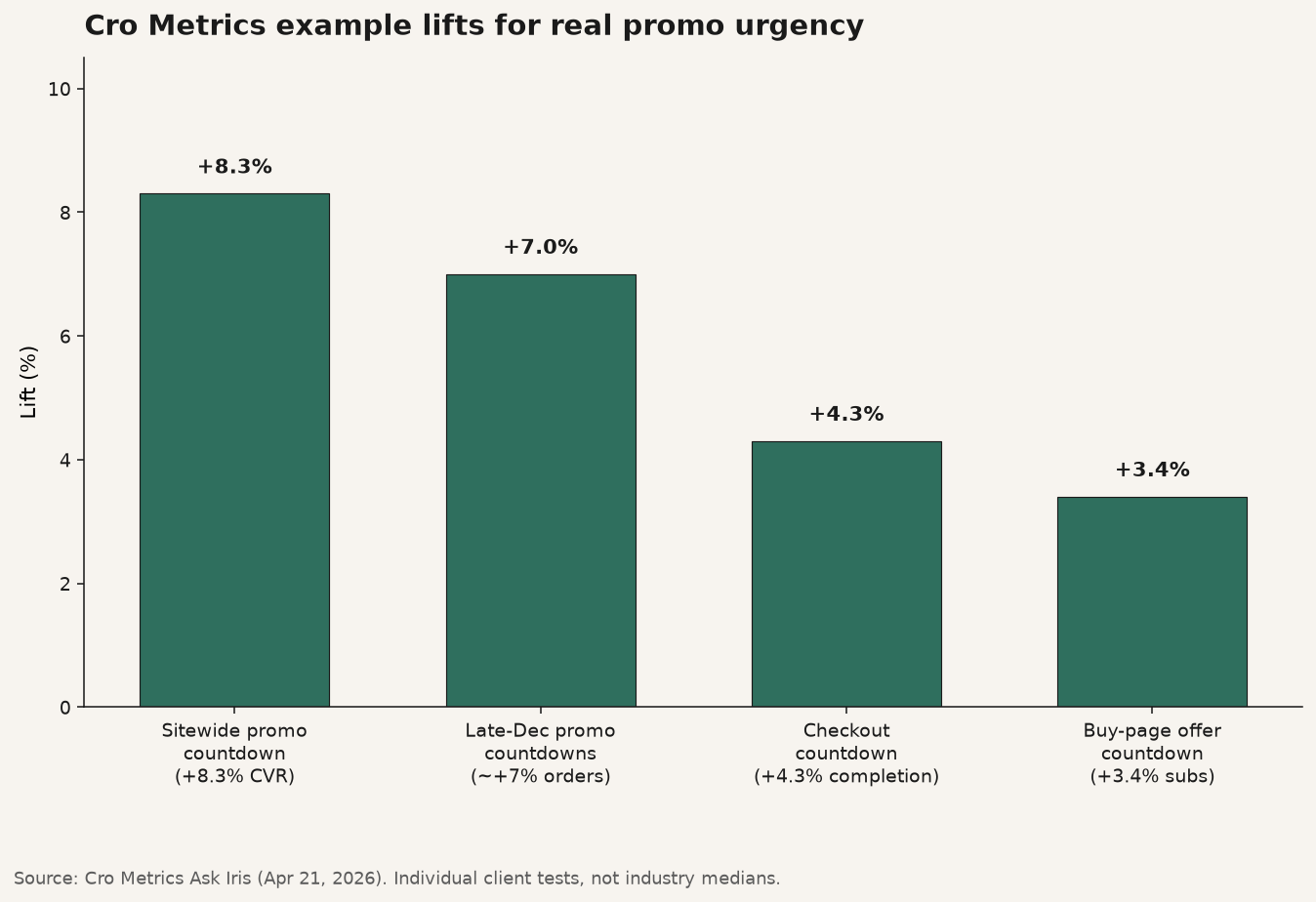
Source: Cro Metrics Ask Iris urgency brief (Apr 21, 2026). Individual test examples from their client set; not industry medians. https://crometrics.com/blog/urgency-that-actually-works/
| Promo type | Constraint | Best when | Failure mode |
|---|---|---|---|
| Calendar flash sale | Hard end date/time | Seasonal peaks; clear merchandising | Vague “limited time” with soft end |
| Shipping cutoff | Carrier deadline | High-intent checkout; gift seasons | Fake cutoff unrelated to shipping |
| Inventory scarcity | Real stock | Popular SKUs; PLP triage | Always-low badges |
| Price-increase notice | Real upcoming price | Subscriptions; SaaS plans | Evergreen “prices rising soon” |
| Affiliate/voucher window | Code expiry + partner rules | Co-selling with creators | Double cost (discount + commission) without lift |
For affiliate-funded vs merchant-funded shopper benefits, keep the funding ledger separate from the timer (discount code vs cashback). For creator distribution of a real promo window, co-branded storefronts beat another link dump (what is a creator storefront).
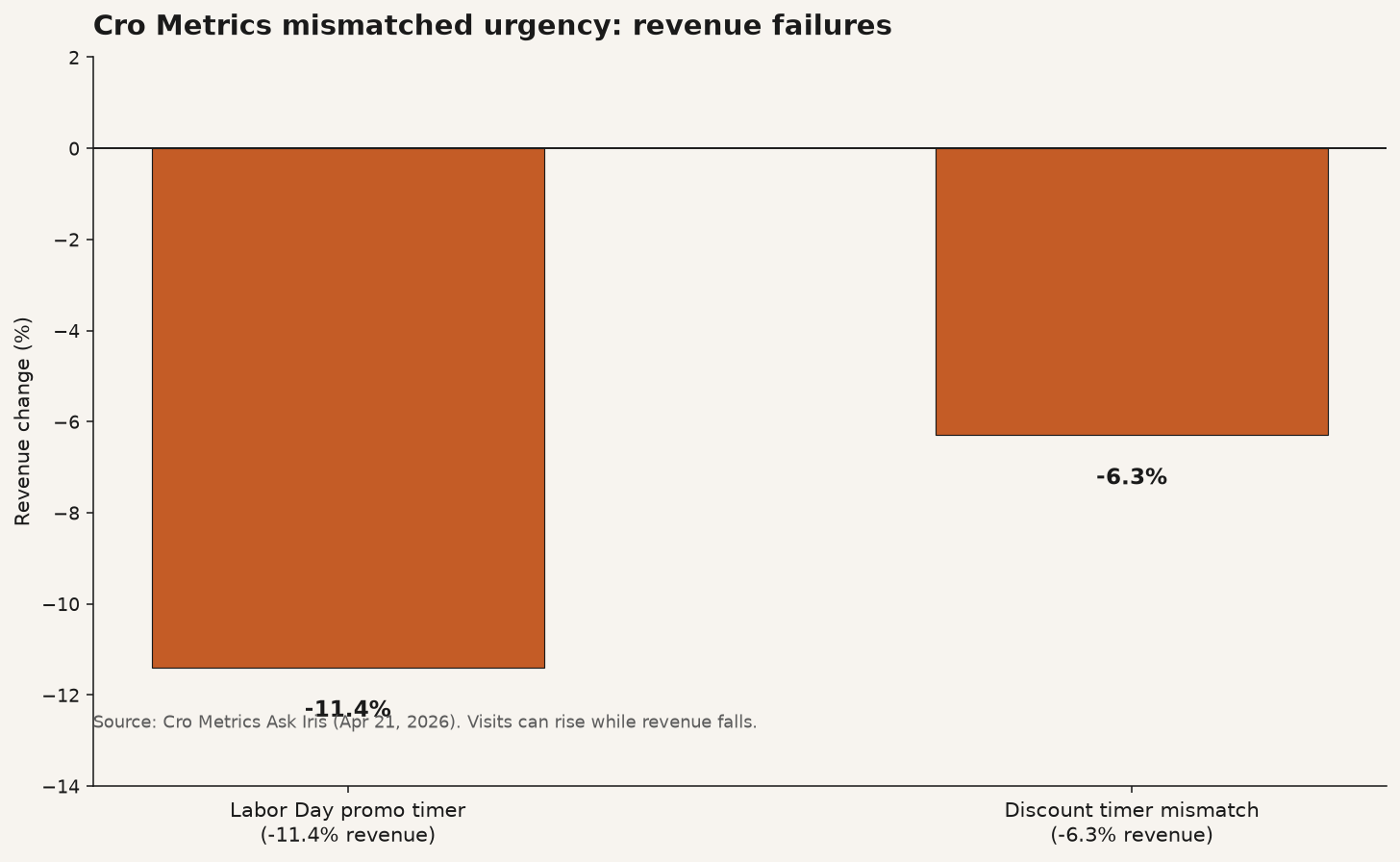
Source: Cro Metrics Ask Iris urgency brief (Apr 21, 2026). Labor Day promo timer and discount-timer examples. https://crometrics.com/blog/urgency-that-actually-works/
Running a limited-time promotion that converts means defining a real window, pricing the offer honestly, placing urgency where intent lives, killing fake cart FOMO, and measuring orders, not clicks.
Q: How do you run a limited-time promotion that converts? A: Start with a real, specific deadline or stock limit you will honor. Place scarcity on browse pages and promo banners with concrete end points, use checkout timers only when intent is high, and skip fake cart FOMO. Cro Metrics’ test set shows lifts like +8.3% CVR for a real sitewide promo countdown and failures when timers mismatch the offer.
Q: Do countdown timers increase conversion rates? A: Sometimes, when the deadline is real and legible. Cro Metrics reports examples including about +7% completed orders for late-December promo countdowns and +4.3% checkout completion for a real offer timer. Generic or mismatched timers can cut revenue (examples at -11.4% and -6.3%).
Q: Are fake scarcity badges illegal? A: Fake scarcity can be a deceptive dark pattern. The FTC’s September 2022 staff report, Bringing Dark Patterns to Light, explicitly discusses baseless countdown timers, false low-stock claims, and false activity messages. This is not legal advice; treat unsubstantiated urgency as a compliance risk.
Q: Should I put urgency messages in the cart? A: Usually no. Cro Metrics finds cart and minicart urgency flat at best across multiple tests, and sometimes harmful to average order value. By cart, shoppers need confirmation, not panic. Put scarcity earlier (PLP) or on a real promo banner instead.
Q: How is a limited-time promotion different from an everyday discount code? A: A limited-time promotion adds a true time or inventory constraint on top of the offer. A standing discount code is a price mechanism without a deadline. Funding still matters: merchant-funded codes and partner cashback are different ledgers even inside a timed window.
How to run a limited-time promotion that converts is an authenticity problem dressed up as a CRO trick. Real deadlines and real stock signals can lift conversion in tested placements. Fake timers create clicks, cut revenue, and invite dark-pattern scrutiny. Write a constraint you can prove, place it where intent already exists, and measure orders.
If you build products and want affiliates to sell a real promo window through co-branded storefronts with a revenue split on every sale, start at feat..
Kit Creator Network vs beehiiv Boosts (paid recommendations): beehiiv's 20% fee-in-CPA vs Kit's 23.5%, buy vs earn, and verification.
Launch promotion playbooks by product type: SaaS free-to-paid medians, DTC checkout tax, digital LP bands, affiliate activation.
Viral loop mechanics explained: native vs referral loops, K = invites x conversion, and why Skok's cycle time often beats chasing K > 1.